 |
| Wholesome Ginger Rogers, RR, & DD are up against the wicked KKK in this WB melodrama. |
Storm Warning
is a watchable, well-acted 1951WB melodrama—that could have been so much more.
The story of a woman who visits her younger sister and witnesses a Ku Klux Klan
killing was inexplicably watered down. Warner Brothers, renowned for their
hard-hitting social dramas of the ‘30s, diluted the drama by not calling out
the Klan for what they are and setting the story in generic anywhere, USA.
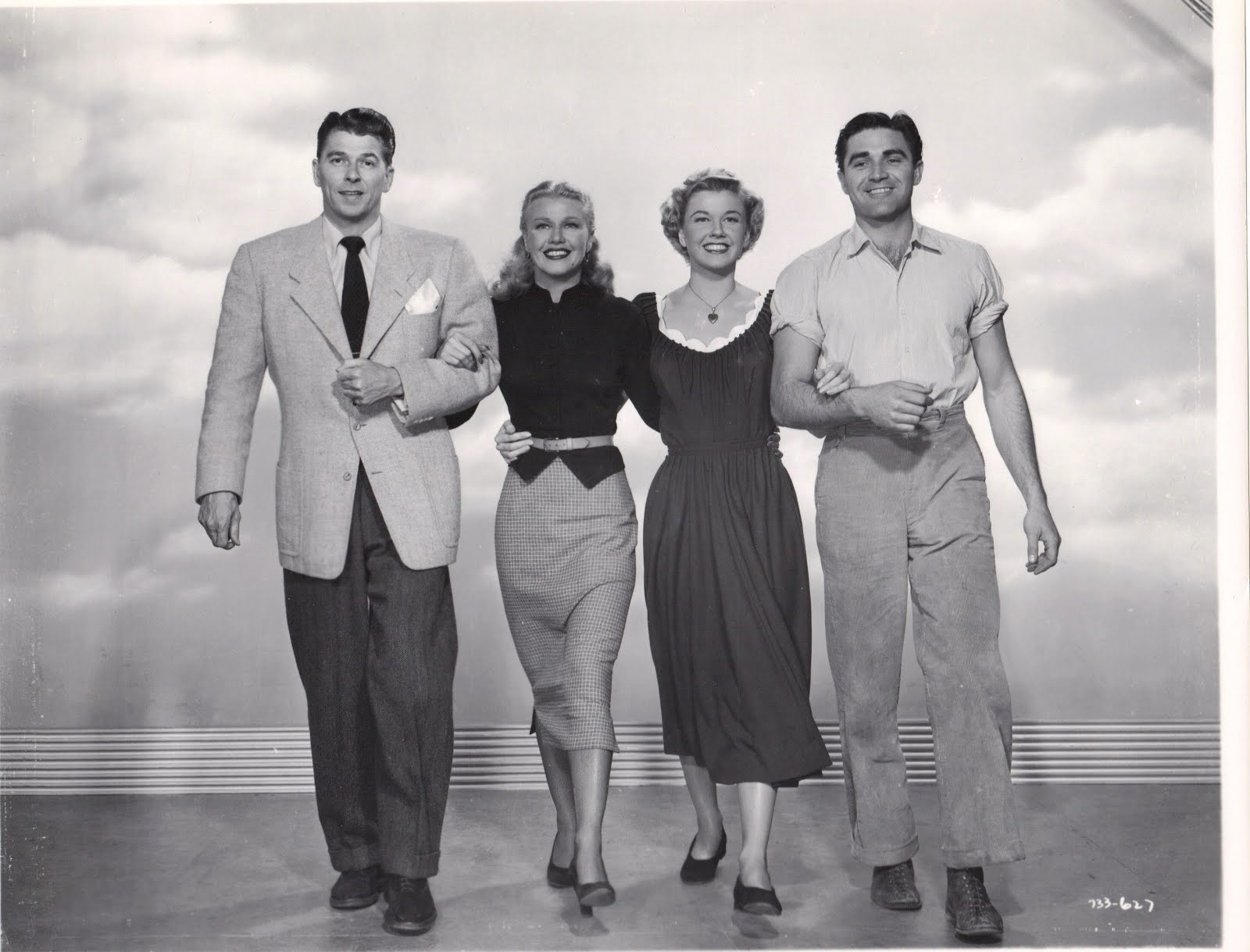 |
| I love the cliche cast arm-in-arm publicity photo, when in most movie dramas, characters are at each others' throats! |
Other
studios were making pictures dealing with race. Stuart Heisler was a gutsy
director and screenwriters Richard Brooks and Daniel Fuchs had already written
about the topic, so the decision must have come from Jack Warner. WB’s Storm Warning, made in ’49, but released
in early 1951, depicted the Klan killing of a white reporter, for nosing around their shady financial dealings.
Uh, okay, who knew that money laundering was the Klan’s claim to fame? The Ku
Klux Klan is only called the Klan, and the fictional town of Rock Point is even
vaguer, referred to as “down here!” While the Klan was in many parts of the US,
it’s implied the town is southern, despite the lack of accents. The only blacks
to be seen are in the crowd scenes at the inquest. The lack of locale and
whitewashing the Klan’s true purpose defuses what could have been a powerful social
drama.
*Some
spoilers ahead!
 |
| Travelling dress model Marsha Mitchell (Rogers) stopped in town to visit her kid sister before Christmas. Is she wondering why the townspeople are wearing white after Labor Day? |
Marsha
Mitchell, a New York dress model travelling by bus to her next gig, decides to
stop over night in Rock Point, where her young married sister Lucy lives with
trucker husband Hank Rice. As Marsha attempts to get a cab to the local
recreation center where her sister works, the locals seem unusually unfriendly,
and are closing everything up early. Marsha the model heads off on foot—in high
heels—to the center, she happens upon an outbreak from the local jail. Men in
hooded sheets are corralling a bound and gagged man from the building when he
breaks away. One of the men shoots him, and Marsha witnesses it all, unseen by
the KKK. She sees two men who are unmasked.
 |
| "I Saw What You Did"with the KKK. Rogers' visiting sister lets brother-in-law Hank (Steve Cochran) know what's up! Doris Day is the kid sis and young wife, Lucy. |
Marsha
high tails it to the local recreation center and Lucy, spilling her story. She
recognizes some of the men (by their shoes?) and points them out to her sister,
who knows them. When they get back to Lucy’s house, who has told Marsha that
she’s pregnant, her husband Hank arrives. Marsha instantly recognizes him as
one of the KKK. Awkward! Let’s just say it’s a helluva icebreaker. When DA Burt
Rainey (Ronald Reagan) finds out that Marsha was in the vicinity of the
killing, he wants her on the witness stand at the inquest. Charley Barr (Hugh
Sanders), Klan big Kahuna and Hank’s
boss, wants Marsha to keep quiet. Though inquest is a success for the Klan, Hank
can’t leave well enough alone, namely Marsha, and follows her back to the house
to “celebrate” with her. What follows is a near-rape interrupted only by his
wife. After he roughs up both women, he drags Marsha off to the KKK meeting as
a mystery guest. Ginger’s Marsha now
refuses to keep quiet, which then makes her the evening’s entertainment:
getting horsewhipped by a Klan member while the others watch, agog… and so will
you. Reagan’s Rainey arrives with Doris’ Lucy and Hank once again makes things
worse, by trying to shoot his sister-in-law, which leads to the tragic finale.
 |
| The opening scenes of 'Storm Warning' are filmed in unsettling film noir style by director Stuart Heisler. |
Director
Stuart Heisler, who should have gotten more prestige projects, has a powerful
point of view in Storm Warning. The
storytelling is strong, especially the opening scenes, where Marsha arrives.
Visually striking and eerily foreboding, Rogers’ Marsha gets rebuffed by
everyone she meets as the small town seemingly shuts down in unison. And when
she stumbles upon the outbreak with the Klan and their victim, hiding in the
shadows, is stunning. The direction, cinematography, and score all heighten the
tension in the best film noir style.
Heisler’s
take on small town life feels authentic, and the supporting cast and extras
look like real people from that era, not a glam film version of local life. The
viewer feels a part of the crowd scenes in the recreation center, the inquest,
and the Klan rally. These scenes are intense and claustrophobic.
 |
| The KKK is about to show NYC model Marsha Mitchell what they think about outspoken women! |
What
director Heisler seemed to have is a knack for getting good performances from
actors, especially when the acting style of film’s golden era was often
theatrical. Ginger Rogers, while quite versatile as a musical, comedy, and
dramatic performer, could often be quite arch and overstated as her stardom
went on. Here, Rogers gives one of her best dramatic performances. The scene
when she witnesses the murder by the Klan could have been very melodramatic.
But it’s all in Rogers’ eyes, with shadows surrounding her face, and the fear,
followed by revulsion of what she’s witnessed. Surprisingly for an old movie,
after she’s made her escape, she stops to get her bearings, and turns away to
vomit.
 |
| Ginger Rogers lets rip as the sister-in-law who's had it with her boorish brother-in-law. |
Rogers’
character, initially shown to be strong-willed but rather shallow, grows in
strength and is not cowed when she recognizes her sleazy brother-in-law as one
of the Klan. In fact, in the scenes after the inquest, Rogers’ Marsha shoots
down his seduction ploy with ferocity that I didn’t know Ginger possessed.
She’s strong and straightforward throughout, with very little posturing. While
researching this film, I noticed more than a few film buffs and fans referred
to Ginger as “old.” Rogers was 40 at the time. While she didn’t look like the
dancing star of the mid ‘30s anymore, Ginger looked like a mature woman with an
incredibly slim, toned figure. Clean living Ginger Rogers (a Christian
Scientist) certainly looked far better than most of her male contemporaries,
who entered the 1950s looking puffy and paunchy, from drugs and/or booze and cigarettes.
 |
| Doris Day, in her first dramatic role, is the small town house wife who's about to have her eyes opened. |
Doris
Day, as the small town wife who wakes up to what’s going on with her husband
and community, is incredibly natural. Storm
Warning was one of Day’s first films and the only one where she dies. Day
wears little makeup, simple clothes, and performs in an unaffected manner, with
none of the hysteria that at times marred her few later dramatic performances.
Day got some great notices from Storm
Warning, but the best one was from Alfred Hitchcock, who complimented her
on the performance—and later asked her to star in his remake of The Man Who Knew Too Much. Doris and
Ginger make believable sisters and have a nice, no-nonsense rapport.
 |
| Doris Day & Ginger Rogers act well together as the two sisters, one young & naive, the other older & street smart. |
Ronald
Reagan, not an inspired actor in my opinion, is actually very good as DA
Rainey. While Reagan fans like to point to Kings
Row (“acting” in quotation marks as the town playboy), I think Reagan was
competent in the old Hollywood style of posturing, but rarely with any true
emotion or heart. But as Rainey, Reagan’s acting is understated and direct, and
he is the most natural that I’ve ever seen him on screen.
 |
| Ronald Reagan gives a natural, solid performance as the weary but dedicated DA, Burt Rainey. |
Steve
Cochran, as Rock Point’s Stanley Kowalski, has a field day as the childish
brute of a husband, Hank. WB gave Cochran the build up, but buried him by
typecasting him as the sexy slime ball. Cochran did have an animal sex appeal
that attracted fans, but his version of Streetcar’s
Stanley shows that Cochran was to Brando what Mamie Van Doren was to Marilyn
Monroe!
 |
| While Steve Cochran makes a sexy thug, let's just say he doesn't fill out the role of the brutish brother-in-law the way Brando does in 'Streetcar." |
The
supporting cast is great, especially Hugh Sanders as the ominous villain Barr,
who frames his evil actions as for the good of the community. Ned Glass is fine
as the sympathetic recreation center owner. Sadly, his Hollywood career was
sidelined by the Hollywood blacklist.
If
the movie pulls the toughest punches, one thing it gets across is the mob
mentality from a community that is divided. Many of the stock rationalizations
that are bandied about in the film are still heard in today’s political arena. There’s
lots of derisive and defensive comments about “outsiders,” “troublemakers,” “we
clean up our own messes,” and women being “safe on the street at night.”
 |
| Steve Cochran's KKK version of Stanley makes his move on Ginger's infinitely more kick ass version of a sister-in-law than 'Streetcar's' Blanche! |
Many
movie critics and fans also noticed the similarity between the visiting older
sister Marsha, the naïve younger sister Lucy, and her thug husband Hank, as
clones of A Streetcar Named Desire’s
legendary Blanche, Stella, and Stanley. Moguls during the studio system were
notorious for recycling material. Still, it was shameless of WB to recycle
before the original was even released! I wonder if Tennessee Williams realized
that he gave WB a two-fer! Just the thought of Williams’ iconic characters
tangling with the KKK gives me the giggles.
 |
| Steve Cochran's brother-in-law Hank even tries to force the issue with his sister-in-law, like 'Streetcar's' Stanley. |
Another
amusing thought is that Joan Crawford turned down the Ginger Rogers’ part,
reportedly telling Jack Warner that nobody would buy Doris Day as her sister. True, but the thought of
Joan getting horse whipped by the KKK would have been high camp.
The
bottom line is, as far as Storm Warning
goes, it is strong stuff. But by not taking a stronger, direct stand against
the Ku Klux Klan, viewers are left with is a melodrama with its convictions
undercut.
 |
| Ginger Rogers was a role model for Doris Day when she aspired to go into show business. The two stars had much in common, starting with that they were Christian Scientists. Both were clean living, athletic, hard-working, multi-talented, loved their fans, and sustained long careers in show biz! |

