Showing posts with label Vincente Minnelli. Show all posts

Monday, August 31, 2020

Debbie & Tony in One-Gag ‘Goodbye Charlie’ 1964

Tony & Debbie: Two '50s stars turn a corner. Curtis faces 40 & Reynolds morphs into her Vegas persona.


For a one-gag premise, Goodbye Charlie is one of the most gaga sex comedies from the '60s. Some current critics have drooled over Charlie, viewing the gender bending as forward thinking. George Axelrod’s plays were certainly risqué in their era, like The Seven Year Itch, Will Success Spoil Rock Hunter, and Goodbye, Charlie. The fact that none of them have endured beyond their original shelf life, along with other Hollywood sex comedies of the era, indicates that they were aiming for prurient Playboy-era laughs than profound humor.  
And Charlie director Vincente Minnelli was not one to push the envelope, like a Billy Wilder. Minnelli craved both the security of his role as a studio director and hetero Hollywood husband, to risk going audacious auteur.
The French poster for 'Goodbye Charlie' is more to the point.

20th Century Fox bought this lesser George Axelrod play as a possible Marilyn Monroe movie, one of several properties earmarked for Marilyn before she went goodbye in the summer of ‘62. Fox offered the movie to Billy Wilder, who had directed MM in Axelrod’s The Seven Year Itch, but Billy turned it down to direct his own tasteless sex comedy, Kiss Me, Stupid.
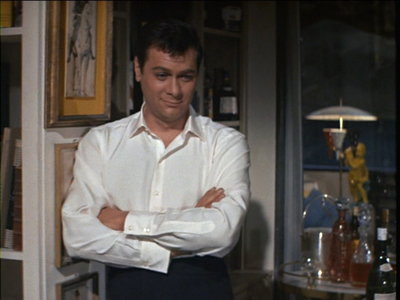
Tony Curtis as the late Charlie's pal, Richard, who's about to get a surprise!

The premise: an alpha male screenwriter gets shot aboard a wild yacht party, only to be reincarnated as a female, when alleged hilarity ensues. Debbie Reynolds is the new Charlie, found naked by a millionaire Mama's boy, dropped off at Charlie's pad, where his pal Richard is staying to settle his affairs.
Fox brought in a gaggle of MGM pros to help put this over, director Vincente Minnelli and star Debbie Reynolds, with backup from Metro’s Helen Rose for gowns and Sydney Guilaroff to design Debbie’s hair/wigs. Tony Curtis, who had starred with Debbie in The Rat Race, is cast as Richard.
Debbie Reynolds is game as Charlie, reincarnated as a woman. But is she good aping a guy? 

Reynolds tries to put over this one-note material, but is mostly one-speed. She first plays Charlie trance-like, as if she's under hypnosis. When she realizes who she was, but now in a woman's body, Debbie’s performance goes broad and butch. Debbie certainly had comedic talent, but is miscast, and overcompensates. Reynolds has some smaller, sly moments that demonstrate what might have been.
'Charlie' gets a makeover, while scheming to make his new situation work to his advantage.

Tony Curtis seems to be on autopilot, but his character isn’t given much to do. Tony is competent, but is stuck playing the straight man, when he was actually a Charlie type. Perhaps Tony should have donned Some Like it Hot drag again!
Tony's Richard with Ellen Burstyn's Frannie and her burstin' floral hat!

Walter Matthau has amusing moments, hamming outrageously as the horny Hungarian producer who shot Charlie. Joanna Barnes, the mean fiancée in 1961’s The Parent Trap, is amusingly snarky here as a Hollywood matron Janie. Pat Boone is smooth if smarmy as millionaire Bruce—not Wayne—who wants to marry Charlie.
Walter Matthau as the Hungarian film producer whose accent changes with each scene!

Also, look for Ellen Burstyn—billed as Ellen MacCrae—as one of the Beverly Hills wives Charlie dallied with. Interesting that Ellen is the same age as Debbie Reynolds and many of her contemporaries, yet Burstyn was just busting out at age 32 in movies, late by Hollywood standards. By the mid ‘70s Ellen was a "realistic" star, while old school stars like Debbie were considered passé in movies.
Debbie's Charlie is washed up on shore, now a woman, with white blonde hair and makeup.

Since this is a Vincente Minnelli movie, set in Hollywood to boot, you can bet the sets and women are highly over-decorated! The women are an array of “Color Me Beautiful” Helen Rose gowns. And whoever did Debbie’s makeup was “inspired” by MM’s last makeover, lots of white and beige costumes, pale blonde hair and nude eye makeup. The Monroe-esque makeup and hair job they gave Reynolds reminds me of all the other actresses of the era who took over parts for Marilyn or were supposed to be the next Monroe. Like Joanne Woodward in The Stripper or Carroll Baker, who looked more like MM than Harlow during this era.  Charlie's Malibu pad is a dress rehearsal for Elizabeth Taylor's Big Sur hippie "shack" in Minnelli's next movie, The Sandpiper. Both abodes looked like the ideal beach home for a tasteful, older director rather than a randy screenwriter or a free-spirited artist!
The animated opening credits gave 'Charlie' a sitcom feel, the Previns' title song didn't help.

The movie's opening, complete with a nutty theme song and animated credits, feels like a ‘60s sitcom—minus the smut. Dory and Andre Previn offered up more of their very on the nose ditties for Charlie, that feel like parody. Three years later, they took this to an art form with Valley of the Dolls.
The glossy production values, stage-bound feel, excess rear-projection shots, and the leering attitude, all made Charlie instantly dated upon release. Time hasn’t changed that. But if you’re in the mood for a time capsule rom-com romp, Goodbye Charlie might be for you.
This movie still sums up the problem with 'Goodbye Charlie.' Released at the end of '64,
it looks, sounds, and feels like a '50s film. 'Virginia Woolf' and 'Bonnie and Clyde' were just around the corner.
FYI: I put all the movie overflow on my public FB  movie page. 


Wednesday, April 24, 2019

‘Some Came Running’ Stars Go the Distance 1958

Frank Sinatra & James Jones' realism versus MGM & Minnelli's gloss in 'Some Came Running.'


Some Came Running has a critical reputation that has run the gamut over the decades. Running was a big commercial success back in 1958, but received mixed reviews. Critics were kind to the actors and Minnelli’s magnificent finale, but not to the source material and MGM gloss.
Today’s critics, film fans, and TCM have revised this movie into the realm of an “essential” film. I always enjoy Some Came Running as a highly entertaining melodrama, with a strong cast, top-notch production values, and an intriguing look at postwar middle-class American morals, as filtered through Hollywood's studio system era. However, an essential classic? Not quite. Censorship and MGM’s “classy” gloss dilutes Some Came Running’s consideration as a classic.
Look what the Greyhound dragged in! Sinatra as the boozy ex-soldier and MacLaine as the brassy babe.

Some Came Running, James Jones' 1200 –plus page follow up to his breakthrough novel From Here to Eternity, was a critical flop, but reader curiosity made Jones’ soldier homecoming story a commercial success. Then MGM bought the behemoth, boiled it down, which was directed by stylish Vincente Minnelli. Frank Sinatra made one of Hollywood's most famous comebacks as scrappy Maggio in Eternity, and was enthused to star in another James Jones’ saga.
Sinatra's Dave and Martin's Bama in their first film scene together.

The old ‘you can’t go home again’ advice certainly proves true for Sinatra’s Dave Hirsh. The army vet rolls into town on a bus, sleeping off a drunk, though how he could catch any zzz’s with Elmer Bernstein’s bombastic opening score is beyond me. With Shirley MacLaine’s good-time Ginny tagging along, Sinatra decides to stick around Parkman, Illinois, where he proceeds to get into non-stop trouble. His partner in hi-jinks is Dean Martin’s Bama Dillert, a gambler and boozer. Not helping Dave’s homecoming is Ginny’s psycho ex-boyfriend, who won’t take no for an answer. Meanwhile, Dave’s older “respectable” brother Frank has introduced him to an academic daughter and father, Gwen and Professor French. Dave is instantly in love with her, but his bad boy baggage gets in the way, not to mention Gwen’s inhibitions. Things come to a head at Parkman’s Centennial celebration, vividly depicted by director Minnelli’s acclaimed carnival climax.
Minnelli expertly introduces the characters and their stakes in the film’s opening scenes. Mid-way, though, Running begins to stroll, dwelling too long on the cynical soldier’s romance with the respectable writing teacher. Perhaps the several drunken altercations could have been tightened up, too. The 137 minute melodrama could have easily been kept at two hours.
Shirley MacLaine got her first juicy role with 'Running' as tart with a heart Ginny Moorehead.

At first, the female stars of Some Came Running got the lioness’ share of praise. Running is recalled as Shirley MacLaine's big breakthrough and Martha Hyer's career peak. Both got Oscar nominations, so that was the take at the time. 
Shirley MacLaine, looking like Stella Dallas, confronts tasteful teacher Martha Hyer over Sinatra's soldier.

Shirley MacLaine rightly became a star in Some Came Running, after several years of getting miscast or stuck in middling material. As Ginny Moorehead, this became the Shirley MacLaine boilerplate role for many years: the tart with a heart. MacLaine is warm, charismatic, funny, and dramatic as the floozy who follows Frank’s Dave Hirsh to his hometown, and now works at a bra factory. However, the flip side of Shirley's star quality is present as well: over the top and too “on.” A decade later, MacLaine’s mugging would turn to caricature as yet another bimbo in Sweet Charity. At times, Ginny comes off like Lucy Ricardo's trashy sister! Part of this is due to the screenplay. In one scene, Ginny actually calls the library a 'li-berry.' Is anyone really that dumb? Minnelli should have dialed Shirley's shrillness down a notch, but both he and MacLaine had a tendency toward overstatement. Running set Shirley MacLaine off on a long career. While Shirley’s Ginny is great fun and touching, she’s also grating instead of ingratiating, at times.
Martha Hyer as Gwen French, the 'classy' other woman in Frank's Dave Hirsh's life.

Martha Hyer had a rather odd career. Hyer was 30 when her career finally got traction, and was often cast as the bland second lead that lost the leading man to the unique Audrey Hepburn or Sophia Loren. And while she wins Sinatra at the end of Some Came Running, Shirley stole the show. Somehow, Hyer got a best supporting actress Oscar nom as Gwen, the prudish college teacher who lives with her father. Even more astounding is how Hyer got a nomination over Judith Anderson and Madeleine Sherwood in Cat on a Hot Tin Roof, also an MGM production. Hyer always reminds me a pod person who gives slightly stilted line readings, as if she’s visiting planet Earth. To be fair, she has some of the movie’s worst lines, not to mention constantly referring to Sinatra’s character by his full name. Hyer was another actress pitched as the next Grace Kelly; let's just say that Martha Hyer was at least more talented than Tippi Hedren. The one scene where Hyer comes to life is when she and Frank get down to business and her Gwen has a hard time warming up. Totally ‘50s, all silhouettes and symbolism, with the uptight teacher letting down her hair, in every way, it is still an effective scene.
When Hyer's frigid Gwen allows Sinatra's Dave to let her hair down, it unleashes her womanly desires!

As skillful as the supporting actresses are, they’re working against the stereotypical female roles that they're given to play—and this is true of stars MacLaine and Hyer, as well. The women are typecast as whores, virgins, bitches or saints. That the actresses breathe any humanity and life into the roles is to their credit, as well as Minnelli, an empathetic woman's director of the highest order. Leora Dana bristles as Agnes, Frank Hirsh’s frustrated country club wife. As rigid as Dana is, she gives you a feel for how trapped Agnes is in her life. Betty Lou Kiem is bright and likable as Dawn, the good daughter, and not insufferable like so many ‘50s movie ingénues. Nancy Gates is genuinely touching as Frank’s secretary, Edith Barclay, who lets her guard down and goes for a romantic drive with the boss. When discovered, she’s the one who must pay. Nancy Gates had a sympathetic and sensual quality that should have led to bigger opportunities. Connie Gilchrist is a warm presence as working class local, Jane Barclay, Edith’s mother. She runs into Sinatra’s Dave at Smitty’s, the local watering hole, and Gilchrist is a breath of fresh air, as always.
Nancy Gates' secretary takes boss Arthur Kennedy out for an after work drive.

I think the male performances are the real standouts in Some Came Running, as they are more naturalistic and hold up better. This is partly because the women's roles were archetypes that are more aptly stereotypes today. The other is the way the actresses played them, when female stars' performances were still more "elevated" than their male co-stars, during the last gasp of studio era “star” acting.
After praise in several post-Eternity roles, Frank Sinatra's persona was rapidly overshadowing his acting roles, and critics began to downplay his abilities. Some non-Sinatra fans claim that he just walked through his movies. The fact that he was famous for doing one or two takes only didn't help.
Frank Sinatra at his naturalistic best, a mostly complementary contrast to Shirley MacLaine's splashy performance.

I think Frank Sinatra's terrific in Some Came Running. As Dave Kirsh, he's the prodigal son who comes back home after 16 years. Aside from a wanderer and carouser, Dave’s been a writer, a soldier, and he's now back where he started. Sinatra is a natural actor, his wry, sarcastic humor is terrific, but he's not afraid to show his tender side, either. His scenes with MacLaine’s tart are alternately sweet or volatile. Dave’s sarcasm toward his phony brother is funny, as are his bantering scenes with Dean’s Bama. Frank’s scenes with love interest Martha Hyer, as Gwen French, become increasingly tender, after his character’s initial bad boy come-ons. Aside from his famed vocals, Frank had a very distinctive and expressive speaking voice, no surprise, for a singer famed for his phrasing.
Like The Manchurian Candidate, Frank is depicted as a deep thinker who loves books, when he's not boozing or chasing broads. Sinatra always came across as street smart, so it's believable that his character is a rough and tumble writer. 
On the flip side, this is yet another movie where Sinatra is at least a decade too old for his role. Honestly, he was even long in the tooth at 38, as Private Maggio, in From Here to Eternity. But Frank's 'bad boy' rep lasted decades. So, Sinatra was 43 in Running, yet his character left boarding school before he was 18 and gone for 16 years as the film begins... Another familiar Frank trope is there's a fight scene where Sinatra is super unconvincing. He still sports the famed scrawny physique here, and the fights feel “stylized,” and it’s about as convincing as Elvis' karate moves!
Frankie's rep as a lover boy is a bit pandered to here, where he's all over Martha Hyer like white on rice. It looks worse by today's standards, but even for '58, 40-something Sinatra acting like he's never seen a woman before is a bit much.
Especially amusing is when Martha's Gwen, the frigid writing teacher who maintains she's only interested in Dave the writer, not the frisky bad boy. After reading a story that the struggling novelist had given up on, Gwen summons him and announces with a straight face: "Dave, you have a very exciting talent!" Any Sinatra fan worth their salt knows that Frank was famous for an exciting talent, other than his singing pipes. And he proceeds to apply that talent to Gwen’s own analysis paralysis!
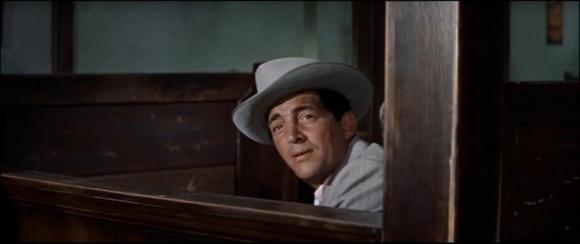
'Some Came Running' introduces Dean Martin as a strong dramatic and comedic actor.

The real surprise was how good Dean Martin was as Bama Dillert, the seemingly sanguine gambler who never takes his hat off. Martin, one of the most laid back show biz personalities ever, is another actor easy to underrate. But Martin just about steals the show and that's saying something with MacLaine turned loose here. Martin is likeable and great with the one-liners and double takes, but he's also a bit melancholy and fatalistic. 
As the gambler who gloms on to Frank’s new guy in town, Martin is at first his genial self. But as time goes by, you realize Dillert's willful obliviousness that life is just one long party is a defense mechanism. Later, when Sinatra’s Dave decides to marry MacLaine's Ginny, Martin’s Bama lets him have it, and he's pretty harsh about it. And Dean plays those not-so-genial moments well, too.
'Kid' brother Frank Sinatra to Arthur Kennedy in 'Some Came Running.' Arthur was a year older than Frank!

Arthur Kennedy once specialized in playing sensitive guys. As he grew older, Kennedy also excelled at playing creeps. Now a character actor, he was most memorable as sleazy janitor Lucas Cross in1957’s Peyton Place. Kennedy is great here, too, as Sinatra's “older” brother, Frank Hirsh, who married well and abandoned his kid brother Dave in a boarding school. In real life, Arthur was only a year older than Frankie! Kennedy is a comic bad guy here, the sanctimonious ass who is actually a sad case. Frank Hirsh reminded me of Frank Burns on M*A*S*H. Kennedy's scenes tangling with Sinatra are alternately dramatic or offer comic relief. Still, the scene when Kennedy's restless Frank takes his secretary out for a drive captures that small town desperation well. 
Vincente Minnelli, who gets downgraded by some critics for his non-musical films, does a great job giving Some Came Running in-depth characters, dramatic situations, and some Douglas Sirk-like subtle digs at American social mores. Yet, his love of MGM gloss gets the better of him, especially with the French father/daughter characters, who are pure drivel.
The home of the phony French family, complete with kitchen/library combo, perfectly sums up intrusive MGM gloss.

The extensive location scenery in Madison, Indiana as the fictional Parkman, Illinois gives authenticity against the MGM gloss. Elmer Bernstein’s score starts sonorously, like a Bible epic, but once Running gets going, his usual trademark jazzy and bombastic style kicks in.
As someone who grew up in a middle-America small town, Some Came Running has a real feel for that life. However the duality of that authenticity versus the genteel MGM version of upper middle class life keeps Some Came Running from being a true classic. The post war era feels right, though I often forgot the movie was set just after WWII. Except for Frank’s uniform and a marquee playing Elizabeth Taylor’s 1946 Courage of Lassie, the movie feels like 1958. Still, the post war era of celebrating peace and prosperity with smoking, drinking, gambling, and hanky panky was a party that lasted a mighty long time! Frank has more fun doing all of the above with Martin’s gambler and MacLaine’s bimbo, than engaging in stilted banter with the collegiate French family—who can blame him?
Frank Sinatra and Shirley MacLaine in the brilliant Minnelli finale of 'Some Came Running.'
Watch Some Came Running for its stellar cast and James Jone’s recognizably human characters in this mid-west version of Peyton Place.
FYI: I put all the movie overflow on my public FB  movie page. 


Monday, January 7, 2019

It's Curtains for 'The Cobweb' 1955

One flew away from the cuckoo's nest!


“The trouble began…” So begins the fevered film version of William Gibson’s novel, The Cobweb. Gibson, best known as the playwright of The Miracle Worker and Two for the Seesaw, wrote the story, inspired by his psychotherapist wife's tenure at The Menninger Clinic. I’ve never read the book, but somehow I don't think the brilliant Gibson plotted The Cobweb like another MGM Grand Hotel-style, all-star soap opera. 
Pulp fiction? Playwright William Gibson's novel.

The original casting for the film’s romantic triangle was MGM mannequins Robert Taylor, Lana Turner, and Grace Kelly—this was more apt for the super-glam soap opera. Instead, familiar film noir faces Richard Widmark, Gloria Grahame, and Lauren Bacall assumed the roles of the idealistic clinic head, dissatisfied wife, and the lonely art therapist—which gives the film a bit of grit.
Sensitive Stevie Holte talks about flowers, art, and life with the sultry and sweaty doctor's wife, played by Grahame.

Widmark’s Dr. McIver has the cockeyed notion that patients should be treated like people, not caged animals, which has the old guard gunning for him, natch. On the home front, his wife Karen is bored in EVERY way. Since the doc is an idealist, Meg, the other woman who pines for him, is also so very noble.
Chaos over curtains for the library!

The film depicts the institution's staff and family as neurotic as the patients. At one point, Widmark declares that he feels they are all trapped—yes—in a cobweb! Only in the melodramatic world of Vincente Minnelli would a film's drama hinge on drapes. And it's curtains for The Cobweb characters, as the various contingents are determined to have their way over the patient lounge's new decor: Lillian Gish as the domineering Miss Inch is aptly named, as she never gives an one, and wants the curtains made cheap; Gloria Grahame's Vicki needs a project, with money or permission no object; and Lauren Bacall's art therapist Meg has the progressive idea of letting an angst-ridden artist/patient design them. Who will prevail?
Susan Strasberg & John Kerr play two patients, attracted to each other,
who venture to the outside world on a date.

MGM's then-resident sensitive young man John Kerr plays the troubled Steve Holte, who runs away from the clinic at the start and near the end of the film! While his performance is as good as the rest of the cast, Kerr's somewhat feral looks make it easy to see why his career was short-lived in an era of Tab Hunter types. But I found Kerry quite effective. 
One of many strange moments, when Richard Widmark tucks in his unbuttoned shirt
without unbuttoning his pants!

Richard Widmark was one of those golden era actors who seemed so natural on the screen and makes the preposterous proceedings almost believable here. Gloria Grahame's natural brass as his wife gives the soapiness some much needed humor. Also, was it in Gloria's contract that she always must look slightly sweaty? I was getting a Maggie the Cat vibe from Grahame here, as the frustrated wife who needs to cool off.
Lauren Bacall got second billing, but fourth-billed Gloria Grahame got all the scenes!

The movie is so overstuffed with characters and situations that Lauren Bacall has nothing to do but look lovely and lonely from the sidelines. Bacall doesn't even have a scene of her own until thirty minutes in and her first kiss with Widmark comes near the film’s finale. There is pleasure to be found in Lauren playing a sympathetic lead rather than her usual snarky self. Then-rising star Susan Strasberg has it even worse. Aside from a few scenes with Kerr toward the end, Strasberg’s always in the group scenes. Surprising, since Susan broke out big in Picnic the same year.
Gloria grabs the fabrics situation by the horn in this climactic curtain scene!

Lillian Gish is amusingly hammy as the firebrand Victoria Inch. And whoever thought of Charles Boyer for Dev, the clinic's former head honcho, must have been out of their mind. As the deluded, drunken, ladies man, Boyer, with his inimitable French accent, is somehow stuck out in the Kansas cornfields. He comes across like Pepe LePew, especially when drooling over Grahame’s character. Was it considered clever to cast Hollywood's most famous neurotic, Oscar Levant, as a mother fixated patient? For me, while rightly famed for his wit, his screen presence always escaped me. 
Fans of golden era Hollywood melodrama will probably The Cobweb, but other movie watchers will probably draw the drapes on this florid film.
Gloria Grahame brings the fever AND the floral curtains to 'The Cobweb!'

FYI: I put all the movie overflow on my public FB  movie page. 

Check it out & join!  https://www.facebook.com/groups/178488909366865/


Sunday, January 7, 2018

The Bad and the Beautiful 1952

Kirk Douglas is the bad-ass movie producer with beautiful star Lana Turner limp in his arms.

Vincente Minnelli’s 1952 take on Hollywood, The Bad and the Beautiful, is delicious melodrama. Yet, the movie-making saga doesn’t have the bite of the two show biz tales that came two years before: Sunset Boulevard and All About Eve.
Since this tinsel town takedown was filmed at mega-glam MGM, it’s no surprise that the film focuses more on the beautiful, rather than the infamous bad side of Hollywood.
Kirk Douglas as the ruthless producer, Lana Turner as sad superstar.

Still, The Bad and the Beautiful is filled with juicy archetypes based on real show biz types. The two standouts are the leads: Kirk Douglas as Jonathan Shields, a ruthless, David Selznick-style wheeler-dealer producer; and Lana Turner as Georgia Lorrison, a lush starlet haunted by her late legendary father, patterned after Diana Barrymore.

Kirk Douglas hit his ferocious stride in the early ‘50s as this Hollywood heel, with a heart deep down—somewhere around his heels.
Lana Turner has one of her very best roles as the high-strung Hollywood star. While her early scenes as the drunken starlet are depicted as just toned-down Turner, Lana gives a straight-forward performance. Later, as Georgia becomes a star, the latter-day lacquered Lana takes over. I love the insane intro to Lana’s character in her flashback: Turner reclining on a day bed, costumed in a powdered wig, britches, and buckled shoes, as if she’s starring in the MGM version of Hamilton!
I'm ready for my flashback! Lana as Georgia, apparently starring in the MGM version of 'Hamilton!'

The entire cast is fine, with Metro starlet Elaine Stewart a scene stealer as Lilah, a bitchy starlet. A curiosity to me is why the great Gloria Grahame won Best Supporting Actress Oscar for her role as Rosemary. Grahame, as the southern belle wife of writer Dick Powell, doesn’t even appear until the last third of the picture. Gloria’s nearly giddy as the sexy, pesky spouse…but the role pales in comparison to Grahame’s other memorable movie work. And when Rosemary dies, it’s off-camera. Typical off-target Oscar honor, I guess.
Gloria Grahame and Dick Powell as the southern academic couple who answer the call when Hollywood rings.

Director Vincente Minnelli and cinematographer Robert Surtees give The Bad and the Beautiful a stylish, virtuoso visual look. Studio life, movie-making, eerie mansions, showbiz parties, and more, are all depicted grandly. Most famous—rightly so—is Lana Turner’s careening car ride, after an ugly confrontation with Douglas. Georgia’s out of control emotions are matched by a sudden rainstorm as she speeds away. The scene climaxes with a hysterical Turner pulling over, collapsing in tears. For those who think that Lana Turner couldn’t act, I say she could—when she chose to.
Considering how many movies have been made about Hollywood, there have are surprisingly few good ones, much less great. As deep dish goes, The Bad and the Beautiful is great as entertainment, but glossy as drama. Fun film-watching, nonetheless!
Hollywood's no joyride for Lana Turner's troubled star in 'The Bad and the Beautiful!"


Sunday, November 19, 2017

Madame Bovary 1949

MGM's 1949 'Madame Bovary' is wildly erratic and highly watchable.
The Vincente Minnelli-directed 1949 version of Gustave Flaubert’s Madame Bovary is fascinating, but wildly erratic, much like the heroine herself.
The huge hurdles for the movie-makers with this take on the once-scandalous novel of a French housewife are never satisfactorily resolved: telling a story that would satisfy audiences, critics—and censors; movie-making with more post-war modern realism, and less from the past era’s style; and bolstering a leading lady who lacked confidence in her acting ability.
I never realized how James Mason sounded like his own best hammy imitation!
Some critics have cited the MGM treatment of Madame Bovary as anti-Emma, claiming that the studio framed the story within the censors’ rule that movie sinners must be punished by the last reel. I disagree. There are plenty of instances in the movie that defends Emma as trapped by her role of a woman, in male-dominated society. I have not read the book, but this adaptation posits that her childish ideas of life arise from her sheltered upbringing as a small town farm girl. When Emma attempts to act on them as an adult woman, the results are tragic. Director Minnelli deserves credit for a reasonably faithful rendition of Madame Bovary, filmed in an era when studios didn’t particularly care about fidelity—to a book, at least. In case you don’t get the message that Madame Bovary is great art and not scandalous trash, there’s a prologue and an epilogue that bookends the trial, which in turn bookends the movie. The idea of portraying author Gustave Flaubert on trial, to defend the decency of MGM’s Madame Bovary, must have seemed like a brilliant idea to offset showbiz censors. However, after James Mason's sonorous speechifying at the trial, we’re treated to his pompous narration that’s so intrusive that it’s comical. You’re relieved when he finally shuts up half way through.

The eternal triangle: Madame Bovary, the suave French playboy, and Mr. Bovary, the dull doctor. Guess what happens next?

This 1949 version of Madame Bovary was one of Metro's 25th silver anniversary movies, but in reality, it was their last hurrah as Hollywood’s greatest studio. Like other MGM takes on the classics about modest folk with only proximity to wealth, the stars of Pride and Prejudice, Little Women, and Madame Bovary still wear improbably lavish costumes and live in “cozy” luxury. Jennifer Jones sports gowns by Walter Plunkett, famed for his Scarlett O’Hara designs for David O. Selznick’s Gone with the Wind. Director Minnelli, despite his own love of glamour, at least attempted to give Emma's rustic life some genteel grit, but was thwarted by MGM.
Just a simple French farm girl making an omelette for the visiting doctor.!
In her first scene, when Emma is cooking breakfast, I burst out laughing. After a stormy night with rain seeping into the country kitchen, there is Jones as Emma, looking utterly pristine. Emma’s morning wear is a gigantic gown, with a huge decorative rose, as she delicately makes an omelette for visiting doctor Charles Bovary (Van Heflin.)
So it goes, with each scene, as Jones swans around in a gown or cape even more lavish and absurd than the last. How much more dramatic would it have been if Emma actually dressed like a country doctor’s wife, and finally gets to fulfill her dream at the Marquis’ ball, swathed in her soiree-stopping, snowy white confection.
Emma is encouraged to live large by the sinister shopkeeper!
Madame Bovary is one of those studio system era movies that are a mish mash of accents—American, British, and one actual Frenchman! Van Heflin is sympathetic as Charles Bovary, the benign and bewildered husband, though he is directed to play the drunken hubby at the ball very broadly, where he bursts Emma’s romantic bubble. The supporting cast, though playing archetypes, offer skillful portrayals. Ellen Corby, Grandma Walton herself, plays Emma’s long-suffering maid. I was puzzled that the great Gladys Cooper (Now, Voyager) has just one scene, making me wonder if a subplot had been cut out of the final film. Louis Jourdan plays yet another charming, smarmy French playboy, who helps lead the heroine to ruin.
Ultimately, Madame Bovary is all about Emma and the actress who plays her. There are a bevy of Madame Bovarys, all have their merits, but the Vincente Minnelli version is still the most famous. This is a bit surprising, since MGM’s Madame Bovary was a flop at the box office. Originally, Lana Turner was offered the role of Emma. This could have been an apt choice, as Turner was a romantic whose shallow outlook created as much disaster in her own life, as Emma Bovary did in hers. Lana thought the script dull and turned it down, and found out she was pregnant, as well. Minnelli was relieved, as he felt Turner’s notoriety would attract more attention from censors, and that an actress with a more respectable screen image would be a better choice.

Lana: "No, Jen, YOU play 'Madame Bovary!' You'll win a second Oscar!'
Enter Jennifer Jones as Emma. Never mind that Jones’ marriage and family with Robert Walker was wrecked when Gone with the Wind producer David O. Selznick set his sights on Jennifer. Or four years later, Selznick was still haggling with his current wife over the end of their marriage. In fact, it was during Madame Bovary’s production that Irene Selznick was granted a divorce. Ultimately, image is everything in Hollywood, and Jones was the dream girl of super productions like Song of Bernadette and Since You Went Away. Ethereal Jennifer Jones as Emma Bovary therefore took the onus off playing a scandalous character.

Jennifer Jones is one of Hollywood's most puzzling personalities. Jones grew up in a theatrical family, who owned a chain of movie theaters. She and first hubby Robert Walker were aspiring actors together. Yet, friend and co-star Joan Fontaine said of working with Jones on her last big movie, 1962’s Tender is the Night, even at that late date, acting “was a kind of torture” for Jennifer.  Jones is an anomaly among performers who grew up surrounded by showbiz—Mickey Rooney, Judy Garland, Sammy Davis—who lived for the limelight. And there are many stars that are shy off-stage, but who have brash personas. Jennifer Jones seemed a bit like Marilyn Monroe, both seeking and repelling stardom. Some critics of Jones have questioned the “shy” Jennifer, claiming it was an act to cover her ambition. To me, her reclusive nature and increasing discomfort on-screen seemed to indicate that Jennifer was not pretending. And yet Jones aspired to stardom, or she wouldn’t have broken up her family for the siren call of superstardom that Selznick promised.

Portrait of Jennifer, as Madame Bovary, dressed to the nines.
Though he technically had nothing to do with this Madame Bovary, David Selznick peppered everyone involved with his famous memos—all about how to bring out the best in Jennifer Jones. Like so many powerful Hollywood men, Selznick was obsessed with his star, and determined to make her into Hollywood’s greatest superstar. Newspaper tycoon William Randolph Hearst attempted the same with Marion Davies. Davies was a showgirl with a natural flair for comedy, but Hearst’s desire was to make her a great dramatic actress. Instead, they made a string of big budget flops that made Marion a punch line. Film contemporaries and historians later said that Davies might have had a more interesting and relaxed career if Hearst had just butted out. And many film folk and critics felt the same in regard to Selznick and Jones.
Jones’ ambivalence is apparent in many of her movies, which is why movie fans and critics are still wildly divided over Jennifer’s abilities as an actress. As Emma Bovary, Jones gives off a jittery intensity throughout, which serves her character well. Jennifer is also wildly uneven as the country girl who longs for romance and riches. Jones can be subtly in tune with Emma in one scene, studio era “dramatic” in the next, and feverishly unnerving after that. Even here, critics and audiences were starting to notice Jones’ nervous tics, especially her tendency to grimace during dramatic scenes.
Every time Emma embraces a new dream—a new home, a baby, a lover, or even a ball gown—Jennifer makes the pronouncement with a fixed, wild stare as if she's playing the beatific Bernadette again, seeing visions. Jennifer seems most comfortable in her love scenes, luxuriating in her romantic fantasy. Yet, as the desperate Emma calling on her former lover for financial help, Jones is theatrically obvious, and therefore, not especially sympathetic. Finally, as Emma on her death bed, after swallowing gobs of arsenic, Jones dies a realistically painful death. 
Jones as Emma, facing her ruin. Jennifer reminds me of Kim Cattrall here.
Perhaps it is Jennifer’s lack of confidence and the inability to create empathy for a basically unsympathetic character that makes Jones' Emma Bovary off putting. Vivien Leigh and Elizabeth Taylor often played passionate women who did foolhardy things (off-screen, too!) but they always retained audience sympathy, especially from female fans. Leigh, a few years before, or Taylor, a decade later, could have easily played Emma. I think MGM’s Ava Gardner might have made a fine Emma. Gardner was a small town farm girl who came to Hollywood, where her dreams turned to disillusion, too. However, Ava was about as insecure about her talent as Jones.
'Madame Bovary' comes alive in the famous waltz scene. This is one of director Vincente Minnelli's best scenes on film.

Wildly uneven as Jones is, Jennifer still has her moments. For this Madame Bovary, the famed ballroom scene is where everything comes together. Jennifer Jones, who looks lovely throughout, is especially fetching in her gauzy, snow-white gown, with black feathers across the bosom. Surrounded by admirers, Scarlett O’ Hara-style, Emma takes a breather between dances. Jourdan as Rodolphe makes his move, the suave stud ready to sweep Mrs. Bovary off her feet. Emma goes from Cinderella to belle of the ball, and this scene is the perfect moment: the increasingly giddy waltz, the camera swirling along with Emma, surrounded by aristocrats, in the arms of a handsome man, waiters who smash windows with chairs when she exclaims that she can’t breathe, and Emma Bovary’s romantic daydreams momentarily come true.

Jones’ other big scene in Bovary is when Emma plans to run off with Rodolphe. Waiting for a stagecoach on a dark, windy night, Jennifer’s intensity conveys Emma’s yearning to escape her small town life. As the stagecoach comes closer into the village, the horses’ hoof beats become louder—symbolizing Emma’s heart pounding? The stagecoach looms into view…and then passes by, followed by a huge close-up of Emma screaming, powerfully portrayed by Jones. Emma, defeated, returns to her home and husband. Charles is waiting and so is a basket of fruit, from Rodolphe, along with a farewell note. Jones’ reaction to her lovers’ kiss off is eerily catatonic.

Emma Bovary's romantic dreams go up in flames. Jones with Van Heflin as Charles Bovary.
Looking at Jennifer Jones’ career in terms of hits is bizarrely skewed. Jennifer starred in eight bonafide blockbusters: Song of Bernadette, Since You Went Away, Love Letters, and Duel in the Sun in the 1940s. Then in the '50s, there were The Man in the Grey Flannel Suit, Love is a Many Splendored Thing, and the critically panned but commercial A Farewell to Arms. Finally, Jones literally went out with a blaze of glory in 1974’s The Towering Inferno. Nearly none of these movies hold up today.  After those films, Jones’ box office stand takes a huge dip when looking at her other films like Portrait of Jennie, Carrie, We Were Strangers, Tender is the Night, as well as Madame Bovary. All were box office duds. The films that have won her cult status were financial flops too, but got her good notices, like Cluny Brown, Beat the Devil, and Indiscretion of an American Housewife. I find her appealing both as the saintly Good Morning, Miss Dove and as the trashy bayou babe in Ruby Gentry—again, not big hits. In Jones’ defense, the movies that stars are most remembered for aren’t always their biggest hits, and Jennifer’s work is worth exploring. Happy hunting though, because Jennifer Jones' career is checkered, to say the least.

Bette as a bitchy Madame Bovary!
Here's a fascinating coincidence: the same year as Jennifer Jones played Emma Bovary, Bette Davis ended her Warner Brothers contract playing a modern day version of Bovary in Beyond the Forest. Having just seen Madame Bovary for the first time, I was shocked at how much Forest author Stuart Engstrand ripped off the Flaubert classic. Seriously, Beyond the Forest is pretty much a replay of Madame Bovary in modern dress. And Bette's character Rosa Moline is just a mean girl version of Emma Bovary. Like Emma, Rosa is also married to a doctor, lives for luxury, looks down on her fellow townspeople, takes a rich lover, humiliates her husband, berates her maid, and dies a slow, painful death. The only thing Emma doesn't do is shoot a porcupine and a boozy tattletale!


The best way to watch this Madame Bovary is to ignore or enjoy its contradictions. Or maybe watch Jones’ Emma as a double feature with Bette’s bitchy broad version of Bovary!


Let's leave Emma Bovary on a happy note, the belle of the ball, and surrounded by admiring men!