Showing posts with label Ann Sothern. Show all posts

Friday, May 3, 2019

‘Lady in the Dark’: Over the Top Style Over Substance 1944


Ginger Rogers isn't turning green because she's singing 'South Pacific' tunes!
Ginger's 'Lady in the Dark' is about to go into a dream sequence is all.


Once groundbreaking, 1941’s Broadway dramatic musical, Lady in the Dark, was a critical and commercial smash for all involved. Lady was especially lucky for the careers of star Gertrude Lawrence, plus newcomers Danny Kaye and Victor Mature. Lady was a sophisticated mix of psychological drama, and music styles of several genres. Lady in the Dark was daring at the time, with analysis in vogue, and women at work in the war years. Yet, the fine points of these two topics soon became dated, leaving this Lady with a somewhat tarnished reputation.
Gertrude Lawrence had a mid-career triumph on Broadway with 'Lady in the Dark,'
 playing over 500 performances. But Hollywood was not going to star a 45 year old
 actress with no film track record in a big movie musical.

Paramount paid nearly $300 thousand dollars for the movie rights to Lady in the Dark. Perplexingly, the studio missed the boat—or specifically, ship—by eliminating what was most memorable about Lady, the instant classic score, including its most famous tune, “My Ship.”
The source material, with the book by Moss Hart, plus words and music by Ira Gershwin and Kurt Weill, dealt with two timely topics: psychoanalysis and career women. Then, Paramount’s film adaptation added its own interpretation. The Hollywood studio system was at its zenith as the entertainment choice of the mainstream public. Hollywood studio heads deemed themselves as the patriarchs of the American way of life. Of course, the bottom line was to appeal to the masses and keep those movie tickets selling! So, the psychiatry of Lady in the Dark was further simplified for filmgoers. More damning was Lady’s message that it was more important to be a “real woman” than a career woman, which was constantly drummed throughout Lady, and through decades of filmmaking, as well.
Ginger Rogers' Liza Elliot is called "boss lady" by her male co-worker & told by her shrink that she "cares little for feminine adornment!" Because, pinstripes?!

What the studio did keep was the story of Liza Elliot, editor of “Allure” fashion magazine. Liza (Ginger Rogers) is stricken with anxiety, depression, and disturbing dreams. Her professional and personal life only exacerbates Elliot’s issues. At work, advertising hot shot Charley Johnson (Ray Milland) has his eye on her job and badmouths her femininity. On the home front, Liza has a safe harbor relationship with a wealthy married man old enough to be her father (Warner Baxter.) Then movie heartthrob Randy Curtis (Jon Hall) arrives at “Allure” for a photo shoot. Randy is taken with Liza because she’s “not one of those glamour girls.” Gee, thanks, Randy! Then, there is also a hint of attraction amidst the hateful zingers from Charley. This dull lot is just Liza’s current personal baggage.
Ray Milland's good time Charley Johnson & Rogers 'boss lady' duke it out in pinstripes over a circus- versus Easter-themed fashion mag issue. Imagine the results when Liza has a dream sequence mixing both. Their looks sum it up!

I consider myself pretty clear-eyed while watching films from past eras, when dated conventions, situations, or dialogue come up. After all, it was the past. And as we seem to forget the past fairly quickly, I don’t think it hurts to be reminded of outdated past attitudes. But some movie material is beyond the pale, and Lady in the Dark comes pretty close. The barrage of sexist insults to Liza from Charley (him telling a co-worker that all Liza needs is a night out and a good…), or the patronizing, prehistoric advice from Liza’s shrink (that she needs a man to dominate her), had me wincing or rolling my eyes.  
Liza takes the advice from her doc that she needs a shrink as if she had a fatal disease!
 I never realized what big blue eyes Ginger Rogers had until I saw 'Lady in the Dark.'

As a talent, Ginger Rogers was always a game girl. She started off as a dancer, but always tried to broaden her range. At her best, Rogers was a graceful, energetic dancer, a decent singer, an engaging comic performer who was great with wisecracks, and a solid dramatic actress. And Ginger was all about glamour, which was worshiped in studio era Hollywood. However, biographer David Chierichetti wrote that director Mitchell Leisen said that Rogers could not relate to the psychiatric profession, which he felt hindered her performance in Lady in the Dark. This seems odd, since Ginger wanted to make this film. Also, Ginger’s doubt should have suited the role, as Liza takes the advice from her family doctor to seek therapy as if she was ordered to get a lobotomy.
Perhaps Liza Elliot is thinking about the size of her shrink bill after checking out the
 doc's stylish office digs! That's a very young Barry Sullivan as Dr. Brooks.

Wouldn’t it have been ironic if Paramount had borrowed Rosalind Russell from MGM to play Lady’s Liza Elliot? Russell made her career in comedies playing strong career women—who usually gave up work by the last reel! Roz was able to play brittle while retaining her likeability. I also couldn’t help but wonder what Joan Crawford might have brought to this role. Even in her heyday, everyone knew that Joan’s career was all to her, and Crawford could have given an intriguing portrayal.
Ray Milland is a shithead with a whip & Ginger Rogers a lady in a cage in the circus dream.

Though engaging performers, neither Ginger Rogers nor Ray Milland, as Liza the “boss lady” and her office adversary, Charley Johnson, come off well. This isn’t their fault, since their roles and especially the dialogue, are impossibly slanted. Rogers comes across as a peevish pill and Milland as a horse’s ass. One wonders what Cary Grant, who played a charming but needling jerk in Hitchcock’s Notorious, might have done as Charley. Cary’s comedic persona was infinitely more charismatic than Milland’s.
As often the case, movie posters finesse the facts. Ginger's Liza Elliot is more lost
than in love, and isn't that keen on any of the three rather dull leading men.

Rogers’ Liza receives constant criticism for not looking feminine enough. You see, she wears—gasp!—tailored dresses. But the work wear is always accessorized with towering hairdos, lacquered makeup, jungle red nails, high heels, and furs! This was classic Hollywood’s idea of austerity style—wearing pinstripes. Edith Head designed the modern clothes.  It’s amusing that the other characters chide Liza for her dress, because Edith’s streamlined clothes for Rogers’ character remain timeless and chic, while everything else looks like campy costumes.
Before there was Lady Gaga's "meat" dress, there was Ginger Rogers' "mink" dress!

Though Edith Head is generally given kudos for all the costumes, the film credits cite three designers, who created the garish glamour for Lady in the Dark. Raoul Pene Du Bois created designs for the dream sequences and Madame Barbara Karinska lent her skills to make the fur fly for the film’s much-publicized “mink dress.” Yes, before Lady Gaga’s “meat dress,” there was Ginger’s “mink dress!” The mink portions of the heavily sequined dress had to be redesigned, requiring Karinska’s services. The first attempt was so heavy, that Ginger couldn’t even walk, much less dance, in the gown. IMO, the debated mink gown sure looks like an Edith Head number, but I’m no costume expert. 
The mink reveals a gown with more sequins than Bob Mackie or Cher could ever imagine!

The dress was highly publicized as costing $35,000—for a fur gown to dance in—which truly symbolizes the wrongheaded approach by Paramount to Lady in the Dark. Frankly, some of the “wow” costumes remind me of the designs that Mae West wore in her final films (by Edith Head) or Lucille Ball’s heavy, clunky clothes from Mame.
The $35,000 mink gown opens to reveal sequins and Ginger's famous legs!

The dream sequences are something out of The Wizard of Oz—in fact, Liza’s work confidante refers to her shrink as such. Also, in Liza’s wedding dream sequence, Rogers is so laden down with a huge platinum pageboy wig, a towering bridal veil, and a kewpie doll painted face, that she looks like Billie Burke’s Glinda the Good Witch. There are so many singers, dancers, scenery, exaggerated costumes, and apparently every smoke machine that Paramount could muster, that Lady looks like Oz—or a mammoth, melting Technicolor cake. Paramount star Mae West once commented that too much of a good thing is wonderful, but I’d use these dream sequences as proof that it isn’t!
Here's Ginger looking like Glinda the Good Witch in one of 'Lady in the Dark's'
 demented dream sequences.

The one sequence where Ginger gets to show off some of her fabled spice is in “The Saga of Jenny” number. Rogers’ in great form here and gets to work that mink dress like nobody’s business.
There are subtle, delightful touches scattered throughout the film amongst the overkill. Lady’s opening titles are clever, mimicking “Allure” magazine. And the dream sequences’ segues are smoothly skillful. It’s a sad commentary that the scenes depicting Liza’s daily life are more visually pleasing than the near-nauseating fantasy dream sequences.
Interestingly, the introductions to the dream sequences are clever and creative.

Mitchell Leisen’s skills have been criticized by some film historians as style over substance. Or that Leisen lucked out in having Billy Wilder, Charles Brackett, and Preston Sturges work for him when they were screen writers. There is truth to this, but he had his gifts—with actors, comic material, and visual style. But with such tricky material as Lady in the Dark, perhaps a stronger director would have fought the unfortunate material cuts, the over the top taste level, and the negative emphasis on the leads’ characters. Leisen’s Lady in the Dark and Frenchman’s Creek, while big commercial successes in 1944, were expensive and problematic to make, badly reviewed, and ultimately, not well-remembered. Leisen’s work without such talented up and comers just didn’t compare.
A perfect example of how Paramount killed 'Lady' with overkill: Ginger & Don Loper
 dancing around what looks like neon candy canes & "fog" that looks like they're being exterminated!

Among the rest of the cast, there are some interesting performers. Young Barry Sullivan, whose voice sounds like it hadn’t changed yet, plays Liza’s shrink, Dr. Brooks. Mischa Auer has a field day as Russell, the flaming fashion photographer. Mary Gilbert is great fun as Rogers’ wise sidekick, Maggie. She was also Humphrey Bogart’s first wife! Gorgeous Gail Russell appears in an early role as Rogers’ high school love rival in a flashback. The difference here Gail was actually a teenager when this was filmed. And yes, we are treated once again to Ginger playing a pre-teen in a pinafore during the circus dream scene. At least Rogers doesn’t play little Liza in the flashbacks with her parents!
Yet another movie where 30 and over Ginger plays a juvenile in a pinafore.

There have been surprisingly few theatrical revivals or filmed versions of Lady in the Dark, due to the lavish story and its problematic take on women.
Interestingly, Judy Garland played in a one hour radio version of Lady in the Dark in 1953 that showcased the music and utilized just enough dialogue from the show’s book to frame the piece. It’s lovely to listen to. Ann Sothern did a 90 minute television version in 1954 that, judging from the audio clips, imbues Liza with more humor than Ginger and a surprisingly strong voice.
Julie Andrews as Helen Lawson, oops, Gertrude Lawrence performing 'The Saga of Jenny' in the bio flick 'Star!'
In 1968, Julie Andrews played Gertrude Lawrence in the biopic Star, recreating elements of Lady in the Dark. Andrews’ version of “The Saga of Jenny,” though well-sung, looks like a ‘60s TV special starring Valley of the Dolls’ Helen Lawson!

Coincidentally, while I was researching this essay, I saw that a one-weekend Master Voices’ staging of Lady in the Dark was performed at The New York Center April 25-27, 2019. The reviews I saw were fine, and interviews I read with the creators involved said that they addressed the dated scenes between the analyst and Liza. One way was by casting Amy Irving as Doctor Brooks, who performed in a more empathetic manner than past male counterparts. The lines from the shrink, who tells Liza where her emotional problems lie, are now spoken by Liza, giving her self-realization. And some of the more dated, inflammatory lines were just deleted altogether.
So, there just might be a brighter future for further productions of Lady in the Dark. As for the 1944 version, it’s all subjective, depending on why you watch older films. I found this Lady to be fascinating, as in “What were they thinking?”

Here's another fugly fashion overstatement from the wedding dream sequence.
At first glance, I thought this was Mae West, not Ginger Rogers!


Thursday, March 28, 2019

‘Sylvia’ Surely a Guilty Pleasure, but No ‘Laura’ 1965

Carroll Baker's 'Sylvia,' a puzzle who sure has a lot of pieces to her past!


Sylvia is a mystery woman, whose story is told in flashback, by the people in her life—all who find her unforgettable. Is Sylvia everything she seems on the surface? A detective is called in to investigate, by her fiancée. Then the gumshoe goes gaga for Sylvia.
If 1965’s Sylvia seems familiar, that’s because it borrows heavily from the famous 1944 film noir, Laura. If you threw a bit of BUtterfield 8 in the cinematic blender with Laura, the resulting concoction would be Sylvia. Howard Fast, who wrote the 1960 novel under the name E.V. Cunningham, seems also influenced by Elizabeth Taylor’s Gloria in John O’Hara’s BUtterfield 8. Fast’s Sylvia is a raven haired and lavender-eyed good/bad girl with a sordid past.
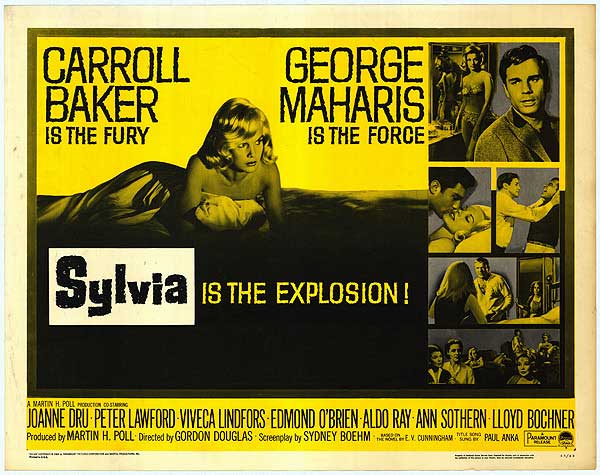
'Sylvia's' poster sums up the stars' shortcomings: Baker is more flat than fury, and Maharis is hardly forceful.

Over the opening credits, jigsaw puzzle pieces of Sylvia’s face are juxtaposed with the richly romantic title ballad by David Raksin, who composed the standard, ‘Laura.’ The problem is that Sylvia came 20 years after Laura, and despite some “daring” ‘60s plot points, it feels dated compared to timeless Laura.
The hokey but highly watchable Sylvia begins when private eye Alan “Mac” Macklin (pretty George Maharis) is summoned in secret to the estate of millionaire Frederic Summers (puffy Peter Lawford). The sinister Summers rolls out his request Mission Impossible-style, complete with home movies, photos, and documents. He wants a major background check on his bride-to-be, Sylvia West (platinum pretty Carroll Baker). The groom has found out that West, a poet and heirloom rose gardener, was not an orphan raised by wealthy relatives in England. Since the 1965 prospective groom can’t just Google or stalk Sylvia on social media, he needs Mac to track down her back story.
Maharis' private eye accepts a mission from Peter Lawford's millionaire, here in his cardigan sweater period.

Mac accepts this mission, and with the help of a handwriting expert and a pompous poet, the detective discovers that Sylvia was not from England, but plain old Pittsburgh. Mac follows leads, from person to person, in the tragic trajectory of Sylvia’s sordid life—starting with Sylvia West once was Sylvia Karoki, from an immigrant slum family. What makes the series of vignettes so watchable is the stellar veteran cast, ranging from over the top to touching, all giving their best shot in their limited screen time.
Viveca Lindfors gives the best performance in 'Sylvia,' subtle as the librarian who first knew the title character.

First up, is Viveca Lindfors as Irma, the possibly lesbian librarian who takes a shine to Sylvia. Lindfors gives the film’s best performance, heart touching without hamming. Irma rhapsodizes over Sylvia’s love for learning and beauty. In the first of endless flashbacks, Lindfors gives a lovely introduction of her first meeting then early-teen Sylvia at the library. Lindfors lilting recollection of Sylvia saying, “I want a book, I want a book…” is soon deflated by Carroll Baker’s flat reading of “I wanna book.” We are treated to 34-year-old Baker in a pinafore and a long Goldilocks wig, photographed in soft, golden light that pinafore-loving Jennifer Jones or Ginger Rogers would pine for. In her scenes as an early teen, Baker is mostly posed kneeling or lying down. Later, we see her at Irma’s apartment, inquiring about a bouquet in a deadpan voice, “Are these real?” This sums up the biggest problem with Sylvia, and that is Carroll Baker. There’s nothing enigmatic, empathetic, endearing, etc. about Baker. Carroll’s Sylvia comes off as charmless for most of the movie.
Carroll Baker as early teen 'Sylvia.' Uh huh.
The first rape scene in 'Sylvia.'


In Gordon Douglas’ solid but by-the-numbers direction, he actually has Lindfors’ Irma ask, “Would you like me to show you where the story began?”
After watching some nice LA and Pittsburgh location shooting, we are then shown a patently phony soundstage slum where you half expect the Dead End Kids to drop by. This leads to a flashback where Sylvia’s drunken stepfather (Aldo Ray) catches her with lipstick that Irma gave her. Accusing her of taking gifts from men, to Sylvia’s vehement denials, he responds by violently attacking and raping her.
My advice to any young girl is to stay away from a guy who drives a vehicle painted "Peter the Healer!"

Young Sylvia walks out of her tenement apartment into the night, changed forever. As she clings to a post, what does she see? Salvation is literally just across the street, complete with huge painted messages on their windows, run by—seriously—Peter the Healer! Pervy Peter promptly gloms on to Sylvia and takes off with her in his Peter Mobile, also painted with holy warnings, like “Sin No More.” Of course, in this sleazy melodrama, it’s more like, sin some more!
A holy man 'Sylvia' can truly trust! Don't worry, Baker's hair becomes increasingly bigger as she claws her way up!

Mac finds out from Pittsburgh police that the pair ended up down in Mexico, with Peter pimping Sylvia out in her new trade. So, Mac heads south of the border, where he comes upon a holy man who actually helped Sylvia. For some insane reason, the hooker feels obligated to the now-deceased Peter and wants to give him a proper funeral. The priest, like everyone else who comes into contact with Sylvia, is taken by her humanity, love of learning and beauty, and vulnerability. That she’s one hot mama is only noted by the bad characters. Once Peter is put underground, Sylvia moves on. One form of her evolution is constantly evolving hair styles, which telegraphs her lot in life: a shaggy waif, a lank-haired tart, a sleek slutty do, to full-glam hooker hair, to the classy coif of a poetess.  Her last name changes almost as much: Sylvia Karoki becomes Kay, Carlyle, and West.
What would you rather do, read poetry naked in bed, or make sweet love with Edmund O'Brien? 

Sylvia bids adios to Mexico, when her classy chassis catches a ride to New York with a middle-aged travelling salesman. And who better to play him than sweaty Edmund O’Brien? As Mac finds out, salesman Oscar Stewart was crazy about Sylvia. “I’m talking about marriage!” he tells Mac. He remembers every detail of their time together. He must be a masochist, because the flashbacks show him begging for crumbs of affection, with Sylvia dishing out curt rejections. You’re supposed to believe that the tough tart travels across the country with a man, for her “company” as her ticket to ride, and she won’t even give him a kiss? When he declares his adoration of her, Sylvia snaps her response, “Aww, shut up.” She’d rather read poetry, while lounging around nearly naked. Their baleful banter reminds me of tired waitress getting an unwanted customer at the end of her shift.
No, this isn't an episode of 'Bewitched.' Ann Sothern is good hearted tart Gracie, with Baker's 'Sylvia.'

From there, Sylvia’s saga is recalled by characters in the sex trade. Most memorable is Ann Sothern’s Gracie, a long-time employee at a “honky tonk arcade.” Good time girl Gracie adored Sylvia, now going straight. They end up roommates, where we are treated to Sylvia studying French, flowers, and the finer things in life. Gracie tries to help by hooking her up with old men with money. Sothern’s big scene comes when she milks Maharis’ Mac for a night of pricey drinks and dinner in exchange for the dish on Sylvia. Sothern is all dolled up in flouncy finery, falls, and false eyelashes. Not only does Sothern’s Gracie devour martinis and caviar, but the scenery as well. Sothern is over-the-top, but deliberately and delightfully so. It is great watching an old pro like Sothern put over this sentimental slop with gusto.
Even in 'Sylvia's' publicity stills, Ann Sothern is over the top!

Then it’s on to “Big Shirley,” a former hooker turned stripper who toiled with Sylvia while hooking at “Mother’s.” Big Shirley is delightfully played by Nancy Kovack, sporting most of her curvy figure and ALL of her comedic timing. Kovack has but one scene, but definitely makes the most of the stripper who’s too tall, wears glasses, and lousy with names. But memories of Sylvia jog her memory enough to send Mac on to the next acquaintance. 
Nancy Kovack as 'Big Shirley' displays more charisma and sex appeal in her one scene from 'Sylvia' than Carroll Baker does in the whole movie!

Then there’s Jane Bronson Phillips, another former hooker who “married a piggy bank,” as Big Shirley coins it. She is played by a no-nonsense Joanne Dru. After they are busted at Mother’s, Jane and Sylvia try to go straight, but their pasts keep popping up. BTW, “Mother” is played by the wonderful character actress Connie Gilchrist. Apparently her part was cut, because not only does she just have once scene, it’s in a long shot! But you’ll recognize that voice instantly, as the madam who’s in no mood for Sylvia’s snooty disposition. After getting fired from their latest legit jobs, Bronson becomes forever indebted to Sylvia when she is hit by a truck—again, don’t ask! Apparently, Sylvia and Jane bonded in jail, and she goes back to hooking, to pay off Jane’s huge hospital bills—what a gal. Again, Dru is another old pro who puts this schmaltz over.
Maharis' Mac with Joanne Dru as the hooker who made good.

This leads us to the final flashbacks. “The Colonial” is a swank bistro run by drag queen/pimp Lola Diamond, who’s dolled up like a latter day Debbie Reynolds. Diamond offers more tasty dishes than what’s on the menu. In her interview, Lola is impressed with Sylvia’s knowledge of what order to use fine dining silverware. Luckily, Diamond is no Professor Higgins, since when he asks Sylvia where she hails from, Baker answers in her most bored, nasal tone, “I was born in El PAAAH-so, by the BORRR-der.”
Heaven help the mister who comes between Sylvia and Lola Diamond!

Sylvia shows up for work to meet her first big spender, salesman Pudgey Smith, who makes Edmund O’Brien look like Clark Gable. Sylvia’s dressed to kill, with a hair flip that talk show gabber Virginia Graham would have killed for. Sylvia and Lola greet Pudgey, looking like a mother-daughter act!
Soon, Sylvia is paying down that hospital bill, when she meets her final client, classy Bruce Stamford III. He is played by Lloyd Bochner, unctuous as always, sporting his standard slick hair and ascot. Bruce shows bookworm Sylvia a tome with lots of pictures of what he’d like them to try. When she refuses, Sylvia is raped once again. This time, Sylvia turns the tables to her advantage, and is given a bundle of hush money. Jane’s “piggybank” parlays this into a nest egg for Sylvia, allowing her to finally give up hooking and pursue her dream of poetry and culture. Talk about graduating from the school of hard knocks.
Was Lloyd Bochner born with an ascot? Forever Cecil Colby to me, here he's sicko rich guy Bruce Stamford III. 

When Mac gathers all this convoluted info and heads back to California, he is torn: report the facts or say there’s no story? Despite her past, Mac’s enthralled with Sylvia, without ever having met her.
When they finally meet—at his favorite bookstore—Mac’s truly smitten—and so is Sylvia. The ending is really anti-climatic, but also remarkable, as Sylvia finally gets her happy ending, but isn’t require to suffer for her past sins, as was usually the case in old movies.
"Is this movie over yet?" Once 'Sylvia' and Mac meet and fall instantly in love, there's nowhere for the story to go.

As Mac, George Maharis is handsome, perfectly competent, and possessed a brash charm. But like many actors who left a hit TV series to become a big movie star, for every Clint Eastwood and Steve McQueen, there were far more Richard Chamberlains and  David Janssens. All solid actors, but without the luck, right vehicles, or “it” factor that separated the popular stars from bonafide superstars.
Carroll Baker's 'Sylvia' and her hair at the height of her call girl career!

As Sylvia, Carroll Baker was in her mid-30s, but still cheerleader pretty and sporting a trim figure, and looks terrific in her tight frocks. The movie, in typical Hollywood style, makes a point to give Sylvia’s age as nearly a decade younger than Baker’s actual age. Though Carroll’s supposed to come off as standoffish, there’s no underlying vulnerability that is the true Sylvia. There are moments, but Baker doesn’t make much of them. During her Hollywood heyday, Baker could be effective, but was undercut by her curt, petulant manner and a voice that was more than a bit like Alice Kramden of The Honeymooners. Baker is better in the later, less dramatic moments with Maharis, when Sylvia is a successful poet.
"Sylvia" is the rare mid-century movie prostitute who gets a happy ending. No suicides or car crashes for her!

Carroll Baker’s tenure as a Hollywood star lasted less than a decade. After she broke through with Giant and especially the once scandalous Baby Doll, Baker was the sexy star who studied at the Actors Studio. What followed was more misses than hits. Baker left WB after constantly fighting for better roles. In 1964, Baker signed with producer Joseph E. Levine at Paramount. Levine decided to give Carroll the big build up as a sex symbol, to replace the recently deceased Marilyn Monroe. Since half of Hollywood was trying to do just that, this should have been a red flag. What made it all curious was Carroll Baker had already been kicking around Hollywood for nearly a decade, and now approaching her mid-30s, Levine was going to make her a sex bomb? In Hollywood, young starlets are given the sex symbol buildup, and once established, aim for respectability with serious roles. Baker was going backward! Carroll was getting the sex bomb reboot when most of her contemporaries were starting to downsize or depart showbiz. Where was all of this supposed to lead? And Carroll Baker just didn’t have the resume of an Audrey Hepburn, Elizabeth Taylor, or Shirley MacLaine as a bargaining chip.
With 1964’s The Carpetbaggers, Baker was her last big hit that also got wretched reviews. And 1965 was her last year in Hollywood, with four dud movies: Harlow, Sylvia, Mister Moses, and The Greatest Story Ever Told. Baker bailed from Hollywood, fighting Levine in a lawsuit to exit her contract. Carroll Baker then worked steadily in Europe and later came back to Hollywood as a respected character actress.
The preposterous plot of Sylvia can either enthrall or gall you, but the stellar supporting cast more than makes up for the shortcomings of the movie’s two stars. Sylvia is Hollywood hokum at its worst, but a guilty pleasure of the highest order.
As of 3/28/19, there is a great copy of Sylvia here: https://ok.ru/video/572813019792


The pieces may not fit, logic-wise, in 'Sylvia,' but it's still fun to watch George Maharis put them together.