Showing posts with label Paul Newman. Show all posts

Monday, January 30, 2023

Stars, Style, & No Substance! ‘What a Way to Go!’ 1964


Shirley MacLaine stars as Louisa May Foster, who marries and loses most of her
 five husbands in 1964's comedy, "What a Way to Go!"


One of the many '60s all-star spectaculars that was heavy on stars and style, but light on solid story or scintillating dialogue, was 1964’s What A Way to Go! Movies like this are often fun for star gazing and glamour. Yet such films are often dull and don't age well, and here’s just a few: Let's Make Love, The V.I.P.s, The Yellow Rolls-Royce, and What's New, Pussycat?

Shirley MacLaine's widow tells shrink Robert Cummings about EVERY husband
in "What a Way to Go!"

This 20th Century Fox fluff is a comedic story of a woman who’s looking for true love but is always left widowed—and richer. Money doesn't buy happiness, but it brings 70-plus Edith Head costumes, Sydney Guilaroff wigs, Harry Winston jewels, and fabulous sets in What a Way to Go! The featherweight romp also features some diverse husbands: Dick Van Dyke, Paul Newman, Robert Mitchum, Gene Kelly, & Dean Martin. 

The super-size comedy was originally meant for superstar Marilyn Monroe, when Fox decided to take Marilyn back after Something's Got to Give. Marilyn certainly could have elevated this mild vehicle with her natural comedic charms. But it was not meant to be, as Marilyn died soon after. Continuing in the same daft logic, Fox then offered the role to their other diva headache, Cleopatra aka Elizabeth Taylor. The part of a woman who marries five times and becomes richer, with bigger wardrobe and bigger hair with each marriage... what a stretch! But ET’s world now revolved around Richard Burton.

Can't imagine why Fox offered this movie to Elizabeth Taylor! Actually,
Robert Cummings plays the shrink in "What a Way to Go!," not a husband...

The sensible choice of Shirley MacLaine as Louisa May Foster was finally made. Was MacLaine as a brunette here a hangover from the prior choice of Liz? Regardless, while Shirley presents a model slim figure that was more in keeping with the '60s than either curvy MM or ET, MacLaine seems at times dwarfed by the outlandish costumes, towering wigs and Christmas tree jewel sparklers.

Naturalistic Shirley MacLaine & '60s glamour didn't seem to go together.
Note the pancake makeup on her face, then her freckled arm in "What a Way to Go!"
With Robert Mitchum as her tycoon husband.

While MacLaine is a natural comedic actress, a strong director like Billy Wilder was needed to keep her from going from Shirley to shrilly. There's more than a few screaming Mimi moments in this broad comedy, but MacLaine also gets some laughs. It's fascinating to see her play the child Louisa with a wink, without the '60s pancake foundation, false eyelashes, stenciled brows, and overdrawn lipstick—though I do detect mascara. 

Shirley MacLaine as little Louisa in an amusing moment from "What a Way to Go!" 

Most of Shirley MacLaine’s co-stars were old pals or lovers, so Shirley has a nice rapport with each "husband" in What a Way to Go! In a nutshell, in order:

Dick Van Dyke is a very energetic match for Shirley. As Edgar Hopper, Dick is a small-town guy whose hero is Thoreau. But when his love rival mocks his and wife Louisa’s low-budget lifestyle, Hopper hops to, and becomes a big success as a businessman. And promptly keels over from overwork!

Dick Van Dyke as Shirley MacLaine's first husband in "What a Way to Go!"

Paul Newman is next up, as the artist in Paris, where Louisa goes to grieve. Paul gives one of his more relaxed comedic performances, unlike the leering Rally Round the Flag Boys and A New Kind of Love. Amusingly, his character’s name is Larry Flint, but not that Larry Flynt. Paul looks great with a beard, as the starving artist who's always eating! Slim and slight Paul and Shirley are dwarfed by the lavish contraptions and sets in their marital sequence. As Larry’s painting machines finally create successful works, Flint is consumed by the cash rolling in. As he and the machines become more frenzied, they turn on their creator.

Shirley MacLaine's Louisa seems to adapt to each husband's life.
Here, she is Paul Newman's artist wife in "What a Way to Go!"

Next, widowed again Louisa meets Robert Mitchum as a Howard Hughes-type tycoon, Rod Anderson, Jr., at the airport (remember Hughes once owned an airline). MacLaine’s unlucky in love lady figures this latest love is already rich, so what can happen? Ironically, their attempt at living simple down on his farm turns out to be a kick in the head for Rod. Mitchum is laid-back and droll, as always.

I never miss a Nina Foch movie! Kidding! Shirley MacLaine goes platinum for a
hot minute in "What a Way to Go!" With hubby #3 Robert Mitchum.

Shirley’s perennial widow meets Pinky Benson at a local diner. Gene Kelly parodies his Singin’ in the Rain persona here as the small town entertainer, who finally makes it big. Though criticized by some folks as too old, Kelly looks fine for 50, is quite funny, and dances beautifully, of course. Pinky’s fate is getting fatally mobbed by his fans!

Shirley MacLaine's Louisa envisions her marriage to Pinky Benson as a Hollywood musical number. Gene Kelly, aptly cast as hubby #4 in "What a Way to Go!"

At this point, once again widowed Louisa is telling her woes to her shrink, when an old beau walks in. Once her small town’s richest guy, the man is now the building’s janitor! Dean Martin plays comedic jerk Leonard Crawley quite well, and his nonchalant demeanor is perfect here. As the one husband that Louise doesn’t initially love, the creep turns out to be the keeper.

Dean Martin bookends "What a Way to Go!" as first a foiled suitor, then as
Shirley MacLaine's final husband.

Finally, there is Bob Cummings, his usual unctuous self as the smarmy shrink who nearly becomes a husband to Louisa, as well.

One surprise was Margaret Dumont, of the Marx Brothers movie fame, who is bizarre and unfunny as Shirley's mother. Plus, Dumont’s dressed like she’s from a guest shot on The Beverly Hillbillies!

The Edith Head costumes and the sets are meant to be over the top but sometimes veer into awesome ugliness. Head cleverly uses the clothes to further Louisa's story, but I was surprised how many costumes were visions of monochromatic vivid colors. I was getting visions of Liz Taylor's Vincente Minnelli-supervised wardrobe in The Sandpiper. And the Pepto Bismol pink mansion of Gene Kelly’s Pinky is truly stomach churning.

Husband Pinky Benson decrees that his mansion be painted in his honor, in
"What a Way to Go!" Wafer slim Shirley MacLaine sports a contrasting black bikini.

Broadway’s Adolph Green and Betty Comden, the couple that wrote this story, also gave us Singin' in the Rain and Auntie Mame. Sadly, their script and wit seems very broad and sporadic in their last feature film together.

There are few zingy lines and most of the movie parodies of each marriage are mildly amusing, except the Ross Hunter-esque "Lush Budgett" sequence, which is so one-note that it quickly becomes tedious. The musical number with Gene Kelly is a great take off on MGM numbers, and still fun in its own right. Shirley and Dick Van Dyke’s expressive faces and graceful forms make their silent movie spoof fun. And Paul Newman and Shirley are certainly sexy enough in their French “art” film parody, though it’s pretty tame.

Shirley MacLaine & Dick Van Dyke are charming in the silent movie fantasy scene that symbolizes their marriage in "What a Way to Go!"

The director J. Lee Thompson was an odd choice for comedy as he previously helmed The Guns of Navarone and Cape Fear. He next directed Shirley in the 1965 bomb John Goldfarb, Please Come Home! Written by William Peter Blatty, who rewarded his friendship with Shirley by modeling her for his heroine in The Exorcist, thus creating the urban myth that MacLaine's daughter needed an exorcism!
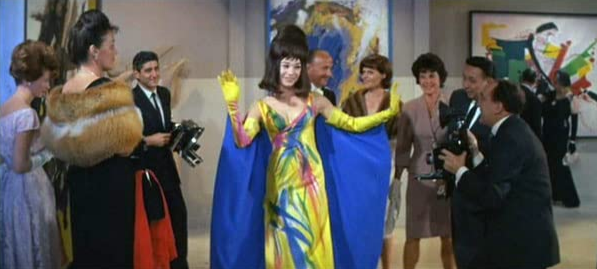
Shirley MacLaine's Louisa in wearable art, courtesy of artist husband Paul Newman
 in "What a Way to Go!"

While I hardly laughed out loud during the entire movie, What a Way to Go! is generally amusing. But it all feels like a pile of frosting—on a cupcake! Shirley MacLaine didn’t carry another hit movie until The Turning Point over a dozen years later. Even then, Anne Bancroft was pulling equal weight. Frankly, Shirley never carried a movie on her own during MacLaine’s leading lady heyday.

There are worse ways to go than watching What a Way to Go! Watch the stars and lavish production, with your brain turned off.

Actress Gari Hardy with Paul Newman, in a deleted scene from "What a Way to Go!" Is it my imagination or is she supposed to resemble Marilyn Monroe? If so, that seems in bad taste as this film was intended for Monroe, before she died two years earlier.


Tuesday, August 17, 2021

Redford & Newman’s Star Power: “The Sting” 1973


Paul Newman & Robert Redford re-team for their greatest hit, 1973's "The Sting."


I hadn't seen The Sting again since it was released, back in Christmas of ‘73. I was a young teen when the smash con man caper finally came to my Upper Michigan town’s theater later that winter. Ironically, the only thing that I remembered now about The Sting is the super sting finale.

During the first half of the '70s, the nostalgia boom was in full bloom in movies, TV, theatre, and music. I think about half of the movies from Robert Redford during the mid '60s and early '70s were period pieces! The Sting was the biggest hit for stars Paul Newman and Robert Redford, even bigger than Butch Cassidy and the Sundance Kid. Part of it was that audiences had loved their teamwork from four years before. Also, people were tired of inflation, Vietnam, and Watergate. Most of all, while The Sting is total cinematic fluff, it was also an extraordinarily well-crafted confection.

Robert Redford & Paul Newman seek elaborate $$$ revenge in 1973's "The Sting."

Deftly done on all counts, The Sting has a clever story, fine acting, stylish production and costumes, and a great score of Scott Joplin music, adapted by Marvin Hamlisch. Watching it again in the summer of '21, The Sting still has snap.

Recall this great art work? The music of Scott Joplin was rediscovered in "The Sting."

The Sting was a coup of an Oscar win for George Roy Hill as director, against a diverse group of nominees: Ingmar Bergman, Cries and Whispers; Bernardo Bertolucci, Last Tango in Paris; William Friedkin, The Exorcist; and George Lucas, American Graffiti. This was Edith Head's 8th and last Oscar win, who accepted by saying that The Sting was her dream assignment, dressing the two most handsome men in the world.

Snapshot of designer Edith Head with Robert Redford, from "The Sting."

Robert Redford has only been nominated once for Best Actor Oscar, for The Sting, which is a bit surprising in itself. And while Johnny Hooker is one of his warmest leading man performances, Redford really should have been nominated for his more in-depth performance in The Way We Were that same year. James Caan, who was shut out for one of his best performances—Cinderella Liberty—snarked at the time that Robert Redford got nominated for being cute!

Robert Redford's big year was 1973, with "The Sting" & "The Way We Were."

Paul Newman, as veteran conman Henry Gondorff, eases into his star character actor era here, and loses some of his studied cool and mannerisms from the '60s. Almost 50, Newman is also quite the silver fox here. As Henry, Newman finally seems naturalistic as an actor, and not so posturing as his previous anti-hero era. Newman’s laid-back humor also felt more organic than in past heavy-handed attempts, as in Harper. Need I really point out that Newman and Redford have a great screen rapport?

Paul Newman, moving into his star character actor era with ease, in "The Sting."

The story was based on two real-life brothers that David S. Ward was inspired by, from David Maurer’s 1940 book The Big Con. Ward claimed he used a number of sources in his research, was upset by the charges of plagiarism, and didn’t want Universal to pay out. The studio was already citing the book in its movie promotion and it didn’t help that Ward named Newman’s character after the last name of the con brothers Maurer wrote about. Universal quickly settled. TV writer/producer Roy Huggins later noted that The Sting also borrowed plot elements from a classic episode of his Maverick series: “Shady Deal at Sunny Acres.” This isn’t to take away from Ward’s tight, zingy script, but why is it so hard for Hollywood talent to give others credit where it’s due?

Robert Redford, as the con man whose biggest con is nearly complete, in "The Sting."

The Sting made a fortune and was a real feel-good picture—but an Oscar winner for Best Picture? Well, far lesser films have won and who says that Oscar winners have to be dramatic, groundbreaking, etc. Sometimes Oscar-winning films and performances can just be entertaining!

The Sting boasts a terrific supporting cast all the way down the line. With two beautiful leading men to compensate, Hill’s cast looks like an idiosyncratic cast from an old Warner Brothers movie. Robert Earl Jones (James’ father!) resonates warmly as Redford’s first partner in crime, who gets rubbed out by heavy Doyle Lonnegan, which sets in motion the elaborate plot of Hooker and Gondorff’s revenge. And as Lonnegan, with his icy blue eyes and barely controlled fury, Robert Shaw makes a masterful villain. Charles Durning, Dana Elcar, Harold Gould, and Eileen Brennan lead a marvelous supporting cast, perfectly evoking a previous movie era. A special shout out to Ray Walston, who is colorful but restrained, perfect in small doses as J.J. Singleton.

Robert Shaw makes a very good villain that gets played, in "The Sting."

George Roy Hill, who often directed period films, was meticulous in creating the movie’s style. Hill wanted it to look like a ‘30s movie. And this was one of the first films to actually do so, when ‘60s period TV shows and movies regularly mixed past and current day styles, often looking absurd. To that end, Edith Head’s costumes lent themselves to the sets and movie’s hues. Art director Henry Bumstead mussed up Universal’s back lot and made it look realistic. Robert Surtee’s cinematography is lovely, with a rosy glow to suggest a past era. Jaroslav Gebr’s beautiful title cards that preceded each vignette suggested classic magazine covers by Norman Rockwell.

At nearly 50, Paul Newman is the silver fox in 1973's "The Sting."

And though Scott Joplin’s music was no longer in vogue by the mid-30s, director Hill felt the jaunty ragtime music fit the feel of the movie’s story. Marvin Hamlisch got Oscars galore that year, for both The Sting and The Way We Were, films which were also good to Redford.

The Sting is the ultimate movie-movie. If you’re looking for fine, fun entertainment to take your mind off the woes of the current-day world, escape to the charming conmen and the creative artistry of The Sting. 

Robert Redford hit his stride as leading man in 1973's "The Sting."

For Redford’s other big hit of 1973, here’s my look at The Way We Were:

https://ricksrealreel.blogspot.com/2016/08/robert-redford-and-barbra-streisand.html

FYI: I put all the movie overflow on my public FB  movie page. Check it out & join!  https://www.facebook.com/groups/178488909366865/

The stars of "The Sting," captured in the 1973 film's beautiful title cards.


Monday, January 25, 2021

Paul Newman as 'Harper' 1966


Paul Newman as 'Harper,' private eye, posing by his shingle.


Opinions vary about the ’66 neo-film noir, Harper. A number of film fans and critics think it’s a latter day detective classic. Others, like me, just find it a slickly entertaining Paul Newman picture.

Paul Newman's gumshoe sure spends a lot of time in his car or on the phone.

In the ‘60s, genre films were increasingly made with a mod wink at old-time Hollywood—in this case, detective movies. Harper was the brainchild of agent turned producer Elliot Kastner, whose greatest talent was pairing great stars with their cheesiest vehicles. This was perhaps Kastner’s best effort: take Ross Macdonald’s first Lew Archer novel, 1949’s The Moving Target, and riff on the ‘40s film noir era. How he got Harper off the ground is beyond me, when his only previous producer credit was Bus Riley’s Back in Town. Here’s Kastner’s IMDB resume of mostly rubbish: https://www.imdb.com/name/nm0440990/?ref_=nmbio_bio_nm

Ironically, Harper now feels more dated than the original movies it tweaks. Harper’s trailer and poster paint him as modern and irresistible, but the promo material feel like they’re for an old Playboy magazine cover.

The promo copy for 'Harper' tries for cool, but today just seems coy.

There's plenty of elbowing the old gumshoe movies: Detective Lew Harper tells the barracuda wife of the missing millionaire that he's a “new type.” New, maybe—but not better. Newman led the way as the new breed of movie anti-hero, a trend I think didn’t age well, either. At 40, Paul as Harper often feels more like an over-aged frat boy, as opposed to the equally cynical, but more worldly-wise Philip Marlowe, Sam Spade or other past film detectives.

The first client visit for 'Harper' deliberately echoes Lauren Bacall's 'The Big Sleep,'
 with hubby Humphrey Bogart as Philip Marlowe.

William Goldman's script has a number of zingers. His take on mid-60s California dreaming is more like a noir nightmare. It’s funny at times, but they’re all easy targets: new age religion, druggie jazz singers, crooked lawyers and dumb cops, rich people trying to buy their way out of trouble, etc. There's not a relatable one in the bunch—least of all Harper, who is crude with suspects, and also a juvenile jerk to his lovely ex-wife, as well. I realize I’m looking at a ‘60s movie through modern eyes, but this movie is even less evolved than the movies it’s mimicking from 20 years prior.

Lauren Bacall is a catty client, whose snarky repartee is definitely not decaffeinated!

You could say the film has a sexist view toward women, as they are all mercilessly mocked for their shortcomings, but the men don't fare much better. The nearly all-star cast is mostly typecast: Lauren Bacall as the missing rich man's wife, is a snarky bitch; Shelley Winters as a former movie star gone blowzy is treated with particular contempt by Harper; Pamela Tiffin is the young rich chick on the make. However, Julie Harris is oddly cast as the junkie jazz singer who is also treated rottenly by Harper.

Shelley Winters played more latter-day blowsy broads than Joan Blondell! 

Bacall and Winters do their schtick very well. This is an era where Bacall's character is mocked as old and wrinkled at age 41, when Harper was filmed—and a whole year older than Paul Newman. Lauren looked quite timeless and chic as the rich super bitch, IMO. However, Shelley Winters is outrageous as the horny and drunk ex-star, and seems to be Harper’s walking punchline.

Pamela Tiffin, as the rich client's sexy stepdaughter, isn't exactly Ann-Margret!

Pamela Tiffin is all big hair and apple-cheeked, and dances quite badly on a pool board in a polka dot bikini. Tiffin mainly pouts and preens. Julie Harris sings a few bars of yet another Andre and Dore Previn movie theme about being lonely.

Julie Harris is the junkie jazz singer who's too high-strung for torture games.

As for the men, Robert Wagner plays his charming pretty boy bit for good-natured humor, his only real talent. At 35, RJ's on the edge of his beauty, which is what Newman calls him throughout. As the new age nutjob, Strother Martin has a field day, up in a mountain top home that looks like a low-rent version of Liz Taylor's pad in Boom! 

This was the last time Robert Wagner could get away w/playing the shallow pretty boy.

The two best performances are Arthur Hill as the family lawyer who is in love with Tiffin’s rich girl. His lovelorn lawyer gets to go through some changes and plays them skillfully, with a tinge of melancholy. Janet Leigh as Harper’s rightfully exasperated ex-wife makes her few scenes count.

Arthur Hill plays the most realistic character in 'Harper,' as Newman's old pal,
who is now the family lawyer for the kidnapped man.

Harper runs just over two hours, too long for this fast-paced genre, and it drags in spots. The subplot involving Harper and his ex-wife is supposed to show how he's unable to give up a thankless job that doesn't love him back. From today's standpoint, Harper’s interactions with his ex make him look a dick, and I don't mean a private one. The scenes that are supposed to be funny aren’t and the one where Harper barges in on her late at night for a booty call and sympathy, only to ditch her the next morning, doesn’t age well.

Newman's Harper lets his ex down not so easily after a late night visit. W/Janet Leigh.

For anybody who feels that I’m too hard on Harper, I was expecting to love this movie, as mystery/suspense is one of my favorite genres. I also love films that depict an era or locale. This movie feels very ‘60s, but not in a good way, just a mainstream, dated way. One example: the hip music that plays in any scenes with young people sounds like Herb Alpert-style elevator music. And the young folks dancing hip looks like the Peanuts characters when they dance for joy.

'Harper's' spoof of the cool kids is strictly Squares-ville!

What about Harper himself, Paul Newman? At this point, Paul had loosened up as an actor, from his sometimes stiff ‘50s stardom. In his quiet, serious moments, Newman is on his way to the stellar star character actor he later became. Yet, his anti-hero stardom here came with his sometimes heavy-handed sense of humor. A stronger director other than journeyman Jack Smight would have reigned in Paul’s smirking, eye-rolling, lip-pursing, voice-mimicking “humor.” 

Paul Newman as Harper cracks himself up constantly, with his amused contempt
for the crooked characters he encounters. It feels a bit sophomoric today.
 

William Goldman, considered one of the best screenwriters and go-to script doctor, scripted many crowd pleasers like this movie. He was a bit like Robert Towne in that regard. Yet, Towne wrote a modern film noir that actually had depth and resonates just as much today—1974’s Chinatown.

Harper’s finish was one of those mod freeze frame non-endings that made me want to throw something at the screen. Harper wasn’t new, but just a mixed bag.

Paul Newman was 40 when 'Harper' was filmed.

Check out my take on Paul Newman’s early forays into southern melodrama from 1958:

The Long, Hot Summer: https://ricksrealreel.blogspot.com/2017/08/the-long-hot-summer-long-but-not-so-hot.html

Cat on a Hot Tin Roof:  https://ricksrealreel.blogspot.com/2016/08/cat-on-hot-tin-roof-still-scorches-now.html

FYI: I put all the movie overflow on my public FB  movie page. 

Check it out & join!  https://www.facebook.com/groups/178488909366865/


"Harper" was going to be called "The Moving Target,"
from the original Ross Macdonald book, for a hot minute.


Sunday, January 14, 2018

Ava Gardner Faces 50 in Style with 'Roy Bean'

John Huston w/favorite leading lady, Ava Gardner: "The Life & Times of Judge Roy Bean."


The opposing anecdotes ahead are about Ava Gardner, on location for 1972’s The Life and Times of Judge Roy Bean. They have always stuck in my head, from an excellent book, The Hustons: The Life and Times of a Hollywood Dynasty, by Lawrence Grobel, published in 2012.
The first is by Dallas’ Victoria Principal, talking about her film debut as Roy Bean’s (Paul Newman) wife. The second is by screenwriter/director John Milius, and this film was his first big screenplay.
#1: “We had a small dinner for her (Ava) and she was over two hours late,” Principal recalled. “She arrived in white jeans and a white shirt that fit her magnificently. And she didn’t walk into the room, she came in like a cat. I have never seen a woman move like that or have that kind of presence, before or since. I have never seen a woman electrify a room sexually like she did. You were aware that she was on the prowl.”
#2: “She (Ava) got drunk,” Milius said. “and got angry at everybody, broke some glasses and stormed off into the desert. I was to go get her and bring her back but I didn’t want to deal with this predatory woman. Looking back, I wish I had. But she was old. There is something about people when they age and look like they have been rebuilt. It was very unappealing.”
Ava was near the end of her partying days, as was
Newman. Remember when the press bragged how
he drank a case of beer a day and still looked great?

These memories are about a film from over 45 years ago, but the quotes are recent. They point up the basic difference between the way men and women view female desirability, but also how older women are still viewed in Hollywood. Look at the pictures that go with this piece. Yes, the film stills are flattering and the artists did a great job recalling Ava’s famed beauty. Now look at the candid shots on the set. Does Ava look awful? To me, she looks like a beautiful middle-aged woman. I’m constantly shocked when watching 40-something female stars in ‘50s and ‘60s movies—they always seem to look a decade older. I mean, Angela Lansbury looked older in Manchurian Candidate than she did 20 years later in Murder, She Wrote! Why? Aside from differing lifestyles, classic era actresses didn’t have the option to indulge in modern cosmetic surgery and fillers starting at age 30!
It’s ironic that young hotshots like Milius, some who openly bragged they were going to bury the old cigar-chomping, starlet-squeezing moguls, turned out to be just as ego-driven, sexist, and ageist as the previous generation. And I guess we’re finding out that decades later, things still haven’t changed all that much. I also wonder if Milius knew that Roy Bean’s Paul Newman was only three years younger than “old” Ava.
Ava at her MGM magnificent.

When I was going for my bachelor’s in the mid-90s, I was in a Spanish class taught by this outrageous woman who grew up in Spain. We had to create a sentence to say, describing something or someone as beautiful. I used Ava Gardner as an example. A young girl piped up, “Who’s Ava Gardner?” And my teacher answered that Ava was a very beautiful actress and had run through many bullfighters, and they had run through her! Touché!
Hollywood’s original wild child, Ava Gardner made more headlines than movies from the mid-60s on. In a long-ago Ava biography, I remember how “concerned” everyone was over what kind of shape she was in, for her role in The Life and Times of Judge Roy Bean. Gardner’s figure was in good shape and pal Edith Head designed a lovely early 20th century frock for the star. But her face… had… wrinkles! Ava used the usual temporary tricks for film work, but never went the plastic surgery route, from what I’ve read. Artfully made up, the cinematographer used the same special lens on Ava that was recently used on Mae West in Myra Breckinridge—who was 30 years older! Let’s just say the results were a bit more successful on Ava.
Ava makes her entrance at the end of 'Roy Bean.'

I recall thinking, reading about Ava as a ‘70s teen, did studios freak out about what kind of shape aging male boozers reported for on a picture? William Holden comes to mind, as does Lee Marvin. How about Richard Burton, Peter O’Toole, Richard Harris, and Oliver Reed? Weathered faces or no, their leading ladies faces were still young and pretty. Rock Hudson told a story about how intimidated he was to work with John Wayne on The Undefeated—until he saw the Duke getting smeared in tan makeup, and fitted with his toupee and girdle. Do you think anybody worries about how Sean Penn is going to look when he shows up for a work? Is there an actress today who likes to work hard, play hard, and doesn’t care about wrinkles? If she exists, I can bet she’s not an American movie star!
Terry O'Neill took still photos on 'Roy Bean' & photographed Ava several times, declaring she was his kind of woman!

Ava was 50 when she agreed to appear in a cameo as theatrical star Lillie Langtry, as a favor to director and admirer John Huston. The movie’s title character is obsessed by the great beauty and his bar is a shrine to Langtry, though he never meets her. Gardner appears in the film’s final scenes, visiting the town named in her honor, 20 years after his death. This would put the real Langtry at 67 if she actually made the pilgrimage. Gardner shows what a natural actress she was, when Ava felt secure. Huston had previously directed Gardner in her greatest performance, as Maxine in Night of the Iguana. Ava has a great light touch here, amused, charmed, wistful, and worldly.

I finally got to see Ava’s five minute guest role in Roy Bean today. But I knew all the behind the scenes scuttlebutt around the film for decades. And it’s the kind of double-standard drama that’s still being played out in Hollywood today.
Today, Ava would be a sexy cougar. Back then, some young hotshots thought she was just old!