Showing posts with label RKO. Show all posts

Wednesday, January 4, 2023

Loretta Young Just Fine as ‘The Farmer’s Daughter’ 1947


As "The Farmer's Daughter," Loretta Young leads a fine cast in this 1947
romantic comedy: Joseph Cotten, Charles Bickford, and Ethel Barrymore.


In my sixth decade, I finally got around to watching the 1947 film The Farmer’s Daughter. I avoided this romantic comedy my entire movie watching life, thinking it silly and sappy.

While The Farmer’s Daughter is a total fairy tale, it is presented as such. The RKO comedy tweaks the premise, offering a wink at its "farmer's daughter" references, since Katie Holstrom is a Swedish Cinderella who makes good. The situations are totally unrealistic, but the dialogue and attitudes are surprisingly smart and forward-thinking for the era.

Loretta Young is "The Farmer's Daughter," who leaves her big family for the big city!

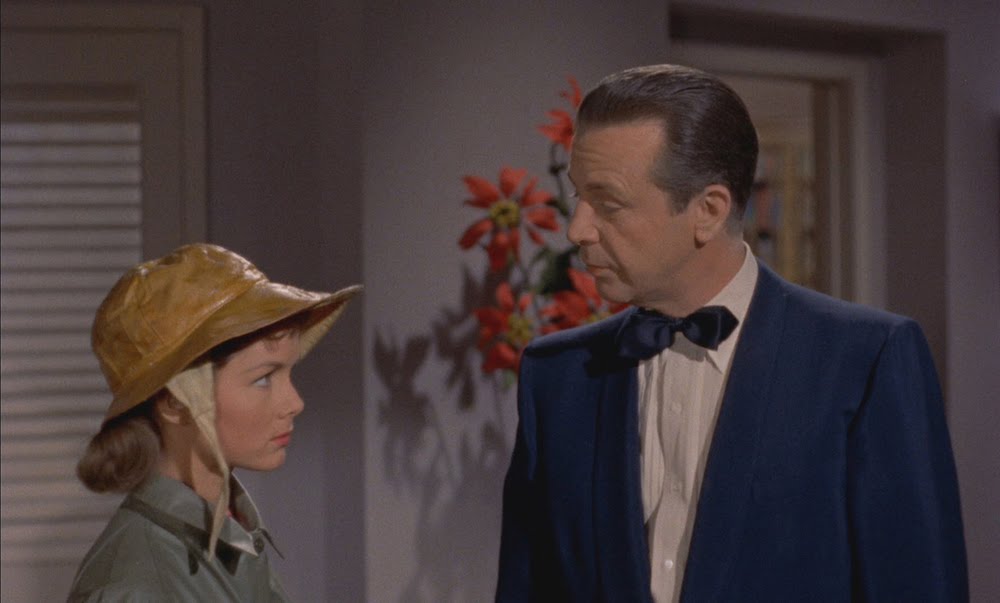
Young’s Katie leaves her farm home for the “capitol city” to become a nurse. The small town girl doesn’t even make it from the bus stop before getting conned out of her savings, by a boozy businessman. Katie finds work at the capital as a maid for the political Morley family. Her refreshing no-nonsense energy ends up charming the entire family, especially the politician son. Through a series of fanciful situations, Katie ends up running for congress! But there are a few bumps along the political stump before Katie Holstrom ends up a winner in every way.  
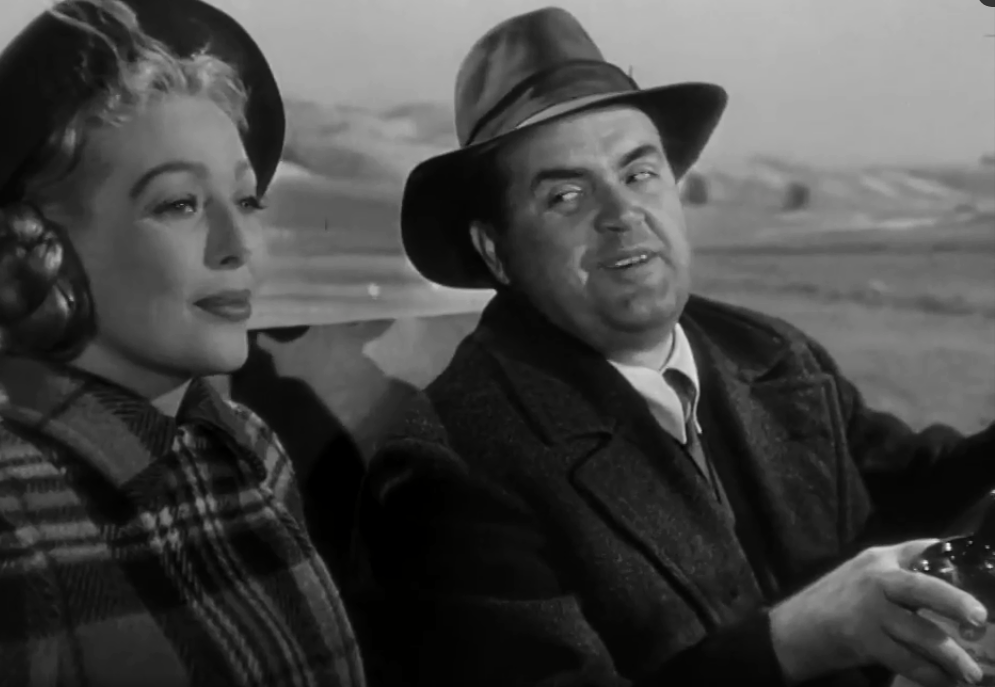
A bump in the road for "The Farmer's Daughter" is when she takes a ride from this bum!

There's a Frank Capra feel to this movie, with populist political attitudes spoon-fed with a bit of cinematic sugar. Message moviemaker Dore Schary produced this film, which may be the reason. It raises the modern eyebrow that a movie made over 75 years ago brings up the issues of a living wage, politicians paying more attention to their donors than constituents, mudslinging, etc. Some things never change!

Don't worry, this "Farmer's Daughter" doesn't dress in hand-me-downs for long!

The topic that always takes over The Farmer's Daughter was Loretta Young's surprise Oscar win in the title role. The consensus was that Rosalind Russell would win, also for RKO, with Mourning Becomes Electra. This was back in the day, when studios swayed their votes toward their own nominees. So, it was a shock that the studio didn't win for their favored nominee. As for the remaining noms, Joan Crawford waited 20 years since arriving in Hollywood to win an Oscar for Mildred Pierce two years before, so she wasn't gonna get a second one two years later for Possessed. Dorothy McGuire, a fine actress, wasn't even nominated for such recent roles in A Tree Grows in Brooklyn, The Enchanted Cottage, or The Spiral Staircase. Frankly, she only got nominated for her leading lady type role in Gentleman's Agreement because it was a "prestige" picture. That leaves Susan Hayward in Smash-Up: The Story of a Woman. Hayward got raves for her first nominated role, but perhaps the insider rumors that the film was a take-off on “beloved” Bing Crosby’s unhappy marriage to alcoholic Dixie Lee hurt her chances. Also, Susan waited as long as Joan to get her first Oscar. 

Loretta Young's surprise Oscar win overshadowed the charms of "The Farmer's Daughter."

That left Loretta Young, in the rare comedy performance that wins an Academy Award.  Was The Farmer’s Daughter an Oscar-winning performance? The short answer is no. But Young is in very good form here, playing with strength, spirit, and good humor as Katie. Her character is not the butt of jokes, and she perseveres and speaks her mind. A scene where Katie practices with a speech from the Morley family’s late senator to practice her English and public speaking is wonderfully done by a subtle Young.
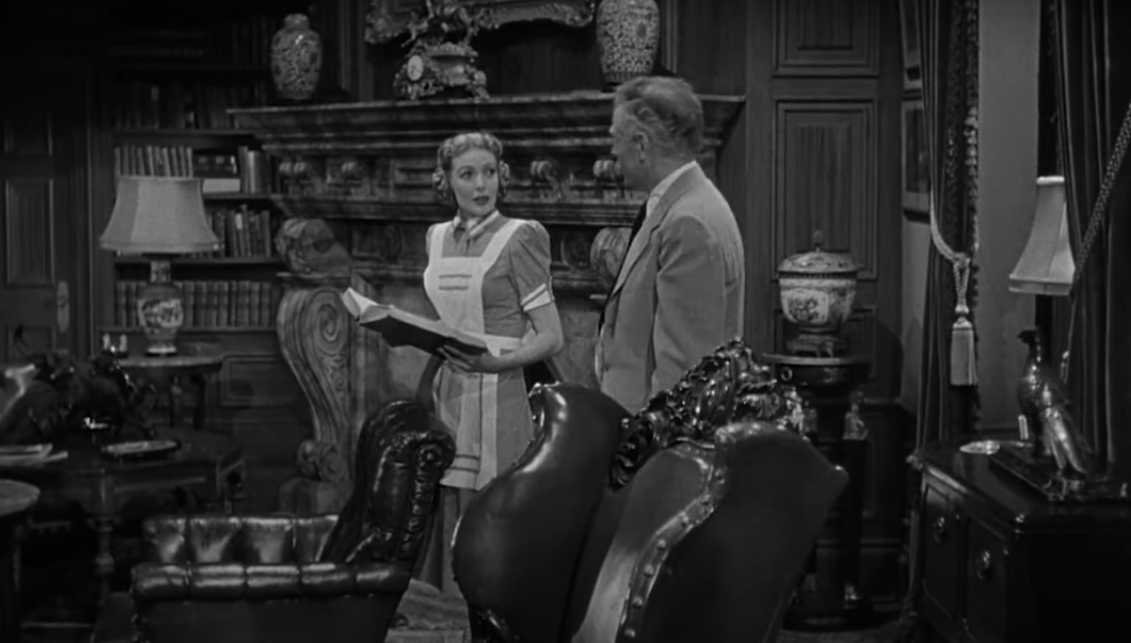
A lovely scene in "The Farmer's Daughter," when Katie reads the late senator's speech.

Though this not being a realistic style film, I wish someone would have asked Loretta to tone down her glamour mask a bit. Ingrid Bergman, the original choice as Katie, certainly would have, as she often did when playing non-glamour roles. When she's asked about her life on the farm, Young's farm girl describes her indoor and outdoor chores in close-up, which is amusing to think of her harvesting crops and livestock in full makeup! Loretta Young could have certainly dialed it back a bit without losing her allure. Loretta had the natural looks that are so coveted and created by cosmetic procedures today: huge cat eyes, full lips, and high, rounded cheekbones. Also, her modest wardrobe is quickly replaced with stylish, form-fitting Edith Head maid frocks and later political outfits.

"The Farmer's Daughter" is the best-dressed maid in the capitol city!

But Loretta Young’s comedic performance is played straight with no winks to the audience. Which makes her character even more endearing, and you will be rooting for her as she goes from farm girl to house maid to political candidate.

Joseph Cotten was underrated during his era as an actor. Often cast for his warm charm, he usually got his best notices when cast as the villain, like Shadow of a Doubt. But his style was very natural in an era when leading men were hyper-masculine, especially post-war when stars like Heston, Lancaster, and Douglas were intense and often anti-heroes. Of course, as Glenn Morley, the politician son from a political family, he is instantly taken by maiden Loretta, which is a bit icky by today's standards. But Cotten pulls it off. Cotten plays the romantic comedy aspect smoothly and is empathetic in the more serious moments.

Joseph Cotten makes a very appealing leading man in "The Farmer's Daughter."

Ethel Barrymore as Cotton’s political matriarch Agatha brings style and droll humor to her role. And Charles Bickford is cast in curmudgeonly mode as the family butler Joseph, who instantly takes to Katie, despite her high spirited ways. Cotton, Barrymore, and Bickford play off each other well as the political household. And they are all charmed in their own way by Katie, who has worked her way into their hearts.

Katie wins the day and election in 1947's "The Farmer's Daughter." Loretta Young
 with Joseph Cotten and Charles Bickford.

As Katie's brawny brothers, James Arness, Lex Barker, and Keith Andes supply the muscle. During the big brawl at the finale, James Arness was indeed a giant of a hero, stacking up the bad guys like fire wood.

As for Loretta's accent, the voice coach who taught Ingrid Bergman to lose her Swedish accent taught Young hers. As for Young's accent, while I'm no expert, it sounded fine without being distracting. Note that Katie’s brothers are accent-free except for a few “yahs.”

These are the brawny brothers of "The Farmer's Daughter":
James Arness, Lex Barker, and Keith Andes.

The naysayers of The Farmer’s Daughter will pick away at the fairytale plot, Loretta's accent, or the politics not being to their liking. Watched with an open mind, it's a charming, bright movie.

As "The Farmer's Daughter," Katie is plain-spoken and often outspoken!

For Loretta fans, inspired by a true story, here's 1949's 'Come to the Stable' stars Loretta Young & Celeste Holm as two nuns on a mission from God to get a hospital built. This comedy-drama can be looked at as a spiritual tale or Hollywood fairy tale. Either way, it has heart and smarts, with Young & Holm giving wholehearted performances, supported by a wonderful cast. My look at this highly entertaining movie about making dreams come true: 

Wednesday, December 7, 2022

Young Janet Leigh & Robert Mitchum in ‘Holiday Affair’ 1949


Janet Leigh, romanced by Robert Mitchum & Wendell Corey, 1949's "Holiday Affair."


Holiday Affair was originally envisioned with bigger stars, but economical RKO settled on up and comers Janet Leigh and Robert Mitchum, and that made the film open for more naturalism and less of a star vehicle. As a widowed mother, Leigh's suitors are Mitchum and Wendell Corey, who seem more suited to film noir, but work well here. This 1949 Affair was filmed in B&W at low-glam RKO. Leigh is still in her early honey brown phase, before she went platinum blonde. All of this adds to the realism of the post-war romantic tale.

Janet Leigh is a war widow with two suitors, Robert Mitchum and Wendell Corey,
in "Holiday Affair." She's also a mother with a young son, played by Gordon Gebert.

Off-camera, Mitchum had just survived a potential career-busting pot bust and jail sentence. Lucky for Mitch, of the two bosses who shared his contract, David Selznick and Howard Hughes, the latter was an eccentric who took chances, and he bought Bob’s contract from Selznick. Speaking of Hughes, Janet Leigh found herself in the same position as many young starlets who caught Howard’s obsessive eye. But she firmly put him in her place, as she was a Metro star, and just loaned out to Hughes’ RKO. Still, Leigh was loaned out to Hughes-run (into the ground!) RKO three times—was this MGM’s way of punishing Janet?

Though Robert Mitchum's image might suggest he's stealing the presents,
he's actually very appealing as free spirit Steve in "Holiday Affair."

Robert Mitchum’s bemused, droll attitude is actually a good fit for light romantic comedy. He’s a straight shooter as Steve in Holiday Affair, offering realistic takes on life and love. Mitchum’s free spirit calls ‘em like he sees ‘em and makes no bones about his attraction to Janet Leigh’s Connie. Her war widow, while appealing and kind, is stuck in the past with her lost soldier husband. Wendell Corey’s Carl is the kindly current suitor for the preoccupied young mother. The stars make a good trio in this triangle. Realistically, both men are decent, and there’s no last minute turning one of them into a bad guy. And Connie, while frustrating in her vacillation, has a lot on her young shoulders as a widow and working mother.

While it's amusing to see film noir faves Wendell Corey & Robert Mitchum as nice guys competing for good girl Janet Leigh, the guys are good in "Holiday Affair."

What’s interesting about this movie is that the story is very fanciful in its set up and storytelling, yet realistic in its dialogue about love and loss, in post-war life. The opening and closing use a miniature train set that morphs into and out of real life. Some of the situations would indeed be considered corny and cringe-worthy by today’s standards. But instead of sledge hammering the plot points with sentimentality, they are handled deftly, a rarity for the era. The three stars play with their typical down to earth manner: Janet Leigh looks quite naturally pretty in her early career, plus regular guys Robert Mitchum and Wendell Corey play with their trademark diffidence. All of this is filmed modestly at RKO. Imagine Holiday Affair at MGM with, for instance, June Allyson, Van Johnson, and Robert Walker. The glamour and sentimental goo would have been slathered on super thick!

Janet Leigh was just 22 when "Holiday Affair" was released for the holidays in '49. 

Janet Leigh brings her warmth and natural appeal to Holiday Affair, a solid actress from the get-go, just three years after being discovered by retired screen legend Norma Shearer. The former Metro star saw Janet’s photo at a ski lodge in early 1946 and recommended her to MGM. By the end of the year, Janet made her acting debut on a radio Christmas Eve broadcast the same year. The following year, Leigh made her film debut as Van Johnson’s love interest in The Romance of Rosy Ridge. The rest, as they say, was history.

Janet Leigh & Gordon Gebert's scenes as mother & son are warmly believable
in 1949's "Holiday Affair."

Robert Mitchum came up in Hollywood the typical way—“extra” work and bit parts. But in just three short years, he scored with The Story of G.I. Joe and got his only Oscar nomination. And like Leigh, his nom was in the supporting category, except Mitchum’s was at the beginning of his career, and hers in mid-career. Wendell Corey also became a star right after the war, making his film debut in 1947’s Desert Fury. Corey was more of a character actor than star, but often added wry humor to his roles, such as Jimmy Stewart’s pal in Rear Window.

The scenes with Leigh and Gordon Gebert, who plays her son Timmy, are pretty adorable but in a realistic way. Gebert certainly isn’t shy in his scenes and he acted until early adulthood. From there, he went to college, and then had a career teaching architecture.

Gordon Gebert was quite the scene-stealer as Timmy in 1949's "Holiday Affair."

Director Don Hartman had been a screenwriter at Paramount for many Bob Hope and several Danny Kaye vehicles. After directing, he became an executive producer at Paramount and then an independent producer, his last was The Matchmaker, before his death at 57 in 1958. Hartman’s humorous touch shows in this comedy-drama.

Holiday Affair has a number of charming scenes that transcend its clichés. The straightforward telling makes this film feels like a scrapbook of another era and not just a too-glamorous old movie. Enjoy this film on its own terms and you will find this a most happy affair.

Train set lovers will just love 1949's "Holiday Affair!"


Sunday, June 13, 2021

Till the End of Time 1946

Guy Madison & Dorothy McGuire team up for 1946's "Till the End of Time."


RKO’s Till the End of Time is a post-WWII drama about veterans who return home and readjust to civilian life, which anticipated instant classic The Best Years of Our Lives by four months. While not of the same caliber, Time’s virtues are at least its own, as it came first.

This was Guy Madison’s second film and first starring role, after his eye-catching cameo in David Selznick’s wartime drama, Since You Went Away. Till the End of Time has much in common with that home front war drama, too. Again, while smaller in scope, Time has that same sentimental take on family and patriotism, but is occasionally leavened by clear insights on readjusting soldiers.

The stars of "Till the End of Time," in true movie fashion, are instantly gaga
for each other--though in this case it's not hard to see why!

The romance between returning Marine Cliff Harper (Guy Madison) and war widow Pat Ruscomb (Dorothy McGuire) is predictably instantaneous. This film was a big hit, what with new heart throb Guy and fresh leading lady Dorothy.

What makes Till the End of Time interesting, at least by today’s standards, is the snap shot of the post-war era, even with its gloss. You get a somewhat realistic look at how people lived, the social values, and how veterans were treated upon returning home. There are a number of small scenes that are heartfelt, such as the vet at the counter suffering PTSD or Bill Williams’ amputee refusing to wear his prosthetics, or Dorothy’s war widow getting unfairly judged about her morals.

McGuire's Pat & Madison's Cliff talk down a vet with a case of PTSD in "Till the End of Time."

The cast, with many familiar faces, is a major plus. Guy Madison is no master thespian, but that’s not why he was chosen for the role of Cliff, the all-American boy. Guy’s line readings are indeed amateurish, but he has a genial charm, plus Madison was one of the most handsome men to step in front of a movie camera. It’s interesting that Guy was only three years older than Rock Hudson. While both actors’ agent was the notorious Henry Willson, who gave them their movie monikers, their studios handled them quite differently. Universal gave Rock the slow build up and Hudson honed what talent he had. David Selznick’s studio made few films and he just flesh peddled his actors out—three appear in this film. So, it was sink or swim for Guy Madison. 

The extent of grooming Guy Madison for stardom seemed to not go beyond
 photographing his beautiful face and body.

"I don't remember this scene in the script!"

Finally, it was Time’s second male lead who inadvertently demonstrated why Madison’s movie career soon fizzled—Robert Mitchum. While handsome men continued to get the buildup in Hollywood, it was the anti-heroes and rugged actors like Mitchum who led the way in post-war Hollywood: Mitchum, Lancaster, and Kirk Douglas, etc. Mitchum’s sardonic manner made him the next Bogart, while Madison went straight to TV and B westerns. As Cliff’s likeable but hell-raising best pal, Bob’s a scene stealer.

This photo has gotten a bit of notoriety, but don't worry,
Robert Mitchum's character just has a metal plate in his head!

I’ve noticed in film reviews and comments that Dorothy McGuire gets criticized as “dowdy” and “too old” as a leading lady for Guy Madison. Well, McGuire’s Pat IS supposed to be older than boyish Guy. A whole six years—horrors! As for dowdy, Dorothy often played unglamorous and later, motherly roles—but her looks were usually glamorous but subtle. As alleged mantrap Pat, RKO gives her the ‘40s glamour treatment with big hair and clothes that engulf her, but McGuire still shines through. For comparison, check out how chic McGuire looks in the next year’s Gentleman’s Agreement. Dorothy is miscast as the neighborhood femme fatale, but she requested the part. Frankly, McGuire plays it no differently than her other leading lady roles, so Pat is smart and sympathetic. And if she’s lonely and wants to have sex, why shouldn’t she? Surprisingly, Pat isn’t required to pay for her “sins” at the movie’s finale.

Dorothy McGuire as war widow Pat in "Till the End of Time."

Jean Porter, an audience favorite of the ‘40s, took over the role of nubile neighbor Helen for Shirley Temple, who got married instead. Porter is even more annoyingly perky than Temple, and gets a lot of screen time love from future husband, director Edward Dmytryk. Except for Eddie’s lavish attention to Jean’s skating and jitterbugging skills, Dmytryk directs a pretty tight film here, especially in the Marines’ homecoming scenes.

I had the same reaction as Guy Madison listening to Jean Porter's prattle!

Bill Williams is suitably bitter as Perry, the injured Marine. Like Madison, Williams later played a TV cowboy, Kit Carson. Bill married Perry Mason’s Barbara Hale, and their son, William Katt, was TV’s The Greatest American Hero.

Bill Williams as Perry, the amputee Marine, in "Till the End of Time."

Watch for Blake Edwards as the shop boss who Madison’s Cliff gets huffy with. Edwards later went on to direct Breakfast at Tiffany’s, The Days of Wine and Roses, and 10, to name just a few of his films.

The rest of the cast, like Tom Tully and Ruth Nelson as Cliff’s worried parents, Selena Royle as Perry’s mother, William Gargan as the Sgt., Richard Benedict as the vet with PTSD, and many other familiar faces, all play their parts well.

Till the End of Time may not be a timeless classic, but it’s a sincere snap shot of an important time in our country’s history.

Guy Madison and Dorothy McGuire gaze admiringly in "Till the End of Time."

For more on Dorothy McGuire, here are my other reviews of her films:

The genuinely romantic The Enchanted Cottage: https://ricksrealreel.blogspot.com/2018/05/the-enchanted-cottage-1945.html

The beautiful A Tree Grows in Brooklyn: https://ricksrealreel.blogspot.com/2017/10/a-tree-grows-in-brooklyn-powerful-story.html

The teen sex camp classic A Summer Place: https://ricksrealreel.blogspot.com/2019/08/a-summer-place-still-steamy-silly-1959.html

FYI: I put all the movie overflow on my public FB movie page. 

Check it out & join!  https://www.facebook.com/groups/178488909366865/

Monday, March 30, 2020

Adorable Debbie in Dated ‘Susan Slept Here’ 1954

Debbie Reynolds was the most darling of starlets in her day.


How’s this for a movie comedy plot? In Hollywood one Christmas Eve, two vice officers from the LAPD bring a 17-year-old female delinquent over to their screenwriter buddy’s bachelor pad that he shares with a Navy pal. The cops know that the comedy writer is looking for juicier material to inspire him. They figure that the girl can stay out of jail and with the writer, who can pump her for... umm… inside information. Of course, all kinds of wacky hee-larity ensue. I’m not overly PC, but can you imagine this story getting the green light today?
Vice squad giving middle-aged screenwriter underage delinquent Debbie as an Xmas present?

Even in 1954, Susan Slept Here was a bit dicey. But the year before, a controversial hit paved the way, The Moon is Blue. Starring William Holden and David Niven, their characters were both very interested in Maggie McNamara’s virginity. I bet that one holds up really well, too!
Howard Hughes, who owned RKO at the time, snapped up Susan. Hughes’ movie sensibilities were stuck in the late silent/early talkie era, his arrival in Hollywood, so is it any wonder this film feels like a time capsule?
Susan Slept Here sports a great cast, who try so hard to put over their unfunny lines and bits of business that Susan feels slightly surreal. Remember that scene in ‘59’s Imitation of Life, when “aspiring” actress Lana Turner tries out for a Broadway play? The audition is for a romantic farce, which isn’t funny, and she’s bombing. Well, that scene with Lana reminds me of this entire movie!
Debbie as delinquent, in gingham & jeans!

Bottom line: 22-year-old Debbie Reynolds in the title role is the best thing about Susan. Though Debbie always had a tendency to overplay, here it comes in handy. Even with just a few years in film under her belt, Reynolds is a pro, a game girl who is great at physical comedy, sly with a comic line, and appealing for the romantic scenes. Debbie also looks natural, still sporting light brown hair and subtle makeup. She’s petite, with a lovely figure, so it’s rather amusing that her Susan doubts her own appeal. But hey, she’s only “17.”
See Mark's PJ bottoms on Susan. When she borrows clothes from him, she swims in them.
Debbie was 5'2" & Dick 5'11", but his clothes on her look swiped from an NBA player!

Aside from Debbie, director Frank Tashlin’s trademark visuals and camera angles fleetingly entertain, but that’s not enough to carry this dull and dated comedy. At times, Susan feels like it’s filmed in 3-D, with actors and objects coming at the camera. Finally, fab fifties fans will admire the décor. Well, that’s about all Susan Slept Here has going for it!
Does this man look 29 to you? 35? Dick Powell at 50, started in films the year Debbie was born!
Apparently there was a shortage of 30-something comic actors in 1954.

Susan’s leading man is Dick Powell. As screenwriter Mark Christopher, he says he’s 35, but can pass for 29. Powell was 50 at the time, and frankly, looked it. While Dick was not as dissipated, in the tubby and/or toupee club, as fellow member Bing Crosby, but Dick had the same aging boyish face that now looked scowly and jowly. Ironically, Dick Powell made his movie debut in 1932, the same year Debbie Reynolds was born! Fittingly, Susan was Powell’s last feature film. While Dick is distinguished and possessed an authoritive speaking voice, these qualities aren’t very funny in a sex farce.
Anne Francis seems to be phoning in some early '50s Marilyn Monroe vibes here!

Anne Francis plays Powell’s fiancée Isabella, who is supposed to be more sophisticated than Susan—she’s all of 24. Francis shows a flair for bitchy comedy but is so glamorized that I didn’t recognize her at first. Still, this MGM starlet looks fetching, too. Francis is totally dolled up to look like the movies current “It” girl, Marilyn Monroe, ala Gentleman Prefer Blondes and How to Marry a Millionaire. Yet, Anne’s barely in the film, until the comedy comes to its climax.
Like How to Marry a Millionaire, putting glasses on a glamour puss gets laughs.

Alvy Moore, later Hank Kimble on Green Acres, plays Powell’s Navy buddy, Virgil. The only time I laughed out loud watching Susan was when Moore’s Virgil says he was Powell’s commanding officer—he was 17 years Powell’s junior! The age game in Susan fools no one, since it’s a plot point, and brought up repeatedly. Glenda Farrell, one-time WB star with sass, plays man-hungry screenwriter Maude, who likes booze almost as much. Farrell, the same age as former co-star Powell, is “comically” depicted as sexually desperate. This movie has more jokes about drinking and sex than your average Dean Martin Show. You know the movie’s in trouble when two reliable comic performers like Moore and Farrell can’t get laughs.
Glenda Farrell as Maude & Alvy Moore as Virgil, react differently to the Susan dilemma.

There are familiar faces that overreact wildly to the proceedings, including a bit by Ellen Corby—Grandma Walton herself—as a diner waitress. When Susan stops at a commissary café, she orders strawberries, pickles, and milk. Corby looks on disbelief, especially when Susan starts mixing them. Powell’s lawyer comes upon her and is aghast when he sees the girl eating the bizarre concoction. Their eye-popping has everything but thought bubbles popping over their heads that scream, “Pregnant!”
Strawberries, pickles, and milk...oh, my! Debbie must be pregnant!

Mark’s Oscar statue is cleverly turned into a character. Unfortunately, he is voiced by radio announcer Ken Carpenter, who loudly reads every line—just like everyone else in the movie. Producer Harriet Parsons’ mother was legendary gossip hobgoblin Louella, so she gets plenty of plugs, plus a chance to play herself, by phone. Finally, there’s a pointless surprise cameo by Red Skelton near the finale, as Maude’s first love.
This get up may be why Dick Powell retired from feature films after Susan Slept Here!

The “dream ballet” is a chintzy nightmare, with gaudy colors, simplistic fantasy, and little dancing. Dick Powell in a spangled version of his character’s Navy uniform makes him look like a missing member of The Village People. Anne Francis is done up like a sexy spider woman, and Debbie, in a shiny version of her gingham and denim outfit. It’s tacky, dreary, and feels like filler.
The two sides of Debbie: bride and tomboy. There's a LOT of pink and blue in this number!

The upsides to Susan Slept Here are the snappy presence of Debbie Reynolds and Frank Tashlin’s visual style. Beyond that, Susan Slept Here is a snooze fest.

FYI: I put all the movie overflow on my public FB  movie page. 
The title song, sung by an insanely cheerful chorus, sounds like a sitcom theme!