Showing posts with label Shirley MacLaine. Show all posts

Monday, June 3, 2024

Shirley MacLaine’s ‘Turning Point’ 1977


Anne Bancroft & Shirley MacLaine, superb as long-time friends facing middle-age
 in 1977's "The Turning Point."


The Turning Point was not only Shirley MacLaine’s 1977 movie comeback but also an apt description of when actresses showed that they still could carry films, after a long dry spell.

Shirley MacLaine and Anne Bancroft made a contrasting cinematic pair: MacLaine is the self-doubting ballet contender who settled for the role of wife and mother; Bancroft is the cool ballet diva whose personal life is practically non-existent. Many of the characters’ specifics were inspired by dancer Nora Kaye—director Herbert Ross’ wife—and her life in the ballet world. I found Arthur Laurents’ screenplay adult and smart, much like The Way We Were. Obviously, he was inspired by the Bette Davis/Miriam Hopkins “woman’s picture” Old Acquaintance in framing the story. That’s fine, as the Laurents/Ross/Kaye/ creative team bring enough of their own story to make it work. And The Turning Point is far better than the actual Old Acquaintance remake from 1980, Rich and Famous.

Shirley MacLaine, Anne Bancroft, & Tom Skerritt
in 1977's ballet drama, "The Turning Point."

Anne Bancroft plays the aging ballet star who visits the city that her friend now lives. 
MacLaine plays a housewife who envies the life of her long-time dance school friend,
in 1977's "The Turning Point."

I saw The Turning Point as a 1977 Upper Michigan high school graduate and I related to the middle class family life setting in Oklahoma City. It felt realistic then and now. I admire how the characters are not judged or punished for their occasional poor choices, as they would have been a generation before. The Turning Point is a hybrid of a smart soap opera with just enough ‘70s realism to make it engrossing entertainment.

Shirley MacLaine as DeeDee, a one-time ballet contender who settled for being a wife
 and mother. She watches her daughter's dance career take off under the wing
of friend and competitor, ballet diva Emma Jacklin (Anne Bancroft).

Shirley MacLaine was a top star from the late ‘50s thru the ‘60s. Many of Shirley’s movies showcased her sassy and brassy personality. Her career seemed to alternate between huge hits and equally big bombs, often the case for newer stars after the studio system glory days. I preferred Shirley with her restrained performances in The Apartment and The Children’s Hour rather than going big in Can-Can or What a Way to Go!

Love the sly look on Shirley MacLaine's face as DeeDee, when the kids ask her
if she could have been a great ballet star, in 1977's "The Turning Point."

By the time of 1969’s expensive flop Sweet Charity, Shirley’s appeal as the raucous pixie had waned with audiences, and MacLaine as a box office draw was over for the time being. MacLaine was in the same boat as contemporaries Liz, Audrey, Doris, Sophia, and Debbie. They were all 40-ish or over in the realistic ‘70s. MacLaine, like a lot of studio era stars, tried television in the early ‘70s and failed. Shirley made a few art movies to some good reviews but drew no audiences. MacLaine went back to performing live and writing, and her memoir Don’t Fall off the Mountain became a well-reviewed best-seller.

DeeDee's jealousy over Emma snaps in the bar scene of 1977's "The Turning Point."

Emma's about to give DeeDee her drink in 1977's "The Turning Point."

As the once promising dancer who opted for marriage and motherhood, DeeDee is one of Shirley MacLaine’s most restrained but heartfelt performances. She’s dialed down her from her previous cut up persona and later grumpy old women roles that started with Terms of Endearment. Not only is Shirley’s performance realistic in her attitudes but she is presented as an attractive but early middle-aged woman.  MacLaine walks a fine line of making us empathetic of her character’s second-guessing life choices, yet not judging DeeDee.

I love Shirley MacLaine's body language in this brawl with DeeDee's longtime
best friend Emma, played by Anne Bancroft, in 1977's "The Turning Point."

This all comes to a head when her former dance classmate and friend Emma (Anne Bancroft) comes to Oklahoma City to perform. Though Emma later confides to DeeDee that her best days are behind her, MacLaine’s housewife is still jealous of her life. What really ignites DeeDee’s envy is when Emma takes her talented dancer daughter under her wing. When DeeDee accompanies her daughter to Emma’s world in NYC, her memories and now fish out of water status makes everything bittersweet. The competition for the daughter’s attention comes to a head in a catfight showdown. While some today groan about how old-fashioned this spat plays, social media and reality TV proves that brawls and catfights are still alive and well.

Anne Bancroft as Emma Jacklin, the grand ballet star at a crossroads in her career,
in 1977's "The Turning Point." A few years later, Bancroft was offered the title role
as "Mommie Dearest," a career bullet Annie dodged!

Anne Bancroft was already in her “grand phase,” what with The Hindenburg and later The Elephant Man. No wonder she was offered the role of Joan Crawford in Mommie Dearest just a few years later. However, it’s most appropriate here, as Emma the ballet diva who’s always “on.” Bancroft does it beautifully. At other times, when the mask slips, Anne’s even better. MacLaine and Bancroft are totally believable as life-long frenemies. The women look great, but in a natural ‘70s way. Sure, this is a mainstream film, so they get some close-up beauty shots. But other times, when contemplating their aging lives, they are photographed realistically. To modern eyes, it’s a bit of a shock to see two actresses in their mid-40s photographed looking like women in—shudder!—their mid-40s! This probably looks like a time capsule to today’s audiences, now used to actresses 30 and over with puffed up cheeks and lips, without a line or expression on their faces.

Shirley MacLaine & Anne Bancroft were both 40-something, without plastic surgery, in 1977's "The Turning Point." This would be considered miraculous in 2024!

The Turning Point has a supporting cast of old pros who offer strong performances. Martha Scott is especially good as the pragmatic but acerbic Adelaide, who keeps her dance company afloat no matter what, and worthy of a supporting Oscar nomination. Tom Skerritt is very appealing as Shirley’s husband Wayne and perhaps worth of a supporting Oscar nod. Instead, the two ingénue performers, Mikhail Baryshnikov and Leslie Browne were nominated. Both are pleasant, attractive, great dancers—but hardly deserving of Oscar nominations.

I've never seen Martha Scott get to be so acerbic, as dance company director Adelaide,
 in 1977's "The Turning Point."

Tom Skerritt is a natural as Shirley MacLaine's husband Wayne, who teaches at
their small town dance studio, in 1977's "The Turning Point."

By the late ‘70s, Hollywood actresses were starting to get good roles again, after a late ‘60s and early ‘70s drought. As often happens, the Best Actress category with lead nominees MacLaine and Bancroft cancelled each other out. Shirley’s long-delayed Oscar came from a movie half a dozen years later, Terms of Endearment. But I really like Shirley here, in The Turning Point, a last hurrah for MacLaine at her most real and empathetic. Shirley MacLaine was at the height of her appeal and the beginning of her maturity, as a star character actress.

Here is my look at Shirley MacLaine, in Billy Wilder’s The Apartment:

https://ricksrealreel.blogspot.com/2019/12/the-apartment-still-perfect-view-1960.html

A haunting, realistic shot of Shirley MacLaine as DeeDee, as her dancer daughter
is now the center of attention, while her best friend Emma is alone on the stage.
1977's ballet drama, "The Turning Point."


Sunday, December 29, 2019

‘The Apartment’: A Still Perfect View 1960

Shirley MacLaine & Jack Lemmon's careers went all the way to the top in 'The Apartment.'

FYI: I put all the movie overflow on my public FB  movie page. 
Check it out & join!  https://www.facebook.com/groups/178488909366865/
The 1960 Billy Wilder comedy-drama, The Apartment, just keeps showing better with time. 
Wilder's work is typically labeled as cynical, which reminded me of a quote that a cynic is the ultimate romantic. If so, perhaps that was Billy Wilder’s general outlook. However, in The Apartment, I'd call his vision honest, with a touch of romanticism.
Jack Lemmon, Shirley MacLaine, and Billy Wilder during filming of 'The Apartment.'

The Apartment was Wilder's career peak, with the film winning best picture Oscar, Wilder as best director, and screenwriter (with I. A. L. Diamond). I adore Wilder’s movies, but The Apartment is Billy’s best blend of the comedic and dramatic, as well as gracefully walking the fine line between risqué and raunchy. Wilder's look at modern day social and sexual mores is sharp-witted and painfully honest, but tempered with a tinge of hope and happiness. 
Lemmon's likeable Bud Baxter does some unlikeable things to get ahead.

The Apartment begins Nov. 1, 1959 and was released the summer of 1960.  Wilder was riding the zeitgeist with his look at post-war America, in the workplace and the bedroom. The Apartment makes a tart response to all the tease of 1959's Pillow Talk and all the sex comedies to come. While the game-changing Doris Day-Rock Hudson bedroom comedy has its pleasures, it presents a Hollywood-ized picture of mid-twentieth century sexual attitudes, palatable for the masses. Pillow Talk is all brightly lit, with pretty people, clothes, immaculate sets, merry music, along with fluffy dialogue and story. This is a stark contrast to The Apartment, with the sterile workplace, realistic characters, smoky bars, rainy streets, and the drab apartment. While Pillow Talk's dialogue has no consequences, The Apartment's pointed barbs cost reputations, jobs, marriages, and nearly a life.
The story is simple: C.C. “Bud” Baxter strives to ride the wave over the multitudes of other faceless workers through hard work AND pimping out his apartment for philandering higher-ups. At first, Baxter’s efforts pay off, but then the situation spins out of control.
Jack Lemmon supplies the booze and the laughs in 'The Apartment.'

Jack Lemmon is the perfect comic everyman as Baxter. He’s viewed as a schnook by his superiors, a heel by his neighbors and bland boyfriend material by his adored elevator operator. Lemmon’s persona was distilled to perfection with his work in The Apartment. Jack’s likeable but not afraid to be a jerk, his physical comedy bits are delightful, and his comic and dramatic timing with the great dialogue here are flawless.
Shirley MacLaine as Fran Kubelik, about to make some changes on New Year's Eve.

Shirley MacLaine can be over the top, but here, she is the model of restraint as Fran Kubelik. With Wilder and Diamond's wonderfully written role, MacLaine is warm, funny, and touching as the adorable young woman who’s stuck in her lot in life. I've read that Marilyn Monroe wished she had played Fran. No doubt that Marilyn would have been just as touching and funny. But the trope back then was that a sexy girl in Fran's situation would have been written as a good-hearted floozy. Fran is written not as a sexy tart with a heart, but just an ordinary girl, trapped by her circumstances. I think it was for the best that Fran was played by the appealing but approachable Shirley.
Fred MacMurray was awfully good at playing the heel, for someone who preferred playing nice guys!

Fred MacMurray was almost always cast as the good guy. It's notable that Billy Wilder got him to play the heel twice, in two of his best films, Double Indemnity and The Apartment. I'll preface this by saying Fred is one of my least favorite film actors. I find MacMurray, like Glenn Ford, competent at best, deadly dull at worst. As exec J.D. Sheldrake, it's disconcerting to see nice guy Fred playing such a hypocritical heel. Lucky for Fred, some of the best zingers in this film are between him and MacLaine. As the exec who is stringing working girl Fran along, his player rationales and her knowing responses still resonate in today's world. MacMurray is quite good here and it's notable that Fred got some flak from fans over playing such a role in this adult movie. After The Apartment, MacMurray embarked on a latter day career of Disney dads and the dad of My Three Sons.
Jack Kruschen is just great as the doc next door, who also prescribes sound advice.

Jack Kruschen plays a bracing character as the doc next door, who comes in handy at a crucial moment in the film. Dr. Dreyfuss is Baxter's conscience and has some memorable lines, and Kruschen plays him with no nonsense, but a big heart.
Ray Walston proves once again that he's best in small doses, as one of the self-centered co-workers, who are the apartment’s temporary occupants. Walston’s caricature comic snark is much more tolerable as an acting side dish than his wearing attempt as a Wilder film leading man, in ‘64’s Kiss Me, Stupid.
Edie Adams surprised me in a character role as the discarded secretary of exec Sheldrake.

Edie Adams has a snappy supporting role as Sheldrake's bitter secretary. Adams has some great lines and though it costs her character’s job, I enjoyed her engineering Fred's comeuppance. Johnny Seven—a name that would make Seinfeld’s George Costanza jealous—has a great cameo as Fran's irate cabdriver brother-in-law.

The Apartment’s supporting cast is stellar, down to bits by future TV faces: David White as a smarmy exec, later perfected as Larry Tate on Bewitched. Hal Miller as the drunk Santa is also in warm up mode, later he played drunk jailbird Otis on The Andy Griffith Show. And Joyce Jameson plays The Blonde, a tweak to memorable Wilder star Marilyn Monroe, and Jameson later played a similar role on The Andy Griffith Show.
For once, a movie ad that sums up the movie accurately!

I could fill this review with Wilder and Diamond's wonderfully witty and knowing lines—but watch this classic for yourselves and enjoy. Aside from the dialogue, the story is one of Wilder's sturdiest vehicles, a model of construction.
My only beef is that the two male leads are a bit old for their roles: a slightly jowly Lemmon was 35 when he played worker bee up-and-comer Baxter, and especially MacMurray, at 52, playing a married man of 12 years, with two young teen-age sons. And Fred was 26 years older than girlish MacLaine, twice her age. However, this is typical for Hollywood, and just a quibble. 
The Apartment has a view of life that could be viewed as an accurate time capsule, but frankly, is still timely. Success over happiness, sex and the workplace, ethical behavior versus getting ahead—it still resonates.
The look when MacMurray's married man tries to give girl on the side MacLaine's Fran
a C-note for Christmas is powerfully played.

Wittily directed, scripted, and performed, The Apartment reminds me of All about Eve. You can find something new just about every time you view these multi-layered classics. Or just enjoy the most memorable moments over and over. 
My friends Bruce and Gwyneth watch 'The Apartment' every New Year's Eve.
Perhaps they have pasta and play gin rummy, too?


Wednesday, April 24, 2019

‘Some Came Running’ Stars Go the Distance 1958

Frank Sinatra & James Jones' realism versus MGM & Minnelli's gloss in 'Some Came Running.'


Some Came Running has a critical reputation that has run the gamut over the decades. Running was a big commercial success back in 1958, but received mixed reviews. Critics were kind to the actors and Minnelli’s magnificent finale, but not to the source material and MGM gloss.
Today’s critics, film fans, and TCM have revised this movie into the realm of an “essential” film. I always enjoy Some Came Running as a highly entertaining melodrama, with a strong cast, top-notch production values, and an intriguing look at postwar middle-class American morals, as filtered through Hollywood's studio system era. However, an essential classic? Not quite. Censorship and MGM’s “classy” gloss dilutes Some Came Running’s consideration as a classic.
Look what the Greyhound dragged in! Sinatra as the boozy ex-soldier and MacLaine as the brassy babe.

Some Came Running, James Jones' 1200 –plus page follow up to his breakthrough novel From Here to Eternity, was a critical flop, but reader curiosity made Jones’ soldier homecoming story a commercial success. Then MGM bought the behemoth, boiled it down, which was directed by stylish Vincente Minnelli. Frank Sinatra made one of Hollywood's most famous comebacks as scrappy Maggio in Eternity, and was enthused to star in another James Jones’ saga.
Sinatra's Dave and Martin's Bama in their first film scene together.

The old ‘you can’t go home again’ advice certainly proves true for Sinatra’s Dave Hirsh. The army vet rolls into town on a bus, sleeping off a drunk, though how he could catch any zzz’s with Elmer Bernstein’s bombastic opening score is beyond me. With Shirley MacLaine’s good-time Ginny tagging along, Sinatra decides to stick around Parkman, Illinois, where he proceeds to get into non-stop trouble. His partner in hi-jinks is Dean Martin’s Bama Dillert, a gambler and boozer. Not helping Dave’s homecoming is Ginny’s psycho ex-boyfriend, who won’t take no for an answer. Meanwhile, Dave’s older “respectable” brother Frank has introduced him to an academic daughter and father, Gwen and Professor French. Dave is instantly in love with her, but his bad boy baggage gets in the way, not to mention Gwen’s inhibitions. Things come to a head at Parkman’s Centennial celebration, vividly depicted by director Minnelli’s acclaimed carnival climax.
Minnelli expertly introduces the characters and their stakes in the film’s opening scenes. Mid-way, though, Running begins to stroll, dwelling too long on the cynical soldier’s romance with the respectable writing teacher. Perhaps the several drunken altercations could have been tightened up, too. The 137 minute melodrama could have easily been kept at two hours.
Shirley MacLaine got her first juicy role with 'Running' as tart with a heart Ginny Moorehead.

At first, the female stars of Some Came Running got the lioness’ share of praise. Running is recalled as Shirley MacLaine's big breakthrough and Martha Hyer's career peak. Both got Oscar nominations, so that was the take at the time. 
Shirley MacLaine, looking like Stella Dallas, confronts tasteful teacher Martha Hyer over Sinatra's soldier.

Shirley MacLaine rightly became a star in Some Came Running, after several years of getting miscast or stuck in middling material. As Ginny Moorehead, this became the Shirley MacLaine boilerplate role for many years: the tart with a heart. MacLaine is warm, charismatic, funny, and dramatic as the floozy who follows Frank’s Dave Hirsh to his hometown, and now works at a bra factory. However, the flip side of Shirley's star quality is present as well: over the top and too “on.” A decade later, MacLaine’s mugging would turn to caricature as yet another bimbo in Sweet Charity. At times, Ginny comes off like Lucy Ricardo's trashy sister! Part of this is due to the screenplay. In one scene, Ginny actually calls the library a 'li-berry.' Is anyone really that dumb? Minnelli should have dialed Shirley's shrillness down a notch, but both he and MacLaine had a tendency toward overstatement. Running set Shirley MacLaine off on a long career. While Shirley’s Ginny is great fun and touching, she’s also grating instead of ingratiating, at times.
Martha Hyer as Gwen French, the 'classy' other woman in Frank's Dave Hirsh's life.

Martha Hyer had a rather odd career. Hyer was 30 when her career finally got traction, and was often cast as the bland second lead that lost the leading man to the unique Audrey Hepburn or Sophia Loren. And while she wins Sinatra at the end of Some Came Running, Shirley stole the show. Somehow, Hyer got a best supporting actress Oscar nom as Gwen, the prudish college teacher who lives with her father. Even more astounding is how Hyer got a nomination over Judith Anderson and Madeleine Sherwood in Cat on a Hot Tin Roof, also an MGM production. Hyer always reminds me a pod person who gives slightly stilted line readings, as if she’s visiting planet Earth. To be fair, she has some of the movie’s worst lines, not to mention constantly referring to Sinatra’s character by his full name. Hyer was another actress pitched as the next Grace Kelly; let's just say that Martha Hyer was at least more talented than Tippi Hedren. The one scene where Hyer comes to life is when she and Frank get down to business and her Gwen has a hard time warming up. Totally ‘50s, all silhouettes and symbolism, with the uptight teacher letting down her hair, in every way, it is still an effective scene.
When Hyer's frigid Gwen allows Sinatra's Dave to let her hair down, it unleashes her womanly desires!

As skillful as the supporting actresses are, they’re working against the stereotypical female roles that they're given to play—and this is true of stars MacLaine and Hyer, as well. The women are typecast as whores, virgins, bitches or saints. That the actresses breathe any humanity and life into the roles is to their credit, as well as Minnelli, an empathetic woman's director of the highest order. Leora Dana bristles as Agnes, Frank Hirsh’s frustrated country club wife. As rigid as Dana is, she gives you a feel for how trapped Agnes is in her life. Betty Lou Kiem is bright and likable as Dawn, the good daughter, and not insufferable like so many ‘50s movie ingénues. Nancy Gates is genuinely touching as Frank’s secretary, Edith Barclay, who lets her guard down and goes for a romantic drive with the boss. When discovered, she’s the one who must pay. Nancy Gates had a sympathetic and sensual quality that should have led to bigger opportunities. Connie Gilchrist is a warm presence as working class local, Jane Barclay, Edith’s mother. She runs into Sinatra’s Dave at Smitty’s, the local watering hole, and Gilchrist is a breath of fresh air, as always.
Nancy Gates' secretary takes boss Arthur Kennedy out for an after work drive.

I think the male performances are the real standouts in Some Came Running, as they are more naturalistic and hold up better. This is partly because the women's roles were archetypes that are more aptly stereotypes today. The other is the way the actresses played them, when female stars' performances were still more "elevated" than their male co-stars, during the last gasp of studio era “star” acting.
After praise in several post-Eternity roles, Frank Sinatra's persona was rapidly overshadowing his acting roles, and critics began to downplay his abilities. Some non-Sinatra fans claim that he just walked through his movies. The fact that he was famous for doing one or two takes only didn't help.
Frank Sinatra at his naturalistic best, a mostly complementary contrast to Shirley MacLaine's splashy performance.

I think Frank Sinatra's terrific in Some Came Running. As Dave Kirsh, he's the prodigal son who comes back home after 16 years. Aside from a wanderer and carouser, Dave’s been a writer, a soldier, and he's now back where he started. Sinatra is a natural actor, his wry, sarcastic humor is terrific, but he's not afraid to show his tender side, either. His scenes with MacLaine’s tart are alternately sweet or volatile. Dave’s sarcasm toward his phony brother is funny, as are his bantering scenes with Dean’s Bama. Frank’s scenes with love interest Martha Hyer, as Gwen French, become increasingly tender, after his character’s initial bad boy come-ons. Aside from his famed vocals, Frank had a very distinctive and expressive speaking voice, no surprise, for a singer famed for his phrasing.
Like The Manchurian Candidate, Frank is depicted as a deep thinker who loves books, when he's not boozing or chasing broads. Sinatra always came across as street smart, so it's believable that his character is a rough and tumble writer. 
On the flip side, this is yet another movie where Sinatra is at least a decade too old for his role. Honestly, he was even long in the tooth at 38, as Private Maggio, in From Here to Eternity. But Frank's 'bad boy' rep lasted decades. So, Sinatra was 43 in Running, yet his character left boarding school before he was 18 and gone for 16 years as the film begins... Another familiar Frank trope is there's a fight scene where Sinatra is super unconvincing. He still sports the famed scrawny physique here, and the fights feel “stylized,” and it’s about as convincing as Elvis' karate moves!
Frankie's rep as a lover boy is a bit pandered to here, where he's all over Martha Hyer like white on rice. It looks worse by today's standards, but even for '58, 40-something Sinatra acting like he's never seen a woman before is a bit much.
Especially amusing is when Martha's Gwen, the frigid writing teacher who maintains she's only interested in Dave the writer, not the frisky bad boy. After reading a story that the struggling novelist had given up on, Gwen summons him and announces with a straight face: "Dave, you have a very exciting talent!" Any Sinatra fan worth their salt knows that Frank was famous for an exciting talent, other than his singing pipes. And he proceeds to apply that talent to Gwen’s own analysis paralysis!
'Some Came Running' introduces Dean Martin as a strong dramatic and comedic actor.

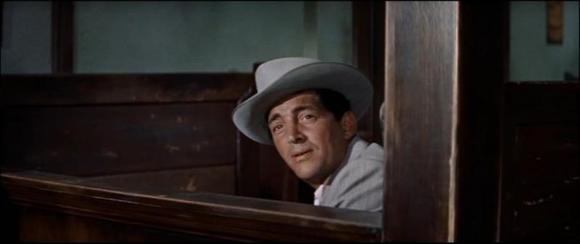
The real surprise was how good Dean Martin was as Bama Dillert, the seemingly sanguine gambler who never takes his hat off. Martin, one of the most laid back show biz personalities ever, is another actor easy to underrate. But Martin just about steals the show and that's saying something with MacLaine turned loose here. Martin is likeable and great with the one-liners and double takes, but he's also a bit melancholy and fatalistic. 
As the gambler who gloms on to Frank’s new guy in town, Martin is at first his genial self. But as time goes by, you realize Dillert's willful obliviousness that life is just one long party is a defense mechanism. Later, when Sinatra’s Dave decides to marry MacLaine's Ginny, Martin’s Bama lets him have it, and he's pretty harsh about it. And Dean plays those not-so-genial moments well, too.
'Kid' brother Frank Sinatra to Arthur Kennedy in 'Some Came Running.' Arthur was a year older than Frank!

Arthur Kennedy once specialized in playing sensitive guys. As he grew older, Kennedy also excelled at playing creeps. Now a character actor, he was most memorable as sleazy janitor Lucas Cross in1957’s Peyton Place. Kennedy is great here, too, as Sinatra's “older” brother, Frank Hirsh, who married well and abandoned his kid brother Dave in a boarding school. In real life, Arthur was only a year older than Frankie! Kennedy is a comic bad guy here, the sanctimonious ass who is actually a sad case. Frank Hirsh reminded me of Frank Burns on M*A*S*H. Kennedy's scenes tangling with Sinatra are alternately dramatic or offer comic relief. Still, the scene when Kennedy's restless Frank takes his secretary out for a drive captures that small town desperation well. 
Vincente Minnelli, who gets downgraded by some critics for his non-musical films, does a great job giving Some Came Running in-depth characters, dramatic situations, and some Douglas Sirk-like subtle digs at American social mores. Yet, his love of MGM gloss gets the better of him, especially with the French father/daughter characters, who are pure drivel.
The home of the phony French family, complete with kitchen/library combo, perfectly sums up intrusive MGM gloss.

The extensive location scenery in Madison, Indiana as the fictional Parkman, Illinois gives authenticity against the MGM gloss. Elmer Bernstein’s score starts sonorously, like a Bible epic, but once Running gets going, his usual trademark jazzy and bombastic style kicks in.
As someone who grew up in a middle-America small town, Some Came Running has a real feel for that life. However the duality of that authenticity versus the genteel MGM version of upper middle class life keeps Some Came Running from being a true classic. The post war era feels right, though I often forgot the movie was set just after WWII. Except for Frank’s uniform and a marquee playing Elizabeth Taylor’s 1946 Courage of Lassie, the movie feels like 1958. Still, the post war era of celebrating peace and prosperity with smoking, drinking, gambling, and hanky panky was a party that lasted a mighty long time! Frank has more fun doing all of the above with Martin’s gambler and MacLaine’s bimbo, than engaging in stilted banter with the collegiate French family—who can blame him?
Frank Sinatra and Shirley MacLaine in the brilliant Minnelli finale of 'Some Came Running.'
Watch Some Came Running for its stellar cast and James Jone’s recognizably human characters in this mid-west version of Peyton Place.
FYI: I put all the movie overflow on my public FB  movie page.