Showing posts with label Eleanor Parker. Show all posts

Wednesday, February 5, 2025

The Many Faces of ‘Eve’ & ‘Lizzie’ 1957


"The Three Faces of Eve" & "Lizzie," that respectively starred Joanne Woodward &
 Eleanor Parker, were both 1957 films that depicted the topic of multiple personalities.


Hollywood had competing films about title characters with three conflicting personalities, both released in 1957. Very specific coincidences, right?! The Three Faces of Eve showcased rising star Joanne Woodward; Lizzie starred film veteran Eleanor Parker. The movies were made on small budgets, returned modest profits, and its stars were praised—with Woodward winning a Best Actress Oscar.

Of course, the studios promoted the more sensational aspects of their subjects
in 1957's  "The Three Faces of Eve" & "Lizzie."

Their Situations

The Three Faces of Eve was based on a true story, with Joanne Woodward as Eve White, Eve Black, and Jane. The first personality is a meek young housewife with a young child. Her behavior has become increasingly erratic, at one point endangering her little girl. It's not long before her doc meets Eve Black, a raucous gal who comes out occasionally to find fun and create chaos. Jane comes on later in the movie as the even-keeled personality, who is the best bet to take over this woman's body. David Wayne is her exasperated husband Ralph; Lee J. Cobb is the sympathetic, but no-nonsense Doctor Luthor.

In 1957's "The Three Faces of Eve," Lee J. Cobb is the psychiatrist,
Joanne Woodward the title character, and David Wayne her bewildered husband.

In Lizzie, Eleanor Parker plays a young woman, Elizabeth, who lives with her drunken Aunt Morgan (Joan Blondell) and works at a museum. Her character is plagued with headaches and insecurities, making her a co-worker to avoid. Her aunt is mostly oblivious to her but does notice her escalating odd behavior. Lizzie’s director, Hugo Haas, also plays the writer neighbor, Walter, who encourages alcoholic auntie to get her niece to kindly doctor Dr. Wright, played by Richard Boone. Once Doc has Elizabeth under hypnosis, he meets her alter ego, Lizzie. She is a vicious character, a female Mr. Hyde. Later in the movie, the doc discovers a third personality, Beth, who is balanced and normal.

In 1957's "Lizzie," Eleanor Parker is the title character with three personalities.
Joan Blondell is the aunt with an overbearing personality!

Their Stories

In The Three Faces of Eve, Eve White is hospitalized for treatment. While the symptoms are identified with her varying personalities, the doctors can not figure out what sets them off. Once home, Eve isn’t getting better. It doesn’t help that husband Ralph wants to drag Eve to another state. And the more Eve Black comes out, it’s more than the reactionary husband can handle. Once he leaves her, this leads Eve back to Dr. Luthor.

David Wayne's Ralph has an obedient wife in Eve, but not when she's Eve Black! Joanne Woodward plays three personalities in 1957's "The Three Faces of Eve."

Lizzie’s Aunt Morgan isn’t a deep thinker, but when auntie's bourbon bottles empty ever faster, her antennae go up. The writer neighbor notices and for some reason is empathetic to the harridan aunt. Yet, he urges her to be more patient to the niece. It all comes to a head when the woman's work life and her erratic nightlife collide. You see, there are nights when mousy Elizabeth is left behind and hellcat Lizzie springs out. She hangs out at local nightclubs on the prowl and one evening meets up with her office place Romeo.

Joan Blondell's Aunt Morgan knows where Eleanor Parker's "Lizzie" finds
the booze AND the boys! "Elizabeth" only gets the hangover! 

The Actors

The Three Faces of Eve got a lone Oscar nomination and win for Joanne Woodward; Lizzie received no nominations.

Joanne Woodward is excellent in all three roles in The Three Faces of Eve. Eve White is totally repressed, a type of role Woodward played well. Joanne played a more raucous sort like Eve Black as the beatnik in The Fugitive Kind. And the later personality to emerge is Jane, the most complete personality to emerge, that Joanne plays with great empathy. Woodward, an Actor's Studio product, is quite natural without going over the top, like Geraldine Page or Kim Stanley would have probably done.

Joanne Woodward as Eve Black comes on to a male nurse like Blanche Dubois
 chatting up the paper boy in 1957's "The Three Faces of Eve."

In Lizzie, Eleanor Parker's performance is quietly effective as the repressed Elizabeth and the serene Beth. Though flatteringly photographed, Parker is quite toned down from her studio era glamour, and is very expressive in Elizabeth’s anguish and Beth’s calm. However, as wildcat Lizzie, Parker goes big, either of her own volition or Haas’ direction. Either way, Eleanor as Lizzie is way over the top. From the way she makes herself up like a clown or vamps around the cocktail bar like Sadie Thompson, it’s funny, not fierce. Also, Elizabeth is 25 going on 26; Eleanor was a lovely 35. Very typical in its movie age math—thankfully, Parker can pass as a decade younger.

Eleanor Parker suffers in chenille as tormented Elizabeth in 1957's "Lizzie."

Lee J. Cobb is more three-dimensional as Eve’s Doctor Luthor than super-kind Richard Boone in Lizzie. David Wayne as Ralph is most realistic as the confused small town spouse of Eve White. 

Joan Blondell's acting as the alcoholic aunt in "Lizzie" is about as subtle as her hat!

Joan Blondell’s performance as the alcoholic aunt in Lizzie is about as subtle as slugging down a bottle of bourbon. Joan gave a handful of memorable dramatic performances in her career and should have been given more opportunities. But Blondell is a complete caricature here—partly the way the character is written, as well as performed. My guess is that came from director Hugo Haas, who made a number of dime store melodramas that were hilariously unsubtle. Blondell’s boozing and barking in her bathrobe gives off a Baby Jane Hudson vibe!

Joan Blondell w/ director Hugo Haas, who plays a kindly neighbor in 1957's "Lizzie."

The Films

Eve White has a traumatic childhood incident that’s subtly recalled. In Lizzie, Elizabeth recalls a vile incident on her birthday, not subtle at all, but still powerful. Both characters find resolution in facing their pasts. The Three Faces of Eve was written by doctors Corbett H. Thigpen and Hervey M. Cleckley, who treated the real Eve. Lizzie was a novel written by Shirley Jackson (The Lottery). 

The book versions of "The Three Faces of Eve" & "Lizzie."

Nunnally Johnson was more famed as a screenwriter than as director, but his intelligence was always a plus, and it shows in the sensitivity of The Three Faces of Eve. Hugo Haas, on the other hand, seemed to dwell on sensationalism in his B-movies. There is a lurid quality to Lizzie that screams Hugo Haas, especially with Joan Blondell’s role and Parker’s performance as the lowdown Lizzie.

Tears Mixed With Humor

The leavening humor in The Three Faces of Eve is in the small town world of the husband and doctors, faced with this strange woman, who’s a timid mouse one moment and then a purring cat on the prowl. There are some smiles with the perplexed classic '50s husband that can’t reconcile the two extreme behaviors of his wife. Eve Black reminded me of a cross between Shirley MacLaine's good-hearted bimbo in '58s Some Came Running and Lee Remick's good-humored trailer tart in Anatomy of a Murder in '59. 

In Lizzie, the humor is unintended camp. The intentional “comic relief” between the aunt and niece, and aunt and neighbor are heavy-handed to the point of hilarity. Lizzie and Aunt Morgan's domestic life reminded me of the dramatized story of Frances Farmer’s life with mother or the Hudson sisters without the wheelchair. I love it when meek Elizabeth walks upstairs to get away from boozing Blondell and randomly barks out an insult as Lizzie, worthy of Kathleen Turner's Serial Mom asking her neighbor if she likes pussy willows!

Lizzie getting herself up to go out reminds me of Faye Dunaway in Mommie Dearest. She meets the sexy janitor in the bar, who has switched out from his work white tee-shirt for evening wear black tee-shirt with jacket, anticipating the Miami Vice look by 30 years. As Lizzie finds the booze and the boys, Aunt Morgan seems more concerned where the booze is going than what's going on with Elizabeth.

Eleanor Parker getting dolled up as "Lizzie" gives me a Faye Dunaway vibe as
 "Mommie Dearest!"

Near the showdown between the two women, Blondell’s aunt snaps, “You look like a slut!”

Parker’s Lizzie gives a Patty Duke/Neely O’Hara snarling delivery, “Drop dead, Auntie, drop dead!”

Future TV Stars

In The Three Faces of Eve, Vince Edwards aka Ben Casey, plays the horny young soldier who wants his due with Eve Black—after all, he spent 8 dollars on her! Near the end of the film, Nancy Culp of The Beverly Hillbillies appears in a flashback as Eve’s mother. In Lizzie, Marion Ross of Happy Days plays a kind co-worker of Parker’s lonely Elizabeth.

Vince Edwards plays a soldier who expects Eve Black to put out in
1957's "The Three Faces of Eve.

Needless Guest Appearances

Alastair Cook's introduction and narration in The Three Faces of Eve is highly unnecessary. It feels very condescending, as if he's a professor lecturing students about a very serious subject! With Lizzie, there is a very distracting piano bar player/singer named Johnny Mathis. He sings two tunes; one is his big hit, It’s Not for Me to Say. At least it wasn’t wailing Johnny Ray! All the while, Parker’s personality-plus Lizzie is working the joint with her hoochie mama antics.

Final Analysis

The Three Faces of Eve and Lizzie have very similar stories, likewise the female characters’ multiple personalities. The difference is in tone. The Three Faces of Eve plays like a pseudo-documentary mixed with a William Inge slice of life drama. Lizzie comes across like a campy “woman’s picture,” to use an old Hollywood term. Here, with the two women at odds in their dreary home, “suffering in chenille” might be more apt!

Why Cinemascope? To fit all those personalities?

"Lizzie" & "The Three Faces of Eve," both from 1957.

By today’s standards, both are very simplistic in the telling of multiple personalities. The one thing Eve and Lizzie have in common is strong lead performances by its stars, Joanne Woodward and Eleanor Parker. Both are worth a look, if only for the attitudes of the era on this controversial subject.

"Jane" is the most balanced personality played by Joanne Woodward in
1957's "The Three Faces of Eve."

"Beth" is the winning personality between meek "Elizabeth" & monstrous "Lizzie."
Eleanor Parker played the triple role.

Bonus Material

Here’s my look at when Joanne Woodward teamed with husband Paul Newman for the first time, 1958’s The Long, Hot Summer: https://ricksrealreel.blogspot.com/2017/08/the-long-hot-summer-long-but-not-so-hot.html

My take on one of Eleanor Parker’s best performances, from 1950 as “cute little trick” who is Caged: https://ricksrealreel.blogspot.com/2019/02/caged-never-classic-but-still-packs.html

Joanne Woodward as tarted up Eve Black in 1957's "The Three Faces of Eve."

Eleanor Parker goes big as demented "Lizzie."

Saturday, February 2, 2019

'Caged' Never a Classic, But Still Packs a Punch 1950

After 1950's 'Caged,' you'll never think of haircuts and kitty cats the same way again!


“Pile out, you tramps! It’s the end of the line!”
That’s the opening line barked to a van full of new female inmates in the 1950 WB melodrama Caged. While critics praised the performances and tight storytelling, more than a few thought the situations were a bit emotionally broad—pun intended. Apparently, the Academy agreed, as leading lady Eleanor Parker was the only Best Actress nominee that year whose picture wasn’t also nominated.
Some critics and film buffs now call Caged dated. True. How could it not be? Caged also gets called camp. While some of the situations and dialogue in Caged are melodramatic, director John Cromwell keeps the story and stars moving at a brisk, no-nonsense clip.
Producer Jerry Wald loved controversy and gave audiences just that with then-shocker 'Caged.'

There are two reasons that Caged still compelling today: First is Oscar-nominated screenwriter Virginia Kellogg’s well-researched and realistic look at women’s prisons of that era. The other is the gritty and glamour-free performances, from a cast of fine character actresses, right down to the smallest parts.
Eleanor Parker has one of her best roles as new kid on the cell block Marie Allen in 'Caged.'

Eleanor Parker got her breakout role as 19-year-old Marie Allen, who was sent to the pen as an accessory to her late husband’s hold-up attempt. Parker goes from wide-eyed innocent to tough cookie during the harrowing movie. She is mostly restrained, which makes Parker’s performance hold up quite well today. Eleanor Parker always reminded me of Anne Baxter, in her later acting style: all husky voice, arched eyebrows, and over-dramatic line delivery. But here, Parker relies much on silent reactions to the brutal treatment she receives and horrors she sees. Pregnant in prison, under a monstrous matron’s thumb, watching other inmates crack up, receiving harsh punishments herself, and finally giving in to the lure of larceny on the outside—Parker as Marie Allen is 100 percent convincing.
It's not long before Parker's Marie Allen's going crazy in 'Caged!'

Hope Emerson has to be one of movie’s most chilling villains as prison matron Evelyn Harper. Crooked, mean, and a bruiser of a tough broad, Emerson’s Evelyn is always keeping score—and a tab. When she realizes Marie has no money to pay her bribes, Harper is hell on wheels to new inmate Allen. Emerson was a pleasant person off-camera, but her creepy, intimidating looks and pitiless performance make her a memorable monster.
Some of the most tense scenes in 'Caged' are between monster prison matron Evelyn Harper and tough inmate Kitty.

Betty Garde as veteran inmate Kitty Stark reminded me of a middle-aged Bette Davis, with her big, baleful eyes and jowly, sullen mouth. Garde brings terrific believability as Kitty, the cellblock “queen bee” recruiting “newbies” for a life of crime outside of prison. While her character is tough, she’s on the level. And after Kitty runs afoul with hellish Harper, Garde has some great lines, and her moment of revenge is chilling.
Left, Olive Deering as tragic inmate June, gives one of the strongest performances in 'Caged.'

Olive Deering is startling as tragic, wide-eyed inmate June. This actress was a cross between young Bette Davis and Carolyn Jones, with her big melancholy eyes. Deering’s performance is riveting, ranging from defiant to hopeless. When June is turned back, her character’s pain is palpable.
WB stalwart Lee Patrick, as Elvira Powell, the new mover and shaker on the cell block of 'Caged.'

Lee Patrick, often the sympathetic type in WB movies, plays both sides of her persona as Elvira Powell, the new queen on the cell block who causes more trouble than she intended, when flaunting her connections and cash. Patrick plays tough well, comes on to new girl Parker convincingly, calling her a cute trick! Lee’s Elvira later shows regret for the trouble that she inadvertently egged Harper on to.
Agnes Moorehead plays a rare heroine as the progressive superintendent Ruth Benton in 'Caged.'

Agnes Moorehead has a rare warm role as the progressive prison superintendent, who is strong and sympathetic. Agnes commands attention as she battles corrupt employees, board members, and politicians. Ruth Benton is one of Moorehead’s juiciest roles as a career character actress.
Ellen Corby aka Grandma Walton, plays Emma Barber, a bonkers inmate who thinks Pearl Harbor is a new girl!

Grandma Walton herself, Ellen Corby, is fun as batshit crazy inmate, Emma Barber. Queenie Smith, who enjoyed renewed popularity on TV in the ‘70s, such as Mrs. Whipple on Little House on the Prairie, has one but wonderful scene as Marie’s skittish, self-centered mother. Gertrude Hoffman also has one memorable scene, as the elderly lifer who tries to set Parker straight, and sighs at the end of her monologue, “What I’d give for a sink full of dirty dishes.” Jan Sterling has one of her early roles as Smoochy, the brassy but good-hearted inmate.
Gertrude Hoffman is great as the lifer who tells the other girls a thing or two, ending with a classic line from 'Caged.'

A throwback to the ‘30s Warner Brothers message movies, Caged, though sentimental at times, still startles. “Women in prison” movies are now a campy genre. Though the slangy dialogue and the lesbian subtext can be considered camp, Caged is straightforward and pulls no punches.
The finale of Caged also contains a memorable quote. When secretary Helen asks what to do with new parolee Marie Parker’s file, Moorehead’s superintendent tersely replies, “Keep it active. She’ll be back.
Parker's parolee embarks on a new life as career criminal, as prison superintendent Moorehead keeps her file open.


Monday, July 30, 2018

The Man with the Golden Arm 1955

Otto Preminger's direction & Frank Sinatra's performance are still strong points
of "The Man with the Golden Arm."


'The Man with the Golden Arm' poster, with great graphics that put Saul Bass on the map in Hollywood.

Nelson Algren’s gritty novel, The Man with the Golden Arm, got great reviews and won the National Book Award in 1950. Though somewhat sanitized, the movie version received raves in 1955, as the first film to deal with drug abuse. Some film fans and critics today refer to The Man with the Golden Arm as “dated.” Since the film is over 60 years old, that’s a given. And the Otto Preminger film isn't perfect, for sure. However, while the film seems tame by today’s standards, it was made under strict censorship, yet took an honest look at a taboo subject. The film's makers chose to release the film without the Production Code's Seal of Approval, rather than to compromise any further—a gutsy move for a '50s film.
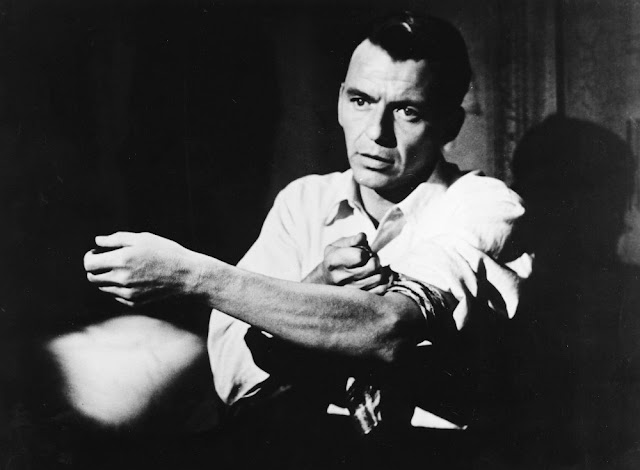
This is Frank Sinatra's brain on drugs: his girlfriend checks out his pupils by match light.

The story is straightforward: Former card dealer and drug addict Frankie Machine (Majcinek) is released from rehab, ready to make a fresh start, with dreams of becoming a drummer. Just one problem, though. Frankie returns to the same set of circumstances that drove him to drugs in the first place: a gambling boss who wants his ‘man with the golden arm’ to deal; a drug dealer who dangles the bait and snatches it away; a nagging wife who guilt trips him for her accident; a lost love who is still tantalizingly around; and most of all, Frankie’s tendency to fall back on drugs when life gets tough.

Interestingly, though it’s commonly thought that Frankie is hooked on heroin, his drug of choice is never named in the film version. And though the novel is famously set in Chicago, the movie’s locale isn’t mentioned. This is odd and adds an air of artificiality. The film’s depiction of drugs is discreet: Every time Frankie gets high, the camera cuts away. While Sinatra gives it his all in the climactic cold turkey scene, it goes by so quickly, it's like Frank has the 24 hour flu! However, what is shown is portrayed in an honest, non-exploitative way.
The street where Frankie lives...looks like a movie set!

What does date this film for me is not so much the drug depiction, but the artificiality of the slum sets and to a lesser extent, the two female stars. Perhaps the film’s tight budget dictated this, but while its attempt to come off as Actors Studio fifties modern, it looks more like the Warner Brothers’ 1938 Angels with Dirty Faces set. Much of 1954’s On the Waterfront was filmed on location and feels authentic. The Man with the Golden Arm sets are artfully detailed, but you never forget for a minute that you’re looking at a movie sound stage. And though token attempts are made to tone down the glamour, Kim Novak still looks studio styled as the working class bar hostess. And Eleanor Parker, as a wife stuck in a wheelchair, sports luxurious shoulder length curls and false eyelashes. The filmmakers strive for realism with the dingy clothes and apartments, but the two female stars stick out like stylish sore thumbs. 
Eleanor Parker blows as Zosh, Frankie's whining, 'crippled' wife. Parker's performance is like this throughout!

Aside from the artful sets is the equally artificial—and awful—performance by Eleanor Parker. In a part that would have been perfect for career whiner Shelley Winters, Parker comes off like a demanding movie star rather than a slum dweller. Parker plays Zosh, a wheelchair-bound wife whose accident was caused by her drunk driver husband, Frankie. Let’s just say that the guilt-mongering, teary-eyed Zosh is the most duplicitous damsel in distress since Joan Crawford’s Blanche Hudson. I’ve always thought Eleanor Parker was neck in neck with Anne Baxter as the throaty-voiced, arched-eyebrow grande dame of the ‘50s. With a mane of hair that would be perfect if Parker was starring in The Gift of the Magi, perhaps Zosh could have cut off her mammoth mane and sold it for Frankie's next fix. Parker has given strong performances elsewhere. Here, Eleanor is so over-the-top, which hits the heights of absurdity when the fake cripple is caught by drug dealer Darren McGavin, or when she takes her final swan song/dive. The real-life Sinatra probably would have smothered her with the nearest pillow after five minutes of Eleanor’s overwrought emoting. When Parker leaps out of her wheelchair and gives herself away at inopportune moments, it’s like watching a Carol Burnett movie spoof.
Though Kim carries much of her Columbia gloss to this United Artists film, Novak is affecting as Frankie's true love.

In her time, Kim Novak was regularly panned as the worst type of studio-created actress. Kim’s "creation" was part of her publicity, but also became her cross to bear. Still, Novak had her moments, especially in films that exploited her self-consciousness and vulnerability. Kim’s big breakthrough was 1955’s Picnic, and Hitchcock cannily exploited this quality in ‘58’s Vertigo. While Novak wasn’t the most versatile or dynamic actress, those sad qualities Kim possessed work for Molly, the beaten down working girl. Also, Novak and Sinatra share a sad, loners’ rapport that offers some much-needed reality.
Director Otto Preminger rehearsing with Kim Novak and Frank Sinatra.

What’s fascinating is looking at pictures of director Otto Preminger working with Novak and Sinatra. Preminger could make mincemeat of new actors, and yet he seems to have treated the oft-uncertain Kim kindly. And Otto, who was an autocrat on the set, miraculously got along fine with frequently temperamental Frank, who liked to do things his way, such as not doing more than one take. Bob Willoughby’s set photos show them all working intensely and happily.
Frank Sinatra as Frankie Machine, returning home from rehab. Sinatra is so expressive in even the still shots.

Like his singing, Frank Sinatra is subtle and naturalistic when he was at his best as an actor. However, Frank’s acting style got him the rap that he wasn't doing anything onscreen, in some quarters. As an actor, Sinatra always reminded me of his idol Humphrey Bogart—always making it look easy—though obviously Bogie was more dedicated to his craft.
To me, Frank is the one thing that's truly real in The Man with the Golden Arm. This movie came soon after Frank’s legendary comeback in From Here to Eternity. As the down on his luck Frankie, I think the real Frank used some of his recent troubles to convey his character’s pain. His character wears his heart on his sleeve, and that was one of Sinatra's gifts as a performer. Whether Frankie Machine is boyishly optimistic or almost child-like when the chips are down, Sinatra is at home playing this character, and is subtle and superb.
Frankie getting his fix, in 'The Man with the Golden Arm.'

The nifty opening titles by Saul Bass made him a Preminger favorite and the go-to movie titles person in Hollywood for a decade. There’s some stylish, evocative photography by another long-time Otto associate, Sam Leavitt. The bombastic score is by the love him or hate him Elmer Bernstein. I usually enjoy Elmer on a soundtrack, but he’s awfully intrusive here—just as much as that other Bernstein—Leonard—was On the Waterfront! That said, Bernstein did snag an Oscar nod.
Frankie waiting on wheel-chair bound wife Zosh (Eleanor Parker) literally hand and foot.

Overall, this was one of Otto Preminger’s stronger efforts as a director. Though some elements are hokey, he elicits strong performances from most of the cast, and pushed the envelope as far as he could in regard to the drug story line. Plus, Preminger’s modern dramas were more adult and realistic than typical Hollywood fare, even in just the way the male and female characters related to one another. And though The Man with the Golden Arm's author was unhappy with the film's changes, most of them were pretty sound for mid-century film making, and nearly none of them were related to the narcotics aspect of the story.
The Man with the Golden Arm is noteworthy and deserves to be seen, for how Hollywood first dealt with drug addiction on the screen, but especially to watch the heartfelt performance by Frank Sinatra.
Amazingly, Frank Sinatra was fine with a firebrand director...and rehearsing!

FYI: I put all the movie overflow on my public FB  movie page. 

Check it out & join!  https://www.facebook.com/groups/178488909366865/