Showing posts with label Barbara Stanwyck. Show all posts

Friday, October 17, 2025

Stanwyck Saves ‘The Night Walker’ 1964


Barbara Stanwyck reunited professionally with ex-husband Robert Taylor in
William Castle's 1964 suspense starrer, "The Night Walker."


Cheap thrills artist William Castle’s The Night Walker, was really more suspense than shock. The flamboyant producer/director played up the scares to ride the early ‘60s wave of post-Psycho/Baby Jane style fright flicks, but this outing was light on horror.

The 1964 film was hardly “hag horror” as star Barbara Stanwyck played a perfectly normal person being tormented and looked quite attractive at age 57. Stanwyck was teamed opposite former husband Robert Taylor, who actually did look very haggard and prematurely aged at 53. They worked together as professionals and without feuding, unlike other stars with histrionic “history.” Five years later, Taylor would be dead of lung cancer, after a lifetime of chain-smoking.

Producer/Director William Castle with his stars, Robert Taylor &
Barbara Stanwyck,  for 1964's "The Night Walker."

The premise of this moody noir-like movie is that after the death of her unstable scientist husband (Hayden Rorke in disfigured makeup), Stanwyck’s Irene Trenton returns to her beauty salon to take her mind off hubby’s sudden death. Irene’s dreams have become increasingly romantic, which had inflamed her jealous husband, convinced that she had a lover. Well, we see at least in her dreams that she has one, played by that unctuous smoothie, Lloyd Bochner of Dynasty fame. At least he doesn’t wear his usual smoking jacket and ascot! He’s quite young and handsome, in his aquiline way.

That's quite a liplock dream lover Lloyd Bochner lays on
Barbara Stanwyck in 1964's "The Night Walker."

The dreams become more intense and dire, as Mr. McDreamy wants to marry her. Are the dreams becoming reality? Is Irene in danger? Or is she merely wigging out? With the rather small cast, there are not a lot of suspects to choose from. The plot of The Night Walker is as slim as Stanwyck’s figure. And you know that Barbara Stanwyck, one of the most sensible stars ever, is not going berserk like Joan Crawford or all “Baby”-ish like Bette Davis. So “the how” of this mystery is more the question than whodunit.

Stanwyck is supposed to go over the top in response to her mental torture, but acting a hysterical scream queen is not Barbara’s bag. “Stany” is best when she’s down to earth or cool and understated. In her best film noirs or suspense films, Barbara Stanwyck is the acting equivalent of Peggy Lee, slyly insinuating without going big. Overall, Stanwyck’s performance is her usual total pro turn, with natural empathy. But when she starts screaming and hollering, it feels false and falls flat.

Barbara Stanwyck bellowing hysterically was not a good look for the cool actress!

I think Stanwyck aged quite gracefully and strikingly, with her gray hair now silver, in a subtle hairstyle and makeup. This is a far cry from most of her contemporaries who were becoming increasingly cartoonish looking or just going to seed. Stanwyck looked her age, but with great style.

Barbara Stanwyck was subtle and stylish in her older years, here in 1964's "The Night Walker." Thankfully, "The Big Valley"was just around the corner, a big career boost.

As the family lawyer in The Night Walker, Robert Taylor acts like a sleep walker. As he aged in dog years, Bob looked increasingly dour, much like Alan Ladd. Taylor also didn’t have Gable’s strong personality or Tyrone Power’s warm charm. The long-time MGM star seemed to be put increasingly out to pasture in westerns. Still, this horror film was a hiccup in both Bob and Bab’s careers.

Robert Taylor was a rough-looking 53 when he made 1964's "The Night Walker."

Producer-director William Castle used great imagination to stretch his B-movie budgets. In The Night Castle, the intro, complete with spoken work creepiness by Paul Frees, is visually striking if not terribly related to the movie itself. The score is by Vic Mizzy, the prolific composer who famously came up with The Addams Family theme. One recurring riff sounds amazingly like “Food, Glorious Food” from the Broadway musical Oliver!, which made its Broadway debut around this time. Coincidence? Who can say?

No, Hayden Rorke and Robert Taylor aren't debating who's the hotter dude for Barbara Stanwyck! From 1964's "The Night Walker."

The dream scenes are stylishly done and subtly, too, except when the courtroom wedding scene is populated by puppets that look like life size versions of The Thunderbirds. Hilariously camp, especially when the chandeliers catch fire and spin, with Stanwyck’s smoky voice emitting raspy screams!

No, this isn't Raymond Burr with blonde hair from "Rear Window," it's one of the creepy puppets/mannequins from 1964's "The Night Walker." Bizzaro!

This film has a thin plot, low budget, and loony logic, typical of William Castle. As a mood piece, it’s quite entertaining and shows some style, along with some eye-rolling chills! The Night Walker pairs well with Stanwyck’s half-baked ‘40s WB thriller, Cry Wolf, with Barbara’s character dealing with the loony men in her life, and a secret lab!

Below is a link to "The Night Walker."
Enjoy!

Here is an excellent, free copy of The Night Walker to watch on YouTube: https://www.youtube.com/watch?v=K5RYClikxcc&t=5s


Below is the link to my review at Stanwyck's
"Sorry, Wrong Number."

Here’s my look at Barbara’s best “woman in jeopardy” role, 1948’s “Sorry, Wrong Number”:  https://ricksrealreel.blogspot.com/2025/06/stanwycks-fatal-phone-call-sorry-wrong.html


Thursday, June 19, 2025

Stanwyck’s Fatal Phone Call: ‘Sorry, Wrong Number’ 1948

Barbara Stanwyck, A+ in an atypical role, as a weak, wealthy woman, who overhears
a plan for murder, in 1948's film noir suspense film, "Sorry, Wrong Number."

*Spoiler alerts ahead*

The 1948 movie version of Sorry, Wrong Number caused some criticism with some critics and film fans at the time—and even thereafter. It was adapted from an instant classic radio play by Lucille Fletcher. The star was Agnes Moorehead as a rich hypochondriac who overhears a phone conversation of a plot to commit murder that very night. It then turns out she is to be the victim! The radio play was a one-character show, offering a tour de force for Moorehead. 

When Paramount and Hal Wallis snapped up the film rights, casting a star name was standard to carry a movie. I think a number of mature actresses could have been great in the role, but Hal picked one of his favorites, Barbara Stanwyck.

The gradual unraveling of Leona Stevenson when she realizes that she is to be a
 murder victim is superbly played by Barbara Stanwyck in "Sorry, Wrong Number."

Since then, there’s been a bit of a bias against the movie version, favoring the radio play. It goes something like this: Hollywood buys the rights of the half hour play, casts a big movie star and pads it out to 90 minutes. But the play is far superior, in less time, don’t you know. This is why I never bothered to see the film version of Sorry, Wrong Number until recently.

Agnes Moorehead, who originated the role of Leona Stevenson
for radio, in "Sorry, Wrong Number."

I get the criticism, but I still prefer the film. I'm not of the school that Agnes Moorehead was robbed and that the movie version was watered down because it was fleshed out to 90 minutes. (Playwright Fletcher also wrote the movie screenplay). Aggie was a great actress, but listening to her become increasingly hysterical, with her naturally querulous voice escalating, was more grating than great, for me. Agnes won much praise for her supporting scenes as a nympho neurotic in Dark Passage the year before, but Moorehead’s few scenes were plenty for me. I can’t imagine 90 minutes of Agnes’ overstated shrillness front and center. I much preferred Barbara Stanwyck’s contrasting understatement. The back story brought Sorry, Wrong Number to just shy of 90 minutes, which was just right, typical for a noir thriller.

Barbara Stanwyck was a no-nonsense woman who usually played strong characters, is quite good in the role of an unsympathetic, spoiled daddy's girl. Stanwyck's innate likability makes Leona Stevenson more empathetic, despite the fact the character is basically a royal pain. Stanwyck was one of the acting greats of her era and goes from imperious to insecure to incoherent with fear and helplessness, all without overacting. 

By the finale of 1948's "Sorry, Wrong Number," Barbara Stanwyck's spoiled
rich matron is at the end of her tether--and soon, her life!

The movie is filled out with flashbacks of Leona and her bought and paid for husband Henry's relationship. There, the tough side of Stanwyck as Leona fits Barbara like a glove. Their courtship and relationship is skillfully depicted, especially as the marriage deteriorates. Henry wants to make his own way, working for her father, while the father and daughter both want a docile pet. This causes Henry to eventually take drastic action, as he gets mixed up with unsavory characters that end up calling in to collect on their favors to him. Henry has to take drastic action, putting a hit out on his wife.

A flashback scene of the woman used to getting what she wants is more familiar
 Barbara Stanwyck territory, in 1948's "Sorry, Wrong Number."

The scenes of Barbara’s deluxe lifestyle is intermingled with her father’s crude depiction of wealth and the drug dealing criminals husband Henry gets mixed up with, which is depicted in jarring film noir style.

The cast is terrific, from Stanwyck, down to Ed Begley, Sr. playing her tough dad, to William Conrad as a chilling baddie, and Ann Richards as Henry's good-hearted former girlfriend. Burt Lancaster is well-cast, since he could be strong or shady, though this isn’t the kind of role that makes for a great leading man. A bit like when Kirk Douglas played Barbara Stanwyck’s even weaker bought husband in 1946’s The Strange Love of Martha Ivers. Both Burt and Kirk soon got away from supporting film divas as weasels and driving in their own movie vehicles.

Burt Lancaster, in one of his early roles, as the trophy husband for rich girl
Barbara Stanwyck in 1948's "Sorry, Wrong Number."

The film version of Sorry, Wrong Number is extremely stylish, right from the opening credits, and you are sucked right in. At the end, as the noisy city train roars by, when Leona is killed in her luxury apartment, is another statement of lifestyles juxtaposed against one another.

The 1948 film version of "Sorry, Wrong Number" is stylish suspense right from
the opening credits!

Sorry, Wrong Number has had various TV versions starring such diverse actors as Mildred Natwick, Shelley Winters, and Loni Anderson! Geraldine Page would have been great as the high-strung heiress in the ‘60s or early ‘70s.

The direction by Anatole Litvak is strong, and he would direct Olivia de Havilland in The Snake Pit the same year. The cinematography by Sol Polito is perfect for a film noir suspense film, as stylish as his work in 1940’s The Letter with Bette Davis. The score by Franz Waxman is powerful and dramatic, elevating the suspense. Edith Head, a designer fave of Stanwyck’s, heightens the storytelling with Barbara’s gowns depicting youth and wealth in the flashback scenes, and her expensive but fussy-looking dressing gown as the bedridden matron.

Barbara Stanwyck as the younger Leona, dressed in soft ermine, against a childhood
portrait of herself, in 1948's "Sorry, Wrong Number."

The main set, with Leona’s whining following all the way down the winding stairs, past the servants’ rooms, to the foyer, and the kitchen, all depicting an expensive lifestyle, but no signs of life.

In the finale, in true noir style, the married couple let their guard down during the final phone call. But it’s too late, the plan is put into action, and the chilling final line is the title of this movie!

Here’s my look at the more charming side of Barbara Stanwyck, in 1945’s holiday favorite, Christmas in Connecticut: https://ricksrealreel.blogspot.com/2017/12/christmas-in-connecticut-1945.html
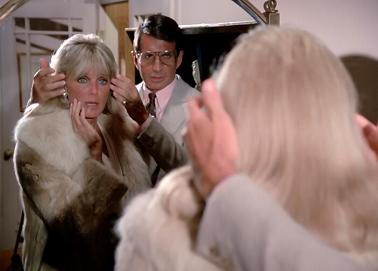
 

Interesting moment in 1948's "Sorry, Wrong Number," when Barbara Stanwyck's spoiled rich woman catches herself in a rare moment of seeing her actual self.

Saturday, July 15, 2023

Sirk’s Switcheroo in ‘There’s Always Tomorrow’ 1956

Barbara Stanwyck & Fred MacMurray, as a designer & toy maker, who are
also old flames in 1956's "There's Always Tomorrow."


Director Douglas Sirk literally flipped the script with 1956's There's Always Tomorrow. Typically, Sirk's cinema forte was slick but subversive soap operas that starred 40-sh femme film divas that faced life's adversity and society's disapproval.

"There's Always Tomorrow" may look like another Ross Hunter produced soap with
 veteran stars, but Douglas Sirk's critical take on post-war life cuts through the suds.

There's Always Tomorrow is like a male version of All That Heaven Allows, which Sirk directed the year before. Instead of a likeable but increasingly miserable female character like Jane Wyman's small town widow, this time it's Fred MacMurray as a faithful husband and father who feels trapped by his middle-class existence. Whereas Wyman's widow unwittingly creates strife with an affair with a younger man, Fred's toy creator causes suspicion among his older children when an old flame comes to town on business. In both cases, their children react with self-centeredness and self-righteousness. And in both films, the privileged, overbearing son is played by William Reynolds! In Heaven, he’s Ned; in Tomorrow, he’s Vinnie. In both roles, he’s perfect, because Reynolds’ characters behave so badly you'll want to throw something at your screen.

Like Jane Wyman in "All That Heaven Allows," director Douglas Sirk casts
another likable star, Fred MacMurray, as a character not content with their lot in life. 

While there is an attraction between both MacMurray's unhappy Cliff Groves and Norma Vale, she is more realistic, as an affair would wreck his happy family. Norma is played by Fred's frequent co-star, Barbara Stanwyck.

Cliff seems to enjoy his career, though he jumps through a lot of hoops to please his boss and clients; at home he's feeling restless. While he loves his wife and family, Cliff feels second best. There’s Always Tomorrow seems to mock the '50s sitcom-style family, where they seem insufferable at times, while Fred is suffering from a lack of attention. Wife Marion is played by lovely Joan Bennett. While I'm sure she was directed to behave this way, Joan’s Marion comes off like a posh parody of the glamorous and saintly sitcom wife of '50s TV. She’s the most chic of Stepford Wives, with pat answers for her husband’s complaints, treating him like a child, insisting he take a hot bath after a rough day, or that he not stay out in the cool night air, lest he catch cold!

Joan Bennett, cast as the perfect wife, Marion Groves, in "There's Always Tomorrow."

Vinnie is a clean cut, crew cut bully, who lords it over his sisters, snaps at his girlfriend, and takes verbal jabs at his father. Ellen, the middle sister, is played by Gigi Perreau as a typical precocious ‘50s teen, girlish with adult pretensions. The youngest daughter, Frances, seems to need all her mother's attention and is truly annoying. These actors as the Groves offspring certainly perform as Sirk directed. In the showdown scene, when the two older children confront Stanwyck's visiting ex-flame, Perreau has an outburst begging Stanwyck that's quite striking.

Gigi Perreau has an emotional moment as the daughter,
in 1956's "There's Always Tomorrow."

Of course, this is Sirk's sly criticism of post-war perfect families, as seen on television and film. In fact, the movie doesn't judge the father for considering an affair at all. By the film's finale, the family finally seems to realize the father needs a little TLC, yet Cliff still seems melancholy as he sees Norma’s plane depart in the evening sky. She is shown brushing away tears in her plane seat.

Fred MacMurray's Cliff feels re-ignited after reuniting with old flame Norma,
played by Barbara Stanwyck, in 1956's "There's Always Tomorrow."

Fred MacMurray, typically bland to me, is well-cast as the ideal film father. In less than five years, Fred would be star in the TV fave, My Three Sons, where he always looked half asleep. Here, he's not afraid to be unlikable. While Cliff is a good man, it's never definitively declared whether he has every right to be irritable at his home life, or is this a faulty perception? I took it that he sees his family situation clearly. Did he miss an opportunity to change his life for more happiness? Or was he about to make a big mistake, over a dull patch in his life? Fred has an in-depth character to play and he does so with authority. 

Barbara Stanwyck as Norma Vale in 1956's "There's Always Tomorrow."
This is one of Barbara's best middle-aged roles, as the warmly sympathetic ex-flame.

As for Barbara Stanwyck, this role in this film was a change of pace for her. Like her friend and contemporary, Joan Crawford, Stanwyck played a lot of tough cookies from mid-career onward. Unlike Joan, Barbara didn't become a caricature. The same year that Joan had one of her best roles and films with Autumn Leaves, Stanwyck had the same as Norma Vale in There's Always Tomorrow. Barbara's character is genuinely warm and charming, realistic and makes no apologies for being a career woman. She's genuinely interested in Cliff's life and is finally realistic about their attraction going any further. Like Crawford, Stanwyck was nearly 50 here. Barbara presents herself as a stylish woman, but not afraid to look her age.

And like Crawford in Autumn Leaves, Stanwyck gets a big scene in There’s Always Tomorrow to tear into! When Cliff’s children come to confront her, Stanwyck’s Norma doesn't grovel for their forgiveness, which would have been typical of the era. Instead, the would-be “other woman” rails at the ingrates for taking their father for granted. Barbara is quite convincing in her fury!

Barbara Stanwyck's "other woman" schools her ex-flame's kiddies on respecting
their neglected dad, in 1956's "There's Always Tomorrow."

There are a number of scenes where Douglas Sirk creates mood and emotion with camera set ups, symbolism, and more. The one that stunned me was when Norma visits Cliff at work, breaking off the possibility of an affair. When she leaves, his latest creation, Rex the Robot is bumped and starts mechanically walking, right off the screen!

"There's Always Tomorrow" benefits greatly from having two of the golden era's
 most naturalistic stars, Fred MacMurray & Barbara Stanwyck, as the mature leads.

Maybe the reason this film is lesser known is because it was not one of Sirk's splashy Technicolor ‘50s extravaganzas. Why wasn't it filmed in color—because it wasn't about wealthy folks, wearing a parade of Jean Louis costumes? Was it because there wasn't a photogenic young co-star, like Rock Hudson? Whatever the case, There’s Always Tomorrow is a beautifully drawn black and white film, instead of a vivid movie oil painting, directed by Douglas Sirk. Like Sirk's other work, there are some forward thinking observations about mid-century American life.

William Reynolds, who so ably played the surly son in both
"There's Always Tomorrow" AND "All That Heaven Allows."

Here’s my look at one of Sirk’s best, All That Heaven Allows, with Jane Wyman & Rock Hudson:

https://ricksrealreel.blogspot.com/2020/10/all-that-heaven-allows-1955.html

Wednesday, February 5, 2020

‘Dynasty’: Catfights, Cliffhangers, & Clothes, Oh, My! 1981-89

Why is Linda Evans, 5'8", the shortest person in the photo? Hair & high heels, baby! That may include Mr. Forsythe! 

FYI: I put all the movie overflow on my public FB  movie page. 


Part 1 of a 3-Part Piece: The Show
As a 20-something waiter who alternately worked and partied nights during the great ‘80s, I missed most of Dynasty during its original run. 30 years later, I found myself constantly sick while working with school kids. Looking for some mindless fun to watch, I decided on Dynasty.
The first season of Dynasty is often described as a dud, which isn’t totally true. The ratings were middling, finishing 24th for the first half season. The problem was that it was about the super rich, and an expensive show to produce; also, Dynasty was created to compete with CBS’ established hit Dallas, which was the #1show for that season.
'Dynasty' producers proclaimed that audiences were not interested in the working class Blaisdel family of Season 1. Out with the poor, in with the super rich!

Dynasty began as a blend of thoughtful epic, like Giant, and a Ross Hunter-type gloss on the glamorous rich. The two sides never really meshed. With Season 2, the sudsy rich took over, and the working folks were sent packing—just like real life! The show then caught the wave of the super rich Reagan era. Still, it’s a shame Dynasty turned into a mindless cartoon, because in the era of Dominick Dunne and Kitty Kelley, it could have been a smart soap. The more serious takes on wealth, ethics, women, and gays fell by the wayside, and replaced by plot gimmicks that were stale soap clichés: amnesia, kidnappings, cliff hanger accidents and murder, and the biggest one of all, replacing actors by melodramatic means. Through the entire run of the show, all four of Blake and Alexis’ offspring were gradually replaced by other actors, to lesser effect.
The Season 1 cliffhanger featured a model, incognito as Alexis, because the producers hadn't cast the role yet! Joan Collins got the part and finally became a genuine star at nearly 50!

Dynasty was a bit like ABC’s Happy Days in its early seasons. The sitcom was low-key and its first two season ratings went from good to so-so. Creator Garry Marshall noticed that the show’s bad boy, Arthur Fonzarelli, captured the audience’s attention. Once Fonzie was the focus, Happy Days got hella ratings. As the show progressed, it became a caricature, and Fonzie’s “jumping the shark” on a motorcycle became a catchphrase for a show whose antics have gone beyond the pale. Dynasty would follow a similar trajectory. The second season introduced Joan Collins as Alexis, Blake’s vengeful ex-wife. In Collins’ words, Alexis became the female JR Ewing.
'Dynasty' stars Joan Collins, John Forsythe, & Linda Evans are all smiles, at the show's peak.

In its prime, Dynasty did break some new ground. First, despite all the pretty young scenery, veteran stars held the show together. Joan Collins became a bonafide star at 50, while John Forsythe and Linda Evans got another hit series. Diahann Carroll, as Dominique Deveraux, made television history again, as TV’s “first black bitch,” as the star herself put it. Women characters in professional positions of power were also forward-thinking for the era. Dynasty was the first time a TV series had a gay character in a starring role. Despite the flip-flopping over Steven Carrington’s sexuality, his character was never a stereotype or portrayed negatively.
As Steven Carrington, Al Corley played the groundbreaking role of the gay son for two seasons. Corley left when the show's creators kept flipflopping on his character's sexuality.

Critics and viewers say that Dynasty jumped their shark after the over-the-top “Moldavian massacre” cliffhanger. While Dynasty was all downhill after that, earlier moments like vixen Alexis doing a hoedown to seal an oil deal, with an encore of Marlene Dietrich’s ‘See What the Boys in the Backroom Will Have,’ was just one campy sign of things to come.
Rock Hudson joined 'Dynasty' for Season 5, as wealthy horse breeder Daniel Reece. He's madly in love with Evans' Krystle, natch. Hudson's later AIDS revelation brought real life soap opera to the show.

Season 5 was the beginning of the end for Dynasty, though nobody realized it at the time, as is often the case. First, the entire season was wasted prepping for the absurd Moldavia royal marriage between pouty Amanda Carrington and the Prince Charmless. Also, the fanfare that greeted genuine movie star Rock Hudson as guest star turned to tabloid gossip over his gaunt appearance, furthered by his abrupt departure from the show. Rock played Daniel Reece, the millionaire/horse breeder who loves Krystle. While Rock brought his usual authority to the role, it’s beyond sad watching this giant of a leading man, a shell of his former self. That summer it was revealed that Rock was ravaged by AIDS. Dynasty finally became the #1rated show, in its 5th season, but got dinged in the ratings next season, and dropped rapidly each season after.
George Peppard played Blake in the 3-hour pilot, 'Oil.'
Producers were displeased with Peppard's performance & behavior.
He was replaced with John Forsythe.
If George Peppard had continued to play Blake Carrington beyond Dynasty’s pilot, it would have just been a retread of his tycoon bastard Jonas Cord in The Carpetbaggers. Peppard was considered problematic for a number of reasons and the producers decided to scrap George’s performance and cut him loose. In the early seasons of Dynasty especially, Blake almost feels bipolar, alternating between gentlemanly and stately, to temperamental and tyrannical. It’s a shame that Dynasty’s writing was often so cartoonish, since the veteran stars like John Forsythe bring empathy to their roles. Forsythe’s warmth, class, and intelligence somewhat alleviate Blake’s actions, like physical violence to anyone who thwarts him, or drunkenly raping his loving wife. (I recall watching this back in the early ‘80s and thinking it was an ugly dramatic twist even then.)  
John Forsythe became Blake Carrington, bringing warmth to a difficult role.
Critics point to the Moldavian Massacre as when Dynasty’s plots went downhill. I beg to differ, but the writing was bad from the start. Aside from the typical soap absurdity, the repetition was mind numbing. Of course, this show was made before the age of recording shows and binge watching. So maybe writers then felt they had more leeway in repeating plot points: kidnapped babies; Krystle constantly suspected of adultery; family members and former flames coming out of the woodwork; Alexis’ constant cock blocking Blake’s business deals; Blake lunging to choke anyone who disobeyed his commands; car accidents; trials; etc.
I love the 'National Enquirer' headline about Steven's rescue, so obviously fake. Also amusing is the Carringtons share the cover with their show's competition, 'Dallas!'

Forsythe and Evans were a great team as Blake and Krystle. But like all nice characters on soaps, they were the show’s punching bags, with everyone scheming against them. I get that no one likes to see characters happy all the time, but the Carrington couple barely survived one calamity before the next crisis, to the point where they barely had one episode of domestic bliss.
No, Blake didn't join the Witness Protection Program. Here, the tycoon is afflicted with trauma-induced blindness. Later, he suffered amnesia. Later still, shot. But then, so did other members of the Carrington family!

That repetition trickled right down to characters’ behavior, like Joan’s Alexis constantly dropping by the Carrington manse, like a glam Gladys Kravitz, to snoop around. How many times did Alexis barge into Blake’s office to have it out? Didn’t he have security? Then there were the famed catfights. The first few were campy fun, but soon everyone but household cook Mrs. Gunnerson was rolling around the mud, pool, or pond. And frankly, the catfights between Linda Evans and Joan Collins were mostly obvious male stunt doubles!
This photo sums up Joan Collins disdain for the 'catfights' the show became famous for. 

Speaking of repetition, it is one thing for daytime soaps to repeat, since they are on five days a week, year-round. Recently, I was watching early Dark Shadows episodes with my Mom. We were laughing at the redundant dialogue between the Collins clan, which sounded like Pee Wee Herman’s Big Adventure’s refrain, “I know you are, but what am I?” Dynasty started repeating tropes right off the bat and seems very lazy for a show that was supposedly so planned out.
Before Alexis Carrington became oil tycoon Alexis Colby, her official talent was as an artist. Judging from this effort, her paintings were aimed at Acapulco tourists!

What I always found hilarious about soaps like Dynasty is how totally unqualified family members are hired to run an oil business or start an upscale hotel, and instantly succeed! The greatest example is Alexis, whose life as a jet setter apparently prepared her to compete in the oil biz with ex-hubby Blake. Of course, Alexis’ skill set mainly involves seducing the competition, scheming, lying, and blackmail.
The cliffhanger for Season 3 took place in a burning cabin, yet Alexis & Krystle's
style differences are on display: glam for Collins, sporty for Evans.

When Dynasty hit its stride in the early seasons, both Linda Evans and Joan Collins looked amazing. Designer Nolan Miller played to their strengths—sleek and sporty for Linda, old-time glamour for Joan—and was a smart and professional designer, if not truly inspired or tasteful. This was apparent in later seasons, as the shoulder pads and furs grew and grew, and costumes that were supposed to be glam started to look drag queen garish.
George Hamilton, Robert Evans-lite as showbiz type Joel Abrigore, makes over aging starlet Rita to replace Krystle Carrington! Why didn't they just call Linda Evans' ex, John Derek?!

I think Season 6 of Dynasty was the worst, when Sammy Jo enlists crazy “director” George Hamilton to kidnap Krystle, with the help of a floozy double, Rita, amateurishly played by Evans. Linda, tarted up with big red hair, hard makeup, and bulky sweaters that would make Bill Cosby envious. Then the Colby clan came along, to use Dynasty as a springboard for its own TV show. Their characters were all either irritating or innocuous, except the great Barbara Stanwyck. Heston was still playing the aging alpha stud, bad toupee and teeth, pot belly and all. Brittle Stephanie Beacham reads all her lines like she’s snapping off celery with her teeth. The young folks were all a bland bunch, except for hunk Maxwell Caulfield, as Miles. On top of all this, the show was still mopping up cheesy characters’ fates from the Moldavian massacre—IMO, the assassins should have been better aims! All of this top-heavy, but not especially satisfying story-telling, caused Season 6 to drop to #7.
Double vision, and double shoulder pads, as quarterback Krystles get ready to rumble!

Between the cardboard Colbys, the two Krystles/kidnapping, and Moldavian aftermath, I lost serious interest in Dynasty. From Season 7 onward, I skipped over the repeat plots: cliffhangers involving car crashes; staircases, murder trials, or getting shot. What did that leave?
'The Colbys' were too carbon copy to successfully cash in on 'Dynasty.'

Well, Alexis’ final wedding, to crazy Sean Rowan, is amusing. Their tacky Mexican wedding, with Joan in a red poufy dress, is nearly worth the whole storyline. The ‘Who killed Roger Grimes?’ plot was fun and the resolution made me smile. TV has always lifted plots from classic movies. Though hardly a classic, I love the theft from Hitchcock’s Marnie, in regard to Fallon’s memory of who killed Roger. J. Eddie Peck as cutie from the past Roger, with Joan as young Alexis, photographed from a discreet distance.
Did it seem like by 'Dynasty's' demise, every character was arrested for murder, or the victim in question?

Producer Aaron Spelling loved old-time stars and veteran actors. His many shows were a haven for aging actors for several decades. Many young actors were brought on board, but it was the older actors who provided the foundation for Dynasty. Lee Bergere, as Joseph, the domineering major domo of the Carrington household, was a versatile scene stealer for the first four seasons. The same is true of Peter Mark Richman, as Andrew Laird, Blake’s long-suffering lawyer.
Somehow, I don't think John Saxon as Mideast oil tycoon,  Rashid Ahmed, would fly today!

Valley of the Dolls’ Paul Burke played Neal McVane, the crooked politician. Burke was another aging actor arriving on Dynasty, toupee and tux at the ready. The Six Million Dollar Man’s Richard Anderson was Blake’s business pal, Buck Fallmont, with Pat Crowley as his wife, with a secret. Diana Douglas, Kirk’s ex-wife and Michael’s mom, plays wacko Mother Blaisdel. Kevin McCarthy shows up to play yet another sleazy shyster. So does Bradford Dillman. Along with Lloyd Bochner as Cecil Colby, they make a slimy TV villain trifecta!
Oily oil tycoon Cecil Colby, played by Lloyd Bochner, with
demure bride in white, Joan Collins' Alexis.
Amidst an army of capable actors, just how bad were the actors playing the pivotal parts of Thomas Carrington and Adam’s adoptive mama? Both characters in their respective stories are on their deathbed, but they inspire hilarity instead of heartbreak. Surprisingly, both accomplished actors! Veteran British actor Harry Andrews played Blake’s estranged patriarch, and is so hammy, he recalls the latter day Orson Welles. And veteran actress Lurene Tuttle as Adam’s “grandmother,” who actually kidnapped him as a baby, is so amateurish, it’s comical. 
You will be amazed at how many familiar names appeared on Dynasty. Here’s the IMDB link to the full cast and crew: https://www.imdb.com/title/tt0081856/fullcredits
Diahann Carroll & Billy Dee Williams were one of the very few black couples on TV in the 1980s.

When Dynasty was at its peak, the stylish soap had energy, humor, and style. Even when the later seasons were a letdown, you could enjoy the cast and the show on a camp level. The less said about the depressing, two-part TV reunion movie, the better! And the recent Dynasty reboot looks tacky and cheap. If you’re going to go for the cheese, go with the tasty original.
Alexis get your gun! A classic 'Dynasty' moment, with ex-wife taking the new bride on a ride!
Krystle loses her baby after getting thrown from her horse,
and bitch Alexis shows no remorse!