Showing posts with label George Stevens. Show all posts

Tuesday, March 11, 2025

‘The More the Merrier’ is Mostly Marvelous 1943


Joel McCrea & Jean Arthur play wartime lovebirds, with matchmaker
Charles Coburn in the middle, in 1943's "The More the Merrier."


A terrific trio of actors—Jean Arthur, Joel McCrea, and Charles Coburn—play wonderfully with one another in The More the Merrier, a 1943 wartime comedy capitalizing on the Washington DC housing shortage.


George Stevens was a director of diverse genres before he went off to war: dramas, comedies, action, even an Astaire-Rogers musical. Stevens was a changed man after WWII, directing several documentaries regarding the war’s atrocities. Post-war, Stevens’ film output became sporadic, with subject matter that was always serious. Pre-war, Stevens directed several comedy-dramas, including the previous year's The Talk of the Town, with Arthur, Ronald Colman, and Cary Grant. Stevens' humanistic touch fully blossomed later in I Remember Mama and Shane, was evident even in his comedies, making their romantic aspects especially engaging.

Charles Coburn's Mr. Dingle cuts to the head of the line in Washington DC's
wartime housing shortage, in 1943's "The More the Merrier."

The tale of The More the Merrier is when Connie Milligan (Jean Arthur) feels it’s her patriotic duty to rent out half of her apartment. What she doesn't count on is aging alpha male Benjamin Dingle (Charles Coburn) charging his way in to her home and telling her that he's the new renter. Not even a day in, he then sublets his room to soldier Joe Carter (Joel McCrea), without consulting Connie. Mr. Dingle naturally plays matchmaker to these two young folk, so comedy and romance ensue. As written, I didn’t care for these introductory scenes with the pushy retiree, who wouldn’t have gotten past my front door.

I love old movies when the leading lady is putting on cold cream, all around her fully
 made-up face! Jean Arthur as Connie Milligan, in 1943's "The More the Merrier."

Let me say that I'm not a fan of slapstick, so the first half hour of The More the Merrier was excruciating for me. While it is expertly plotted and performed, the introduction of the three strong-willed characters clashing, complete with door slamming and misunderstandings, is hard to take if you're not fond of such antics.

Jean Arthur's Connie reacts to the sounds of her male roomies "bonding!"
From 1943's "The More the Merrier."

Let me also confess that I'm a bit allergic to the charms of Jean Arthur. Yes, I respect her as a talent, both adept in comedy and drama. Arthur's right up there with Carole Lombard as a supreme practitioner of screwball comedy. Her choice in films was superb and she aged beautifully onscreen. Born in 1900, she was at least a half a dozen years older than most of her contemporaries of the '30s and her career sailed along through the half of the '40s, and only ended by her choice. Given Jean Arthur's popularity and quality films, I was surprised that The More the Merrier was Arthur's only Oscar-nominated performance!

Jean Arthur's Connie unwinds by practicing her dance moves to some Latin music.
 From 1943's "The More the Merrier."

That said, I find Jean Arthur hard to take for the reason most people love her, that cartoon voice that goes right through my head. It’s the same reason I can't abide June Allyson, Judy Holliday, and Melanie Griffith. Their voices may be unique, but I find them irritating, especially with their matching personas. When Arthur plays officious types, like here and the post-war A Foreign Affair, she's too good at it, to the point of obnoxiousness. Luckily, the scripts of The More the Merrier and Billy Wilder's A Foreign Affair are three-dimensional enough to give her redeeming qualities. My aversion to Jean Arthur was the main reason that I’ve never watched The More the Merrier until this year. And I can now say that I’m glad I did!

Little does Jean Arthur's Connie know that new tenant Joel McCrea is got the
Latin groove, too! From George Stevens' "The More the Merrier."

I've had the impression that Joel McCrea, while very popular in his time, was considered a poor man's Gary Cooper in the film industry. While I have a soft spot for Coop, I find Joel McCrea's naturalistic, no-nonsense manner very appealing and modern. And he doesn't have that halting way of speaking like Cooper, who sometimes sounded like English wasn't his first language!

Here, Joel's soldier, who's only in DC for a week before being shipped out, is comically deadpan at first, but is soon affable toward Coburn's Mr. Dingle. And natch, it's love at first sight for practical soldier Joe and even more practical Connie, who has her whole life mapped out. 

Joel McCrea is in his prime here and there are several scenes of his showing off his fine tan form, which he wasn’t shy about in his heyday. Arthur is lovingly photographed, stylishly dressed, and looks most appealing. As Connie and Joe let down their mutual guard and fall in love, the movie really comes alive for me. 

Joel McCrea, tan and trim, as soldier Joe Carter, in 1943's "The More the Merrier."

Charles Coburn is at his most irascible as Mr. Dingle and he's wonderful. A top character actor of the era, Coburn could be just as great as a villain, like the incestuous uncle to Bette Davis’ vixen from In This Our Life or the cold doctor who needlessly amputates Ronald Reagan's legs in Kings Row. Or he could be highly amusing, such as the blustering Binky in Gentleman Prefer Blondes or here, as the meddling retiree in The More the Merrier. Coburn won a Best Supporting Actor Oscar as Mr. Dingle. 

Even Charles Coburn's Mr. Dingle gets in the dance spirit, in 1943's
"The More the Merrier."

After a first half hour of slapstick, it’s the Washington DC atmosphere, the stars’ tender romance, and funny supporting cast that make The More the Merrier truly enjoyable. The breakfast scene, where Connie and Joe not so subtly question each other, with unwanted interjections from Mr. Dingle, is sharply funny. The rooftop scene is my favorite, offering a charming war-time scene of various tenants relaxing and socializing. Connie knits and has her diary with her, while the two guys read a Dick Tracy cartoon strip to each other. Since Connie has a safe fiancee, she and Joe’s romancing is furtive. First, with the scene where they try to go on a non-date date, then their apartment stoop wooing, and ending with pillow talk through a bedroom wall—sweetly funny and genuinely romantic. The climatic cab scene, with all the characters concerned hashing things out is great fun. The only thing that mars the ending is Arthur's comically fake crying that is grating, only topped decades later by Diane Keaton breakup bawling in Something's Gotta Give.

I love this rooftop scene, with Connie, Mr. Dingle, and Joe hanging out with the
other tenants, in 1943's "The More the Merrier."

Yes, Connie has a dork boyfriend. And yes, Joe has to go on military assignment in Africa. By the finale, they marry and will wait for one another. The More the Merrier is a wartime fairytale, with everyone rubbing elbows and more, is great fun and depicted with genuine feeling, thanks to its great stars and director.

Jean Arthur's Connie & Joel McCrea's Joe, married at last, but not without a few
 minor hitches, in 1943's "The More the Merrier."

My look at Jean Arthur in a very similar role, in Billy Wilder’s post-war comedy/drama, A Foreign Affair: https://ricksrealreel.blogspot.com/2023/05/billy-wilders-adult-foreign-affair-1948.html

And here’s my take on Joel McCrea, just fine as Alfred Hitchcock’s Foreign Correspondent: https://ricksrealreel.blogspot.com/2025/01/hitchcocks-fine-foreign-correspondent.html

Another lovely scene from 1943's "The More the Merrier." Joe & Connie pour
their hearts out while in single beds, through a bedroom wall.
Joel McCrea & Jean Arthur make a fine romantic team here.


Monday, February 28, 2022

The Only Game in Town 1970

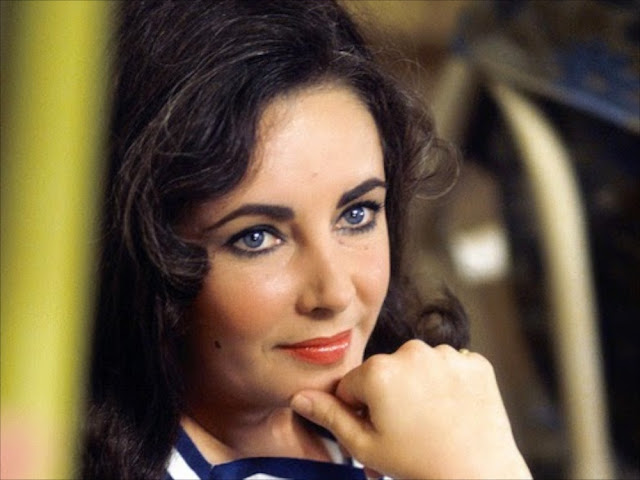
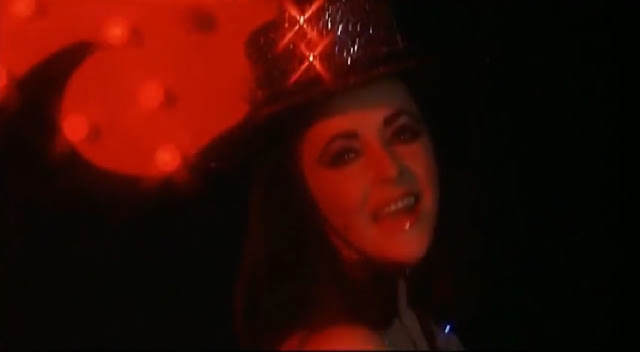
One of Elizabeth Taylor's directors accurately if unkindly said that "Elizabeth's face
is her fortune, but her body belongs to somebody else!" Yes, but what a face!


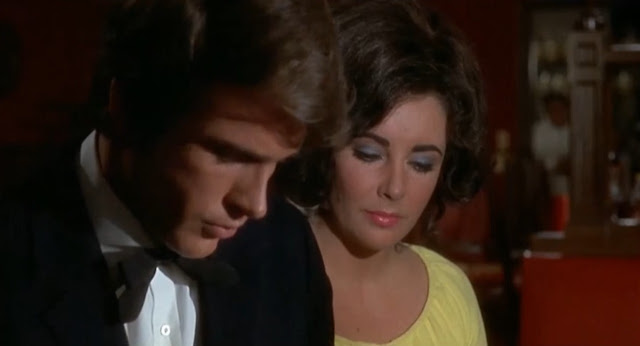
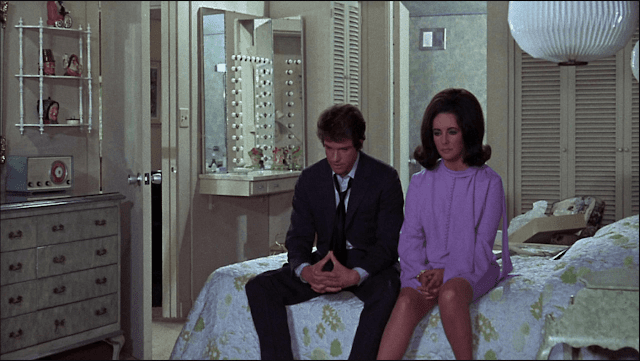
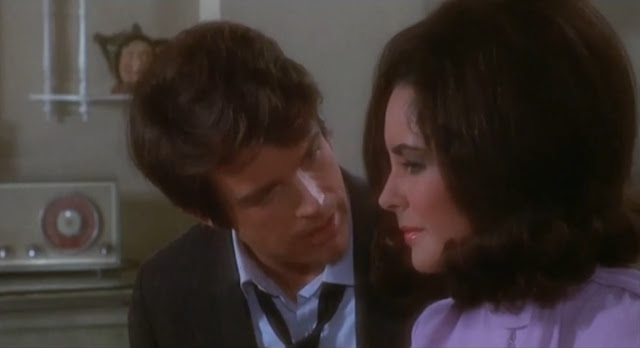
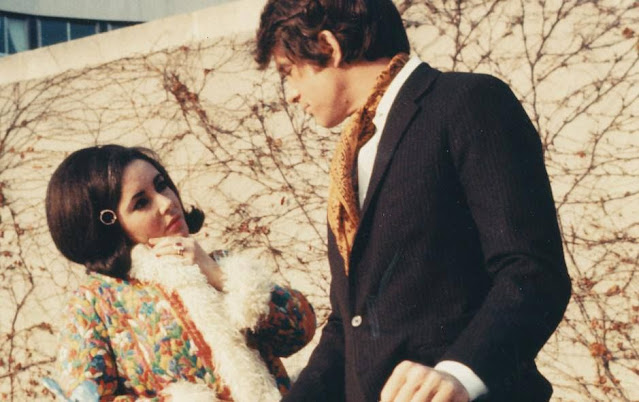
Warren Beatty & Elizabeth Taylor's rapport is one of the few bright spots in
1970's romantic drama,"The Only Game in Town."


A life-long Elizabeth Taylor fan, there are not many ET films that I won't repeat-watch, but The Only Game in Town is one. I found a great print of this flick recently, so I gave it a second try. Once again, I was bored to tears.

The Only Game in Town is basically a two-character Broadway play turned movie that was filmed late 1968/early '69, but dumped into release January, 1970! For the last time, The Only Game in Town won Elizabeth Taylor her highest salary, 1.25 million dollars. As in A Place in the Sun and Giant, Taylor got favored director George Stevens, but as with Monty Clift and James Dean, Taylor got a hot method leading man, Warren Beatty, fresh off Bonnie and Clyde. 

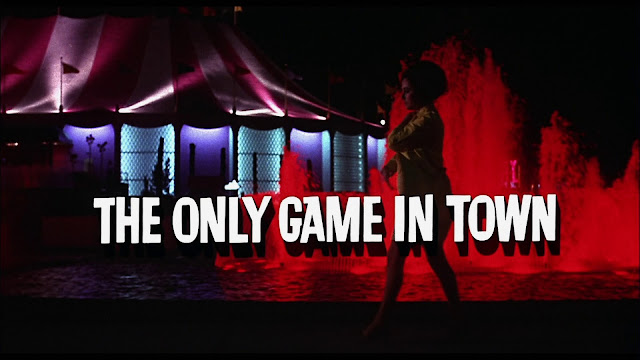
One of the few scenes of location shooting, the opening credits of ET strolling home.

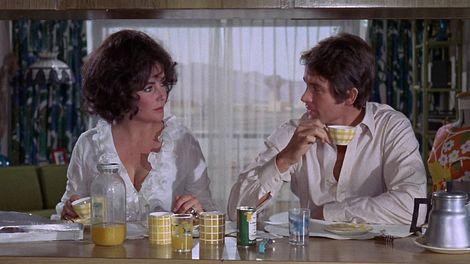
Game was set in Las Vegas, but filmed mostly in Paris. Why? So Taylor could be near Richard Burton, where he was filming his dud, Staircase. There was some exterior filming in Vegas. And if nearly all the film takes place in her character's apartment or with Beatty in casinos, what was the difference?

The one-night stand between Fran & Joe becomes something deeper in
"The Only Game in Town."

The real problem, as often the case with movies that bomb big, was the script. The Only Game in Town was first a poorly reviewed Broadway flop. Here, Warren Beatty's Joe is an addicted gambler and Taylor's Fran is an aging showgirl, waiting for her married lover to come through with a proposal. Then Joe and Fran hook up, start to fall for each other, and fight and make up along the way. That’s it.

ET doesn't even do jazz hands as the aging showgirl in "The Only Game in Town."

The other big problem with Game is both stars are miscast. Warren Beatty was far too young and breezy to be believable as a world-weary, down on his luck gambler. Frank Sinatra was first choice, but left when Taylor's emergency hysterectomy took a long recovery, and he left the project. Elizabeth Taylor, as many viewers noted, was too short and plump to play a Vegas showgirl. The perfect team would have been Sinatra and Shirley MacLaine, as an extension of the roles they played in Some Came Running a decade before.

Big stars, with even bigger hairstyles, in "The Only Game in Town."

What is unfair from today’s viewpoint is how many critics and film fans have dumped all the blame on Taylor. Many commented that Liz looked like Beatty's mother. Taylor did look matronly with her shapeless minis and with football helmet wigs. Some of this was the era’s style, none of which suited petite and plump Elizabeth. However, at 36, her face still looks quite lovely here. And while Beatty was boyish at 31, but he doesn't look like the kid from Splendor in the Grass. With Heaven Can Wait eight years later, Warren at 40 would start giving himself the soft focus treatment. Even if Taylor looks older, I think of all the prematurely aged actors like Gable, Cooper, Crosby, Stewart, and Astaire, acting opposite new stars like Audrey, Grace, or Leslie Caron— all a quarter of a century younger! And many of young Elizabeth’s co-stars were 15 to 20 years older, too. Here, Elizabeth hardly looked like a hag.

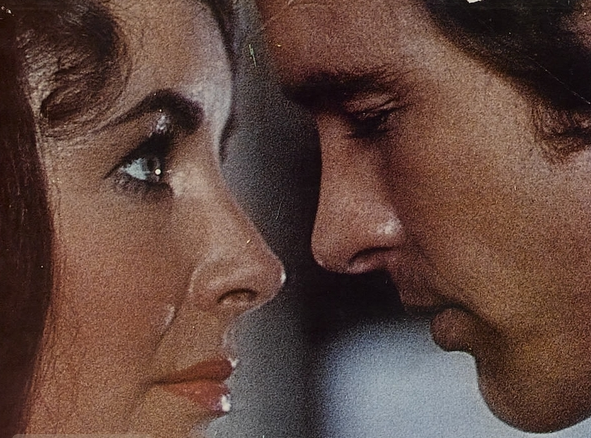
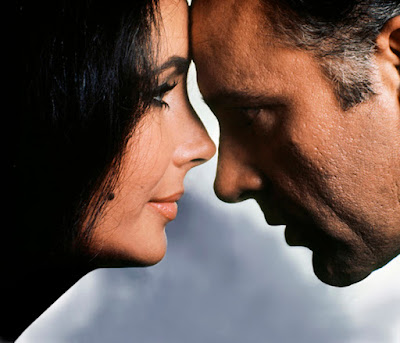
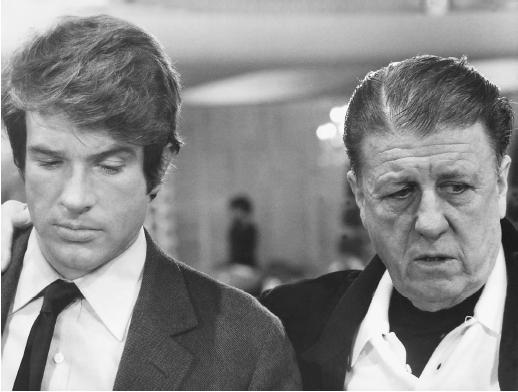
This profile photo of Elizabeth Taylor & Warren Beatty reminds me of a famous pic of ET & Richard taken five years before. Burton admitted concern over Beatty's charms.


Off-screen, Taylor and Beatty certainly had a mutual admiration society, to the point where hubby Richard Burton admitted concern. When Elizabeth said she thought of Warren as a brother, Burton replied, "Yes, but I worry about incest!" Taylor later told Barbara Walters that she rated Warren an 11 on a scale of one to 10. Elizabeth called Warren “Warren Beauty;” my nickname for him is “Sleeping Beatty!” I've always thought of Beatty as an artsy George Hamilton, but his wry charm can appeal. Beatty commented much later that he thought Elizabeth had the most beautiful face he’d ever seen and that he never met an actress less interested in acting, at that point.

Warren Beatty as Joe & Elizabeth Taylor as Fran, about to commit in "The Only Game in Town." One critic commented that ET's face was still a national attraction, but her performance was awfully grand. Warren's sleepy style didn't win raves, either.

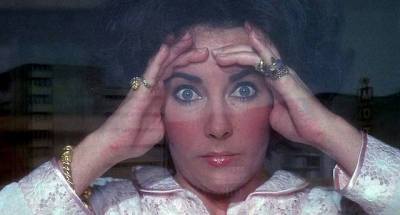
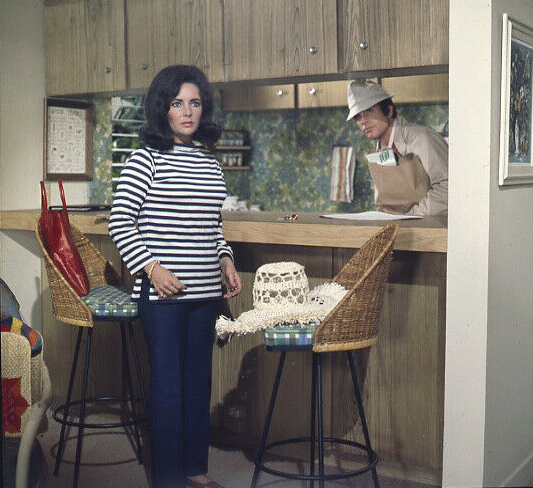
More than Taylor’s physical attributes, it’s her intrusive fame that distracts. What showgirl who’s a homebody that watches old movies would constantly be changing outfits, wigs, and wear full makeup just to sit around her apartment? Or wake up wearing tons of jewelry? Scenes with hefty Liz asking to be carried by Beatty into the bedroom, or questioning the size of a diamond ring, all seems like begging for ridicule. Also, has anyone ever noticed how much Kim Novak’s more believable Third Girl from the Left resembles The Only Game in Town? Both feature an aging showgirl, schmuck boyfriend, and younger beau.

Who wears their jewelry to bed? Elizabeth Taylor in "The Only Game in Town!"

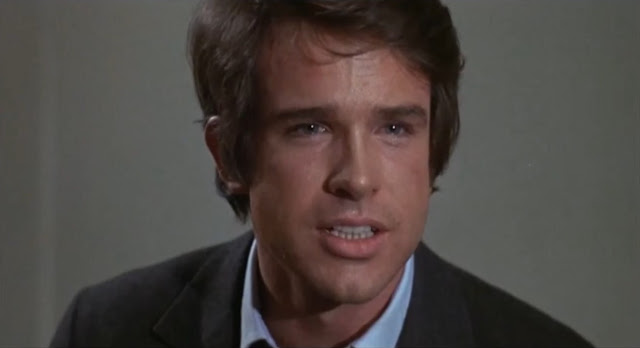
Despite Taylor being overly dramatic in the big scenes, she’s good in her brittle banter with Beatty. I like the scene where they twit each other by singing to each other from different rooms. While Warren Beatty is not one of my favorite actors, he does show a flair for humor. His youth plays against him, where his constant jokes doesn't seem like a defense mechanism of an older guy keeping reality at bay, but that of an immature jerk. Still, in his big scene, where he finally admits that he's in love with Fran, teary-eyed and all, Beatty’s genuinely touching.

Warren Beatty's great as Joe declares his love for Fran in "The Only Game in Town."

George Stevens was known for his character-driven, methodic style. You come to know the characters here, but after Fran turns down her long-time beau's proposal, the movie has nowhere else to go. This was Stevens’ last film and his work had become lethargic, as in 1965’s The Greatest Story Ever Told.

The only thing more boring than Fran's married lover finally agreeing to put a ring
on it is staring at the avocado green decor!

Vicki Tiel and Mia Fonssagrives were Taylor’s designer friends. Their clothes represent Taylor's worst style period. Yes, ET was not a '60s chick. But they really couldn't think of any other way of dressing her than to throw her in tent-like minis? Thankfully, they stick to solid colors, which makes ET's coloring pop. I'm sure hairdresser Alexandre of Paris knew the drill of what Liz wanted, but couldn't he have fashioned her wigs not to look like bowling balls? One critic correctly commented that Taylor looked like the dancing tomato from the old drive-in movie ads, in rounded ‘dos and muumuu minis, with her short legs sticking out.

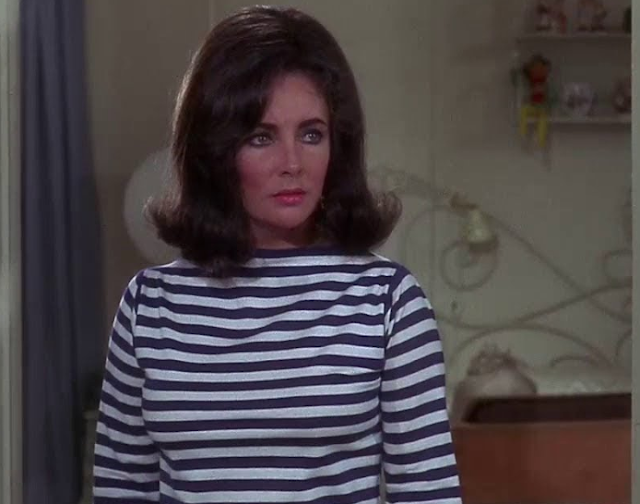
Liz looks lovely in an indigo blue boating top...

I guess ET's fancy designers forgot that stripes aren't exactly slimming when your star is short and chubby. And Elizabeth Taylor's hat is nearly as tall as she is!

Taylor hadn’t been slim on film since Cat on a Hot Tin Roof, but didn’t start getting called out on it until The Sandpiper. I recall Rex Reed’s quote about ET in Game, that she looked like “the Goodyear Blimp pumped full of Chasen’s chili.” The unkind comments on her weight reached fever pitch in the late ‘70s as a fat Republican wife, and Joan Rivers led the pack. It’s odd that in our current PC culture, some show biz writers or bloggers think it’s funny to make Liz Taylor fat or drunk jokes, while clutching their pearls over the same criticism of today’s stars.

While Warren Beatty enjoyed working with ET, the real reason he accepted
"The Only Game in Town" was to work with George Stevens. Beatty's later work reflected Stevens methodical style, for better and worse.

The Only Game in Town was an attempt at the kind of mainstream movie Elizabeth Taylor used to make. Critic Pauline Kael aptly wrote that “after the initial pleasure of seeing Elizabeth looking prettier than she has in years, Game is a sluggish star vehicle of the bad old days.” I don’t think anyone involved here was at their best, and watching this Game once is definitely enough.


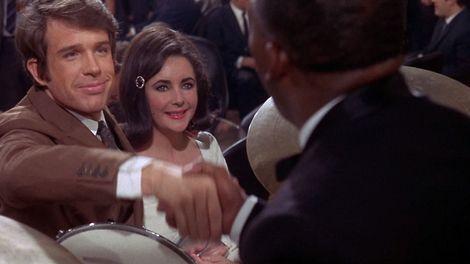
The scene where Joe wins big, then loses bigger, is one of the best from "The Only Game in Town." Interesting that Beatty began the decade starring with Vivien Leigh & ended with Elizabeth Taylor.

Here’s my post on the 10 year anniversary of Elizabeth Taylor’s passing: https://ricksrealreel.blogspot.com/2021/03/reflections-of-life-long-elizabeth.html

FYI: I put all the movie overflow on my public FB  movie page. 

Check it out & join!  https://www.facebook.com/groups/178488909366865/ 

Is this the apricot scarf Carly Simon wrote about in "Your So Vain?" 


Saturday, October 17, 2020

Monty Still Has ‘A Place in the Sun’ 1951

Elizabeth Taylor & Montgomery Clift, romantic dream team of 'A Place in the Sun.'

Montgomery Clift co-starred in several hit films with veteran stars, but 1951’s A Place in the Sun was the classic that Monty carried and cemented his stardom.

A Place in the Sun is based on Theodore Dreiser's 1925 tome, An American Tragedy, which was loosely taken from a real life drowning death earlier that century. Some have criticized Sun for being too lightweight in comparison to the novel. True, but Paramount failed once before, filming a gloomy ’31 version of this doomed romantic triangle of the ambitious young man romancing a poor girl, and a socialite. Director George Stevens wanted to make serious points about our society’s values. Yet, he was realistic enough to know that a young love triangle would draw audiences and make the drama as a whole more palatable. This was especially so, after he started working with stars Montgomery Clift and Elizabeth Taylor, and saw the sparks fly.

Montgomery Clift, the ambitious young man torn between Elizabeth Taylor & Shelley Winters.

Despite the romantic triangle vying for screen time with the damning message on wealth and social status, Sun is still a rather dark romantic picture. Clift as the conflicted protagonist spends most of his screen time leading a double life, covering up, and is at least partially responsible for the death of the young factory girl he has impregnated.

Montgomery Clift at age 29, during filming of 'A Place in the Sun.'

Clift is incredibly intense and vulnerable in this film. With each major scene as George Eastman, he becomes so stricken with tension and guilt, sweaty and hunched over, that he looks like he's in physical pain. At his best, Montgomery Clift is the greatest of "the big three" method acting gods, IMO. Imagine instead James Dean or Marlon Brando as George Eastman. Both could have been quite interesting, but Monty's far less mannered than James Dean, and far more open in his emotional torment than Brando. Marlon often backed his rawness with brute masculinity. Not that there's anything wrong with that! But it was almost a buffer for audiences, where Clift let his vulnerability show freely, with no apologies.

Monty as George Eastman, attempting to articulate his motives.

Did you know that Elizabeth Taylor was the only actress to appear as leading lady to all three of the '50's "method actor" greats—Clift, Dean, and Brando?

Monty wasn’t keen on Hollywood, but he still seemed drawn to movies, and only occasionally went back to the theater. Whatever his mindset, Monty’s situation mirrors his character’s, in that Clift desired, but was uncomfortable in a wealthy world that Elizabeth Taylor inhabited with ease.

Elizabeth Taylor as a wealthy girl who embodies poor, lonely boy Clift's dreams.

A Place in the Sun was actually filmed in the fall of '49 and wrapped up in early 1950. Several reasons have been given as to why the film wasn't released until nearly two years later, in the fall of '51. One factor for sure was George Stevens, always a methodical director, became even more so in his post-war work.

Montgomery Clift, at the peak of his powers and youth in 'A Place in the Sun.'

Montgomery Clift wasn’t the only person who influenced Elizabeth on the Sun set. George Stevens was another important person in Taylor’s life with his direction of her at the beginning and ending of her adult box office stardom.  A Place in the Sun was her first serious drama in ‘51. Giant turned Taylor into a super star in ‘56. And 1970's The Only Game in Town was Steven's final film and the last time Elizabeth Taylor received her million dollar salary.

Clift as George, the first time he lays eyes on Elizabeth Taylor, as Angela Vickers.

Someone astutely said that Elizabeth Taylor's look in A Place in the Sun set the standard for brunette beauty for a generation. Taylor also met another pro on this film who would become a lifetime associate and friend: Edith Head. Edie's violet-sprigged dress became THE prom gown for at least one movie season.

Sexy and seventeen! Elizabeth Taylor in her first iconic film look.

Elizabeth Taylor was just 17 when she filmed A Place in the Sun. Her co-stars, Montgomery Clift and Shelley Winters, were both a dozen years older than her. In the scene where Winters’ character, Alice Tripp, hems and haws for an abortion from a doctor, and he asks the pregnant girl her age. Tripp replies 22, while Winters was 29 in '49. The difference was Monty had significant stage experience and Shelley had come up the show biz ladder the hard way. Both had significantly more life experience than Elizabeth. Taylor started in movies at age 10 and was a star in National Velvet by 12. Extremely protected by both her parents and MGM, Elizabeth once aptly said that she "was a virgin both physically and mentally." Yet none of that shows on film, which is a testament to Taylor's innate screen ability.

Elizabeth's maternal quality was a Taylor character film constant, whether the recipient was a horse, dog, or leading man.

A trait that George Stevens focused on in Taylor was her maternal quality. Notice how many times Taylor cradles Clift in A Place in the Sun, as if she's mothering him. That she pulled this off and the "Tell Mama all" scene as a teen is most remarkable. A few have written that Stevens wisely avoided the movie clichés of great romance. In Sun, Angela's always on the periphery, and the first time George sees her, she doesn't even notice him. 

Shelley Winters is Alice Tripp, a factory girl who falls for Clift's restless George.

For Shelley Winters, who was playing sexy tarts with hearts, Sun was her big break as a serious actress. Like Cher later in Silkwood, a strong director required Winters to leave her glamour and ego at the door. Shelley wore little makeup, stopped bleaching her hair, and bought clothes off the rack, some even borrowed from her sister. While she knew the role was a winner, Winters’ ego as a woman was rightfully hurt, as Shelley was held up unflatteringly as a comparison to a gorgeous teenage Taylor. A wag once said, "George Stevens brought out something in Elizabeth Taylor that would make men kill for her, and something in Shelley Winters that made men want to kill HER."

Shelley Winters about to go into full whine mode in the row boat!

Director Stevens implies to great effect. How did that first night with George and factory girl Alice get by the censors?! Or when Alice goes to the doctor after she becomes pregnant? Even implied candor got censored back then. And yes, this was the first of many movies where water was not Shelley Winters' friend!

If looks could kill. George listens to Alice's oblivious plans for their married life.

It's been said that the wonderful Anne Revere, who plays Clift's pious parent (and also played Taylor's mother in National Velvet) was greatly edited out of her place in the sun because she was blacklisted. I question that, because I'm not sure how much more she would have fit in the over two hour film. You see her when George calls her after he’s connected with wealthy relatives and again when he's in trouble for murder. Since she lives afar, where else would she have fit in a scene? 

Anne Revere plays Clift's religious mother, who visits him on death row.
By the time 'A Place in the Sun' was released, Revere was blacklisted.

The only performance I found less than stellar was Raymond Burr as the district attorney. Glowering menacingly, he becomes more threatening to the point of his histrionic breaking of the oar in the boating accident reconstruction scene. Also, having watched a lot of Perry Mason in the last year, I was surprised how much heavier Burr was in his early years as the heavy.

Elizabeth Taylor & Montgomery Clift became best friends on this film.

Clift and Taylor became fast and famous friends, and often looked for vehicles to perform in. They reunited in the ill-fated 1957 epic Raintree County, where Monty endured his near-fatal car accident. They appeared two years later in Suddenly, Last Summer. This film was a triumph for Elizabeth and Katharine Hepburn, with Monty on the sidelines, who was hard to cast at this point.

Clift's George Eastman, whose dreams have ended on death row.

Taylor and Clift were to reunite for 1967’s Reflections in a Golden Eye. The role of the closeted army major seemed ideal for Clift, with Taylor reprising her bitchy southern belle persona. Clift was considered uninsurable at this point, and Taylor shut up the studio suits by offering her million dollar salary as insurance for Monty. Everyone was amazed, including Monty. Sadly, Clift died at 45, before filming started. Monty was replaced by Marlon Brando. And Taylor was obligated to make a movie that she had agreed to do, for Monty's sake. How fitting it was that Clift and Taylor first met at the beginning of his stardom, and that Elizabeth was one of the few who stood by him to the end. Monty only made a handful of films, with a few that are bonafide classics. For that, Montgomery Clift will always have his cinematic place in the sun.

Life and art often blurred for Elizabeth Taylor, but who was always there for her dear friend Montgomery Clift.

FYI: I put all the movie overflow on my public FB  movie page. 

Check it out & join!  https://www.facebook.com/groups/178488909366865/