Showing posts with label Montgomery Clift. Show all posts

Friday, January 28, 2022

Tyrone Power’s Personal Best: 'Nightmare Alley' 1947

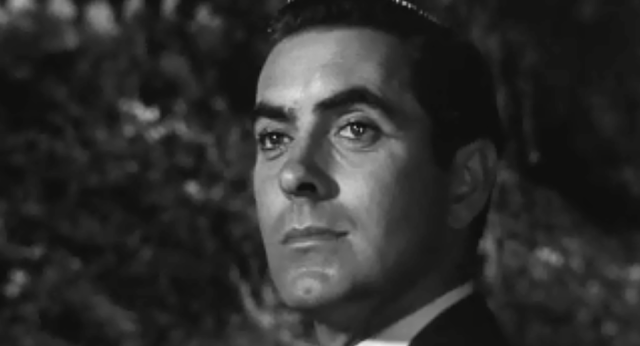
Tyrone Power as Stan Carlisle, charismatic con man, in 1947's "Nightmare Alley."


Tyrone Power became an instant star at 20th Century Fox in 1936, in Lloyd’s of London. Ty was their combination of Robert Taylor and Clark Gable. Studio head Darryl F. Zanuck considered him their golden boy, and Ty was still a top star over two decades later, when he died at 44 in 1958. At the peak of his stardom, Tyrone Power pushed to make the bleak film noir, 1947’s Nightmare Alley.
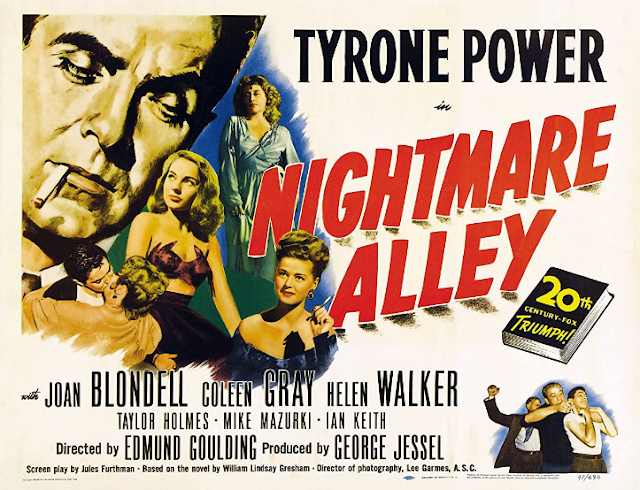
Legend has it that studio head Darryl F. Zanuck placated top star Tyrone Power
in making "Nightmare Alley," but basically dumped it upon release.

In Nightmare Alley’s opening carny scenes, Tyrone Power is slim and darkly handsome in his white tee shirts, reminiscent of another young hustler on the make, Montgomery Clift in 1951’s A Place in the Sun. Though Power was an intelligent and sensitive actor, I think Tyrone was closer to Rock Hudson in terms of image and talent. Clift played against his looks, until Monty lost them in his car accident; Power played the matinee idol, as Hudson later did.
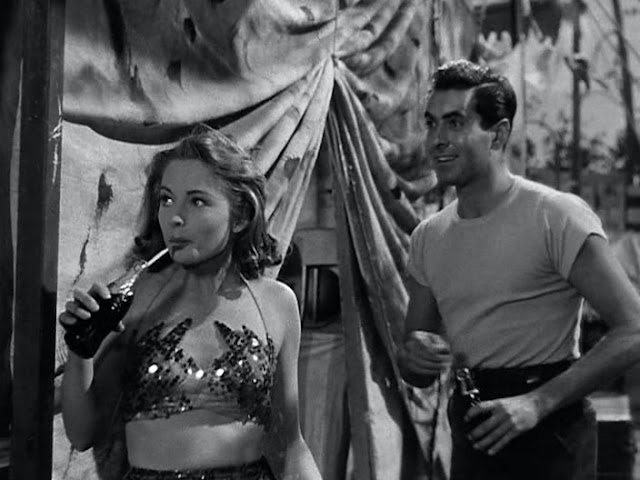
Tyrone Power's Stan Carlisle begins as a carny sucking up to the females in "Nightmare Alley."


Yet, Power and Hudson deserve credit for rising to the occasion in later, better roles. Fox studio head Darryl F. Zanuck initially opposed Tyrone’s plan to make 1947’s Nightmare Alley; nearly two decades later, Rock Hudson was also advised against playing a fatalistic role in 1966’s dark sci-fi drama, Seconds. Interestingly, their characters pretend to be something they’re not. Both films had downbeat endings; neither film was given a great release, despite some strong reviews, and both failed at the box office. Today, they are cult classics.
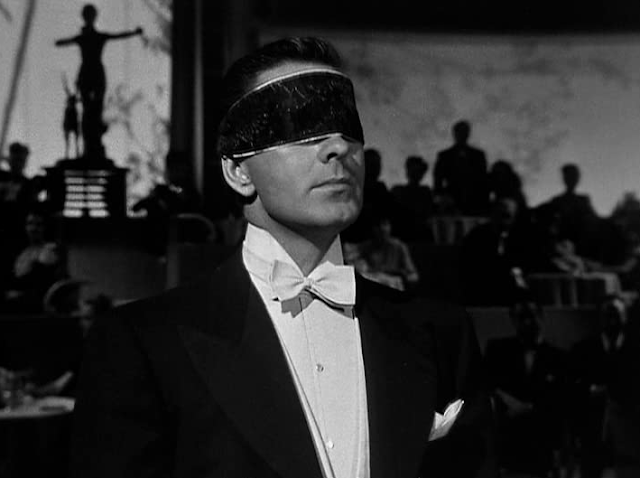
Tyrone Power's "The Great Stanton" has moved up to the nightclub circuit in "Nightmare Alley."

Power’s Stan Carlisle goes from hustling carny to nightclub trickster to faux spiritualist throughout the course of Nightmare Alley. Even Stan senses at some point he's going to trip himself up, yet this slick climber just can't help himself. 

Stan's natural good looks, charm, and gift of gab are both his meal ticket and his downfall. He’s coasted on these gifts, to get him through tough times. Stan has moments of clarity when he admits that he's no good or reveals his true intentions. Then the wall of self-belief goes back up. The moments when Stan truly reveals himself are tantalizing, as they’re like a cloud that passes over his forced sunny vision that what he's doing is just fine. Tyrone Power's charm is just as effortless, yet his subtle glances let you see that Stan’s wheels are turning. Ty’s warm eyes turn hard when things aren't going the hustler’s way, or Stan’s lofty speechifying—are all excellently done. 
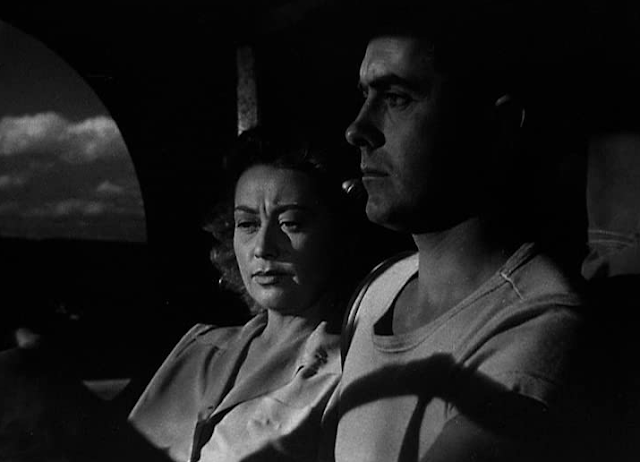
A telltale moment when Tyrone Power's con man shares his real ambitions. 
Also, love it when Joan Blondell puts out her cigarette on the vehicle dashboard!


Ironically, director Edmund Goulding had just directed Tyrone Power in 1946’s The Razor's Edge, where Power plays a man genuinely seeking spiritual enlightenment. In Nightmare Alley, he plays a man faking spiritual powers throughout, though he's desperately seeking something. As Tyrone Power's Stan becomes all "spiritual," his proselytizing reminds me of Ronald Reagan's speechifying! 

Love this opening shot of Joan Blondell in "Nightmare Alley": Sexy and world weary.
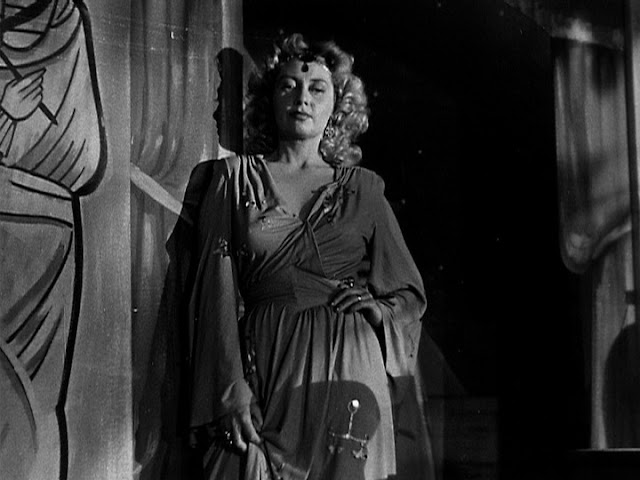
Joan Blondell gives a strong, natural performance as Zeena, Stan's first mark in the film. Joan was 41 when she made Nightmare Alley and there’s no attempt made to hide the fact. Joan’s slightly blowsy looking broad is contrasted by her good heart and straightforward manner, which makes her very appealing in contrast to Powers’ smoothie Stan. Blondell is effortlessly believable; Nightmare Alley and A Tree Grows in Brooklyn should have led to better roles. Instead, the studio system just considered Blondell over the hill.
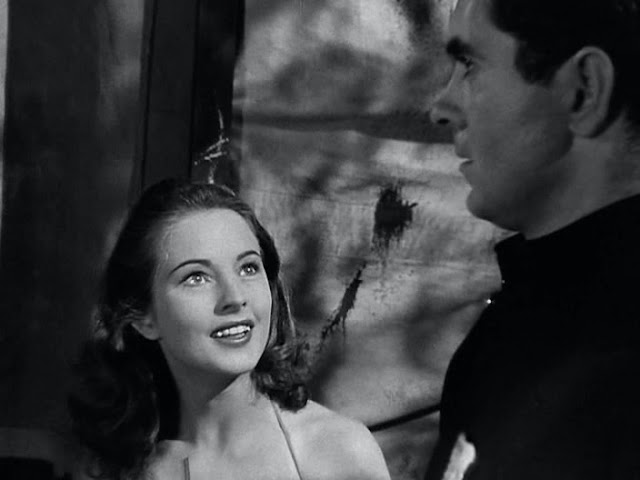
Coleen Gray as naive Molly, conflicted by Stan's charm & her own common sense.

Coleen Gray goes above and beyond the typical starlet acting turn. Gray is solid and sincere as Molly, the younger carny girl with whom Stan replaces Zeena. Gray's character is decent, if a bit naive. Despite her strong arguments with Stan, Molly just can't say no to him.

Ian Keith as Pete, Zeena’s alcoholic hubby, is both pathetic and chilling in his personal decline. Taylor Holmes gets to run the gamut as the skeptic millionaire, Ezra Grindle, who eventually falls for the psychic’s scam, leading to a powerful climactic scene. The entire supporting cast is strong, playing their roles with conviction.
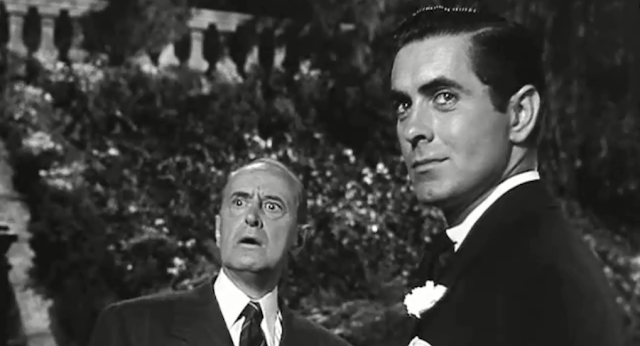
Tyrone Power's Stan scams rich skeptic (Taylor Holmes), in "Nightmare Alley."
Note tell-tale signs of Power's aging; compare this shot to the telling close-up at the top.

Stan really slips when he gets mixed up with supercillious shrink Lilith Ritter, played with unnerving steel by Helen Walker. The doctor seems interested in him, but Stan keeps her at arm's length, which may be partly the reason she plays him for a fool. Though Stan sees her recording patients’ sessions, he still comes to her couch to unload. That’s hella hubris on his part to think she wouldn't turn the recording table on him, just because he’s good at charming and conning.
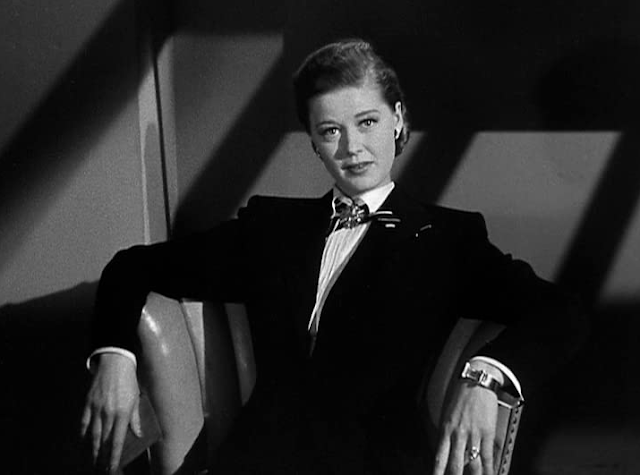
Helen Walker had a distinctive physical presence and should have been a bigger star.
But she was one of those Hollywood starlets who flamed out. Here as the tough shrink.

This is Tyrone Power's vehicle all the way, and he's excellent in his star performance as a charismatic heel. Tyrone was at the peak of his physical beauty here and his Stan looks boyish in the beginning, sophisticated in suits and tuxes in mid-film, and then hard living as his deeds catch up to him by the finale. It makes me think that Tyrone Power might have made a marvelous Dorian Gray.
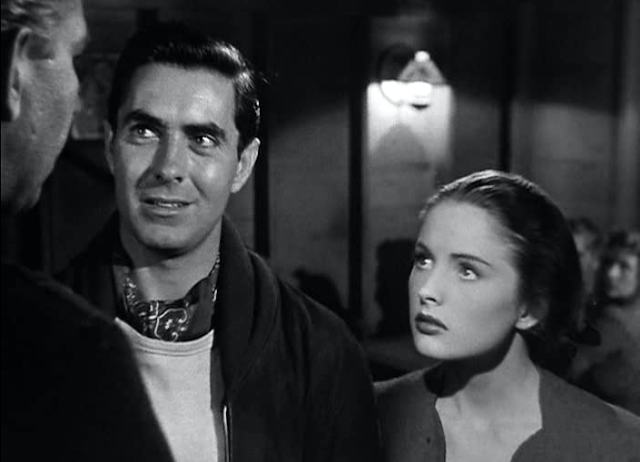
Some Ty side-eye! Power's Stan assesses his latest jam, in "Nightmare Alley."

Edmund Goulding does a great job directing. The cinematography by Lee Garmes is striking, a beautiful example of a noir nightmare, with its takes on carnival life, city nights, etc. The movie is taut, fast-paced, and adult, in great part due to Jules Furthman’s screenplay. Considering William Lindsay Gresham’s novel is much more explicit, it's amazing what made it to the screen. The ending is a bit of a cop out, but that was imposed on the project by the studio.
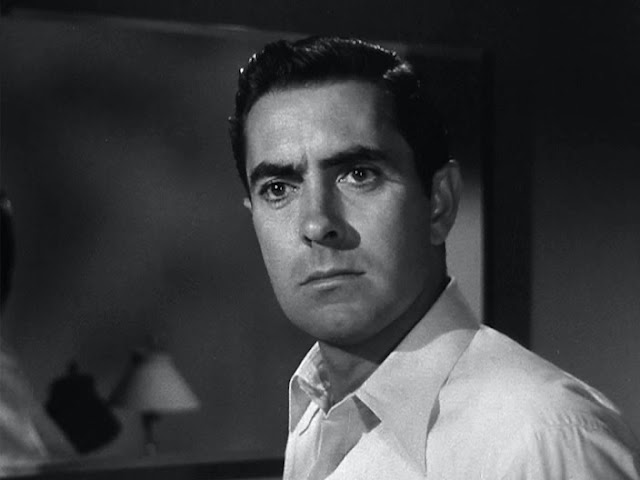
One of film's most handsome men, Tyrone Power could have been a perfect Dorian Gray.


I’m not much of film noir fan, with all their improbable coincidences, but Nightmare Alley is a riveting character study of a flawed man going full circle, with only himself to blame for his downward spiral and fate.
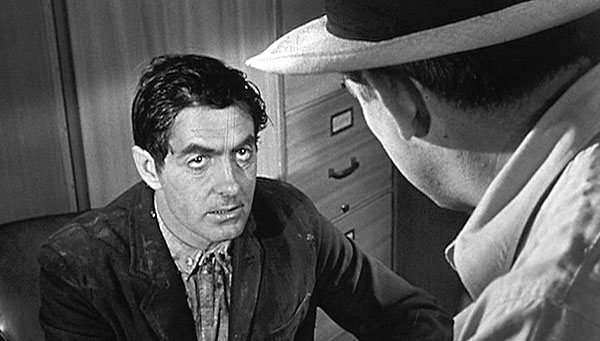
Tyrone Power's Stan at the bitter end of "Nightmare Alley."
Doesn't Ty look like George Clooney on a bender here?

Here’s my look at the other movie where Tyrone Power played a charming con man, 1957’s Witness for the Prosecution:

https://ricksrealreel.blogspot.com/2020/11/witness-for-prosecution-1957.html


All my movie overflow is on my public FB movie page. Check it out & join!  

https://www.facebook.com/groups/178488909366865/


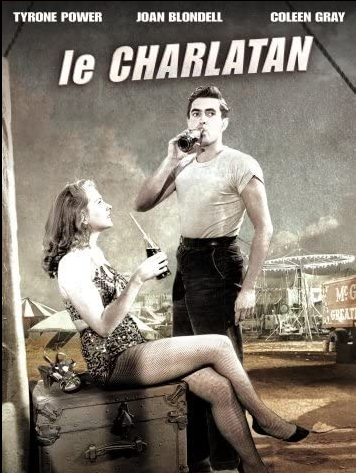
This poster for "Nightmare Alley" is much more to the point!
 

Monday, May 10, 2021

‘Elizabeth and Monty’: Bio Explores Famed Friendship

Author Charles Casillo is the first to write a duo biography of iconic film team
 Elizabeth Taylor and Montgomery Clift.


Elizabeth Taylor and Montgomery Clift’s fabled friendship has been written about before. However, Elizabeth and Monty: The Untold Story of Their Intimate Friendship, by Charles Casillo, is the first full-length book about their relationship. The duo biography comes out May 25th.

 Author Casillo mixes interviews from show business folk that he has gathered over the years. Also, Casillo has a discerning eye, as he culled information from a wide range of books and interviews that have documented the stars' lives and careers. As author of several movie biographies and a show biz professional himself, Casillo has a keen knowledge of classic Hollywood and offers an even-handed, empathetic eye toward great stars living and working under the scrutiny of the press and public.

Montgomery Clift & Elizabeth Taylor: The '50s movie dream team.

Elizabeth and Monty is a subtle rebuttal of the recent Making Montgomery Clift documentary. The project was made by Clift's nephew, utilizing materials archived by Clift's brother. The doc correctly zeroes in on the biggest problem of celebrity bios of troubled stars: Books and film stories of tragic stars accentuate the negative, and give the impression that such stars never had a happy moment in their lives. Marilyn, Judy, and Monty are always held up as cautionary tales of this genre. While Elizabeth Taylor was alive, the tabloid media was gleeful when she was sick, divorced, or fat, with handwringing over how fame and fortune doesn't bring happiness. Making Montgomery Clift shows a playful side of Monty, not tormented from being gay, per se. However, what the doc doesn't address at all is WHY Monty was so spectacularly self-destructive. Charles Casillo goes further in exploring that Clift wasn’t unhappy about his gay side, but having to hide it. The author does feel that Clift’s core unhappiness goes back to a childhood, where he was held up by his strong-willed mother as the special one in the family. Yet, Casillo sensibly points out that there is too much emphasis on trying to show a specific incident or reason as to why an artist like Clift went off the rails. Whatever the reasons were, the sensitive Clift reacted to it throughout his short life. Elizabeth had a similar upbringing with her mother, which is perhaps why Taylor and Clift bonded instantly. She similarly melded the same way later with Michael Jackson, who had a difficult childhood and stage parent from hell, too.

Elizabeth Taylor was an empathetic, loyal friend to Montgomery Clift.

Clift’s good friends—performers who didn't become professional show biz tale tellers later—recalled how they had to ultimately walk away from him. Those reliable sources note his obsession with pills, massive boozing, and how he turned into an infantile version of Mr. Hyde when high on either or both.

'Raintree County': Even before Montgomery Clift's famous car crash, at 35,
Monty's alcohol and pill abuse was already taking its toll on his face and body.

As for Elizabeth, I think her issues with substances started with her unending health issues, some nearly deadly. But like many showbiz people, who are expected to “sparkly, Neely, sparkle” 24/7, Elizabeth found that a pill or a cocktail, then more and more, took the edge off. I found it admirable that Elizabeth, at an age when most addicted stars were well down the slippery path, sought help, and did so publicly. That inner strength was perhaps what once led Elizabeth to swear that she’d never end up like Judy. It's interesting though, that while Monty and Elizabeth had a love/hate relationship with fame, Taylor wore it far more lightly.

The car accident that changed Montgomery Clift's life, after leaving
Elizabeth Taylor's home on May 12, 1956.

The book balances the hectic personal and professional lives of both stars well, wisely focusing on their most important times together. In intelligent, yet very readable prose, Casillo tells of “Bessie Mae” and Monty’s relationship, on-screen and off. I also admire that the author doesn’t shy away from the more sexual aspects of Taylor and Clift’s personal lives, but doesn’t sensationalize them, either.

Montgomery Clift at age 39 in "Suddenly, Last Summer."

Taylor and Clift teamed for three films—A Place in the Sun, Raintree County, and Suddenly, Last Summer—and their last attempt was a reunion that wasn't meant to be: Reflections in a Golden Eye. Casillo offers great on-screen and off-screen backstories on all counts.

Montgomery Clift in his last completed film, 'The Defector,' in 1966.
Monty's co-star is friend and one-time lover Roddy McDowall. 

Monty died shortly before filming began on Reflections in a Golden Eye. And judging from Clift’s looks in his last film, The Defector, Monty was in no shape to play an Army type, in such a demanding role. Had he been in better shape Clift might have been just fine, a counterpoint to macho From Here to Eternity. 

Elizabeth Taylor is flanked by Richard Burton & Montgomery Clift at the
'Night of the Iguana' premiere in 1964. The film's director, John Huston,
was to direct Taylor and Clift later, in 'Reflections in a Golden Eye.'

In Making Montgomery Clift, Clift's nephew notes that Monty made just as many films after Raintree County as he did before. That basically sums up the rose-colored glasses clarity of this Clift family doc. True, Monty turned in some fascinating performances that were informed by his post-accident persona, but his few hit movies were carried by other stars. And Elizabeth Taylor figured prominently in his latter day work. MGM floated the idea of partially recouping costs with their insurance and replacing Monty on Raintree County. Also, during Suddenly, Last Summer, the powers that be wanted to re-cast the erratic Clift. Elizabeth’s response to these suggestions was along the same lines: “Over my dead body.” And when studio execs didn’t want Monty for Reflections in a Golden Eye, because he was considered uninsurable, Taylor settled the situation by putting up her million dollar salary as collateral. You how many friends there are like that in Hollywood? Yeah, one in a million! As for the doc’s claim that Clift wasn’t all that perturbed losing his looks to his car crash—please. What actor, much less one of show business’ most handsome faces, would think that? Again, author Casillo subtly refutes this notion with facts from Clift’s friends.

The beginning of a beautiful friendship: Elizabeth Taylor & Montgomery Clift
at the premiere of 'The Heiress' in 1949. Taylor was 17 & Monty a dozen years older.

Charles Casillo could have written volumes about the twist and turns of Taylor and Clift’s lives. Casillo offers a fine focus on the two film legends times together, a recap for their fans and a primer for those just finding out all about Elizabeth and Monty.

Author Charles Casillo.

This duo biography is out May 25.

Here’s the link to Charles Casillo’s Elizabeth and Monty: The Untold Story of Their Intimate Friendship at Amazon:

https://www.amazon.com/Elizabeth-Monty-Untold-Intimate-Friendship/dp/1496724798

Rick’s film blog here: https://ricksrealreel.blogspot.com/

My review for Taylor and Clift’s A Place in the Sun here: https://ricksrealreel.blogspot.com/2020/10/monty-still-has-place-in-sun-1951.html

My review for Taylor and Clift’s last pairing, Suddenly, Last Summer, here: https://ricksrealreel.blogspot.com/2018/03/suddenly-last-summer-1959.html

My tribute to the 10 year anniversary of Elizabeth Taylor’s passing here: https://ricksrealreel.blogspot.com/2021/03/reflections-of-life-long-elizabeth.html

FYI: I put all the movie overflow on my public FB  movie page. 

Check it out & join!  https://www.facebook.com/groups/178488909366865/


Saturday, October 17, 2020

Monty Still Has ‘A Place in the Sun’ 1951

Elizabeth Taylor & Montgomery Clift, romantic dream team of 'A Place in the Sun.'

Montgomery Clift co-starred in several hit films with veteran stars, but 1951’s A Place in the Sun was the classic that Monty carried and cemented his stardom.

A Place in the Sun is based on Theodore Dreiser's 1925 tome, An American Tragedy, which was loosely taken from a real life drowning death earlier that century. Some have criticized Sun for being too lightweight in comparison to the novel. True, but Paramount failed once before, filming a gloomy ’31 version of this doomed romantic triangle of the ambitious young man romancing a poor girl, and a socialite. Director George Stevens wanted to make serious points about our society’s values. Yet, he was realistic enough to know that a young love triangle would draw audiences and make the drama as a whole more palatable. This was especially so, after he started working with stars Montgomery Clift and Elizabeth Taylor, and saw the sparks fly.

Montgomery Clift, the ambitious young man torn between Elizabeth Taylor & Shelley Winters.

Despite the romantic triangle vying for screen time with the damning message on wealth and social status, Sun is still a rather dark romantic picture. Clift as the conflicted protagonist spends most of his screen time leading a double life, covering up, and is at least partially responsible for the death of the young factory girl he has impregnated.

Montgomery Clift at age 29, during filming of 'A Place in the Sun.'

Clift is incredibly intense and vulnerable in this film. With each major scene as George Eastman, he becomes so stricken with tension and guilt, sweaty and hunched over, that he looks like he's in physical pain. At his best, Montgomery Clift is the greatest of "the big three" method acting gods, IMO. Imagine instead James Dean or Marlon Brando as George Eastman. Both could have been quite interesting, but Monty's far less mannered than James Dean, and far more open in his emotional torment than Brando. Marlon often backed his rawness with brute masculinity. Not that there's anything wrong with that! But it was almost a buffer for audiences, where Clift let his vulnerability show freely, with no apologies.

Monty as George Eastman, attempting to articulate his motives.

Did you know that Elizabeth Taylor was the only actress to appear as leading lady to all three of the '50's "method actor" greats—Clift, Dean, and Brando?

Monty wasn’t keen on Hollywood, but he still seemed drawn to movies, and only occasionally went back to the theater. Whatever his mindset, Monty’s situation mirrors his character’s, in that Clift desired, but was uncomfortable in a wealthy world that Elizabeth Taylor inhabited with ease.

Elizabeth Taylor as a wealthy girl who embodies poor, lonely boy Clift's dreams.

A Place in the Sun was actually filmed in the fall of '49 and wrapped up in early 1950. Several reasons have been given as to why the film wasn't released until nearly two years later, in the fall of '51. One factor for sure was George Stevens, always a methodical director, became even more so in his post-war work.

Montgomery Clift, at the peak of his powers and youth in 'A Place in the Sun.'

Montgomery Clift wasn’t the only person who influenced Elizabeth on the Sun set. George Stevens was another important person in Taylor’s life with his direction of her at the beginning and ending of her adult box office stardom.  A Place in the Sun was her first serious drama in ‘51. Giant turned Taylor into a super star in ‘56. And 1970's The Only Game in Town was Steven's final film and the last time Elizabeth Taylor received her million dollar salary.

Clift as George, the first time he lays eyes on Elizabeth Taylor, as Angela Vickers.

Someone astutely said that Elizabeth Taylor's look in A Place in the Sun set the standard for brunette beauty for a generation. Taylor also met another pro on this film who would become a lifetime associate and friend: Edith Head. Edie's violet-sprigged dress became THE prom gown for at least one movie season.

Sexy and seventeen! Elizabeth Taylor in her first iconic film look.

Elizabeth Taylor was just 17 when she filmed A Place in the Sun. Her co-stars, Montgomery Clift and Shelley Winters, were both a dozen years older than her. In the scene where Winters’ character, Alice Tripp, hems and haws for an abortion from a doctor, and he asks the pregnant girl her age. Tripp replies 22, while Winters was 29 in '49. The difference was Monty had significant stage experience and Shelley had come up the show biz ladder the hard way. Both had significantly more life experience than Elizabeth. Taylor started in movies at age 10 and was a star in National Velvet by 12. Extremely protected by both her parents and MGM, Elizabeth once aptly said that she "was a virgin both physically and mentally." Yet none of that shows on film, which is a testament to Taylor's innate screen ability.

Elizabeth's maternal quality was a Taylor character film constant, whether the recipient was a horse, dog, or leading man.

A trait that George Stevens focused on in Taylor was her maternal quality. Notice how many times Taylor cradles Clift in A Place in the Sun, as if she's mothering him. That she pulled this off and the "Tell Mama all" scene as a teen is most remarkable. A few have written that Stevens wisely avoided the movie clichés of great romance. In Sun, Angela's always on the periphery, and the first time George sees her, she doesn't even notice him. 

Shelley Winters is Alice Tripp, a factory girl who falls for Clift's restless George.

For Shelley Winters, who was playing sexy tarts with hearts, Sun was her big break as a serious actress. Like Cher later in Silkwood, a strong director required Winters to leave her glamour and ego at the door. Shelley wore little makeup, stopped bleaching her hair, and bought clothes off the rack, some even borrowed from her sister. While she knew the role was a winner, Winters’ ego as a woman was rightfully hurt, as Shelley was held up unflatteringly as a comparison to a gorgeous teenage Taylor. A wag once said, "George Stevens brought out something in Elizabeth Taylor that would make men kill for her, and something in Shelley Winters that made men want to kill HER."

Shelley Winters about to go into full whine mode in the row boat!

Director Stevens implies to great effect. How did that first night with George and factory girl Alice get by the censors?! Or when Alice goes to the doctor after she becomes pregnant? Even implied candor got censored back then. And yes, this was the first of many movies where water was not Shelley Winters' friend!

If looks could kill. George listens to Alice's oblivious plans for their married life.

It's been said that the wonderful Anne Revere, who plays Clift's pious parent (and also played Taylor's mother in National Velvet) was greatly edited out of her place in the sun because she was blacklisted. I question that, because I'm not sure how much more she would have fit in the over two hour film. You see her when George calls her after he’s connected with wealthy relatives and again when he's in trouble for murder. Since she lives afar, where else would she have fit in a scene? 

Anne Revere plays Clift's religious mother, who visits him on death row.
By the time 'A Place in the Sun' was released, Revere was blacklisted.

The only performance I found less than stellar was Raymond Burr as the district attorney. Glowering menacingly, he becomes more threatening to the point of his histrionic breaking of the oar in the boating accident reconstruction scene. Also, having watched a lot of Perry Mason in the last year, I was surprised how much heavier Burr was in his early years as the heavy.

Elizabeth Taylor & Montgomery Clift became best friends on this film.

Clift and Taylor became fast and famous friends, and often looked for vehicles to perform in. They reunited in the ill-fated 1957 epic Raintree County, where Monty endured his near-fatal car accident. They appeared two years later in Suddenly, Last Summer. This film was a triumph for Elizabeth and Katharine Hepburn, with Monty on the sidelines, who was hard to cast at this point.

Clift's George Eastman, whose dreams have ended on death row.

Taylor and Clift were to reunite for 1967’s Reflections in a Golden Eye. The role of the closeted army major seemed ideal for Clift, with Taylor reprising her bitchy southern belle persona. Clift was considered uninsurable at this point, and Taylor shut up the studio suits by offering her million dollar salary as insurance for Monty. Everyone was amazed, including Monty. Sadly, Clift died at 45, before filming started. Monty was replaced by Marlon Brando. And Taylor was obligated to make a movie that she had agreed to do, for Monty's sake. How fitting it was that Clift and Taylor first met at the beginning of his stardom, and that Elizabeth was one of the few who stood by him to the end. Monty only made a handful of films, with a few that are bonafide classics. For that, Montgomery Clift will always have his cinematic place in the sun.

Life and art often blurred for Elizabeth Taylor, but who was always there for her dear friend Montgomery Clift.

FYI: I put all the movie overflow on my public FB  movie page. 

Check it out & join!  https://www.facebook.com/groups/178488909366865/


Sunday, March 11, 2018

Suddenly, Last Summer 1959


What happened Suddenly, Last Summer? An aging southern socialite wasn’t able to accompany her son on their travels, so he took his beautiful young cousin instead. The poet son died under mysterious circumstances, and the girl has suffered a mental breakdown. The rich aunt now wants extreme measures to quiet her niece. A doctor, at the institution where the young woman is held, fights to find out the truth. That’s the short take on the over-the-top 1959 film, taken from Tennessee Williams’ one-act play, which is still riveting as hell.
"Truth is the bottom of a bottomless well."

Of the many facets of Suddenly, Last Summer that fascinate, it’s Tennessee Williams’ subliminal self reflection on his life and career that resonates for me. The film and its source material have been criticized for gay self-loathing. True, but it was reflective of what many gays experienced during his era, and shouldn’t be forgotten. The playwright also addresses his eternal struggle, to write about often painful things, countered with anesthetic but counterproductive partying with booze, boys, and drugs. Fading youth is a frequent Williams’ lament. The civilized world versus the more base elements of life is another. Williams’ commentary comes through in some of my favorite lines in Suddenly, Last Summer.   
As I get older, this has become my favorite line from 'Suddenly, Last Summer.'

Wealthy New Orleans matron Violet Venable was the lone unsympathetic role in Katharine Hepburn's long career—and she hated playing the part. Why? Speculation ran the gamut. A few naïve souls said that Kate didn’t realize this was gay material—this seems absurd, as Hepburn worked with gays her whole career, and was most likely a lesbian herself. Others said that while Hepburn strongly wanted to work with Williams, but regretted playing the villain, and she preferred to be the headstrong but likeable heroine.
Still, some thought it was simply ego. Hepburn, accustomed to being the star attraction, was now playing second lead to a younger actress, Elizabeth Taylor. Adding insult was the film’s climax, when Elizabeth is shown in flashback in all her sexy swimsuit glory, contrasted with cruel close-ups of Hepburn’s unfiltered face and wrinkled hands, to emphasize that Aunt Violet’s illusions are shattered.
Hepburn was furious after seeing these shots.
Mankiewicz shot Kate unfiltered at 'Summer's' end.

Hepburn was famous for spitting at director Joseph Mankiewicz on the last day of shooting Summer, allegedly over his treatment of troubled co-star Montgomery Clift. For many years, this was the story told by Hepburn and others. Much later, Kate said it was over the director’s above-described treatment of her. It’s noteworthy that Joe was Kate’s producer on two of her biggest MGM hits, The Philadelphia Story and Woman of the Year. Given their history, Kate was unpleasantly surprised that he favored 27-year-old Elizabeth over her 52-year-old self.
For most of the movie, Hepburn was photographed as a mature beauty, easy to accomplish with her slim figure and still-striking bone structure. But Kate, who liked to give the impression that she had no time for Hollywood glamour, was just as fussy as Joan Crawford or Lana Turner over how she appeared onscreen.
Thankfully, Hepburn, with her distinctive staccato vocals, does not attempt a southern accent. The dragon dowager who wants to shut up a “babbling” young woman with a new “operation” is basically Williams’ mother and his emotionally fragile sister, Rose, who was given a lobotomy to control her outbursts. Hepburn’s natural authority as Violet is combined with a cool charm that barely conceals her rage at a niece whom she blames for her son’s death. Hepburn blazes through Williams’ long monologues as though she wants the promising doctor to bear witness to her pain. As Violet, Hepburn gets to lament life’s unfairness, charm the young doctor, insult her greedy family and most of all, confront her young niece, played by Taylor.
Director Joe Mankiewicz with his star. Notice "Mank" is wearing gloves, due to a skin condition exacerbated by stress!

On Hepburn, Joe Mankiewicz later opined in the early ‘70s that Hepburn was “the most experienced amateur actress in the world…whose performances, though remarkably effective, are fake.” Interestingly, critic Pauline Kael echoed the same sentiments later, on Kate’s TV version of Tennessee Williams’ The Glass Menagerie. I think there’s truth in that statement, regarding Hepburn’s latter day performances, but here, Kate’s larger-than-life persona fits Violet Venable perfectly. And for the record, “Mank” thought Kate was “damn good” in Suddenly, Last Summer.

With Tennessee Williams, it's a thin line between love and hate!
Tennessee Williams wrote in Life magazine that he thought Elizabeth Taylor was too mature and worldly as Catherine Holly, though he did say her acting was a triumph over miscasting. Williams’ take was understandable. Starting with his Cat on a Hot Tin Roof, Taylor was on the tsunami ride of her femme fatale image. Patricia Neal, who played the role on stage in London, wrote in her memoirs that she desperately wanted the movie role. Neal was six years older than Taylor, and if you wanna talk about mature and worldly, Pat was your gal. Like Lansbury and Bacall, Neal always seemed older and world weary before her time. And just two years later, Patricia Neal was playing the aging housekeeper in Hud. Age-wise, I think newcomer Lee Remick would have looked the part—Catherine Holly’s age isn’t given, but I always assumed that she was in her early ’20s. Remick was sly that same year in Anatomy of a Murder, but I don't think she was ready yet for such a demanding role. 
Yes, please!

Though Hepburn and Taylors's first monologues are terrific, the film comes to life when Mankiewicz stops treating the movie like a filmed play. The climactic scene, where Catherine is induced with ‘truth serum’ to recall what happened last summer, is visually brilliant. Some unkind souls at the time felt the recreation of events were designed to bolster Elizabeth’s emoting. Later, a few film buffs have sneered that her performance is simply over-acting. I think Taylor’s performance is the right balance between naturalistic and theatrical, which is perfect for Tennessee Williams. Taylor’s exchanges with Montgomery Clift’s doctor are sly and subtle. Later, Catherine’s sedated by the blonde male nurse, as Taylor sleepily recalls her and Sebastian’s next destination—“We’ll fly north, little bird.” Elizabeth is understated, yet powerful here. The camera goes in for a gradual huge close-up of her face, and it is mesmerizing.
Katharine Hepburn & Elizabeth Taylor square off as the the forbidding aunt & the fiery niece, debating Sebastian's memory.

It’s been condescendingly said that Elizabeth Taylor is only good when she has a great director. My response is that’s true with pretty much ALL actors. Hepburn, Davis, and Crawford all benefited from directors who didn’t let them steamroll through movies with their diva personas. Even Meryl Streep is a better actor when she has a great director and material. Plus, Elizabeth Taylor demonstrated that she was able to carry inferior vehicles, like BUtterfield 8.
Hepburn’s cool, steely demeanor and Taylor’s fiery emotionalism makes a fascinating acting counterpoint and is the foundation of Suddenly, Last Summer.
Elizabeth Taylor and best friend Montgomery Clift on the set of 'Suddenly, Last Summer.'

Montgomery Clift was nearly replaced with newcomer Peter O' Toole, by producer Sam Spiegel, due to Monty’s drug and alcohol problems that accelerated after his famous car accident two years prior. Best pal Elizabeth Taylor's response to Spiegel and Mankiewicz, who both wanted him replaced: “Over my dead body.”
While Monty seemed sedated, his intelligence and intensity still shines through. Especially when compared to Rob Lowe's single dumbfounded expression in his amateurish performance as the doctor in the 1993 BBC remake. I’ll never forget when Rob was on Live! With Regis & Kathy Lee, promoting his version of Suddenly, Last Summer. Kathy Lee, like Catherine Holly, was given to “babbling,” and kept interrupting to talk about the Elizabeth Taylor version. Lowe pompously commented that the BBC version, with Maggie Smith as Aunt Violet and Natasha Richardson as Catherine, wasn’t like “the glossy Hollywood version.” And Kathy Lee just went right on talking about how haunting the original version was!
Monty, Mank, Kate & Liz prove there's no problem on this set!

 I’ve seen the ‘93 version again recently, and it is indeed a faithful adaptation of Williams’ one-act play. Yet, the Rob Lowe remake is also dull as dishwater. The wonderful Maggie Smith is dotty right from the get-go as Violet, in a surprisingly one-note, shrill performance. While Richardson is naturalistic and appealing as Catherine, she is often whiny and dull. The dramatic tension between the two women here is zilch. It reminded me a great deal of the TV remake of Whatever Happened to Baby Jane? The ‘91 TV version had two great actresses who were actually sisters, Vanessa and Lynn Redgrave, and yet the more “natural” version had absolutely zero tension.

The 1959 version of Suddenly, Last Summer has been praised, condemned, deemed dated, called camp, and everything in between. The two hour expansion of a one-act play, filmed during the last gasp of Hollywood censorship, is not perfect. Yet, it was groundbreaking and a sign of things to come in ‘60s cinema. Watching Hepburn and Taylor share the screen, speaking some of Tennessee Williams’ most memorable lines, guided by one of Hollywood’s most literate directors, is something to behold.


Catherine finally remembers what happened to Cousin Sebastian last summer.