Showing posts with label Edith Head. Show all posts

Friday, August 21, 2026

10 Things I Love About 'To Catch a Thief’ 1955


Golden beauty Grace Kelly and darkly handsome Cary Grant make a
sizzling screen team in Alfred Hitchcock's 1955 hit "To Catch a Thief."


I’ve only seen clips of Alfred Hitchcock's To Catch a Thief over the years, until I wrote this post. Released in August 1955, the romance heist film seemed fluffy to me, compared to his other '50s classics. Well, I was right… and wrong. 

Alfred Hitchcock's 1955 hit, "To Catch a Thief," was light comedy and suspense, 
with great style and romance.

Hitch’s To Catch a Thief IS total fluff, but it's also stylish, smart, sexy, and totally FUN fluff. Here’s at least 10 reasons why!


Great director, stars, & scenery made '55's "To Catch a Thief" a picnic to film.

Grace Kelly looks ravishing in her Edith Head gowns, as she seduces Cary Grant, 
in 1955's "To Catch a Thief."

#1: Grace Kelly as Francie Stevens, a game rich girl on holiday, is a pleasure. Kelly pursues Cary Grant’s reformed thief, and she is confident, bright, funny, and coolly sexy while doing so. Tan and very blonde, Kelly looks stunning in her Edith Head costumes. Like another timeless '50s film icon, Audrey Hepburn, Grace followed her own style sense. Aside from classic clothes, Grace's hair and makeup are subtle. No stiff, matronly hairdos or stenciled, overstated makeup, which was so common in post-war Hollywood films, even with young actresses. Grace's golden locks aren't brassy, like the other blonde bombshells. Kelly's gowns are stellar and her '50s casual wear is fun, not frumpy or fugly. In a word, Grace looks magnificent. Kelly is also fun and relaxed, classy but not pretentious, and she and Cary Grant have a great rapport and chemistry.

Cary Grant as suspected jewel burglar John Robie, in Hitchcock's 1955 hit,
 "To Catch a Thief."

 Grace Kelly gowned by Edith Head & Cary Grant looking handsome in a tux.
 Hitchcock's 1955 hit, "To Catch a Thief."

#2: Cary Grant at 50 is at the very peak of his leading man persona in To Catch a Thief, as one-time jewel thief John Robie. Cary's charm was contrasted with his enigmatic side, used well by Hitchcock, especially in darker roles, such as Notorious and North by Northwest. Here, Hitch and Cary play the Grant-type character mostly for light humor. And Cary's gift for physical comedy is on display, like the chase scene through a farmer’s market floral display. Grant is effortlessly bemused and amusing, as the former thief suspected by everyone as up to his old tricks again. Cary's fit, graceful, and super-stylish. Cary looks like a million and has a deep tan that George Hamilton would kill for! Grant had impeccable taste and Hitchcock was fine with him selecting is own wardrobe.

Alfred Hitchcock's 1955 hit, "To Catch a Thief."

#3: In To Catch a Thief, actually filmed the summer of '54, Alfred Hitchcock's storytelling was tight, the mix of exterior and interior filming seamless, the notion that a blonde actress could be sexy and smart was fresh, and escapist romance didn't have to be mindless. Hitchcock was quoted as saying that he didn't make films that were a slice of life, but piece of cake. To Catch a Thief is one tasty slice of cinematic cake.

Cary Grant's suspected thief escapes by bus, only to end up seated next to 
director Alfred Hitchcock,  in 1955's "To Catch a Thief."

I think Alfred Hitchcock was at his very peak in the first half of the 1950s. Films like Strangers on a Train, Rear Window, Dial ‘M’ for Murder, and To Catch a Thief were all precise and taut storytelling. Hitch had some big hits after Thief , but they became longer and eventually more repetitive and belabored—Marnie is the perfect example of what torpedoed his film director standing. The notable exception was 1960's Psycho, which was Hitchcock's rebuttal to critics that he could indeed make down and dirty thrillers, with just as much directorial style. Then it was right back to leisurely suspense films, while trying to create a new Hitchcock blonde—all of which was swiftly becoming passé.

Grace looking chic in Edith Head fashions, in Hitchcock's stylish
1955 h
it "To Catch a Thief."

#4: Edith Head designs some gorgeous gowns for Grace Kelly, and assembles some classic day looks as well. Head was at her zenith in the 1950s, dressing seemingly every star, but notably three top young actresses: Grace Kelly, Audrey Hepburn, and Elizabeth Taylor.

Grace Kelly in a gown fit for a future princess and Jessie Royce Landis
as her outspoken mother, in 1955's "To Catch a Thief."

Head gets dinged by some critics as a prolific rather than inspired designer. I think she walked the fine line of pleasing her studios (Paramount and then Universal), directors, and stars very well, while developing an enduring reputation. Head's career lasted 5 decades and won her 8 Oscars, which should speak for itself.  Hitchcock loved Head because she understood what he wanted. Edith liked working with Hitch because he trusted her to do her job. 

Michelle Auber as the French girt with an eye for Cary Grant's "The Cat,"
in 1955's "To Catch a Thief."

#5: The supporting cast is all in great form: Jessie Royce Landis as Kelly’s blunt mother; John Williams as the insurance detective; and Brigitte Auber, who played tomboyish Danielle, is still alive at 101! The international cast mixes well with the American and British stars.

The beautiful scenery and stars were a huge part of Hitchcock's 1955 smash hit, 
"To Catch a Thief."

#6: The French locales, selected from various parts of the southern France coast, are breathtaking. One of the reasons that some of the location shooting was so eye-catching is that To Catch a Thief was one of the first films to use a helicopter for filming. Most of the interiors were shot back on Paramount's lot. The sets are gorgeous and they are seamlessly woven with the location outdoor shots.

"It's true, Cary. Fireworks are '50s film symbolism for sex!"

#7: The cinematography, the score, and all the production values are top notch. Paramount’s color in Vista Vision is lovely and superior to the color films of mid-century MGM and WB. Hitch was now working with some of his favorite people, in front of and behind the camera. And the final results showed onscreen.

#8: Thief’s script by John Michael Hayes is witty and fun. Some risqué lines and the lovers acting like grownups are refreshing to see in a mid-1950s film are refreshing. 

To wake up in this French villa every day with Cary Grant would be heavenly!
 1955's "To Catch a Thief."

#9: The home of Grant's reformed burglar is most impressive, inside and out. I imagined living there while watching To Catch a Thief!

Grace Kelly's rich girl embraces the splendors around her: the Riviera, Cary
 Grant, and her Sunbeam Alpine sports car! From 1955's "To Catch a Thief."

#10: Kelly’s rich girl’s car is a gunmetal blue Sunbeam Alpine that would pair perfectly with John Robie’s villa.

Grace Kelly wet and wonderful here as the rich girl who is after Cary Grant's
 smooth ex-criminal, in 1955's "Too Catch a Thief."

Some things that I didn’t love about To Catch a Thief are minor quibbles: Grant trying to pass himself as a business man from Oregon—seriously! Or Hitch trying to palm Auber off as younger than Kelly. She's 3 years older and looks even more so! Grace’s Francie treated as an old maid and handed off to a stranger 25 years her senior by mother Landis was patently ridiculous—though he WAS played by Cary Grant. And though Kelly herself found older men attractive off-camera—but that's another story! Finally, this gorgeous movie begins with a huge close-up of a frumpy matron in the morning, hairnet and all, shrieking that her jewels are gone, is so repulsive. An example of Hitch's perverse sense of humor?

Cary Grant at 50 was in fine form, in 1955's "To Catch a Thief."

To Catch a Thief may not be the most suspenseful Alfred Hitchcock film, but it's one of his most stylish, a perfect light entertainment. Enjoy!

Grace Kelly gets the last word, but Cary Grant gives the final reaction, 
in 1955's "To Catch a Thief."

North by Northwest 1959

The Alfred Hitchcock catch me if you can classic, North by Northwest, was the film forerunner to the modern summer blockbuster. My take: https://ricksrealreel.blogspot.com/2020/08/north-by-northwest-1959.html


Rear Window 1954
Rear Window remains one of Alfred Hitchcock’s best Technicolor blockbusters. My take:


Monday, January 30, 2023

Stars, Style, & No Substance! ‘What a Way to Go!’ 1964


Shirley MacLaine stars as Louisa May Foster, who marries and loses most of her
 five husbands in 1964's comedy, "What a Way to Go!"


One of the many '60s all-star spectaculars that was heavy on stars and style, but light on solid story or scintillating dialogue, was 1964’s What A Way to Go! Movies like this are often fun for star gazing and glamour. Yet such films are often dull and don't age well, and here’s just a few: Let's Make Love, The V.I.P.s, The Yellow Rolls-Royce, and What's New, Pussycat?

Shirley MacLaine's widow tells shrink Robert Cummings about EVERY husband
in "What a Way to Go!"

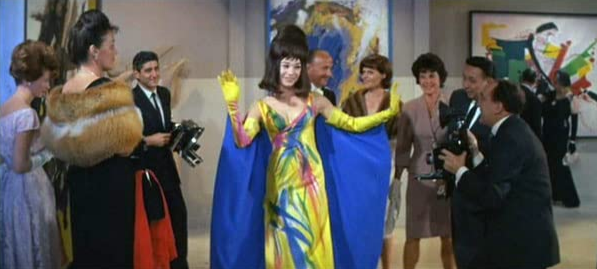
This 20th Century Fox fluff is a comedic story of a woman who’s looking for true love but is always left widowed—and richer. Money doesn't buy happiness, but it brings 70-plus Edith Head costumes, Sydney Guilaroff wigs, Harry Winston jewels, and fabulous sets in What a Way to Go! The featherweight romp also features some diverse husbands: Dick Van Dyke, Paul Newman, Robert Mitchum, Gene Kelly, & Dean Martin. 

The super-size comedy was originally meant for superstar Marilyn Monroe, when Fox decided to take Marilyn back after Something's Got to Give. Marilyn certainly could have elevated this mild vehicle with her natural comedic charms. But it was not meant to be, as Marilyn died soon after. Continuing in the same daft logic, Fox then offered the role to their other diva headache, Cleopatra aka Elizabeth Taylor. The part of a woman who marries five times and becomes richer, with bigger wardrobe and bigger hair with each marriage... what a stretch! But ET’s world now revolved around Richard Burton.

Can't imagine why Fox offered this movie to Elizabeth Taylor! Actually,
Robert Cummings plays the shrink in "What a Way to Go!," not a husband...

The sensible choice of Shirley MacLaine as Louisa May Foster was finally made. Was MacLaine as a brunette here a hangover from the prior choice of Liz? Regardless, while Shirley presents a model slim figure that was more in keeping with the '60s than either curvy MM or ET, MacLaine seems at times dwarfed by the outlandish costumes, towering wigs and Christmas tree jewel sparklers.

Naturalistic Shirley MacLaine & '60s glamour didn't seem to go together.
Note the pancake makeup on her face, then her freckled arm in "What a Way to Go!"
With Robert Mitchum as her tycoon husband.

While MacLaine is a natural comedic actress, a strong director like Billy Wilder was needed to keep her from going from Shirley to shrilly. There's more than a few screaming Mimi moments in this broad comedy, but MacLaine also gets some laughs. It's fascinating to see her play the child Louisa with a wink, without the '60s pancake foundation, false eyelashes, stenciled brows, and overdrawn lipstick—though I do detect mascara. 

Shirley MacLaine as little Louisa in an amusing moment from "What a Way to Go!" 

Most of Shirley MacLaine’s co-stars were old pals or lovers, so Shirley has a nice rapport with each "husband" in What a Way to Go! In a nutshell, in order:

Dick Van Dyke is a very energetic match for Shirley. As Edgar Hopper, Dick is a small-town guy whose hero is Thoreau. But when his love rival mocks his and wife Louisa’s low-budget lifestyle, Hopper hops to, and becomes a big success as a businessman. And promptly keels over from overwork!

Dick Van Dyke as Shirley MacLaine's first husband in "What a Way to Go!"

Paul Newman is next up, as the artist in Paris, where Louisa goes to grieve. Paul gives one of his more relaxed comedic performances, unlike the leering Rally Round the Flag Boys and A New Kind of Love. Amusingly, his character’s name is Larry Flint, but not that Larry Flynt. Paul looks great with a beard, as the starving artist who's always eating! Slim and slight Paul and Shirley are dwarfed by the lavish contraptions and sets in their marital sequence. As Larry’s painting machines finally create successful works, Flint is consumed by the cash rolling in. As he and the machines become more frenzied, they turn on their creator.

Shirley MacLaine's Louisa seems to adapt to each husband's life.
Here, she is Paul Newman's artist wife in "What a Way to Go!"

Next, widowed again Louisa meets Robert Mitchum as a Howard Hughes-type tycoon, Rod Anderson, Jr., at the airport (remember Hughes once owned an airline). MacLaine’s unlucky in love lady figures this latest love is already rich, so what can happen? Ironically, their attempt at living simple down on his farm turns out to be a kick in the head for Rod. Mitchum is laid-back and droll, as always.

I never miss a Nina Foch movie! Kidding! Shirley MacLaine goes platinum for a
hot minute in "What a Way to Go!" With hubby #3 Robert Mitchum.

Shirley’s perennial widow meets Pinky Benson at a local diner. Gene Kelly parodies his Singin’ in the Rain persona here as the small town entertainer, who finally makes it big. Though criticized by some folks as too old, Kelly looks fine for 50, is quite funny, and dances beautifully, of course. Pinky’s fate is getting fatally mobbed by his fans!

Shirley MacLaine's Louisa envisions her marriage to Pinky Benson as a Hollywood musical number. Gene Kelly, aptly cast as hubby #4 in "What a Way to Go!"

At this point, once again widowed Louisa is telling her woes to her shrink, when an old beau walks in. Once her small town’s richest guy, the man is now the building’s janitor! Dean Martin plays comedic jerk Leonard Crawley quite well, and his nonchalant demeanor is perfect here. As the one husband that Louise doesn’t initially love, the creep turns out to be the keeper.

Dean Martin bookends "What a Way to Go!" as first a foiled suitor, then as
Shirley MacLaine's final husband.

Finally, there is Bob Cummings, his usual unctuous self as the smarmy shrink who nearly becomes a husband to Louisa, as well.

One surprise was Margaret Dumont, of the Marx Brothers movie fame, who is bizarre and unfunny as Shirley's mother. Plus, Dumont’s dressed like she’s from a guest shot on The Beverly Hillbillies!

The Edith Head costumes and the sets are meant to be over the top but sometimes veer into awesome ugliness. Head cleverly uses the clothes to further Louisa's story, but I was surprised how many costumes were visions of monochromatic vivid colors. I was getting visions of Liz Taylor's Vincente Minnelli-supervised wardrobe in The Sandpiper. And the Pepto Bismol pink mansion of Gene Kelly’s Pinky is truly stomach churning.

Husband Pinky Benson decrees that his mansion be painted in his honor, in
"What a Way to Go!" Wafer slim Shirley MacLaine sports a contrasting black bikini.

Broadway’s Adolph Green and Betty Comden, the couple that wrote this story, also gave us Singin' in the Rain and Auntie Mame. Sadly, their script and wit seems very broad and sporadic in their last feature film together.

There are few zingy lines and most of the movie parodies of each marriage are mildly amusing, except the Ross Hunter-esque "Lush Budgett" sequence, which is so one-note that it quickly becomes tedious. The musical number with Gene Kelly is a great take off on MGM numbers, and still fun in its own right. Shirley and Dick Van Dyke’s expressive faces and graceful forms make their silent movie spoof fun. And Paul Newman and Shirley are certainly sexy enough in their French “art” film parody, though it’s pretty tame.

Shirley MacLaine & Dick Van Dyke are charming in the silent movie fantasy scene that symbolizes their marriage in "What a Way to Go!"

The director J. Lee Thompson was an odd choice for comedy as he previously helmed The Guns of Navarone and Cape Fear. He next directed Shirley in the 1965 bomb John Goldfarb, Please Come Home! Written by William Peter Blatty, who rewarded his friendship with Shirley by modeling her for his heroine in The Exorcist, thus creating the urban myth that MacLaine's daughter needed an exorcism!

Shirley MacLaine's Louisa in wearable art, courtesy of artist husband Paul Newman
 in "What a Way to Go!"

While I hardly laughed out loud during the entire movie, What a Way to Go! is generally amusing. But it all feels like a pile of frosting—on a cupcake! Shirley MacLaine didn’t carry another hit movie until The Turning Point over a dozen years later. Even then, Anne Bancroft was pulling equal weight. Frankly, Shirley never carried a movie on her own during MacLaine’s leading lady heyday.

There are worse ways to go than watching What a Way to Go! Watch the stars and lavish production, with your brain turned off.

Actress Gari Hardy with Paul Newman, in a deleted scene from "What a Way to Go!" Is it my imagination or is she supposed to resemble Marilyn Monroe? If so, that seems in bad taste as this film was intended for Monroe, before she died two years earlier.


Saturday, October 17, 2020

Monty Still Has ‘A Place in the Sun’ 1951

Elizabeth Taylor & Montgomery Clift, romantic dream team of 'A Place in the Sun.'

Montgomery Clift co-starred in several hit films with veteran stars, but 1951’s A Place in the Sun was the classic that Monty carried and cemented his stardom.

A Place in the Sun is based on Theodore Dreiser's 1925 tome, An American Tragedy, which was loosely taken from a real life drowning death earlier that century. Some have criticized Sun for being too lightweight in comparison to the novel. True, but Paramount failed once before, filming a gloomy ’31 version of this doomed romantic triangle of the ambitious young man romancing a poor girl, and a socialite. Director George Stevens wanted to make serious points about our society’s values. Yet, he was realistic enough to know that a young love triangle would draw audiences and make the drama as a whole more palatable. This was especially so, after he started working with stars Montgomery Clift and Elizabeth Taylor, and saw the sparks fly.

Montgomery Clift, the ambitious young man torn between Elizabeth Taylor & Shelley Winters.

Despite the romantic triangle vying for screen time with the damning message on wealth and social status, Sun is still a rather dark romantic picture. Clift as the conflicted protagonist spends most of his screen time leading a double life, covering up, and is at least partially responsible for the death of the young factory girl he has impregnated.

Montgomery Clift at age 29, during filming of 'A Place in the Sun.'

Clift is incredibly intense and vulnerable in this film. With each major scene as George Eastman, he becomes so stricken with tension and guilt, sweaty and hunched over, that he looks like he's in physical pain. At his best, Montgomery Clift is the greatest of "the big three" method acting gods, IMO. Imagine instead James Dean or Marlon Brando as George Eastman. Both could have been quite interesting, but Monty's far less mannered than James Dean, and far more open in his emotional torment than Brando. Marlon often backed his rawness with brute masculinity. Not that there's anything wrong with that! But it was almost a buffer for audiences, where Clift let his vulnerability show freely, with no apologies.

Monty as George Eastman, attempting to articulate his motives.

Did you know that Elizabeth Taylor was the only actress to appear as leading lady to all three of the '50's "method actor" greats—Clift, Dean, and Brando?

Monty wasn’t keen on Hollywood, but he still seemed drawn to movies, and only occasionally went back to the theater. Whatever his mindset, Monty’s situation mirrors his character’s, in that Clift desired, but was uncomfortable in a wealthy world that Elizabeth Taylor inhabited with ease.

Elizabeth Taylor as a wealthy girl who embodies poor, lonely boy Clift's dreams.

A Place in the Sun was actually filmed in the fall of '49 and wrapped up in early 1950. Several reasons have been given as to why the film wasn't released until nearly two years later, in the fall of '51. One factor for sure was George Stevens, always a methodical director, became even more so in his post-war work.

Montgomery Clift, at the peak of his powers and youth in 'A Place in the Sun.'

Montgomery Clift wasn’t the only person who influenced Elizabeth on the Sun set. George Stevens was another important person in Taylor’s life with his direction of her at the beginning and ending of her adult box office stardom.  A Place in the Sun was her first serious drama in ‘51. Giant turned Taylor into a super star in ‘56. And 1970's The Only Game in Town was Steven's final film and the last time Elizabeth Taylor received her million dollar salary.

Clift as George, the first time he lays eyes on Elizabeth Taylor, as Angela Vickers.

Someone astutely said that Elizabeth Taylor's look in A Place in the Sun set the standard for brunette beauty for a generation. Taylor also met another pro on this film who would become a lifetime associate and friend: Edith Head. Edie's violet-sprigged dress became THE prom gown for at least one movie season.

Sexy and seventeen! Elizabeth Taylor in her first iconic film look.

Elizabeth Taylor was just 17 when she filmed A Place in the Sun. Her co-stars, Montgomery Clift and Shelley Winters, were both a dozen years older than her. In the scene where Winters’ character, Alice Tripp, hems and haws for an abortion from a doctor, and he asks the pregnant girl her age. Tripp replies 22, while Winters was 29 in '49. The difference was Monty had significant stage experience and Shelley had come up the show biz ladder the hard way. Both had significantly more life experience than Elizabeth. Taylor started in movies at age 10 and was a star in National Velvet by 12. Extremely protected by both her parents and MGM, Elizabeth once aptly said that she "was a virgin both physically and mentally." Yet none of that shows on film, which is a testament to Taylor's innate screen ability.

Elizabeth's maternal quality was a Taylor character film constant, whether the recipient was a horse, dog, or leading man.

A trait that George Stevens focused on in Taylor was her maternal quality. Notice how many times Taylor cradles Clift in A Place in the Sun, as if she's mothering him. That she pulled this off and the "Tell Mama all" scene as a teen is most remarkable. A few have written that Stevens wisely avoided the movie clichés of great romance. In Sun, Angela's always on the periphery, and the first time George sees her, she doesn't even notice him. 

Shelley Winters is Alice Tripp, a factory girl who falls for Clift's restless George.

For Shelley Winters, who was playing sexy tarts with hearts, Sun was her big break as a serious actress. Like Cher later in Silkwood, a strong director required Winters to leave her glamour and ego at the door. Shelley wore little makeup, stopped bleaching her hair, and bought clothes off the rack, some even borrowed from her sister. While she knew the role was a winner, Winters’ ego as a woman was rightfully hurt, as Shelley was held up unflatteringly as a comparison to a gorgeous teenage Taylor. A wag once said, "George Stevens brought out something in Elizabeth Taylor that would make men kill for her, and something in Shelley Winters that made men want to kill HER."

Shelley Winters about to go into full whine mode in the row boat!

Director Stevens implies to great effect. How did that first night with George and factory girl Alice get by the censors?! Or when Alice goes to the doctor after she becomes pregnant? Even implied candor got censored back then. And yes, this was the first of many movies where water was not Shelley Winters' friend!

If looks could kill. George listens to Alice's oblivious plans for their married life.

It's been said that the wonderful Anne Revere, who plays Clift's pious parent (and also played Taylor's mother in National Velvet) was greatly edited out of her place in the sun because she was blacklisted. I question that, because I'm not sure how much more she would have fit in the over two hour film. You see her when George calls her after he’s connected with wealthy relatives and again when he's in trouble for murder. Since she lives afar, where else would she have fit in a scene? 

Anne Revere plays Clift's religious mother, who visits him on death row.
By the time 'A Place in the Sun' was released, Revere was blacklisted.

The only performance I found less than stellar was Raymond Burr as the district attorney. Glowering menacingly, he becomes more threatening to the point of his histrionic breaking of the oar in the boating accident reconstruction scene. Also, having watched a lot of Perry Mason in the last year, I was surprised how much heavier Burr was in his early years as the heavy.

Elizabeth Taylor & Montgomery Clift became best friends on this film.

Clift and Taylor became fast and famous friends, and often looked for vehicles to perform in. They reunited in the ill-fated 1957 epic Raintree County, where Monty endured his near-fatal car accident. They appeared two years later in Suddenly, Last Summer. This film was a triumph for Elizabeth and Katharine Hepburn, with Monty on the sidelines, who was hard to cast at this point.

Clift's George Eastman, whose dreams have ended on death row.

Taylor and Clift were to reunite for 1967’s Reflections in a Golden Eye. The role of the closeted army major seemed ideal for Clift, with Taylor reprising her bitchy southern belle persona. Clift was considered uninsurable at this point, and Taylor shut up the studio suits by offering her million dollar salary as insurance for Monty. Everyone was amazed, including Monty. Sadly, Clift died at 45, before filming started. Monty was replaced by Marlon Brando. And Taylor was obligated to make a movie that she had agreed to do, for Monty's sake. How fitting it was that Clift and Taylor first met at the beginning of his stardom, and that Elizabeth was one of the few who stood by him to the end. Monty only made a handful of films, with a few that are bonafide classics. For that, Montgomery Clift will always have his cinematic place in the sun.

Life and art often blurred for Elizabeth Taylor, but who was always there for her dear friend Montgomery Clift.

FYI: I put all the movie overflow on my public FB  movie page. 

Check it out & join!  https://www.facebook.com/groups/178488909366865/