Showing posts with label Franchot Tone. Show all posts

Thursday, March 2, 2023

Jean Harlow is a Hilarious ‘Bombshell’ 1933


Lee Tracy as a pugnacious PR man & Jean Harlow as the dervish movie diva,
in 1933's screwball comedy "Bombshell."


Bombshell was one of the first movies that Jean Harlow showed she had a flair for comedy, with Red-Headed Woman and Red Dust as the intro the year before. MGM’s Bombshell, from 1933, is a still-funny comedy, with Hollywood getting skewered even then.

Director Victor Fleming and screenwriters John Lee Mahin and Jules Furthman were inspired by the scandalous life and media frenzy surrounding “It” girl Clara Bow. Fleming was once engaged to Bow and familiar with her life story. But Bombshell also spoofs Jean Harlow's own life and career, from her own family of hangers-on, the sex bomb reputation versus the real Harlow, and some zingers even aimed at MGM. It's a smart, clever movie still and you realize how things don't really change all that much in showbiz. Look at today's stars who are more famous for their scandal ridden “personal” lives than any particular talent.

Jean Harlow as movie star Lola Burns & Lee Tracy as PR flack "Space" Hanlon
make a terrific team in MGM's "Bombshell."

Jean Harlow was a live wire in Bombshell, with a natural sense of humor, and a good-hearted screen persona. As Lola Burns, I love how her character puts on studio-trained ladylike airs, but in the next scene she's yowling at her ingrate family, scoundrel press agent, and problematic boyfriends. Yet, Jean never goes overboard, and keeps it real. Harlow was a working class Carole Lombard, once Jean got to lighten up her femme fatale image, and played the sex bomb and her scripts for laughs. The movie blurs the on-screen Lola Burns with real-life Jean Harlow by having Burns do re-takes for Red Dust and showing Harlow with Gable in Hold Your Man.

Jean Harlow as Lola Burns in MGM's Hollywood satire, 1933's "Bombshell."

Lee Tracy is personifies the fast-talking wise-cracker, studio PR hound “Space Hanlon.” Tracy practically trademarked this archetype when he became a Broadway smash as “Hildy” Johnson in the original The Front Page. He is hilarious, changing his tune on a dime, with a “Can you believe I’m getting away with this?” attitude. There's something very appealing about him. He’s impishly baby-faced, yet looks like he’s seen a few late nights, and not from colic. You totally believe Jean falling for him. One also forgets how handsome Pat O' Brien was in his young days, no-nonsense as always, as the director who is sweet on Lola. Oh so handsome Franchot Tone amusingly spoofs his cultivated gentleman image as the suitor who seemingly comes out of nowhere.

Lee Tracy reminds me a little of Michael Keaton in this photo. Tracy's a motor mouth
 riot as "Space" Hanlon to Jean Harlow's movie "Bombshell."

Frank Morgan's a hoot as Jean's irrepressible father, a lovable blowhard always in need of cash for booze and horses. Louise Beavers gets off some pre-code one-liners as Jean's good-hearted maid.

Frank Morgan's one of many scene-stealers to Jean Harlow's exasperated "Bombshell!"

There are some sly zingers about Hollywood and the whole dog and pony show of presenting stars to the press and gossip columnists in the best light, and hoping they don’t dig too deep beneath the shiny surface.

But this is ultimately a great vehicle for Jean Harlow, stylishly done in high spirits, right from the opening credits by MGM's top studio director Victor Fleming, to the stars still battling it out at the finale. 

FYI: I put all the movie overflow on my public FB  movie page. 

Check it out & join!  https://www.facebook.com/groups/178488909366865/
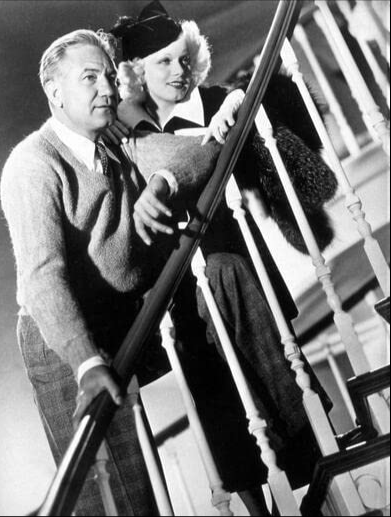
"Bombshell" director Victor Fleming with star Jean Harlow.


Tuesday, March 6, 2018

Dynamic Davis is 'Dangerous' 1935

Bette Davis works up a lather in this dull soap opera, with charming Franchot Tone.

I watched 1935’s Dangerous recently, which I haven’t seen since the afternoon movies of the ‘70s. Last year, I saw Bette Davis' career breakthrough in ‘34’s Of Human Bondage, for the very first time. Davis gives her all in both, but the difference is in the material she’s working with.
Even at the time, Davis acknowledged that her Oscar win for Dangerous was a consolation prize for when she was conspicuously passed over for Bondage. That's putting it mildly. As with Elizabeth Taylor's sympathy win for1960’s BUtterfield 8, Davis victory over strong competition like Katharine Hepburn in Alice Adams was all about compounding a previous cinematic slight. 
Bette Davis and Jack Warner with a 'Dangerous' Oscar. Not feeling the love!

At first, Davis turned down Dangerous, as it was a schlocky attempt to cash in Bette's turn as Mildred Rogers in Bondage. All very ironic, since studio boss Jack Warner told her to go hang herself for even wanting to play such a role. Davis starred in the Maugham classic on loan out and got rave reviews for her groundbreaking portrayal. Warner Bros gave her no support with the studio’s voting block, even they had no best actress nominee in the hopper. The next year, Jack Warner turned around and wanted Bette to basically repeat her Bondage performance in Dangerous, a cobbled together soap about a washed up actress. Warner was cashing in on Davis on the way up, whereas MGM cashed in on Elizabeth Taylor on her way out, in BUtterfield 8. Ironically, both actresses ultimately toiled at their home studios for 18 years. 
Bette Davis got star billing at last in 'Dangerous.'

Dangerous is an "original" script that played off the recently deceased stage legend Jeanne Eagels. An exciting talent, Eagels was a fiery talent who succumbed to alcohol and hard drugs, flamed out, dead at 35. Davis plays Joyce Heath, a once in a lifetime talent who is a jinx to every man she meets. Now a derelict alcoholic, Heath catches the eye of famed architect Don Bellows (Franchot Tone), who seeks to rehabilitate her for the noblest and most unbelievable of reasons—he adored her interpretation of Juliet. To this hogwash, scriptwriter Laird Doyle added several shrewish scenes, where Bette lashes out at her male co-stars, exactly as Davis did to Leslie Howard in Bondage. Of course, Davis and Tone’s characters fall in love. But bad girl Bette can’t have the hero, so just like BUtterfield 8 there’s a car crash that solves everything. That's the plot, in a nutshell.
Bette Davis was the first film actress who dared to look unglamorous. In 'Dangerous,' 
she was a drab, drunken actress.

Davis was not impressed, but intrigued by playing the Eagels-esque legend, as she admired the late actress. Davis also realized it was better than anything else Warner was offering.
Even BUtterfield 8 had the framework of John O’Hara’s novel to work off of. Dangerous scraps sewed together for a very flimsy vehicle for new star Davis. If it wasn't for Bette's dynamic new style of acting, Dangerous would be an instantly forgotten Warner Brothers’ “B” movie.
Franchot Tone and Margaret Lindsay as a happy couple...before Bette comes along!

As Bette’s embattled leading man, Franchot Tone is far more engaging than Leslie Howard, who apparently was bored by film acting. I’m not sure why the popular MGM leading man was loaned out to WB for this B+ movie, but Franchot is at the height of his appeal and attractiveness here. Tone’s warmth and charm is an audience buffer to Bette's shrewish drunk. 
Once again, an aristocratic brunette is (temporarily) thrown over by the leading man, who is ensnared by neurotic Bette. In Bondage, lovely Frances Dee waits for Leslie Howard to come to his senses. In Dangerous, that task goes to beautiful Margaret Lindsay, who played the dutiful second fiddle to Bette in other WB films, like Bordertown and Jezebel.
The great Alison Skipworth, as Tone’s housekeeper, heaves her mountainous bosom with disapproval at dipsomaniac Davis, and their scenes offer some comic relief.
Bad girl Bette redeems herself by reuniting with an ex-husband that she just tried to kill,   now that's love!

Bette's bad girl atonement means going back to a dopey ex-husband, who she just tried to kill in the prior scene. Talk about a tacked-on ending. Director Alfred E. Green, one of WB’s “studio” directors, who specialized in B+ pictures, does what he can in telling this thin tale. Screenwriter Laird Doyle, whose job it was to whip up this vehicle for Bette, was one of WB’s prolific screenwriters. Sadly, Doyle died at age 29 in 1937, while taking flying lessons.
There is no reason to watch Dangerous except to see Bette Davis in action when she finally got a star role at Warner Brothers. It took three years, two dozen mostly bad movies, and another studio for Warners’ to get a clue in what they had in Bette. A lawsuit by their star a year later, over the lack of good roles, proved that Bette Davis meant business.
Once Bette Davis won her first Oscar, she began to make hay in Hollywood.