Showing posts with label Herbert Marshall. Show all posts

Monday, January 27, 2025

Hitchcock’s Fine ‘Foreign Correspondent’ 1940


Is reporter Joel McCrea (R) tilting at windmills? George Sanders & Laraine Day
 certainly wonder, in Alfred Hitchcock's 1940 film, "Foreign Correspondent."


Rebecca was Alfred Hitchcock’s 1940 American breakthrough smash hit, and deservedly so. Yet Foreign Correspondent, the British director’s other 1940 film, was just as fine in its own right.

Director Alfred Hitchcock making his customary cameo, here with star Joel McCrea,
in 1940's "Foreign Correspondent."

Foreign Correspondent is imaginative suspense mixed with wartime espionage, and makes for rousing entertainment. Some of Hitchcock’s favorite film themes are represented in Foreign Correspondent: the everyman thrown into intrigue; the “MacGuffin,” Hitch-speak for the thing everyone is after; the sympathetic villain; the imposters; sudden violence; suspense set pieces against memorable backdrops.

Joel McCrea as John Jones grows from brash, boyish reporter to a fine
"Foreign Correspondent," Alfred Hitchcock's 1940 espionage film.

Joel McCrea was cast when Gary Cooper turned the title role down. Though Coop had his own style, McCrea was a better choice, a more open and spontaneous actor. As John Jones, Joel’s crime reporter turned foreign correspondent, who’s given the handle Huntley Haverstock. McCrea runs the gamut from brash young reporter, to flirtatious fellow, and serious correspondent, who relies on his gut instincts. McCrea’s natural style ages well and he was a precursor to William Holden’s charming, solid all-American guy.

Laraine Day was just 19 when she played love interest Mary Fisher in 1940's
"Foreign Correspondent."

Laraine Day, in an early role as Carol Fisher, is McCrea’s love interest. Day does well enough, but is definitely a product of her film era. Herbert Marshall is Stephen Fisher, Carol’s father, and revealed to be the villain half way through, another classic Hitchcock move. Marshall is quite empathetic as the flawed man, and had the ability to play both noble and nasty men. George Sanders is Scott ffolliatt, another correspondent who aids McCrea’s character on his mission. George is so young here, and playing not so jaded as he was often later cast. Albert Bassermann is a human “MacGuffin,” in this case, Van Meer, a captive politician. He is excellent as the prisoner worn down by torture for his political secrets, but not before Van Meer gives a stellar speech to the villains. Robert Benchley is the urbane fellow reporter Stebbens. Pre-Santa Claus Edmund Gwenn is a darkly comic villain who tries with determination to rub out McCrea’s reporter. Eduardo Ciannelli is the creepy main villain, Krug, who has a very good reason for wearing turtlenecks! Harry Davenport, Doctor Meade of GWTW fame, is no-nonsense as McCrea’s editor.

Albert Bassermann learned to speak English phonetically for his role as Van Meer, here with Joel McCrea, in 1940's "Foreign Correspondent."

The production of Foreign Correspondent is most atmospheric: The photography, the tight story, and special effects, which often depicts overcast days, pouring rain, and pitch black nights. There’s a sweeping score by Alfred Newman, William Cameron Menzies created the amazing set piece—that stunning plane crash, all aided by Rudolph Mate’s painterly cinematography.

The memorable war time message has been seen as a weak aspect of the movie. Quite to the contrary, I think. This was the cross roads the United States was at, whether to commit in joining WWII. England was starting to get attacked when Foreign Correspondent was released. Just over a year after this film’s release, the US was attacked by Japan at Pearl Harbor. So, the film’s message that the enemy was coming closer was more than apt.

Here is Joel McCrea’s Foreign Correspondent, written by Ben Hecht, giving the word to American audiences in the film’s finale:

“Don't tune me out, hang on a while—this is a big story, and you're part of it. It's too late to do anything here now except stand in the dark and let them come... as if the lights were all out everywhere, except in America. Keep those lights burning, cover them with steel, ring them with guns, build a canopy of battleships and bombing planes around them. Hello, America, hang on to your lights: they're the only lights left in the world!”


As London is beginning to get bombed, McCrea's reporter makes his rousing speech. When "Foreign Correspondent" was released in July 1940, it was really happening.

Producer Walter Wanger of Algiers, stayed out of Hitch’s hair in Foreign Correspondent, unlike his boss, producer David O. Selznick, who drove him crazy on Rebecca and other films. Hitchcock brings his distinct point of view to each aspect of the story, whether it’s the suspense, human drama, romance, or leavening humor. In his second year of US filmmaking, Alfred Hitchcock had arrived with his two 1940 films. Foreign Correspondent is a worthy precursor to the later Notorious, The Man Who Knew Too Much, and North by Northwest.

In Alfred Hitchcock's second year in Hollywood, he directed 1940 releases "Rebecca" & "Foreign Correspondent."

Here’s my look at Hitchcock’s last hurrah for sheer entertainment, North by Northwest: https://ricksrealreel.blogspot.com/2020/08/north-by-northwest-1959.html

Thursday, May 4, 2023

Fox’s Faithful Rendition of ‘The Razor’s Edge’ 1946


Gene Tierney & Tyrone Power are the well-cast leads in the 1946 all-star version
of "The Razor's Edge."


The Razor’s Edge from 1946 is remarkably faithful to W. Somerset Maugham’s best-seller, with many key passages of dialogue lifted directly from the book. While movie adaptations still run roughshod over their source novels, back in the golden era, studios were even cavalier with movie versions. The smart movie makers knew to adhere to the story as much as possible, as David Selznick did with Gone with the Wind and Rebecca.

Studio head Darryl F. Zanuck personally oversaw the production of 1946's
"The Razor's Edge."

20th Century Fox head honcho Darryl F. Zanuck was intrigued by the public’s response to W. Somerset Maugham’s spiritual best-seller. The autobiographical novel’s hero is questioning life after WWI and no doubt mirrored many readers’ feelings after WWII. Star Tyrone Power, having just served in the war, felt a similar chord regarding this work.

Lovers Isabel & Larry can't reconcile their opposite worlds in "The Razor's Edge."

Reading the source novel of The Razor’s Edge, one can see how well Fox cast the film. Larry Darrell is described as dark, slim, with incredibly striking dark eyes. Rich girl Isabel, once she loses her youthful baby fat, is described as sleek and sensual with striking hazel eyes, like Gene Tierney. The stylish society snob, Elliot Templeton, is a great role for Clifton Webb. And tragic Sophie, who’s described as attractive but not beautiful, is fiercely played by young Anne Baxter. Her volatile character is played just as she’s described in the novel. Herbert Marshall makes a most urbane author as M. Somerset Maugham. The only dud is John Payne as Isabel’s “regular guy” husband, Gray. While pleasant enough in musicals and comedies, Payne’s out of his league here.

Tyrone Power's Larry Darrell, both fresh out of the service, in "The Razor's Edge."

The Razor’s Edge was filmed April through July of '46. Power went into the production right out of the service and turned 32 during filming on May 5. Tyrone is at the peak of his male beauty, charm and sensitivity, and with the gravity of having just served in the war. While Power’s seeking Larry Darrell is the mouth piece for the film’s spiritual philosophies, Tyrone is much more natural and convincing than when Gary Cooper looked most uncomfortable reciting Ayn Rand’s beliefs in 1949’s The Fountainhead. When one compares Power to MGM’s robotic Robert Taylor, Tyrone had a genuine quality that complemented his talents and great looks. Director Edmund Goulding also guided Ty through another challenging role, in 1947’s Nightmare Alley.

Tyrone Power as Larry Darrell, after he's sought spiritual enlightenment.


Gene Tierney was 25 during filming and Anne Baxter turned 23 just two days after Power's birthday. It is incredible how actresses back then seemed more womanly, while so young. Tierney is incredibly sophisticated as Isabel and Baxter looks older than her years as working class girl Sophie, who hits the skids after suffering great personal tragedy.

Gene Tierney & Anne Baxter as younger Isabel & Sophie, in "The Razor's Edge."

Gene Tierney was not a highly praised actress in her time. And Gene got some sharp critical jabs in The Razor’s Edge, but I think Tierney's terrific as Isabel. And it's a well-rounded character, not one-dimensional and softened. Gene plays the bright and charming, but self-centered rich girl pitch perfect.

Gene Tierney wows as Isabel, on her last night with Larry, in "The Razor's Edge."

Clifton Webb, while he gets to be the acerbic scene-stealer in a number of scenes, per usual, he also gets to be generous and good-humored. Webb’s deathbed scene surprised me in his touching emotionalism, as the social snob who sobbingly acknowledges that he’s been forgotten by his in-crowd. 

Clifton Webb is genuinely moving in his final scene from "The Razor's Edge."

Herbert Marshall is empathetic, but with dry humor, as author Maugham. Marshall had quite an association with screen works of W. Somerset Maugham, appearing in Garbo’s The Painted Veil, with Bette Davis in The Letter, and George Sanders in The Moon and Sixpence.

Herbert Marshall is W. Somerset Maugham, the author of "The Razor's Edge."


The Razor’s Edge is an intelligent, adult adaptation, though tweaked somewhat to be studio movie-friendly.  Zanuck and those involved in the production put great effort into this film. Edmund Goulding, who directed literate fare such as Grand Hotel, does a great job balancing movie style without letting it take over the film’s story. Since the movie was filmed immediately after WWII, location shooting was out of the question. The production offers a convincing depiction of Paris and other locales, without being obvious—like plunking a landscape of the Eiffel Tower outside of Larry’s apartment window!

Anne Baxter is startling as Sophie, who can't overcome tragedy in "The Razor's Edge."

It’s interesting to compare Power in The Razor's Edge with The Sun Also Rises, two literary Darryl F. Zanuck super productions just over a decade apart. But the difference between Power then and later is a shock. It's really a shame that they didn't film Sun right after Razor.

Gene Tierney's Isabel later looks at Anne Baxter's Sophie as an adversary in 1946's
 "The Razor's Edge."

The comparison to The Sun Also Rises is similar in their lead characters. Both male leads have suffered in WWI, leaving them at odds with the tantalizing women they love.

Also, there’s great similarity in characters between The Razor’s Edge and The Great Gatsby: lone wolfs Larry and Jay; society belles Isabel and Daisy; tragic Sophie and Myrtle; Gray as a nicer Tom Buchanan; and Maugham as the outsider observer, like Nick Carraway. They're variations of certain character archetypes. And wouldn't Tyrone and Gene have made a marvelous Jay and Daisy, as well? Finally, Tierney’s Isabel has a bit of Scarlett O’ Hara in her makeup, willing to be tough as a means to an end. And Power’s Larry is a bit of Rhett and Ashley!

Larry’s transformation is very detailed in the book version of The Razor’s Edge, but the movie does a skillful job of skimming his spiritual change. Both the novel and the ’46 adaptation of The Razor’s Edge are very worthwhile, indeed.

Tyrone Power at his peak, as Larry Darrell, in 1946's "The Razor's Edge."

Tyrone Power in his personal favorite role as a carny con man in the cult classic, 1947’s Nightmare Alley. My take here:

https://ricksrealreel.blogspot.com/2022/01/tyrone-powers-personal-best-nightmare.html

Here’s my look at Gene Tierney in her signature role, as 1944’s Laura:

https://ricksrealreel.blogspot.com/2018/04/laura-1944.html

20th Century Fox does justice to W. Somerset Maugham's "The Razor's Edge."


Thursday, May 17, 2018

The Enchanted Cottage 1945

Dorothy McGuire and Robert Young 'feel pretty' when they're in 'The Enchanted Cottage.' 


One way to look at 1945’s The Enchanted Cottage is pure Hollywood golden era fantasy.  Another way—beauty is literally in the eye of the beholder—is that the film’s message is timeless.
The British government commissioned playwright Sir Arthur Wing Pinero to write The Enchanted Cottage, to uplift WWI’s returning soldiers, after many men returned home physically and emotionally shattered. First a play, then a silent movie, The Enchanted Cottage was remade two decades later for WWII audiences, with Dorothy McGuire and Robert Young. 
Dorothy McGuire as lonely Laura Pennington looks on at the cottage's latest lovebirds, Beatrice and Oliver.

Oliver Bradford brings his lovely fiancée, Beatrice, to a cottage where honeymooners once nested, on the New England coast. The tradition was broken 25 years earlier when the last groom died tragically; the bride is now the cottage’s taciturn owner/housekeeper, Mrs. Minnett. The current couple's plans are put on hold when Oliver is sent off to war after the Pearl Harbor attack. Tragedy strikes when he is injured and left disfigured. His lovely bride-to-be bails and Oliver later arrives alone at the cottage.
Mildred Natwick and Dorothy McGuire as the lonely housekeeper and maid, keepers of the cottage.

The soldier meets the housekeeper's maid, Laura Pennington, a girl with a homely face and the heart of a romantic. They bond and Oliver proposes. Sadly, Laura is more in love than Oliver; for him, it's a marriage of convenience. Yet, on their honeymoon, he sees past his self-pity and realizes how loving Laura is. Miraculously, they begin to appear physically beautiful to each other. Laura attributes this to the enchanted cottage. Hedging their bets, they keep to themselves, not wanting to jinx their good fortune. Finally, the newlyweds decide to face his parents. Their sympathetic pianist pal, Major Hillgrove, who is blind, tries to warn the visiting family. However, Oliver's childish mother and boorish stepfather react badly, breaking the couple's romantic spell. Oliver and Laura are crushed. The housekeeper passionately tells them that their love for each other is what makes them beautiful, not the cottage. They realize that she is right, and the newlyweds renew their bond.
Robert Young & Dorothy McGuire are Oliver and Laura, who see each other's inner beauty.

Cottage hosts a small but stellar cast: Robert Young, who found later renewed fame on TV in Father Knows Best and Marcus Welby, was an intelligent leading man whose unmannered work looks better to modern audiences’ eyes. Young plays charmingly cheerful and later bitter and disillusioned equally well. Interestingly, this was Robert Young's favorite film, for its romantic message, and later told Leonard Maltin that he didn't want filming to end.
Herbert Marshall is the blind pianist who befriends the reclusive couple.

Herbert Marshall, with that mellifluous voice, is the perfect storyteller here and as usual, plays with authority. Though blind, his character has more of a clue than the others. It’s ironic that Herbert Marshall himself was an English WWI veteran who lost a leg in service.
Spring Byington is a scene stealer as the shallow, clueless chatterbox mother. Byington gives Billie Burke a run for her money in the flighty department here. Hillary Brooke manages to remain sympathetic as Beatrice, the beauty who leaves the soldier after his injuries leave him scarred.
Mildred Natwick is a standout as the heartbroken housekeeper.

Mildred Natwick deserved a best supporting actress Oscar nomination for her role as the brusque housekeeper with a broken heart. Natwick’s big scene, when Mrs. Minnett tells the new couple the true secret of the cottage, is moving and beautifully performed.
Dorothy McGuire gives a soulful performance as the homely maid with a beautiful heart.

However, the jewel in the crown is Dorothy McGuire. A popular star in her day, Dorothy should have been even bigger. Amazingly, McGuire did not receive an Oscar nomination for her soulful performance as lovelorn Laura, nor for her tough tenement mother Katie Dolan, in A Tree Grows in Brooklyn—both released in 1945. Perhaps that’s because McGuire was under contract to producer David Selznick, and not to RKO or Fox respectively, as all studios encouraged their blocs of voters to support their own stars. Selznick star Jennifer Jones had recently snagged an Oscar at Fox for The Song of Bernadette—but she was his protégée and future wife. While 1945 was Joan Crawford’s year for Mildred Pierce, a number of the other nominees were Hollywood’s perennial pet nominees, and Dorothy should have made the cut. As Cottage’s Laura Pennington, McGuire is as soft and gentle as she was tough and hurting as Tree’s Katie Nolan. The scene at the canteen, when no soldier will ask the homely housekeeper to dance, is a reverse-Cinderella moment where she doesn’t become the belle of the ball, and is a classic tearjerker moment. McGuire reminds me of Eva Marie Saint—an appealing, classy, smart leading lady who was perhaps too “normal” to be a larger than life movie diva.
The dreamy photography of 'The Enchanted Cottage' softens Robert Young's & Dorothy McGuire's harsh looks.

My one quibble: From today’s viewpoint, Laura is hardly hideous, and Oliver's scars and limp arm aren’t very horrifying. But for a '40s film, when beauty and perfection were everything, McGuire and Young gamely present themselves as imperfect. McGuire's pain at being rejected is palpable, and Young's self-pity at no longer being perfect and carefree is realistic.

What makes The Enchanted Cottage work is the taste level of everyone involved. Director John Cromwell was always terrific with actors. He was also a strong storyteller and very adult in the handling of material. Of Human Bondage, In Name Only, and Caged come to mind, where he shows strong emotions without going over the top.
'The Enchanted Cottage' is both haunting and a honeymooners' haven!

The Enchanted Cottage’s score and tone poem for Robert and Laura was created by Roy Webb, who received the film's sole Oscar nomination. The cinematography by Ted Tetzlaff is soft focus perfection. The score and photography together create a romantic atmosphere in which this dream-like story is played out. The nearly poetic screenplay was written by DeWitt Bodeen and Citizen Kane’s Herman Mankiewicz.
A remake of The Enchanted Cottage has been discussed several times. First, in the early '70s, there was talk of McGuire and Young playing the older roles of the housekeeper and pianist. That fell through when Dorothy, after a screening, declared the story a product of its time. I think in terms of the story—if not the sentiments—McGuire was right. In the mid-1970s, Cher wanted to get into movies, starting with a remake of Cottage, a project she pursued for years. She owned the rights twice! Other great stars like Streisand, Midler, and Spielberg have remade their favorites, A Star is Born, Stella (as in Dallas), and Always (A Guy Named Joe). Sometimes, it's better just to watch your film faves and not remake them in your image.
Dorothy McGuire's Cinderella gone wrong moment, when the canteen hostess gets her to go dance with the soldiers.

I noticed in research for The Enchanted Cottage some people feel that the message of the movie is that unattractive people need to hide away. I’m not sure why, because the film’s final scenes are clear. Once the couple's spell is broken by family members, the housekeeper tells them the truth, and declares that their love is what makes them beautiful to one another. Alone, Oliver and Laura talk it over, and reaffirm their love. They then write their names on the cottage's glass panes like past newlyweds. The film ends with the couple joining the pianist and his guests at a dinner party, ending their seclusion.
Eventually, Oliver and Laura's names join the other newlyweds' names on the cottage's window panes.

The other complaint is confusion over the film’s POV, when the couple shows off their “new” selves. It’s simple: the damaged soldier and homely girl appear the way to whoever is looking at them. When the husband is looking at his bride, she is beautiful. When the stepfather listens to their story, he sees their actual appearance. Once the couple realizes that there is no miracle, they see their actual themselves. When Oliver and Laura reaffirm their love, they're beautiful again. To nitpickers, I think they just confirm the film's message about people seeing what they want to see!
The real charm of The Enchanted Cottage is that it is one of the most genuinely romantic movies ever. For a studio era movie, it’s quite subtle. This film may be a product of its time, but it’s also timeless.
Here's my own little 'enchanted cottage' in Upper Michigan!


Friday, April 21, 2017

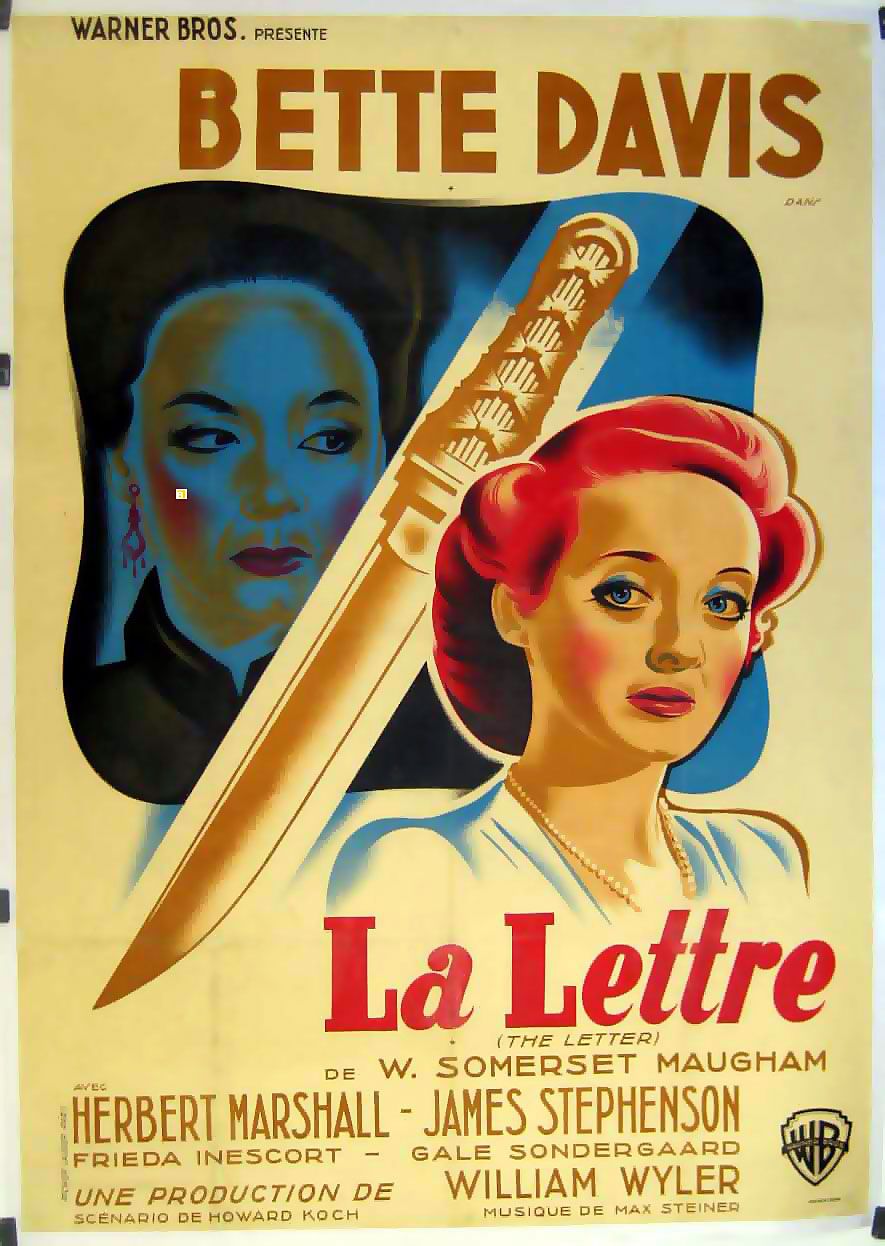
Bette Davis: Double Bad in 'The Letter' and 'The Little Foxes'

“Nobody’s as Good as Bette When She’s Bad!”
***Spoiler alerts ahead***
That Warner Bros. advertising slogan for Bette Davis took on an extra meaning when she became older, crankier, and campier. I hadn’t watched The Letter and The Little Foxes, two from her heyday in ‘40 and ’41, since my teens. Re-watching recently, I was pleasantly surprised to see Bette’s tendency to overact kept in check by her favorite director, William Wyler.

Bette's bad medicine in 'The Little Foxes.'
Davis overplayed hot-headed, hard-hearted dynamic divas, like In This Our Life, Mr. Skeffington, and Beyond the Forest. Perhaps Davis downplayed the pyrotechnics in The Letter and The Little Foxes because Bette’s a cool customer as both “bitch” characters.

Leslie Crosbie in Letter and Regina Giddens in Foxes are two of her greatest roles. And both of Bette’s characters take extreme actions to control of their destiny in a man’s world: murder.
In The Letter, Bette takes on another M. Somerset Maugham anti-heroine, after her breakthrough in 1934’s Of Human Bondage. Leslie Crosbie runs hot and cold as the ex-pat plantation wife who plugs a man full of lead while leaving her house—not exactly the perfect hostess.

The setting is a Singapore rubber plantation. Leslie’s husband Robert blindly adores her and they are popular in their upper-middle class set. She claims self-defense, saying the man, a family friend, “tried to make love to me.”
Yes, but didn’t Leslie pump a full round of bullets into his carcass as he staggered off her front porch?
Howard, their family friend—and lawyer—agrees to take the case. Soon enough, an ambitious young Asian lawyer sidles up to Stephenson’s character and tells him there’s a letter—and since that’s the title of the movie, it must be pretty juicy!

Gale Sondergaard & Bette Davis have a memorable confrontation in 'The Letter.'
Leslie and the gentleman caller were lovers. The letter by Leslie wasn’t a casual invite, but a summons. The holder of the incriminating note is the playboy’s Asian wife. The letter comes with steep postage: $10,000. Behind the husband’s back, Howard the lawyer and Leslie the adulteress use the family savings to buy the note back. This easily paves the way for the “proper” British wife’s acquittal. Today, Leslie Crosby would be considered the perfect example of white privilege.

Wanting a fresh start elsewhere, Robert is devastated to learn just why he is financially wiped out. Leslie comes clean, but to a painful degree. After her painful confession, Leslie soon pays for her sins. Leslie Crosbie may have been acquitted, but she’s not off the hook.

Bette played it director William Wyler's way, but she wasn't happy about it!
Davis and Wyler, who had a volatile professional and personal relationship, fought over Leslie’s telling her husband that she still loved the man she killed. Wyler wanted Bette say it to movie spouse Marshall’s face; Davis felt the wife could never look him in the face and say such a thing. When they came to an impasse, Bette walked off the set. This was a preview for coming attractions on The Little Foxes set.

What prevents The Letter status as a true classic is the censorship-mandated, tacked on ending where Leslie is killed by the vengeful wife. Otherwise, William Wyler weaves this tale of murder, passion, sexual frustration, class, and white privilege with skillful ease. Tony Gaudio’s photography is truly stunning, especially during the film’s opening and closing night scenes. Gaudio actually makes the moon a mesmerizing character. Max Steiner, composer for many Davis dramas, offers a haunting and romantic score.

Bette with Victor Sen Yung and James Stephenson, going to retrieve 'The Letter.'
Herbert Marshall goes his first round with Davis as Bette’s put upon husband, Robert. Marshall is empathetic as he goes from sure to sorrowful, regarding his marriage. James Stephenson as Howard made his film debut and won a best supporting nomination, to boot. Stephenson plays the lawyer’s ethical entanglement well. The supporting standout is Gale Sondergaard, genuinely chilling as Mrs. Hammond, the widow of wife’s lover. When she forces Leslie to meet her in person to retrieve the letter, the tension is incredible, with barely a word or gesture wasted by either actress. It’s all in the eyes. Despite the forced ending, their final, fatal meeting is still eerie.

Bette giving the moon a baleful look, which haunts her through 'The Letter.'
As for Bette, she’s subtly brilliant. Maugham’s Leslie Crosbie is a tricky role: She’s both sympathetic and a bitch; she’s passionate and stone-cold. It amazes me that Davis could play this type of role in the ‘30s and ‘40s and still win audiences over. An old female friend of mine, Alice, a moviegoer from that era, once commented that there were three actresses that men couldn’t stand: Bette Davis, Joan Crawford, and Katharine Hepburn. I’ll amend that to straight men! All were strong-willed, smart, not conventionally beautiful, and the first two often played roles that bedeviled the male characters. Davis, as the cool English “lady” with fire underneath, required a finesse which Bette employs to terrific effect.

Bette as Regina in 'The Little Foxes,' photo by George Hurrell.
Davis and Wyler re-teamed for the last time with Lillian Hellman’s The Little Foxes. (Their first was Bette’s second Oscar winner Jezebel.) This time, their collaboration was so combative that they never worked together again, though they remained friends. Tallulah Bankhead originated the role of Regina Giddens on Broadway. Movie mogul Samuel Goldwyn bought the property for William Wyler to direct. Wyler requested Davis for Regina, who just turned 33, to play the 40-something mother of a 17-year-old girl.

The Little Foxes was Lillian Hellman’s indictment on American greed and capitalism, which ironically became a huge commercial success. Regina Giddens relies on her invalid husband Horace for finances to remain comfortable; Regina’s crooked brothers, Oscar and Benjamin Hubbard, have already amassed fortunes. Still, they all want more. A visiting investor offers to make them partners in a cotton mill. The brothers have their share and count on Regina to get her estranged husband to put up the third share. The mill, which promises to exploit the locals, gets a prompt no from her noble husband. Once again, he is played by long-suffering—literally, this time—Herbert Marshall. The brothers put up Oscar’s dimwit son to steal the funds from Horace’s bank deposit box. When Mr. Giddens finds out, he refuses to press charges, to thwart the deal. Naturally, Mrs. Giddens is livid.

Oh, did I mention Horace Giddens has a serious heart condition?

Bette as Regina, watching her husband crawl in the background, dying.
And Regina is serious as a heart attack that she will hold the cards in this deal. Regina and Horace have a showdown. She whips him for foiling her attempt at good fortune, and for good measure, tells Horace that their entire marriage a failure and she never loved him. Well, that has him reaching for the heart medicine, which he promptly knocks over. Whoopsy! Regina gets up to help, then hesitates. Opportunity knocks for the opportunistic southern belle. This famous onstage scene was made even more legendary on film by Citizen Kane’s cinematographer Gregg Toland’s renowned deep-focus photography. In the background, Herbert Marshall, acting out the throes of a heart attack, crawls across the room and up the staircase for help; in the foreground, Bette bolted to her chair, her wide eyes their widest, as she waits for the perfect moment to strike. The scene is still a showstopper: kudos to Wyler, Toland, Marshall, and Davis. Also, when I think of that grueling scene, I recall that poor Herbert Marshall wore a wooden leg, due to a war injury.

Patricia Collinge is great as poor Aunt Birdie, trampled by her greedy family.
Most of the Broadway cast was brought in to recreate their roles. They are all terrific, especially Patricia Collinge, as tragic Aunt Birdie. Miserably married to Regina’s brother, Oscar, Birdie gradually became an alcoholic. Birdie’s scene of recalling her life’s journey—belle of the ball, bartered bride, and finally, the bottle—is a stunning piece of acting by Collinge.

Bette’s performance was controversial. There’s a confusing history of quotes as to whether William Wyler wanted Bette to play Regina like Bankhead or that he thought Davis’ own interpretation was too unlikeable. Whatever the case, Wyler hated Davis’ portrayal. And Bette despised his direction of her. Tensions peaked where Bette walked off the set and production was shut down for several weeks. This is one of the key points in Bette Davis’s career when the “difficult” label was applied. Who was right and who was wrong?

Rare shot of Bette as Regina in color. Davis was made to look older in B&W.
It’s hard to say, since Davis and Wyler were equally hard-headed. For me, what matters in the end is what’s up onscreen. Bette powdered her skin, thinned her lips, and narrowed her eye makeup to look pinched, weary, and older. Which Wyler also hated. Only 33, Davis plays a scene where Regina dolls up for her husband’s return home, to butter him up. Regina catches an unexpected glimpse of herself in the mirror, at an unforgiving angle. The belle gets a reminder that she’s no longer the sweet young thing, but bitter and hard. Imagine another actress of that era willing to submit to such a harsh close-up. As with Leslie in The Letter, Bette’s Regina is bad, with no excuses as to how she got that way. Bette’s Regina is restrained, for such a show-stopping role; Davis is also a team player, this isn’t just a vehicle for her.

Bette with Frank Capra & William Wyler on 'The Letter' set.
The Letter and The Little Foxes are films that dealt with tough topics in an adult way, but still entertained. That’s why they still hold up today. Finally, despite their combustible chemistry, Bette Davis gives two of her best performances, playing bad to the bone, under the tough, strong direction of William Wyler.