Showing posts with label Michael Curtiz. Show all posts

Friday, March 20, 2020

How Joan Crawford Became ‘Mildred Pierce’

Joan Crawford in her Oscar-winning role as "Mildred Pierce."


Mildred Pierce is still Joan Crawford's signature film. Like all long-time stars, Crawford is revered for several key roles, but this is the one most associated with Joan, personally and professionally. Mildred Pierce was Joan Crawford's great comeback, though Joan thought of it as a career Oscar. That didn't hurt Crawford’s chances either, with a then-20 year stint in show biz. 
Crawford's back story was one of the most famous in Hollywood, much like the later Marilyn Monroe. Everyone knew that Joan had a tough upbringing, pulled herself up by her trademark ankle straps, and by the dint of hard work and self-belief, became a star. Even more impressively, Crawford STAYED a star!
In rags-to-riches stories like Mildred Pierce, I'm always a sucker for the climb to the top.

Mildred Pierce is a mother and wife whose working class marriage is over. Determined to give her two daughters, Veda and May, a better life, driven Mildred goes from baking pies at home to a hardworking waitress. Pierce’s dream of opening her own restaurant comes true and she is on a winning streak. Unfortunately, her luck with men hasn’t changed. Mildred goes from boring Bert Pierce to cads with designs on her and/or her money. Then there’s oldest daughter Veda, for whom no amount of money seems enough. Mildred gets in over her head financially and emotionally.
***Spoilers ahead for the few who haven't seen what Mildred Pierce did!***

Though the movie differs from the book in how it handles scoundrel Monty in the mother-daughter triangle, it doesn't take away from the story. It’s rather ingenious how the film deals with a stepfather dallying with his stepdaughter, back in the crushing censorship era. Otherwise, it's a streamlined version of the James M. Cain novel. To compare the '45 WB film with the 2011 HBO mini-series is apples and oranges.
James M. Cain’s three best novels were made into acclaimed films in the mid-1940’s: Double Indemnity, Mildred Pierce, and The Postman Always Rings Twice. Author James M. Cain was pleased enough with Crawford’s performance that he sent a first edition Mildred Pierce to Joan, just prior to her Oscar win: “To Joan Crawford, who brought Mildred to life just as I had always hoped she would be and who has my lifelong gratitude."
Ah, the healing powers of winning an Oscar!

Jerry Wald was prolific, whether as a WB screenwriter, or later as producer. Wald was one of those golden era movie men who genuinely loved movies and their stars. Crawford had a huge cheerleader in Wald, who held out for Joan as Mildred Pierce. Wald and Crawford went on to make a total of five films together.
“Please don’t tell anyone what Mildred Pierce did!” This was a memorable but misleading slogan. Studio publicity departments tried to play up the sex angle for any movie this side of Mary Poppins. WB tried to paint Mildred Pierce as a femme fatale. In the trailer, the narrator pronounces: “Mildred, who left her mark on every man!” Husbands Bert and Monty attest to her wiles, with would-be suitor Wally wryly commenting, “Loving her was like shaking hands with the devil.” Given Wally’s treatment of Mildred, I’d say it was the other way around!
Who's the devil? Wally Fay thinks he hears opportunity knocking with newly single Mildred.

 The infamous box office poison list of 1938, created by independent theater owners, included the name Joan Crawford. While Joan’s later ‘30s movies may not have been blockbusters, most of them made near or over the $100 million mark in today’s dollars. Most of Crawford’s films weren’t outright clinkers, like Dietrich and Hepburn, also divas on the d-list. After Joan’s comeback in ‘39’s The Women, Crawford’s films were a mixed bag, but most of them still modestly successful.
Joan was down, but she wasn't washed up!

The real problem, IMO: Joan Crawford was viewed as past her shelf life. MGM’s other two divas, Garbo and Shearer, had both retired and all eyes were now on Crawford. Joan became famous at the height of the silent era, as the epitome of flaming youth, but it was now 1943. As Sharon Stone once quipped, every year in the life of a movie actress is like dog years. Ultimately, Joan had the same longevity as MGM’s Lassie, but she had to leave Metro to prove herself.

I never thought Joan’s Oscar competition for Mildred Pierce was that tough. Of the actresses, 3 of the 5—Ingrid Bergman, Greer Garson, and Jennifer Jones—had just won Oscars, so winning a second so soon was unlikely. Luise Rainer’s back to back Oscar wins—then straight to oblivion—cured the Academy of that impulse. Also, their current nominations were for popular, but not great movies—The Bells of St. Mary’s, The Valley of Decision, and Love Letters. That left Gene Tierney in Leave Her to Heaven. While this movie has been critically elevated over the years, at the time it was wildly popular, but viewed as pulp entertainment. As lovely as Tierney is, her performance ranges from trance-like to childishly petulant. One real contender wasn't even nominated: Dorothy McGuire, for her tough and tender Katie in A Tree Grows in Brooklyn. Even Dorothy’s homely cleaning girl in The Enchanted Cottage was more worthy. But Fox threw its votes to home girl Gene. Despite the competition, Joan's performance was a worthy winner on all fronts: a comeback, a career award, and a restrained performance in a fine film noir, smothered with mother love soap opera.
Less was more: toned down, but not de-glamorized. Joan in an early scene of Mildred Pierce.

Joan as Mildred is typically described as de-glamorized. Even by '45 standards, that's a stretch. Crawford was toned down from her typical over the top MGM glamour. Still, even as the pie-making housewife, Joan’s Mildred is wearing red lipstick, mascara, and high heels in the kitchen. For the first half of the film, when the waitress/cook is making her way to the top of the food chain, Joan's clothes, hair, and makeup are simple, and she looks most appealing. Once Mildred makes it big, Joan is suffering nobly in fur and shoulder pads.
This "gardening" outfit was typical over the top MGM gloss,
once Crawford's calling card, but was now considered old hat.

One amusing moment is the scene where devilish daughter Veda makes their maid, Lottie (Butterfly McQueen), wear Mildred's waitress uniform. This is a signal to her mother that Veda knows how Mommie makes the moolah. Just prior, Hattie exclaims how Mildred cooks all night and waits tables all day, and Crawford comments that it keeps her slim. McQueen looks in askance at her own generous waist line, plus, she's half a head shorter than Joan. Yet, there she is, fitting perfectly into Mildred's uniform!
Mildred's uniform on loan to Lottie!

As far as other actresses playing Mildred, it's been widely written that almost all the top WB actresses were considered. How true or how seriously each star was considered is hard to say. It’s also important to note that the script of Mildred Pierce was cycled through numerous screenwriters before Ranald McDougall’s was accepted.
Who wore it best? The same uniform as Lottie's? Ha!


WB’s queen Bette Davis probably had first pick, but her "big" personality was starting to overshadow her performances. Critic James Agee famously pointed this out in his review for Bette's ‘45 vehicle, The Corn is Green. Plus, she and Michael Curtiz didn’t get along.
I think Barbara Stanwyck would have made a more realistic Mildred than Joan and could have had a hit with the role. It’s been said that she wanted Mildred and Curtiz wanted her. But this was producer Jerry Wald’s baby and he wanted Crawford. Would “Missy” have been as iconic as Joan? Hard to say, but remember that Stanwyck is still raved about for her turn in Cain’s Double Indemnity.
Ann Sheridan was mentioned and she’s quoted as saying the early script depicted mother and daughter as too tough and the daughter “a horror.” Ann could have brought warmth and humor, and maybe Mildred Pierce could have been that star vehicle she never really got. Again, would Ann be iconic as Mildred?
Ida Lupino could have made a tougher Mildred, but she had just played a role similar in The Hard Way. Catch The Hard Way sometime and you will be surprised at how similar the opening scene is to Mildred Pierce.
My belief is that Joan Crawford offered to appear in Ann Blyth's screen test to show 
she was a team player AND to dispel any doubts about Crawford herself as Mildred. 

One thing that has stuck in my craw about Joan Crawford’s mythology is that she had to screen test for Mildred. It’s been written by reputable people and could very well be true. The anecdote that a great star like Joan had to screen test to get a part, then to win an Oscar for it!—sets my bullshit barometer off. Later stories say WB and/or director Michael Curtiz demanded the test. That, I flatly doubt. I can see where Joan felt confident enough to play Mildred that she offered to screen test for the role to remove any doubt. In recent years, at a Mildred Pierce screening, Ann Blyth said that Crawford was kind enough be in her screen test. Also, in a Hollywood Reporter interview, Blyth commented that it was unheard of for a star of Joan’s stature to screen test. There seems to be no physical evidence, which makes me suspicious. So, who knows?
Director Curtiz accused Crawford of trying to sneak in shoulder pads 
throughout Mildred Pierce. Thankfully, I don't think this pair made it in!

Mildred Pierce was altered to fit Crawford’s talents and image as a star; Pierce is more movie “moral” and less of a hausfrau. Joan’s stoicism and restraint are her hallmark here. Like all great stars, Crawford benefited from a strong director. Crawford excelled when George Cukor kept her “playing the star” in check, with The Women, and especially, A Woman’s Face. The movie Mildred Pierce fits Joan like a glove, and that’s how Joan played her, the steel beneath the velvet glove. 
After Veda gives her mother a wish list for future wealth (a maid, limo, and new house),
Mildred goes for a goodnight kiss, and Veda gives her the kiss-off! "Let's not get sticky about it."

Some have said that Crawford didn’t convey motherly warmth as Mildred, but I disagree. Pierce is so driven to succeed, for her children, that she has a hard time letting her guard down. Crawford conveys Mildred’s feelings toward her children and the men in her life very subtly. Especially when you consider Crawford’s performances in the next decade, Joan is at her most restrained here. Noteworthy, too, is Joan’s narration of the flashbacks. They are well-performed, with little of the grand “MGM English” that she acquired at Metro. Ultimately, all the elements about Joan Crawford, her life and career at this time, are what she put into the role, and helped make Mildred Pierce become so iconic.
Kid sister Kay's moving death scene.  From left: Bruce Bennett as Bruce Pierce,
Lee Patrick as Mrs. Biederhof, Ann Blyth and Joan Crawford as Veda and Mildred Pierce.

Ann Blyth got an Oscar nomination as Veda, yet she mostly stuck to ingĂ©nue roles. However, she was equally as nasty in ‘48’s Another Part of the Forest, as little fox Regina Giddens. As the grown up Veda, Ann Blyth reminded me very much of the young adult Gloria Vanderbilt, with her tilted eyes, downturned, toothy smile, and jutting chin. Blyth herself was just 17, the same age as when Veda gets her birthday car and starts growing up too fast. In the early scenes, Blyth looks very much like herself, a teenage girl. It's a tribute to the WB hair, makeup, and costume department that helps Blyth make a convincing young femme fatale. 
Ann Blyth at 17.
Young Gloria Vanderbilt resembles Ann Blyth.

Blyth is amusing when playing up Veda's pretensions. There’s the scene where Mildred tucks Veda into bed, with a promise of a better life, and the venal daughter asks if someday they could have a maid, new house, and maybe a limousine! What every war time teen wants, right? Blyth truly comes alive when she laces into Crawford’s Mildred. The showdown scenes between daughter and mother are electric. When her unusual features twist into a sneer and Veda lets Mommie have it, Ann Blyth is eerily convincing.

Zachary Scott was so effective as the charming cad that he was typecast forever. Off-screen, Scott was true southern gentleman, and well-liked. Blyth mentions his beautiful dark eyes in one interview and he was probably never more the debonair playboy than here, as Monte Beragon. In The Carol Burnett Show parody, Harvey Korman brilliantly skewers Scott’s snide demeanor. Yet Scott makes you believe there’s a side to Monte who still loved Mildred.
Zachary Scott is superb as scoundrel Monte Beragon,  who is about to take his first tip.

Jack Carson, as Wally Fay, is skilled at walking the fine line of funny and tough. His Wally is a con man, for sure, yet a likeable one. Carson’s Wally is a comic wolf, but has a soft spot for Mildred. Yet, the operator in Wally doesn’t let him forgo any opportunities. Carson has some of the most rat-a-tat-tat dialogue in the movie, with some real zingers, and he bats them out of the park every time. His line of delivery always reminded me of WB’s Looney Tunes Foghorn Leghorn!
Jack Carson as Wally Fay. Carson was wonderful in comedy, but equally adept in drama.

Eve Arden, as Mildred’s sidekick Ida, plays the definitive "Eve Arden" role. Arden is the no-nonsense observer, brittle but with a heart. Plus, she has most of the movie's best lines. Ida’s “femininity” is brought up so often, was this code for being “one of the girls?” Jo Ann Marlowe, as tomboy Kay, is not only believable, but a loveable scene stealer. You're actually crushed when Kay dies of pneumonia. Bruce Bennett has the thankless role of Bert, Mildred's dour hypocrite of a first husband. Yet, other Bennett performances that I've seen are much the same. He reminds me of a cranky Gary Cooper.
Eve Arden as Ida, Mildred's gal Friday. Arden basically created "the Eve Arden role."

Some minor quibbles:  Lee Patrick got short-changed a lot in her movies. It’s a tribute to her talent that she made the most of her screen time. Her Mrs. Biederhof is talked about more than seen... and that’s only at Kay's death scene! Speaking of which, Mildred Pierce has a zingy script by Ranald MacDougall, but Kay’s post-death scene, seems weakly written. Mrs. Biederhof scurries off to make tea and Mildred’s eulogy underwhelms, capped with, “Dear God, please don't anything happen to Veda.”
The most memorable moment of Mildred Pierce? Mother and daughter's big showdown.
Joan Crawford saves her trademark stare for the big scenes!

When Mildred finds Veda performing at a seedy night club, complete with drunken sailors’ catcalls, I’m always reminded of another long-suffering mother. That’s Annie in Imitation of Life, when she tracks down her daughter performing in a nightclub, with raucous old men leering at Sarah Jane. Both scenes follow the mamas’ visits to their daughters’ dressing rooms, shared with crass but good hearted older showgirls, natch. A real hoot for those who hate vain Veda—who once sneered at a dress Mildred scrounged for—is when she goes from a bare midriff costume to excusing herself to change, into a hula skirt! Sadly, the coconut shell bra was not shown.
Veda shakin' what her mother gave her. Mildred is so glad the music lessons paid off!

Like Michael Curtiz' Casablanca, all the elements in his take on Mildred Pierce are aces: the script is razor sharp, the cinematography and setups and sets are a storytelling marvel. The precision here, with all of WB’s top craftsmen on hand, there’s nary a wasted moment, with many subtle touches amongst the melodrama.
There's film noir, soap opera, and rat-a-tat-tat dark humor, all expertly woven. Naturally, WB tried to duplicate the huge success, so they churned a lot of noir soaps out, some named after the female characters, like Nora Prentiss and Flaxy Martin. Joan did several self-titled soaps, like Daisy Kenyon and Harriet Craig. Crawford also played a clutch of mature women from the wrong side of the tracks, clawing their way to the lonely top. Some were successes, some were not. Mildred Pierce is endlessly fascinating, and trying to replicate it was trying to catch lighting in a bottle.
Here's my take on the anti-Mildred Pierce, the notorious Mommie Dearest starring Faye Dunaway: https://ricksrealreel.blogspot.com/2021/09/the-making-aftermath-mommie-dearest-1981.html
And here's Zachary Scott as yet another cad, but this one gets a look back at how he became that way, in 1948's Ruthless, backed by an all-star cast: 

FYI: I put all the movie overflow on my public FB  movie page. 

Another great scene between Blyth's vicious Veda & Crawford's long-suffering Mildred.


Monday, December 9, 2019

‘White Christmas’ Still a Stellar Crowd Pleaser 1954

1954’s White Christmas, while not a classic, is still a pleasant holiday perennial, 65 years later.

FYI: I put all the movie overflow on my public FB  movie page. 
Check it out & join!  https://www.facebook.com/groups/178488909366865/
White Christmas is the holiday movie version of a fruitcake, a treat to some, indigestible to others, but for the majority, the idea of the movie is a satisfying enough experience. I find fruitcake and White Christmas one and the same—picking out the icky stuff—whether it’s neon candies in the cake or fast-forwarding anything that involves unappetizing Danny Kaye in the flick. I focus on what’s tasty, and I do like an old-fashioned cake, which White Christmas resembles: Bing Crosby and Rosemary Clooney’s smooth singing, Vera-Ellen’s excellent dancing, mostly great Irving Berlin Songs, a fine supporting cast, and lavish production values—all delightfully delicious.
The "boys" perform for the troops at the opening of "White Christmas."

The plot of White Christmas is as slim as Vera-Ellen’s figure: WWII soldiers Bob Wallace and Phil Davis (Bing Crosby and Danny Kaye) bond during war time and also revere their general, Tom Waverly (Dean Jagger.) Post-war, the duo becomes show biz dynamite, later producing their smash hit shows. They meet a sister act, Betty and Judy Haynes, (Rosemary Clooney and Vera-Ellen), and the sparks soon fly, i.e. Crosby and Clooney, and Kaye and V-E. They follow the sisters to Vermont for a gig, only to find their old general is running a white elephant of an inn, which likely won’t see a white Christmas! The guys brainstorm to bring their show to the inn and Bob/Bing goes on “The Ed Harrison Show” to promote the event. Clooney’s Betty thinks they are just exploiting the General, which causes the only dramatic tension in the film, a silly misunderstanding. By showtime, at the now snow-covered inn, all is resolved.
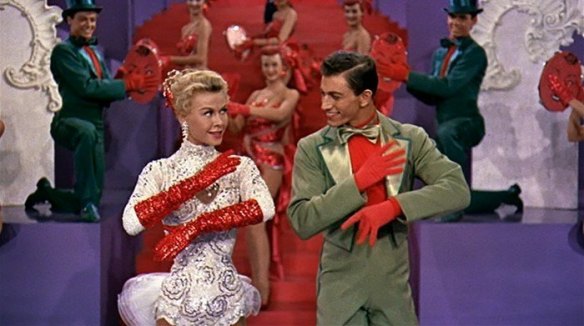
Crosby, Clooney, Kaye, and Vera-Ellen perform "Snow," charmingly staged.

White Christmas was a top-grossing film of 1954 and made multiple fortunes for Paramount ever since, as the movie became a perennial favorite. This movie-movie was old-fashioned, even in ’54, and that’s part of its charm. Still, had White Christmas been made even a half dozen years later, I doubt if it would have been such a mammoth hit. This film was one of the last hurrahs for studio era Hollywood, when Bing and Danny were at the peak of their movie stardom, and nearly the last movie appearances of Rosemary Clooney and Vera-Ellen. The film was the biggest hit that long-time director Michael Curtiz ever had—and this is the guy who made Casablanca and Mildred Pierce! Interestingly, 20th Century Fox put out their own all-star Irving Berlin extravaganza in ‘54, There’s No Business Like Show Business. While it too was a commercial success, White Christmas made more than twice as much, at half the cost, than Show Business.
One of two all-star Irving Berlin musicals in '54, the other was Fox's "There's No Business Like Show Business." 

Throughout White Christmas, you have to not just suspend disbelief, but take your lumps of coal along with the gems. The film opens in ’44, with Bing and Danny as soldiers, performing for the boys. Overlook that Crosby was over 50 and Kaye was 43, and then Bing soothingly launches into his signature song “White Christmas,” with soldiers thinking longingly of home, a touching moment.
Bob Wallace and Phil Davis' rocket ride to fame, in 'White Christmas!'

After the war, Wallace and Davis launch into a warp speed rise to stardom, in one of those movie montages that always make me smile. In White Christmas’ case, especially so, since it reminded me of the old Bugs Bunny spoof, “We’re the Boys of Chorus.” When the “boys” meet the girls, we are treated to the classic duet “Sisters,” which is then spoofed by Bing and Kaye, with Danny especially having a delightful time camping it up.
'White Christmas' montage to fame reminds me of this!

Soon, the guys are tagging along with the gals to Pine Tree, Vermont, where they reunited with General Waverly, who is now an innkeeper. His hired help seems to consist mostly of the delightful Mary Wickes, a welcome presence in any film. Along with no snow, there are practically no guests. The duo decides to bring their latest show to the inn, with the help of the ladies. The “Let’s put on a show!” clichĂ© is pretty irresistible to me, too!
Luckily, the "Minstrel Show/Mr. Bones" number segues into Vera-Ellen's "Mandy."

Unfortunately, the first number up is “I’d Rather See a Minstrel Show/Mr. Bones.” At least it wasn’t done in blackface, but it still feels mighty dated. But then comes the zingy finish, “Mandy,” a wonderful, upbeat tune that becomes a wow with the dazzling, energetic dancing of Vera-Ellen and John Brascia. Bing and Danny perform nimbly with the accomplished V-E, but when Brascia takes over, wowza! Brascia looks like a dark Richard Egan and is obviously having a great time as he struts his stuff. He also had the distinction of dancing the previous year with Joan Crawford, in Torch Song’s infamous “Two-Faced Woman,” which WAS filmed in blackface.
Even better is when sizzling John Brascia takes over the dancing with Vera-Ellen!

Bing and Rosie have a great rapport when their characters aren’t bickering. A sweet number is “Count Your Blessings (Instead of Sheep).” This is intimately performed when the duo are having a late night snack at the inn. I have never cared for Bing Crosby as a person, but as a performer, Bing’s laid back presence was great in both comedy and drama, and his natural style has aged well. Of course, Bing was blessed with a beautiful voice that served him well for many decades.
Rosemary Clooney & Bing Crosby bring their warm, mellow personas to 'White Christmas.'

Clooney didn’t make a lot of movies, they probably weren’t her forte. Plus, the singer’s natural looks and figure were at odds when beauty and glamour were still everything for a film actress of this era. But I enjoy Rosie’s relaxed style in White Christmas, and her singing is top notch, especially in her big torch number, “Love, You Didn’t Do Right By Me.”
Rosemary Clooney's torch number, "Love, You Didn't Do Right By Me," with gorgeous 20-year-old George Chakiris.

The film’s worst number comes with “Choreography.” Some folks adore Danny Kaye, but I find him insufferable. Kaye’s constant “on” demeanor makes Mickey Rooney look subdued. I find Kaye to be the male equivalent of Betty Hutton, practically begging the audience for adoration. “Choreography” is one of those reactionary ‘50’s musical numbers mocking current trends—here, modern dance and beatniks! Danny and the chorus girls are all done up in black, complete with Kaye in a beret and guy-liner. This reminds me of those “rock and roll” spoof numbers from other ‘50s musicals—also very lame. Director Curtiz too often lets Kaye go into his shtick, and it’s like watching Seinfeld’s “Kramer” go off on a fey tangent. To give Danny his due, Kaye is an agile, energetic performer, and he gets on with Bing quite well.
A little bit of Danny Kaye goes a long way. Above, Kaye camps it up in "Choreography."

The best tunes in White Christmas are the simply staged songs: Bing’s title tune for the boys; Danny and V-E’s nimble The Best Things Happen When You’re Dancing; the quartet harmonizing on Snow, charmingly performed in a train car; John Brascia and Vera-Ellen dancing like dervishes to Abraham; even Rosemary’s Love number is subtly staged, with young George Chakiris getting some face time as one of the male dancers. The showstopper numbers are fun, but the gaudy Fab Fifties colors are nearly nauseating!
Dean Jagger as General Waverly is the heart of "White Christmas."

Dean Jagger is a strong presence as General Waverly, with those brilliant blue eyes, radiating warmth and strength. Jagger provides the substance amidst the blizzard of sentiment in White Christmas. His two big bookend scenes at the beginning and finale of the film provide genuine feeling amidst the fluff. Dean is dynamic.
Vera-Ellen, right, performs "Sisters" with on-screen sister Rosemary Clooney.

Vera-Ellen performs well enough within the conventions of this kind of musical, but she really comes alive in the dance numbers. Plus, V-E looks lovely in her Edith Head costumes, showing off her whippet slim figure. Watching White Christmas hit me that Vera looked a good deal like Mitzi Gaynor, also a dancer at the tail end of the musical era. Another coincidence is that Mitzi was the second female lead of her Irving Berlin movie, There’s No Business Like Show Business.
Vera-Ellen look-a-like Mitzi Gaynor with The Merm in her Berlin bonanza,
'There's No Business Like Show Business.'

Although this semi-remake of 1942’s Holiday Inn was bookmarked for a Bing Crosby-Fred Astaire reunion, it wasn’t meant to be. Fred backed out, then Donald O’Conner got sick, that’s when Danny Kaye took over. I’m surprised frequent Crosby co-star Bob Hope wasn’t considered, or that Paramount didn’t go with their younger musical-comedy team, Martin and Lewis. However, Bing and Danny were at the zenith of their movie stardom in ’54.
Mary Wickes is wonderful as always, with Rosemary Clooney, in 'White Christmas.'

Age is a bit absurd in White Christmas. Jagger refers to Crosby as “son” when they are the same age. Par for the era’s course is the 25 year age difference between Crosby and Clooney. And Kaye’s “boyish” antics are a bit hard to take at age 43. Clooney is the older “mother hen” sister, when she was 7 years younger than Vera-Ellen.
If 'White Christmas' deleted dated numbers like "Gee, I Wish I Was Back in the Army," "I'd Rather See a Minstrel Show," & "Choreography," the result would be a near-perfect 1 hour and 45 minute movie! 

The finale is a fitting wow, though I winced at the lyrics of “Gee, I Wish I Was Back in the Army.” When Clooney sees Bing appeal to his former soldiers on “The Ed Harrison Show,” she realizes Crosby is on the level. Everyone reunites at the inn for the big tribute to the General. While it’s sentimental, Jagger and the cast put it over, with a reprise of White Christmas as the camera pulls away in a dazzling shot of the snow falling outside, the stage show, and the audience. White Christmas has its highs and lows, but ends on a lovely high note.

The fabulous closing shot of 'White Christmas.'


Sunday, March 18, 2018

'Flamingo Road' Reunites Crawford & Curtiz 1949

Joan Crawford wears a waitress uniform once again for 'Flamingo Road!'

FYI: I put all the movie overflow on my public FB  movie page. 

Some say that studio head Jack Warner re-teamed Joan Crawford with Michael Curtiz, who guided her Mildred Pierce comeback, in 1949’s Flamingo Road because the star was slipping. Critics point to the box office returns of Crawford’s post-Mildred pictures as proof.
I don’t think that’s a fair comparison. While those films did about half the box office business of 1945’s Mildred Pierce, Crawford’s Oscar winning role as a waitress turned tycoon was a once-in-a-lifetime blockbuster, her all-time highest-grossing movie. Joan’s first three post-Mildred movies all made it over the 100 million mark, in today’s dollars. And they were not typical Crawford films: in Humoresque, Joan was an alcoholic socialite; in Possessed, Crawford played crazy; and in Daisy Kenyon, she was a career girl at a crossroads.
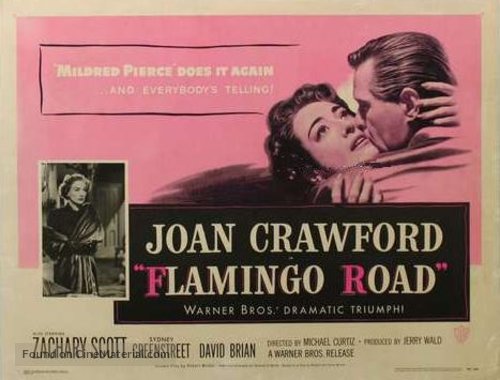
This WB poster pushes the 'Mildred Pierce' connection and the star's still shapely figure.

Warner may have wanted to shore up Crawford’s continued popularity with a more commercial picture, which Flamingo Road certainly was. In fact, this was her last bonafide hit film for Warner Brothers. The noir southern soap opera was the beginning of a series of Crawford shady lady roles, and what followed was a case of diminishing returns. Next year’s stylish Crawford mashup, The Damned Don’t Cry, marked a huge drop off in Joan’s drawing power, and with a few exceptions, stayed that way from 1950 on.
Joan was born in a wagon of a traveling show! Yes, Crawford still has IT-look above her head.

Flamingo Road is often described as campy Crawford cinema. Imagine my surprise to find that it was not—except for the hooty opening sequence, with Joan as a hoochie mama dancer in a traveling carnival show—complete with a veil. The scene hilariously shows Joan performing for a gaggle of gaga adolescent boys. Joan, who was officially 41—I’m of the school who think that Crawford was actually a few years older—either way, was too mature for this. When Joan’s Lane Bellamy falls for Zachary Scott’s deputy, her love rival is played by Virginia Huston, who was 24 here!
Joan with some of her favorite WB leading men: L, David Brian, and R, Zachary Scott.

This film came out the same year that Bette Davis was trying to convince audiences she was a small town sex bomb in Beyond the Forest. Davis commented that WB should have had cast studio star Virginia Mayo in her role. The same thought crossed my mind when I first saw Joan here as Lane Bellamy—Mayo would have been a no-brainer. Whatever—let’s just say that Joan was MUCH better preserved in Flamingo Road than Bette was in Beyond the Forest.
Joan as Lane Bellamy, carny girl turned waitress, and on her way up!

Once that suspension of disbelief is dispensed with, Flamingo Road is a highly watchable melodrama that has a strong story, cast, production, and direction. Under Warners’ top director Michael Curtiz, Joan gives an intense, yet restrained performance as the ex-carny girl who wants to put down roots. Lane’s weak-willed beau Field Carlisle is under the thumb of crooked sheriff, Titus Semple, played by Sydney Greenstreet. The sheriff has political plans for the deputy. So, Zachary Scott’s weak charmer (did he ever play anything else?) marries the rich girl from Flamingo Road and immediately hits the bottle. Meanwhile, Titus does everything he can to run Lane out of town. Crawford’s character must really like the real estate in Boldon, because she will not leave. After release from a jail stint, railroaded by Titus, Lane goes to work at Lute Mae’s a “roadhouse.” Lute is played by the great Gladys George, the best wisecracking scene stealer since Thelma Ritter. Note all George’s world-weary talk of getting “old,” while Joan is constantly referred to as a “girl,” and they’re nearly the same age.
Joan Crawford gets great lighting and lines in 'Flamingo Road': "I'm not a carny girl anymore!" 

At Lute Mae’s, Lane meets Dan Reynolds, played by David Brian, who was also Bette Davis’ tough businessman lover in Beyond the Forest. This was the first of Brian’s several pairings with Crawford, who “discovered” him. As always, Crawford has men fighting over her. The thing is, the two leading men are only mildly appealing, so the real interest comes when Crawford and Greenstreet square off. As Sheriff Semple, Sydney Greenstreet is a worthy adversary for Joan, a forerunner to Orson Welles sweaty slob of a sheriff in Touch of Evil.
Sydney Greenstreet's crooked sheriff & Joan's Lane tussle at 'Flamingo Road's' climax!

The indomitable Lane is at first unnerved by sweaty, sinister Titus, but quickly asserts herself—after all, she is played by Joan Crawford! Flamingo Road’s most famous line comes after Titus Semple says he never forgets anything. Joan’s Lane Bellamy replies: “You know, Sheriff, we had an elephant in our carnival with a memory like that. He went after a keeper that he'd held a grudge against for almost 15 years—had to be shot. You just wouldn't believe how much trouble it is to dispose of a dead elephant.”
Gladys George is great as Lute Mae, wondering if new hire Lane will be worth the trouble.

Coming from a campy ‘50s Crawford vehicle, Joan would have dropped this line like a piano from a twenty story building. Here, the star’s delivery is snapped, but simply said. Director Curtiz was able to keep Crawford as understated here as he did in Mildred Pierce. Oh, occasionally the MGM “English” creeps in, especially once Lane becomes a “lady,” but here it works. I always thought that Joan more fun as a working class girl, which is where she came from in real life. At the Flamingo’s early scenes, Joan sports dishwater blonde hair and curls. Her clothes are tight and manner plain-spoken. Crawford’s demeanor as Lane is no-nonsense but game, with her vulnerability just below the surface. Crawford is actually most appealing when her characters are on their way up, as in Mildred Pierce, as opposed to later scenes, when she’s suffering nobly in mink.
For Joan Crawford, guns and minks go together like Pepsi and vodka!

While Flamingo Road is pure melodrama, from Written on the Wind author Robert Wilder, there’s a real story to hold audience interest. Michael Curtiz elevates the book’s atmospheric world of a southern town and its class system. Curtiz and cinematographer Ted McCord bring great visual style to the storytelling and the scenes at Lute Mae’s roadhouse especially pop. McCord’s deep focus photography is reminiscent of Gregg Toland (Citizen Kane, The Little Foxes).
Once JC's a stylish "lady," she wears some swanky duds by Travilla.

Caricature for Crawford was just around the corner in the ‘50s. But here, in Flamingo Road, Joan goes from cheap to chic, and is framed throughout in soft lighting and deep shadows. Travilla, who famously dressed Marilyn Monroe over at 20 Century Fox, and later infamously overdressed those Valley of the Dolls, creates Crawford some sexy frocks as the waitress and sleek outfits as the wealthy wife. Whatever age Joan was, she is in super-fine form here, and wears it all with her usual aplomb.

Warner Brothers made many film noir soap operas with their female stars in the last half of the ‘40s, but most were dark and dreary. Joan Crawford moved mountains to elevate hers, while holding her ground for better roles. In my research, I was amazed at how many Warner Brothers’ female stars were suspended for turning down bad movies, and some even sued: Bette Davis, Olivia de Havilland, Ann Sheridan, Ida Lupino, and even sweet Joan Leslie!

After leaving long-time studio MGM, Joan Crawford was off-screen for two years after signing with WB, waiting for a proper comeback vehicle. While none of Joan’s WB films topped Mildred Pierce, Flamingo Road is a finely crafted, fun film that crosses several genres, and provides Crawford with a worthy vehicle.
Just a reminder, 'Flamingo Road' is by the same folks who brought you 'Mildred Pierce!'