Showing posts with label Joan Blondell. Show all posts

Wednesday, February 5, 2025

The Many Faces of ‘Eve’ & ‘Lizzie’ 1957


"The Three Faces of Eve" & "Lizzie," that respectively starred Joanne Woodward &
 Eleanor Parker, were both 1957 films that depicted the topic of multiple personalities.


Hollywood had competing films about title characters with three conflicting personalities, both released in 1957. Very specific coincidences, right?! The Three Faces of Eve showcased rising star Joanne Woodward; Lizzie starred film veteran Eleanor Parker. The movies were made on small budgets, returned modest profits, and its stars were praised—with Woodward winning a Best Actress Oscar.

Of course, the studios promoted the more sensational aspects of their subjects
in 1957's  "The Three Faces of Eve" & "Lizzie."

Their Situations

The Three Faces of Eve was based on a true story, with Joanne Woodward as Eve White, Eve Black, and Jane. The first personality is a meek young housewife with a young child. Her behavior has become increasingly erratic, at one point endangering her little girl. It's not long before her doc meets Eve Black, a raucous gal who comes out occasionally to find fun and create chaos. Jane comes on later in the movie as the even-keeled personality, who is the best bet to take over this woman's body. David Wayne is her exasperated husband Ralph; Lee J. Cobb is the sympathetic, but no-nonsense Doctor Luthor.

In 1957's "The Three Faces of Eve," Lee J. Cobb is the psychiatrist,
Joanne Woodward the title character, and David Wayne her bewildered husband.

In Lizzie, Eleanor Parker plays a young woman, Elizabeth, who lives with her drunken Aunt Morgan (Joan Blondell) and works at a museum. Her character is plagued with headaches and insecurities, making her a co-worker to avoid. Her aunt is mostly oblivious to her but does notice her escalating odd behavior. Lizzie’s director, Hugo Haas, also plays the writer neighbor, Walter, who encourages alcoholic auntie to get her niece to kindly doctor Dr. Wright, played by Richard Boone. Once Doc has Elizabeth under hypnosis, he meets her alter ego, Lizzie. She is a vicious character, a female Mr. Hyde. Later in the movie, the doc discovers a third personality, Beth, who is balanced and normal.

In 1957's "Lizzie," Eleanor Parker is the title character with three personalities.
Joan Blondell is the aunt with an overbearing personality!

Their Stories

In The Three Faces of Eve, Eve White is hospitalized for treatment. While the symptoms are identified with her varying personalities, the doctors can not figure out what sets them off. Once home, Eve isn’t getting better. It doesn’t help that husband Ralph wants to drag Eve to another state. And the more Eve Black comes out, it’s more than the reactionary husband can handle. Once he leaves her, this leads Eve back to Dr. Luthor.

David Wayne's Ralph has an obedient wife in Eve, but not when she's Eve Black! Joanne Woodward plays three personalities in 1957's "The Three Faces of Eve."

Lizzie’s Aunt Morgan isn’t a deep thinker, but when auntie's bourbon bottles empty ever faster, her antennae go up. The writer neighbor notices and for some reason is empathetic to the harridan aunt. Yet, he urges her to be more patient to the niece. It all comes to a head when the woman's work life and her erratic nightlife collide. You see, there are nights when mousy Elizabeth is left behind and hellcat Lizzie springs out. She hangs out at local nightclubs on the prowl and one evening meets up with her office place Romeo.

Joan Blondell's Aunt Morgan knows where Eleanor Parker's "Lizzie" finds
the booze AND the boys! "Elizabeth" only gets the hangover! 

The Actors

The Three Faces of Eve got a lone Oscar nomination and win for Joanne Woodward; Lizzie received no nominations.

Joanne Woodward is excellent in all three roles in The Three Faces of Eve. Eve White is totally repressed, a type of role Woodward played well. Joanne played a more raucous sort like Eve Black as the beatnik in The Fugitive Kind. And the later personality to emerge is Jane, the most complete personality to emerge, that Joanne plays with great empathy. Woodward, an Actor's Studio product, is quite natural without going over the top, like Geraldine Page or Kim Stanley would have probably done.

Joanne Woodward as Eve Black comes on to a male nurse like Blanche Dubois
 chatting up the paper boy in 1957's "The Three Faces of Eve."

In Lizzie, Eleanor Parker's performance is quietly effective as the repressed Elizabeth and the serene Beth. Though flatteringly photographed, Parker is quite toned down from her studio era glamour, and is very expressive in Elizabeth’s anguish and Beth’s calm. However, as wildcat Lizzie, Parker goes big, either of her own volition or Haas’ direction. Either way, Eleanor as Lizzie is way over the top. From the way she makes herself up like a clown or vamps around the cocktail bar like Sadie Thompson, it’s funny, not fierce. Also, Elizabeth is 25 going on 26; Eleanor was a lovely 35. Very typical in its movie age math—thankfully, Parker can pass as a decade younger.

Eleanor Parker suffers in chenille as tormented Elizabeth in 1957's "Lizzie."

Lee J. Cobb is more three-dimensional as Eve’s Doctor Luthor than super-kind Richard Boone in Lizzie. David Wayne as Ralph is most realistic as the confused small town spouse of Eve White. 

Joan Blondell's acting as the alcoholic aunt in "Lizzie" is about as subtle as her hat!

Joan Blondell’s performance as the alcoholic aunt in Lizzie is about as subtle as slugging down a bottle of bourbon. Joan gave a handful of memorable dramatic performances in her career and should have been given more opportunities. But Blondell is a complete caricature here—partly the way the character is written, as well as performed. My guess is that came from director Hugo Haas, who made a number of dime store melodramas that were hilariously unsubtle. Blondell’s boozing and barking in her bathrobe gives off a Baby Jane Hudson vibe!

Joan Blondell w/ director Hugo Haas, who plays a kindly neighbor in 1957's "Lizzie."

The Films

Eve White has a traumatic childhood incident that’s subtly recalled. In Lizzie, Elizabeth recalls a vile incident on her birthday, not subtle at all, but still powerful. Both characters find resolution in facing their pasts. The Three Faces of Eve was written by doctors Corbett H. Thigpen and Hervey M. Cleckley, who treated the real Eve. Lizzie was a novel written by Shirley Jackson (The Lottery). 

The book versions of "The Three Faces of Eve" & "Lizzie."

Nunnally Johnson was more famed as a screenwriter than as director, but his intelligence was always a plus, and it shows in the sensitivity of The Three Faces of Eve. Hugo Haas, on the other hand, seemed to dwell on sensationalism in his B-movies. There is a lurid quality to Lizzie that screams Hugo Haas, especially with Joan Blondell’s role and Parker’s performance as the lowdown Lizzie.

Tears Mixed With Humor

The leavening humor in The Three Faces of Eve is in the small town world of the husband and doctors, faced with this strange woman, who’s a timid mouse one moment and then a purring cat on the prowl. There are some smiles with the perplexed classic '50s husband that can’t reconcile the two extreme behaviors of his wife. Eve Black reminded me of a cross between Shirley MacLaine's good-hearted bimbo in '58s Some Came Running and Lee Remick's good-humored trailer tart in Anatomy of a Murder in '59. 

In Lizzie, the humor is unintended camp. The intentional “comic relief” between the aunt and niece, and aunt and neighbor are heavy-handed to the point of hilarity. Lizzie and Aunt Morgan's domestic life reminded me of the dramatized story of Frances Farmer’s life with mother or the Hudson sisters without the wheelchair. I love it when meek Elizabeth walks upstairs to get away from boozing Blondell and randomly barks out an insult as Lizzie, worthy of Kathleen Turner's Serial Mom asking her neighbor if she likes pussy willows!

Lizzie getting herself up to go out reminds me of Faye Dunaway in Mommie Dearest. She meets the sexy janitor in the bar, who has switched out from his work white tee-shirt for evening wear black tee-shirt with jacket, anticipating the Miami Vice look by 30 years. As Lizzie finds the booze and the boys, Aunt Morgan seems more concerned where the booze is going than what's going on with Elizabeth.

Eleanor Parker getting dolled up as "Lizzie" gives me a Faye Dunaway vibe as
 "Mommie Dearest!"

Near the showdown between the two women, Blondell’s aunt snaps, “You look like a slut!”

Parker’s Lizzie gives a Patty Duke/Neely O’Hara snarling delivery, “Drop dead, Auntie, drop dead!”

Future TV Stars

In The Three Faces of Eve, Vince Edwards aka Ben Casey, plays the horny young soldier who wants his due with Eve Black—after all, he spent 8 dollars on her! Near the end of the film, Nancy Culp of The Beverly Hillbillies appears in a flashback as Eve’s mother. In Lizzie, Marion Ross of Happy Days plays a kind co-worker of Parker’s lonely Elizabeth.

Vince Edwards plays a soldier who expects Eve Black to put out in
1957's "The Three Faces of Eve.

Needless Guest Appearances

Alastair Cook's introduction and narration in The Three Faces of Eve is highly unnecessary. It feels very condescending, as if he's a professor lecturing students about a very serious subject! With Lizzie, there is a very distracting piano bar player/singer named Johnny Mathis. He sings two tunes; one is his big hit, It’s Not for Me to Say. At least it wasn’t wailing Johnny Ray! All the while, Parker’s personality-plus Lizzie is working the joint with her hoochie mama antics.

Final Analysis

The Three Faces of Eve and Lizzie have very similar stories, likewise the female characters’ multiple personalities. The difference is in tone. The Three Faces of Eve plays like a pseudo-documentary mixed with a William Inge slice of life drama. Lizzie comes across like a campy “woman’s picture,” to use an old Hollywood term. Here, with the two women at odds in their dreary home, “suffering in chenille” might be more apt!

Why Cinemascope? To fit all those personalities?

"Lizzie" & "The Three Faces of Eve," both from 1957.

By today’s standards, both are very simplistic in the telling of multiple personalities. The one thing Eve and Lizzie have in common is strong lead performances by its stars, Joanne Woodward and Eleanor Parker. Both are worth a look, if only for the attitudes of the era on this controversial subject.

"Jane" is the most balanced personality played by Joanne Woodward in
1957's "The Three Faces of Eve."

"Beth" is the winning personality between meek "Elizabeth" & monstrous "Lizzie."
Eleanor Parker played the triple role.

Bonus Material

Here’s my look at when Joanne Woodward teamed with husband Paul Newman for the first time, 1958’s The Long, Hot Summer: https://ricksrealreel.blogspot.com/2017/08/the-long-hot-summer-long-but-not-so-hot.html

My take on one of Eleanor Parker’s best performances, from 1950 as “cute little trick” who is Caged: https://ricksrealreel.blogspot.com/2019/02/caged-never-classic-but-still-packs.html

Joanne Woodward as tarted up Eve Black in 1957's "The Three Faces of Eve."

Eleanor Parker goes big as demented "Lizzie."

Sunday, April 21, 2024

Charismatic Steve McQueen is ‘The Cincinnati Kid’ 1965


Steve McQueen tries to keep his cool as "The Cincinnati Kid."


There were many talented hands involved with the poker playing epic, 1965’s The Cincinnati Kid. However, Steve McQueen is the winner, in the title role. McQueen isn’t just cool, but also effortlessly natural and emotionally understated as the man who has something to prove.

Like Paul Newman, Steve McQueen knew the power of his piercing blue eyes.

A common criticism of The Cincinnati Kid is that Paul Newman’s The Hustler from 1961 is a much more powerful story. That should go without saying. To me, the similarities between the two films are superficial:  both title characters struggle to make a name in their game; both are going up against a veteran champ in their respective sport. Otherwise, the movies are apples and oranges: Newman’s film is a stark, realistic black and white drama; McQueen’s movie is a stylish, colorful crowd-pleaser. The Hustler is a classic; The Cincinnati Kid is great entertainment and holds up well 50 years later.

A smile from the usually laconic Steve McQueen, as "The Cincinnati Kid."

I’ve only seen a few of Steve McQueen’s films because many of them are genre flicks. However, from what I’ve seen, I’m always knocked out by McQueen’s naturalistic performances. As The Cincinnati Kid, Steve’s card player is tough, but only when he has to be. Though he has ethereal Tuesday Weld and erotic Ann-Margret in his thrall, McQueen’s bad boy truly only wants Weld. When he strays once with A-M, he sees that it’s a mistake. In the typical male star vehicle, it’s a given that the hero can beat up any man and bed every female in sight. Steve McQueen differed from his greatest competitor, Paul Newman. Growing up, I always thought of them as the same type. While McQueen’s beat-up good looks and blue eyes are irresistible, Steve was no male beauty like Paul. I like Steve’s style during the ‘60s, much more than Newman’s cocky anti-hero. McQueen reminds me of an updated version of Bogart and Garfield. The final scene where the Kid admits that he’s done, tonelessly matter of fact, is just one of many understated moments by Steve McQueen in The Cincinnati Kid.

The scene when Steve McQueen's "Cincinnati Kid" quietly admits defeat is powerful.

Edward G. Robinson’s performance as veteran gambler Lancey Howard is one of his best—and one of Eddie’s most restrained. Nicknamed “The Man,” Howard knows that “The Kid” is coming down the pike. When Howard rolls into New Orleans, he’s like visiting royalty. I love watching Robinson as Lancey, like a Cheshire cat, taking everything in with great stillness. His poker face is quite entertaining, contrasted with those half-asleep eyes that miss nothing. After a game with a sore loser of a rich man, a game is set up that includes The Man and The Kid. During that third act poker game, Robinson gets to genially spar with former WB co-star Joan Blondell, and his interaction with younger star McQueen is understated and riveting. Eddie was quoted that he admired McQueen, that he was a throwback to the WB stars like himself, Bogie, Cagney, and Garfield. Robinson was totally right.

"I'm still the top stud poker player, see?" Edward G. Robinson as Lancey Howard
aka The Man in 1965's "The Cincinnati Kid."

What a shame that Edward G. Robinson didn't get an Oscar nod for his subtle, dryly humorous performance. This and his final turn as Sol in 1973’s Soylent Green were most worthy for Best Supporting Actor Oscar nomination consideration. The fact that Eddie got zero Oscar nominations in his film career is one of the Academy’s blindest blunders.

One-time WB stars Edward G. Robinson & Joan Blondell reunited as a card shark
& card dealer in 1965's "The Cincinnati Kid."

Aside from Steve McQueen, Ann-Margret, and Tuesday Weld, with their modern style, there's a lot of period detail for a ‘60s movie that wasn't a costume picture. McQueen has his designer hair cut, but his clothes are timeless, except for that cool rain jacket in the opening scenes. And Weld’s hair is very ‘60s hippie chick, but she’s otherwise in character. Then there’s Ann-Margret as Shooter’s young wife, Melba. I like A-M overall as an actress and she seems like a class act as a person. But her shallow kitten with a whip gets old really fast. Compared to the natural performances and physical appearance of the rest of the cast, Annie’s tidal wave of dyed red hair, awning-sized false lashes, and her purring/hissing cat in heat act stands out in the wrong way. Totally ‘60s in a ‘30s set movie, Ann-Margret’s performance is ironically the one thing that is dated in an otherwise authentically atmospheric film.

Ann-Margret as Melba the Cat? As Karl Malden's faithless wife, Melba even cheats
at jigsaw puzzles! From 1965's "The Cincinnati Kid."

Tuesday Weld’s Christian, a country girl in New Orleans, is her quirky, child-like self. But as the good girl to Ann-Margret’s vamp, Weld has a more genuine rapport with McQueen’s character. The Kid’s bathtub scene, when Christian explains a foreign movie that she’s just seen is one example of their charming interplay.

Tuesday Weld & Steve McQueen have a sweet rapport in 1965's "The Cincinnati Kid."

The cast of The Cincinnati Kid is simply incredible. Karl Malden is a flawed good guy, Shooter, coerced into cutting the cards in the Kid’s favor, because of debts incurred by his trampy wife, Melba. Malden’s empathetic, as always. Rip Torn, of the John Cassavetes/Ben Gazzara department of creeps, is the poor sport money man who wants the Kid to take down reigning ancey. Joan Blondell has her likeable broad routine down pat by now as card dealer Lady Fingers. All the actors get their moment to shine: Jack Weston as grouchy Pig; plus Jeff Corey, Dub Taylor, Cab Calloway, Karl Swenson, Milton Selzer, and Burt Mustin. Uncredited but remarkable is Ken Grant as the little shoeshine boy who always wants to challenge the Cincinnati Kid in a penny pitch.

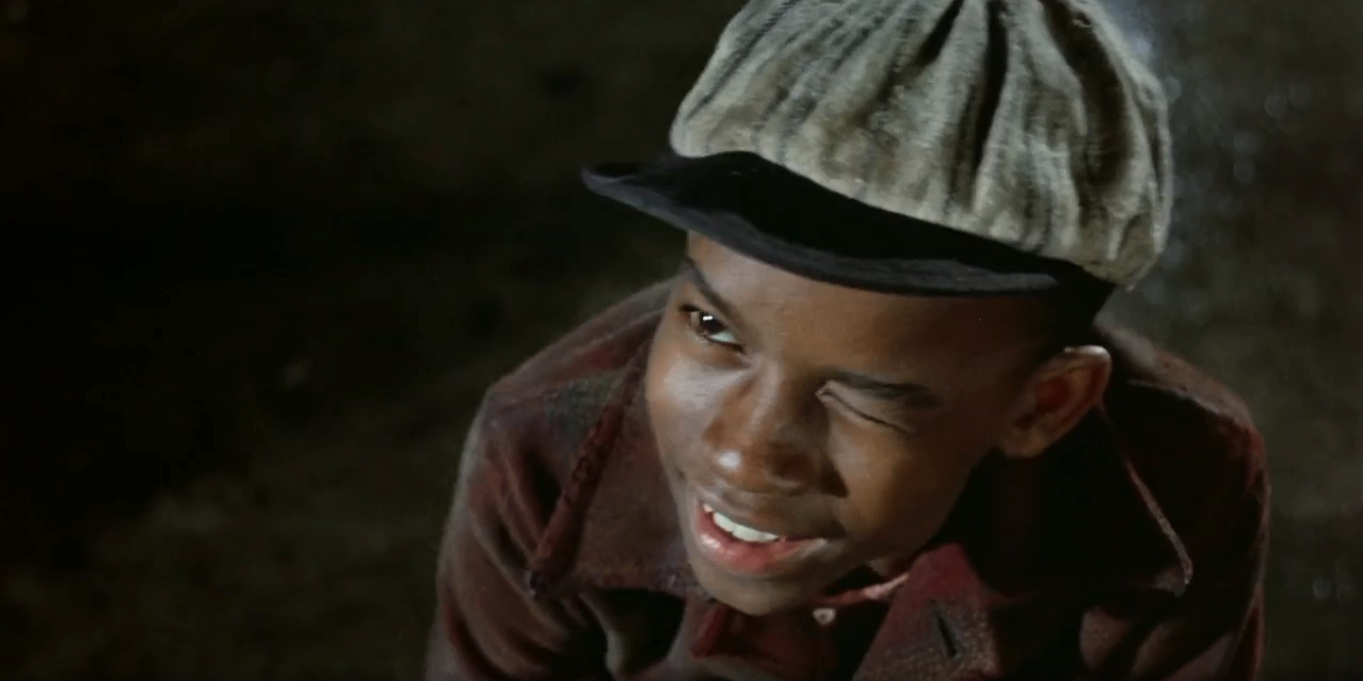
Ken Grant is winning as the shoe shine boy who dogs "The Cincinnati Kid."

The shoe shine boy who idolizes and challenges "The Cincinnati Kid," 1965.

The movie’s tight yet intriguing visual style is courtesy of director Norman Jewison, editor (future director) Hal Ashby, and versatile cinematographer Philip H. Lathrop (Touch of Evil and Point Blank). Jewison was an actor’s director who was also a great storyteller and it shows here. The story, though it revolves around cards, is really about what the stakes are for these characters in the game. You notice every character, even if they are only reacting to the major players, a hallmark of a Jewison movie.

Director Norman Jewison at right, listening to his star, Steve McQueen, on the set of
 "The Cincinnati Kid." Tuesday Weld is in the middle of the talk.

The Cincinnati Kid was from a novel by Richard Jessup, a writer with a tough upbringing, similar to star Steve McQueen. Sadly, both men died young, two years apart, from cancer. The crisp and humorous script is by old pro Ring Lardner, Jr., first time off the black list, and newcomer Terry Southern, who came into his own in the ‘60s. Lalo Schifrin provides the score, with Ray Charles singing the theme song.

An amused beef from me: Why didn't Jewison reshoot the scene where McQueen throws Malden up against the door, after the Kid finds out Shooter is favoring him with the cards? When Steve slams Karl, the entire wall wobbles!

Rip Torn, so good at playing villains, is rich SOB Slade in "The Cincinnati Kid."

Some movie critics and film fans have complained about card games as a subject matter and the impossible odds of The Kid and The Man’s last hands. Personally, I find card games incredibly boring. The game scenes here were filmed with great skill and I was much more interested in the players’ motivations than their card hands.

The Cincinnati Kid is a crowd-pleaser, you’re either all in, or you’re out.

Here’s my look at director Norman Jewison’s 1967 ensemble masterpiece, In the Heat of the Night: 

http://https://ricksrealreel.blogspot.com/2020/06/in-heat-of-night-1967.html


"The Cincinnati Kid" is on its game as great entertainment.

Saturday, January 20, 2024

Jane Wyman Lifts ‘The Blue Veil’ 1951


Jane Wyman is the governess who wears "The Blue Veil" from 1951.


The Blue Veil is a most straightforward melodrama, a tearjerker tale of a life-long governess, of what was once called a "woman's picture." The 1951 film was released through RKO, a moderate hit in its day with mostly positive reviews, but today is mostly forgotten. This is because there’s nary a good copy to be had and is rarely shown. Whether it’s copyright or estate issues—it’s actually a Norman Krasna and Jerry Wald production—The Blue Veil deserves to be restored.

Jane Wyman as Louise Mason wears the traditional governess/nanny "Blue Veil."
 With Cyril Cusack as the toy store owner who admires "LouLou."

As The Blue Veil takes place over several decades and still clocks in at the standard one hour and forty five minutes, some of the events and especially reactions seem a bit perfunctory. What helps is the cast is populated with old pros, who convey the most with each scene. Yet, it is Jane Wyman's warmth and strength that hold this episodic tearjerker together, and nabbed Wyman a Best Actress Academy Award nomination.

Jane Wyman is a young widow who just finds out her new baby has died,
in 1951's "The Blue Veil." Jane was 34 when this was filmed.

There is the era's "get on with it" attitude toward trauma and life changes evident in The Blue Veil. For example, within the first five minutes, Jane Wyman's Louise Mason goes from a war widow with a baby, to suddenly losing her child, with a doctor who comes in and gives the world's most generic non-explanation, capped with, "…we did all we could for it." Later, a practical employment lady who thinks that Louise should be a nanny ASAP to ease her pain! Likewise, when Louise is eased out from her duties after the widower boss remarries, his new bride asks how many weeks it will take the nanny to teach her everything about caring for the baby. No time for therapy back then!

Jane Wyman as nanny Louise Mason, with her first charge. Charles Laughton is her
 boss and Vivian Vance is his new bride. "The Blue Veil" from 1951.

While the “mother love” storyline can be very sentimental, Jane Wyman's acting is warm, but not sticky sweet. That's why I enjoy Jane in movie soaps. Some movie fans think of Wyman as dull, but I find her acting naturalistic. Especially when shed of glamour, Jane Wyman appeals with those huge doe eyes and soft but firm voice. She suggests deep feeling without the diva posturing so typical of the era. I find Wyman’s acting more in keeping with Barbara Stanwyck and Olivia de Havilland than say, Crawford or Davis. 

The Blue Veil starts after WWI and ends after WWII, so Jane's Louise goes through a series of jobs, with the governess/nanny/nurse in the "blue veil" uniform connecting deeply with several families.

Louise's first charge is Freddie, whose mother died giving birth, almost the reverse of her own situation. The widower is Charles Laughton as Frederick, most appealing as the lonely man, in a rare normal role. Laughton and Wyman have a nice rapport, and the businessman proposes to Louise. She wisely turns him down, feeling two lonely people does not make for a happy marriage. So secretary Vivian Vance soon accepts his proposal instead, and lives the dream of a prosperous businessman's wife. An example of how even-handedly The Blue Veil is told, Vance's character is pragmatic but not a villain. While Wyman’s Louise is saddened by her departure, she made the call, and accepts the situation gracefully.

I love overlap "dissolves"from classic films. Here, Jane Wyman's nurse says goodbye
 to her first child, then shown leaving to find a new job, from "The Blue Veil."

If Wyman's Louise was a young war widow just after WWI, that would put “LouLou” in her early '50s at the post-war end of this film. As Louise starts caring for her last child, each subsequent scene makes her looks older. By the finale, Wyman looks like Margo in Lost Horizon, after she escaped Shangri-La!

At the finale of "The Blue Veil," Jane Wyman's nanny is suppose to be in her early
 '50s, but looks like Helen Hayes in "Airport!"

Next, “LouLou” cares for two boys, the younger especially attached, the sons of a wealthy couple, with Agnes Moorehead in sympathetic mode as Fleur Palfrey. Moorehead acted five times opposite Wyman: Johnny Belinda; The Blue Veil; Magnificent Obsession; All That Heaven Allows; and Pollyanna.

Agnes Moorehead is Jane Wyman's second employer in 1951's "The Blue Veil."

Here, she meets Richard Carlson as the boys’ tutor, Jerry. A warm charmer and dreamer, he wants more than this temporary gig. He gets a teaching job offer in Syria—of a century ago! He wants Louise to run off with him and marry. That Jerry is weak of character shows when he's easily discouraged by Moorehead, then Wyman herself, when they both make valid points of his intentions. On the train, he projects his doubts on Louise, who then calls it off and goes back to her job.

I love this warm romantic scene between Jane Wyman & Richard Carlson in 1951's
 "The Blue Veil."

Some time elapses when Louise now takes care of the daughter of Annie Rawlins, an aging musical stage star. Her daughter Stephanie, played by 12 year old Natalie Wood, adores Louise. As is usually the case, the child becomes attached to doting nanny LouLou. Annie is good-hearted but thoughtless and often a no-show at her daughter's big life moments. When Stephanie calls Louise her mother at her confirmation, the nanny lets her mother know that it’s best to leave. This sets up a major tearjerker scene, when Louise tells Stephanie she has to go. Wyman and Blondell were old pros by this point and play with their typical naturalism. Wood is remarkable as the disappointed daughter and plays her big scene, begging Louise stay, quite movingly.

Tearjerker scene from "The Blue Veil," when Jane Wyman's governess realizes it's time to move on. Young Natalie Wood as her charge & Joan Blondell as the mother.
Natalie Wood was 12 when she made "The Blue Veil."
She is quite good as the girl who becomes attached to Wyman's nanny.

I was a bit surprised that Blondell got a supporting actress Oscar nomination for The Blue Veil. Her role is brief as the good natured broad, and she isn't doing anything new. Yet, she got no nods for A Tree Grows in Brooklyn or Nightmare Alley, in roles that were bigger and juicier. But that's Hollywood, where some very strange Oscar nominations and wins were awarded in the ‘50s. Gloria Grahame in The Bad and the Beautiful and Jan Sterling and Claire Trevor for The High and the Mighty come to mind.

Dan O'Herlihy & Audrey Totter play a young couple who go to England during WWII,
 leaving their baby boy with Jane Wyman's dependable nanny, in "The Blue Veil."


Louise's last stint as nanny comes for Helen and Hugh Williams, played by Audrey Totter and Dan O'Herlihy. They have a baby boy, Tony, and LouLou fits right in. Then British hubby Hugh is called off to war. When he is reported missing, Lulu holds down the fort while Helen goes off to find him. He is wounded and later dies, and she stays on for the war's duration. After the war, Helen stays on, for very vague reasons. By this time, Lulu is caring for Tony for free, even working to support him! While Lulu has taken care not to become too attached to her charges in the past, this time she does. When Helen finally returns, the boy is a grade-schooler playing baseball. Lulu attempts to run off with Tony, but is found. Totter’s Helen now has bulldog husband Henry Morgan in tow, who wants to press charges. But the district attorney shames them for their lack of communication, appreciation, or payment. Louise is heartbroken when they leave with Tony.

Have a hanky handy when Audrey Totter's Helen comes back nearly a decade later
for her son, in the care of Jane Wyman's nanny, from 1951's "The Blue Veil."

By this time, Louise is looking like and acting like a latter day Madame X, but having had none of her fun! Along the way, Louise turns down a third offer of marriage, from irascible but good guy Frank (Cyril Cusack), who owns a toy store that she frequents for her charges. Unfortunately, he dies of a heart attack when the police come looking for Louise.

Jane Wyman's nanny is now an elementary school janitor in 1951's "The Blue Veil."


Louise winds up as a janitor at an elementary school, to be near children. Today, she'd probably be pegged as a predator, but that's another discussion! Going home one day, she nearly steps out in front of a car, but is saved. At an eye doctor for a checkup, he turns out to be her second charge, Robbie Palfrey, who was once afraid of storms. Unbeknownst to Lulu, he arranges a dinner for her and her previous kiddos. With their spouses, they enjoy a lovely reunion, with Robbie announcing he wants Lulu to care for his own children. At this point, you will have used up a box of tissues!

Jane Wyman's "LouLou" is asked to be nanny to her one-time charge's children in
the finale of 1951's "The Blue Veil."


One of Jane Wyman’s smaller films, like the likewise underrated So Big, The Blue Veil is a straight up soap, but played with genuine feeling. Director Curtis Bernhardt, who made his name at WB, did well with actors and keeps this movie moving along smoothly. The Blue Veil feels more like a ‘40s movie in the increasingly modern ‘50s film world, but if you’re in the mood for cinema suffering with an uplifting finale, Wyman and a stellar cast are worth watching.

Here’s my look at one of Jane Wyman’s best latter day roles, in Douglas Sirk’s All That Heaven Allows, with Rock Hudson: https://ricksrealreel.blogspot.com/2020/10/all-that-heaven-allows-1955.html

A stellar cast is a bonus in 1951's "The Blue Veil," but Jane Wyman's performance as
 Louise Mason, a nanny for over three decades, holds this film together.