Showing posts with label Sydney Greenstreet. Show all posts

Wednesday, August 13, 2025

Zachary Scott is ‘Ruthless’ to Stellar Co-Stars 1948


Louis Hayward & Diana Lynn look on in disbelief at Zachary Scott's
shameless selfishness in 1948's film noir by Edgar G. Ulmer, "Ruthless."


The rise and fall of a charming but scoundrel of a man was a movie staple even before Citizen Kane. But the movies that came after that iconic epic often had more than a hint of Kane-style storytelling. Such is the case with Edgar G. Ulmer’s B+ budget noir soap from 1948, Ruthless, starring Zachary Scott as the ambitious heel, naturally.

In Ruthless, you get a bit more of the anti-hero’s back story than the typical Zachary Scott villain. It’s a dark tale of a boy torn between his cold, bitter mother and charming, but unreliable father. Let down by both parents one fateful night, young Horace Vendig turns up at a family who have befriended him, with a daughter that Horace had saved from drowning, as well. From then on, Vendig seems determined to take any upwardly mobile opportunities that come his way, no matter who gets hurt. 

Robert Anderson, so endearing as young George Bailey in "It's a Wonderful Life,"
 grows up to be rotten Zachary Scott in 1948's "Ruthless."

What's interesting for movie fans is that young Horace is played by Robert Anderson, who was famed for portraying young George Bailey in It's a Wonderful Life. He's so inherently earnest that it's hard to see him grow up into Zachary Scott, who often did everything but twirl his mustache in multiple movies, as the charming but cunning cad. What sets this apart from Scott's rogue's gallery of bad guys is that Vendig is aware of his fatal flaw but can't help himself. And Scott was a subtle enough actor who could convey this duality.

Here's Zachary Scott, giving his patented baleful stare to Louis Hayward,
who plays life-long friend Vic in 1948's "Ruthless."

Even though the family that takes him in and treats him like a son, going so far as to send him off to Harvard, even when he has the love of their sweetheart daughter, it's just not enough. Vendig goes through several dream opportunities, but tosses them away when he something better to exploit. Eventually, karma calls!

This movie packs a lot of story in the usual 1 hour and 45 minute running time, but cult director Edgar G. Ulmer gets the job done! Those Citizen Kane touches, with the great man’s humble beginnings, the characters introduced and then cast aside, great wealth conveyed on a budget, and Vendig’s goals become grandiose to the point that he’s bound to get his comeuppance.

I like Zachary Scott without his pencil mustache that he typically sported.
Scott as young Horace Zendig in 1948's "Ruthless."


What truly makes this movie a guilty treasure treat is not the soap opera story but the fantastic cast. Zachary Scott is good as usual in the lead, with Robert Anderson empathetic as his younger self. Raymond Burr appears as Vendig's gambler dad and is quite grand as the showboater. Diana Lynn is quite endearing and sparkling as Horace's first love, Martha, who any man would be happy with. She later appears as another more pragmatic woman, Mallory, who bewitches Vendig. Louis Hayward is solid is Vendig's life-long friend, Vic, and later his critic, much like Joseph  Cotten was to Orson Welles as Citizen Kane. The child actors who portray them are very good. Aside from Robert Anderson as young Horace, there’s Ann Carter as young Martha and Arthur Curtis who really looks like Hayward as a young Vic. Martha Vickers is beautiful and warm as good girl Susan, who also gets taken for a ride by Horace. Later on, Lucille Bremer, coming on like an early Bette Davis neurotic, plays his wife, Christa. Horace steals her from besotted Sydney Greenstreet, as Buck Mansfield, a business giant that Vendig takes down. This is one hell of a cast, with everyone is quite believable in their roles. The only scene that’s not believable is when massive Greenstreet and whippet-thin Scott struggle to the death on a dock!

Zachary Scott as Horace Vendig, about to explain his shady past,
in 1948's film noir, "Ruthless."

The storytelling is flashback, noir style, which I'm fine with. But I had to laugh when the first LONG flashback occurred when Scott's Vendig was about to light a cigarette. And when the flashback is over, Lynn extinguishes his match, some 40 minutes later! Zach must have relayed his backstory with the speed of a narrator citing the side effects of a drug in a TV commercial!

Diana Lynn in a dual role, here as Mallory, hilariously blows out Scott's match
40 minutes later after the flashback, in 1948's "Ruthless."

The story of Ruthless Vendig is very dramatic and soapy ala JR Ewing in Dallas! But the movie's style, acting, and a few twists make this a very enjoyable '40s noir melodrama. 

Diana Lynn is utterly winning as Zachary Scott's first love in 1948's "Ruthless."

Martha Vickers is quite lovely and appealing as Zachary Scott's next conquest,
in 1948's film noir, "Reckless."

Lucille Bremer first plays Sydney Greenstreet's trophy wife, then Zachary Scott's,
in 1948's film noir "Ruthless."

Here’s my take on the film that features Zachary Scott’s greatest villain, Monte Beragon, in the 1945 Joan Crawford  Oscar vehicle, Mildred Pierce: https://ricksrealreel.blogspot.com/2020/03/how-joan-crawford-became-mildred-pierce.html


The poster for 1948's "Ruthless" looks like a score card for
each character's dominant personality trait!


Sunday, March 18, 2018

'Flamingo Road' Reunites Crawford & Curtiz 1949

Joan Crawford wears a waitress uniform once again for 'Flamingo Road!'

FYI: I put all the movie overflow on my public FB  movie page. 

Some say that studio head Jack Warner re-teamed Joan Crawford with Michael Curtiz, who guided her Mildred Pierce comeback, in 1949’s Flamingo Road because the star was slipping. Critics point to the box office returns of Crawford’s post-Mildred pictures as proof.
I don’t think that’s a fair comparison. While those films did about half the box office business of 1945’s Mildred Pierce, Crawford’s Oscar winning role as a waitress turned tycoon was a once-in-a-lifetime blockbuster, her all-time highest-grossing movie. Joan’s first three post-Mildred movies all made it over the 100 million mark, in today’s dollars. And they were not typical Crawford films: in Humoresque, Joan was an alcoholic socialite; in Possessed, Crawford played crazy; and in Daisy Kenyon, she was a career girl at a crossroads.
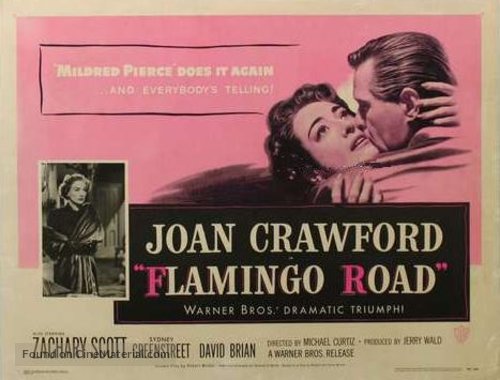
This WB poster pushes the 'Mildred Pierce' connection and the star's still shapely figure.

Warner may have wanted to shore up Crawford’s continued popularity with a more commercial picture, which Flamingo Road certainly was. In fact, this was her last bonafide hit film for Warner Brothers. The noir southern soap opera was the beginning of a series of Crawford shady lady roles, and what followed was a case of diminishing returns. Next year’s stylish Crawford mashup, The Damned Don’t Cry, marked a huge drop off in Joan’s drawing power, and with a few exceptions, stayed that way from 1950 on.
Joan was born in a wagon of a traveling show! Yes, Crawford still has IT-look above her head.

Flamingo Road is often described as campy Crawford cinema. Imagine my surprise to find that it was not—except for the hooty opening sequence, with Joan as a hoochie mama dancer in a traveling carnival show—complete with a veil. The scene hilariously shows Joan performing for a gaggle of gaga adolescent boys. Joan, who was officially 41—I’m of the school who think that Crawford was actually a few years older—either way, was too mature for this. When Joan’s Lane Bellamy falls for Zachary Scott’s deputy, her love rival is played by Virginia Huston, who was 24 here!
Joan with some of her favorite WB leading men: L, David Brian, and R, Zachary Scott.

This film came out the same year that Bette Davis was trying to convince audiences she was a small town sex bomb in Beyond the Forest. Davis commented that WB should have had cast studio star Virginia Mayo in her role. The same thought crossed my mind when I first saw Joan here as Lane Bellamy—Mayo would have been a no-brainer. Whatever—let’s just say that Joan was MUCH better preserved in Flamingo Road than Bette was in Beyond the Forest.
Joan as Lane Bellamy, carny girl turned waitress, and on her way up!

Once that suspension of disbelief is dispensed with, Flamingo Road is a highly watchable melodrama that has a strong story, cast, production, and direction. Under Warners’ top director Michael Curtiz, Joan gives an intense, yet restrained performance as the ex-carny girl who wants to put down roots. Lane’s weak-willed beau Field Carlisle is under the thumb of crooked sheriff, Titus Semple, played by Sydney Greenstreet. The sheriff has political plans for the deputy. So, Zachary Scott’s weak charmer (did he ever play anything else?) marries the rich girl from Flamingo Road and immediately hits the bottle. Meanwhile, Titus does everything he can to run Lane out of town. Crawford’s character must really like the real estate in Boldon, because she will not leave. After release from a jail stint, railroaded by Titus, Lane goes to work at Lute Mae’s a “roadhouse.” Lute is played by the great Gladys George, the best wisecracking scene stealer since Thelma Ritter. Note all George’s world-weary talk of getting “old,” while Joan is constantly referred to as a “girl,” and they’re nearly the same age.
Joan Crawford gets great lighting and lines in 'Flamingo Road': "I'm not a carny girl anymore!" 

At Lute Mae’s, Lane meets Dan Reynolds, played by David Brian, who was also Bette Davis’ tough businessman lover in Beyond the Forest. This was the first of Brian’s several pairings with Crawford, who “discovered” him. As always, Crawford has men fighting over her. The thing is, the two leading men are only mildly appealing, so the real interest comes when Crawford and Greenstreet square off. As Sheriff Semple, Sydney Greenstreet is a worthy adversary for Joan, a forerunner to Orson Welles sweaty slob of a sheriff in Touch of Evil.
Sydney Greenstreet's crooked sheriff & Joan's Lane tussle at 'Flamingo Road's' climax!

The indomitable Lane is at first unnerved by sweaty, sinister Titus, but quickly asserts herself—after all, she is played by Joan Crawford! Flamingo Road’s most famous line comes after Titus Semple says he never forgets anything. Joan’s Lane Bellamy replies: “You know, Sheriff, we had an elephant in our carnival with a memory like that. He went after a keeper that he'd held a grudge against for almost 15 years—had to be shot. You just wouldn't believe how much trouble it is to dispose of a dead elephant.”
Gladys George is great as Lute Mae, wondering if new hire Lane will be worth the trouble.

Coming from a campy ‘50s Crawford vehicle, Joan would have dropped this line like a piano from a twenty story building. Here, the star’s delivery is snapped, but simply said. Director Curtiz was able to keep Crawford as understated here as he did in Mildred Pierce. Oh, occasionally the MGM “English” creeps in, especially once Lane becomes a “lady,” but here it works. I always thought that Joan more fun as a working class girl, which is where she came from in real life. At the Flamingo’s early scenes, Joan sports dishwater blonde hair and curls. Her clothes are tight and manner plain-spoken. Crawford’s demeanor as Lane is no-nonsense but game, with her vulnerability just below the surface. Crawford is actually most appealing when her characters are on their way up, as in Mildred Pierce, as opposed to later scenes, when she’s suffering nobly in mink.
For Joan Crawford, guns and minks go together like Pepsi and vodka!

While Flamingo Road is pure melodrama, from Written on the Wind author Robert Wilder, there’s a real story to hold audience interest. Michael Curtiz elevates the book’s atmospheric world of a southern town and its class system. Curtiz and cinematographer Ted McCord bring great visual style to the storytelling and the scenes at Lute Mae’s roadhouse especially pop. McCord’s deep focus photography is reminiscent of Gregg Toland (Citizen Kane, The Little Foxes).
Once JC's a stylish "lady," she wears some swanky duds by Travilla.

Caricature for Crawford was just around the corner in the ‘50s. But here, in Flamingo Road, Joan goes from cheap to chic, and is framed throughout in soft lighting and deep shadows. Travilla, who famously dressed Marilyn Monroe over at 20 Century Fox, and later infamously overdressed those Valley of the Dolls, creates Crawford some sexy frocks as the waitress and sleek outfits as the wealthy wife. Whatever age Joan was, she is in super-fine form here, and wears it all with her usual aplomb.

Warner Brothers made many film noir soap operas with their female stars in the last half of the ‘40s, but most were dark and dreary. Joan Crawford moved mountains to elevate hers, while holding her ground for better roles. In my research, I was amazed at how many Warner Brothers’ female stars were suspended for turning down bad movies, and some even sued: Bette Davis, Olivia de Havilland, Ann Sheridan, Ida Lupino, and even sweet Joan Leslie!

After leaving long-time studio MGM, Joan Crawford was off-screen for two years after signing with WB, waiting for a proper comeback vehicle. While none of Joan’s WB films topped Mildred Pierce, Flamingo Road is a finely crafted, fun film that crosses several genres, and provides Crawford with a worthy vehicle.
Just a reminder, 'Flamingo Road' is by the same folks who brought you 'Mildred Pierce!'


Saturday, December 23, 2017

Christmas in Connecticut 1945

The softer side of Barbara Stanwyck is on full display as a lifestyle writer whose faux
 perfect life inspires a soldier in 1945's feel-good "Christmas in Connecticut."


You know why I think movie fans have a soft spot for the 1945 romantic comedy Christmas in Connecticut? Because we all want to live in that lovely country home! So what if it’s only a set? As 30 Rock’s Liz Lemon likes to say: “I want to go to there!”
Christmas in Connecticut is no It’s a Wonderful Life, but I still enjoy watching this war time Warner Brothers’ comedy every holiday season—it’s fast-paced fun, and filled with a great cast of stars and character actors.
If all the world's a sound stage, I'd like it to look like the set of 'Christmas in Connecticut!'

A rescued navy hero, Jefferson Jones (Dennis Morgan) wishes to have Christmas with all the trimmings at home. Not just any home, but the country Connecticut cottage of Martha Stewart-esque writer Elizabeth Lane (Barbara Stanwyck) and her family. This also inspires Lane’s boss, Alexander Yardley (Sydney Greenstreet), that he invites himself along, too. One problem…okay, several: Lane lives in a NYC apartment, is single, has no children, and can’t cook!
Dennis Morgan as the navy hero with food and romance on his mind.

Lane’s sort-of boyfriend, John Sloan, is an architect and offers his awesome abode to carry out the charade of Lane as queen of country living. Sloan also uses this opportunity to propose marriage. They bring Lane’s Uncle Felix, who has been feeding her all the recipes for her column, to do the actual cooking.

Well, when soldier Jones meets lifestyle queen Lane, sparks fly and they fall immediately in love. The rest of Christmas in Connecticut is a comedy of errors with Lane and her team trying to pull off the “perfect family” Christmas, with Jones and Yardley wanting to see Lane pull out all “the hostess with the mostess” moves. What ensues is farfetched, frothy fun.
Barbara Stanwyck as the city girl who writes about country living and cooking.

What I really love about Christmas in Connecticut is watching Barbara Stanwyck as no-nonsense but high-spirited Elizabeth Lane. Stanwyck later became renowned for all the tough cookies she played in film noirs and westerns, especially later on The Big Valley. However, in the ‘30s and ‘40s, Stanwyck played well in every genre. I watched Barbara and Henry Fonda in the classic The Lady Eve for the first time recently—and it confirmed what I already knew from Connecticut—that Stanwyck was skilled at comedy.
Writer Lane finds herself falling in love with hero Jones, in 'Christmas.'

Barbara rarely looked better than in Christmas in Connecticut. Unlike some movie divas, Stanwyck, while golden era glamorous, looked like a real person: simple make up, hair that actually moved, and clothes by Edith Head that looked like they didn’t belong to a drag queen.

I never thought much about Dennis Morgan until I saw him in1943’s The Hard Way this year on TCM. Morgan put a bit of an edge to his usual charm and it played well. In Connecticut, as the navy hero on the mend, Morgan is a charmer, all twinkling eyes and dimpled grin. Not hard to see why he was a wartime favorite!

To see Sydney Greenstreet, one of WB’s great movie villains, in a comedy, always throws me off. I always expect to see Stanwyck go into tough grrrl mode and butt heads with ominous Greenstreet. Here, Greenstreet’s got game as the increasingly confused magazine mogul Yardley.
S.Z. Sakall shows Barbara how to do the "flippety-flop" to show off her skills!

A special shout-out to S.Z. “Cuddles” Sakall as Uncle Felix. Sakall was one of Warners’ great character actors and he really steals the show here. Sakall is such fun as the Hungarian chef who can barely keep up with the pretense taking place. What I find touching about watching Sakall is that he’s so endearingly funny, yet in real life, he was a European refugee from Hitler’s regime. Sakall lost three sisters, his niece, and his wife’s brother and sister to the concentration camps. Talk about a trouper.
Dennis Morgan at the height of his boyish appeal as hero Jefferson Jones

The rest of the cast is stellar: Reginald Gardiner as dull boyfriend Sloane, Una O’Conner as the touchy housekeeper, Joyce Compton as southern comforting nurse Mary Lee, and funny characters right down to the bit parts. Watch Christmas in Connecticut, nostalgic, yet poking knowing fun at the attempts to create a “perfect” Christmas.

FYI: I put all the movie overflow on my public FB  movie page. 

Check it out & join!  https://www.facebook.com/groups/178488909366865/


If all the world's a stage, why can't I get better lighting, like these two great stars? See top of this shot!

Friday, July 8, 2016

We'll Always Have 'Casablanca' 1942

'Casablanca' still casts its classic spell nearly 80 years later.

Critics and audiences still like to argue whether Casablanca is great art or merely great entertainment—let them, I say. Casablanca still captivates, no matter how you define the 1942 Warner Brothers’ war-time romance.

Bill Kennedy, movie host with the most!
I was junior high age when I first watched Casablanca on the late show. From where I sat on my plaid sofa, in 1970s Upper Michigan, it was just another dated war time romance: lots of air sirens, police whistles, patriotism, sneering Nazis, and brave Bogie and Bergman clutching one another in the face of danger.

A few years later, I watched Casablanca again on Detroit TV 50’s Bill Kennedy at the Movies. By then, I was hooked on classic Hollywood and much more impressed. Kennedy was as proud as a peacock whenever the one-time actor got to show and chat about a true blue classic like Casablanca. By high school graduation, I felt like Bill had been my favorite teacher—in film.

What set Casablanca apart from other exotic romances, especially the many cinema copycats to come, was the classic melodrama captured a time and place vital in American and world history. The U.S. had avoided getting into WWII, much like Rick/Bogart: “I stick my neck out for nobody.” 

Everyone comes to Rick's movie blog!
However, Pearl Harbor changed all that on Dec. 7, 1941. Casablanca was filmed the following year, in an atmosphere of uncertainty. Many of the supporting cast members were ex-pats and refugees from all over Europe, who had already suffered in varying degrees from the bulldozing Nazi regime. S.Z. “Cuddles” Sakall, who played Rick’s head waiter—and memorably taught Barbara Stanwyck to flip pancakes in Christmas in Connecticut—lost three sisters to the concentration camps. Cast member Helmut Dantine spent time in a concentration camp before escaping to the U.S.

The plot of Casablanca is a cliché: Resistance fighters are trying to move through Casablanca and not get caught in the occupied city’s Nazi web. It’s a serviceable but straight-forward framework.

The rest, however, is memorable. The studio system was at its peak and Warner Brothers’ best was rolled out for Casablanca: Michael Curtiz, the studio’s # 1 director; Hal Wallis, their most artistic producer; Humphrey Bogart, emerging as WB’s top actor; promising newcomer Ingrid Bergman, “borrowed” from David Selznick; the pick of the studio’s stock company of great character actors; a polished script with some of movies’ most memorable lines; cinematography that was both crisp and dreamlike, a dramatic Max Steiner score, and of course, the ultimate movie love song, As Time Goes By.

Bogart & Bergman in a flashback of happiness as Rick & Ilsa. They'll always have Paris & we'll always have 'Casablanca.'
 Casablanca was a hit, making a leading man out of character actor/movie villain Humphrey Bogart, at age 43. The following year, his new status was confirmed when 19-year-old Lauren Bacall became Bogie’s baby, onscreen and off, in To Have and Have Not. Casablanca cemented Swedish star Ingrid Bergman’s status as a Hollywood leading lady. Three Oscars were to come later for other performances, yet Ilsa is still Bergman’s signature role.

Bogart and Bergman as Rick and Ilsa (two-thirds of a triangle) are genuinely moving because their performances are realistic, as well as romantic. Can you imagine if MGM had made this with Clark Gable and Joan Crawford, with Gable’s bluster and Crawford’s posturing? They might have made Casablanca popular but not an enduring classic.

Some of the great WB cast of 'Casablanca.' Bogart & Bergman with Claude Rains & Paul Henreid.
For those who think Casablanca is just high-grade Hollywood fluff, watch To Have and Have Not. WB was hoping lightning would strike twice. While it was just as well-made and entertaining as Casablanca, To Have has none of its emotional resonance or depth.

Casablanca became Hollywood’s greatest wartime romance, with its notion of sacrifice in an uncertain world. The film and its classic love theme became a touchstone of a time and place, but also as a symbol of true romance.
Luminous Ingrid Bergman as Ilsa, her signature role IMO.

I recently watched Casablanca four decades later, on yet another plaid U.P. sofa. I was knocked out anew by the film’s genuine romanticism, since movies are typically filled with phony romance. Casablanca is fascinating because of its perfect counterpoints: Bergman’s dreamy close-ups to Bogart’s sharp tongue; the stars’ chemistry to a scene-stealing supporting cast; great dialogue to classic cinematic images; the booming Warners’ soundtrack to Wilson softly crooning As Time Goes By; and most of all, the genuinely romantic versus traditional happy ending.
At 43, Humphrey Bogart finally becomes a romantic leading man at Warner Brothers!

Casablanca proves that, to lift a lyric, audiences will always welcome lovers, like Rick and Ilsa, no matter how much time goes by.
FYI: I put all the movie overflow on my public FB  movie page. 
1942: The beginning of a beautiful friendship between "Casablanca" and audiences.