Showing posts with label Stuart Heisler. Show all posts

Tuesday, October 3, 2023

Fright “B” Flick Classic ‘Among the Living’ 1941

Albert Dekker, here as the crazy one of twin brothers, and starlet Susan Hayward,
in 1941's "Among the Living."


A Southern gothic “B” thriller, Paramount’s 1941 Among the Living is taut and tense, with a fascinating cast, for reasons both on-screen and off. This movie reminds me of a cross between Kings Row, the TV version of Peyton Place, and Dark Shadows. 

Albert Dekker as twins Paul & John Raden, one good and one bad, natch!
1941's "Among the Living," with Frances Farmer and Susan Hayward.

Stuart Heisler went on to direct gritty little gems like Smash-Up, Storm Warning and The Star, with Susan Hayward, Ginger Rogers, and Bette Davis, respectively. Among the Living was among Heisler’s first directorial efforts after editing over 30 films, dating back to the silent era.

Paramount's 1941 "Among the Living" has gained a cult following over the years,
for it's stylish "B" movie storytelling and the eclectic cast.

Albert Dekker is terrific in a dual role of John and Paul Raden, the former is the brother who comes home for his tycoon/tyrant father's funeral. The latter is a brother thought to be dead, but is deranged and kept prisoner in the decaying family manse. After the funeral, the insane brother escapes his keeper, set off by the thought of his vicious father buried next to his victim mother.

Albert Dekker as normal twin John Raden, with his wife, played by Frances Farmer
in 1941's "Among the Living." Here, they attend his father's funeral.

It's been noted that there is a bit of Frankenstein's monster story regarding insane brother Paul. He was traumatized at a young age by his late hateful, violent father, and now acts out under certain triggers, like a woman’s scream. Others have noted Of Mice and Men's Lenny in Paul’s child-like demeanor. Dekker gives both characters full-blooded portrayals and did not to resort to hamming as the deranged Paul, which makes the performance powerful. Ironically, Dekker played a head doc at a southern sanitarium, urging new hire Montgomery Clift to perform a lobotomy on Elizabeth Taylor’s character in Suddenly, Last Summer, with a huge donation dangled by her auntie, played by Katharine Hepburn. In Among the Living, Harry Carey is the doctor bought off with a new hospital, by the Paul Raden’s father, to fake his son’s death and keep his existence secret.

Albert Dekker as mentally unbalanced Paul Raden, in 1941's "Among the Living."


Off-screen, Dekker had some big ups and downs. He was successful in California politics, though his going up against Joe McCarthy may have slowed down his film career, with “greylisting.” He kept his foot in the door of Broadway to fill in the downtimes. Later, Dekker’s son accidentally shot himself as a teen. Dekker had some issues himself, with a kinky sex life that led him to being found dead of apparent auto asphyxiation. Let's just say what was found wasn't pretty. For more on Albert Dekker: https://en.wikipedia.org/wiki/Albert_Dekker

Frances Farmer as the concerned wife of Albert Dekker's John Raden,
in 1941's "Among the Living."


The vagaries of show biz are demonstrated in Among the Living with the two female stars, Frances Farmer and Susan Hayward. Only six years earlier, Frances Farmer was swiftly heralded as the next big thing in Hollywood. She made a commercial hit with Bing Crosby in Rhythm on the Range and a substantial dual role in Come and Get It had her poised for major stardom. But a reputation as "difficult" and Farmer’s increasing emotional problems swiftly reduced her roles to “B's” and less screen time. This was her last film for Paramount and she was fourth billed, with a handful of scenes as the wife of the sane brother. Frances looks lovely as always and is competent in the cardboard role.

Susan Hayward as Millie, small town girl on the make, in 1941's "Among the Living."

Susan Hayward, who had just arrived at Paramount two years prior, was on her way up. She plays Millie, the small town vixen who unknowingly gets mixed up with the insane brother. And while her character is a gold digger, she also seems to be relatable. And Susie plays her part with spark and surely got noticed by the studio and movie fans. Frances was just four years older than Susan and just about finished in Hollywood. Ironically, both women were heavy smokers and died of cancer prematurely, Frances in 1970 and Susan in 1975. Both were 57.

Watch for Jean Phillips, Ginger Rogers one-time stand-in, as the bar girl who runs afoul with Dekker’s deranged brother, Paul. The climax of their scene is vividly suspenseful.

Jean Phillips as an unfortunate victim of Albert Dekker's deranged Paul Raden,
in 1941's "Among the Living."

The action of this movie is very well-staged and that is likely due to Heisler. His scenes of the KKK in action with 1950’s Storm Warning are skillful, too.

If you accept the construct of the story in Among the Living within the “B” movie thriller, it actually goes above and beyond: flesh and blood characters, good acting, underlying class issues, and an atmospheric style that is haunting.

Albert Dekker's Raden brothers, at their mother's grave, in "Among the Living."

Here’s my look at the controversial life of Frances Farmer: https://ricksrealreel.blogspot.com/2018/02/finding-frances-farmer-fact-versus.html

And here’s my take on Susan Hayward, in one of her first substantial roles: https://ricksrealreel.blogspot.com/2020/08/house-of-strangers-1949.html


Sunday, May 19, 2019

Ginger, Reagan, & Doris Day VS the KKK in ‘Storm Warning’ 1951

Wholesome Ginger Rogers, RR, & DD are up against the wicked KKK in this WB melodrama.


Storm Warning is a watchable, well-acted 1951WB melodrama—that could have been so much more. The story of a woman who visits her younger sister and witnesses a Ku Klux Klan killing was inexplicably watered down. Warner Brothers, renowned for their hard-hitting social dramas of the ‘30s, diluted the drama by not calling out the Klan for what they are and setting the story in generic anywhere, USA.
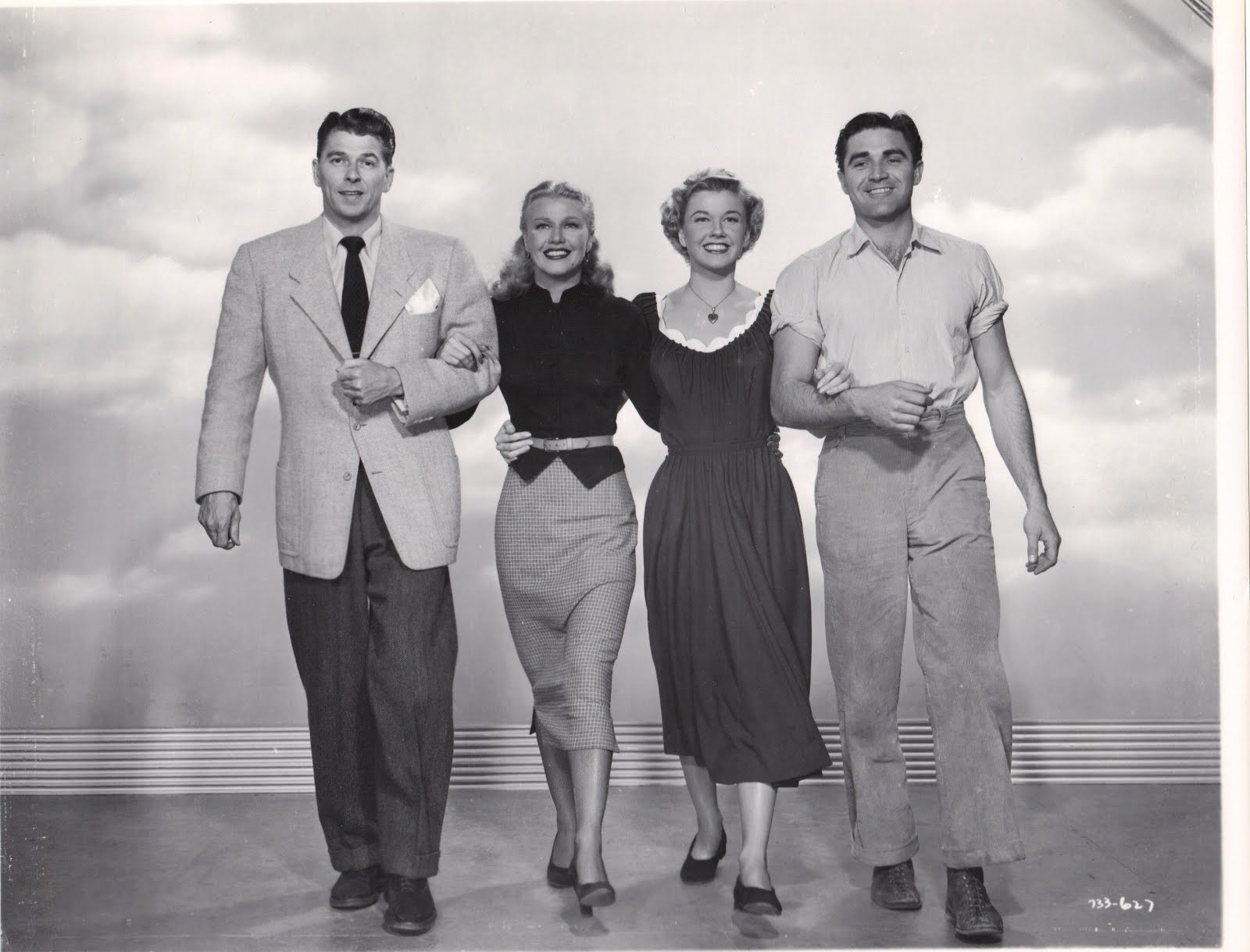
I love the cliche cast arm-in-arm publicity photo, when in most movie dramas, characters are at each others' throats!

Other studios were making pictures dealing with race. Stuart Heisler was a gutsy director and screenwriters Richard Brooks and Daniel Fuchs had already written about the topic, so the decision must have come from Jack Warner. WB’s Storm Warning, made in ’49, but released in early 1951, depicted the Klan killing of a white reporter, for nosing around their shady financial dealings. Uh, okay, who knew that money laundering was the Klan’s claim to fame? The Ku Klux Klan is only called the Klan, and the fictional town of Rock Point is even vaguer, referred to as “down here!” While the Klan was in many parts of the US, it’s implied the town is southern, despite the lack of accents. The only blacks to be seen are in the crowd scenes at the inquest. The lack of locale and whitewashing the Klan’s true purpose defuses what could have been a powerful social drama.
*Some spoilers ahead!
Travelling dress model Marsha Mitchell (Rogers) stopped in town to visit her kid sister before Christmas.
Is she wondering why the townspeople are wearing white after Labor Day?

Marsha Mitchell, a New York dress model travelling by bus to her next gig, decides to stop over night in Rock Point, where her young married sister Lucy lives with trucker husband Hank Rice. As Marsha attempts to get a cab to the local recreation center where her sister works, the locals seem unusually unfriendly, and are closing everything up early. Marsha the model heads off on foot—in high heels—to the center, she happens upon an outbreak from the local jail. Men in hooded sheets are corralling a bound and gagged man from the building when he breaks away. One of the men shoots him, and Marsha witnesses it all, unseen by the KKK. She sees two men who are unmasked.
"I Saw What You Did"with the KKK. Rogers' visiting sister lets brother-in-law Hank (Steve Cochran) know what's up!
Doris Day is the kid sis and young wife, Lucy. 

Marsha high tails it to the local recreation center and Lucy, spilling her story. She recognizes some of the men (by their shoes?) and points them out to her sister, who knows them. When they get back to Lucy’s house, who has told Marsha that she’s pregnant, her husband Hank arrives. Marsha instantly recognizes him as one of the KKK. Awkward! Let’s just say it’s a helluva icebreaker. When DA Burt Rainey (Ronald Reagan) finds out that Marsha was in the vicinity of the killing, he wants her on the witness stand at the inquest. Charley Barr (Hugh Sanders), Klan big Kahuna and Hank’s boss, wants Marsha to keep quiet. Though inquest is a success for the Klan, Hank can’t leave well enough alone, namely Marsha, and follows her back to the house to “celebrate” with her. What follows is a near-rape interrupted only by his wife. After he roughs up both women, he drags Marsha off to the KKK meeting as a mystery guest.  Ginger’s Marsha now refuses to keep quiet, which then makes her the evening’s entertainment: getting horsewhipped by a Klan member while the others watch, agog… and so will you. Reagan’s Rainey arrives with Doris’ Lucy and Hank once again makes things worse, by trying to shoot his sister-in-law, which leads to the tragic finale.
The opening scenes of 'Storm Warning' are filmed in unsettling film noir style by director Stuart Heisler.

Director Stuart Heisler, who should have gotten more prestige projects, has a powerful point of view in Storm Warning. The storytelling is strong, especially the opening scenes, where Marsha arrives. Visually striking and eerily foreboding, Rogers’ Marsha gets rebuffed by everyone she meets as the small town seemingly shuts down in unison. And when she stumbles upon the outbreak with the Klan and their victim, hiding in the shadows, is stunning. The direction, cinematography, and score all heighten the tension in the best film noir style.
Heisler’s take on small town life feels authentic, and the supporting cast and extras look like real people from that era, not a glam film version of local life. The viewer feels a part of the crowd scenes in the recreation center, the inquest, and the Klan rally. These scenes are intense and claustrophobic.
The KKK is about to show NYC model Marsha Mitchell what they think about outspoken women!

What director Heisler seemed to have is a knack for getting good performances from actors, especially when the acting style of film’s golden era was often theatrical. Ginger Rogers, while quite versatile as a musical, comedy, and dramatic performer, could often be quite arch and overstated as her stardom went on. Here, Rogers gives one of her best dramatic performances. The scene when she witnesses the murder by the Klan could have been very melodramatic. But it’s all in Rogers’ eyes, with shadows surrounding her face, and the fear, followed by revulsion of what she’s witnessed. Surprisingly for an old movie, after she’s made her escape, she stops to get her bearings, and turns away to vomit.
Ginger Rogers lets rip as the sister-in-law who's had it with her boorish brother-in-law.

Rogers’ character, initially shown to be strong-willed but rather shallow, grows in strength and is not cowed when she recognizes her sleazy brother-in-law as one of the Klan. In fact, in the scenes after the inquest, Rogers’ Marsha shoots down his seduction ploy with ferocity that I didn’t know Ginger possessed. She’s strong and straightforward throughout, with very little posturing. While researching this film, I noticed more than a few film buffs and fans referred to Ginger as “old.” Rogers was 40 at the time. While she didn’t look like the dancing star of the mid ‘30s anymore, Ginger looked like a mature woman with an incredibly slim, toned figure. Clean living Ginger Rogers (a Christian Scientist) certainly looked far better than most of her male contemporaries, who entered the 1950s looking puffy and paunchy, from drugs and/or booze and cigarettes.
Doris Day, in her first dramatic role, is the small town house wife who's about to have her eyes opened.

Doris Day, as the small town wife who wakes up to what’s going on with her husband and community, is incredibly natural. Storm Warning was one of Day’s first films and the only one where she dies. Day wears little makeup, simple clothes, and performs in an unaffected manner, with none of the hysteria that at times marred her few later dramatic performances. Day got some great notices from Storm Warning, but the best one was from Alfred Hitchcock, who complimented her on the performance—and later asked her to star in his remake of The Man Who Knew Too Much. Doris and Ginger make believable sisters and have a nice, no-nonsense rapport.
Doris Day & Ginger Rogers act well together as the two sisters, one young & naive, the other older & street smart.

Ronald Reagan, not an inspired actor in my opinion, is actually very good as DA Rainey. While Reagan fans like to point to Kings Row (“acting” in quotation marks as the town playboy), I think Reagan was competent in the old Hollywood style of posturing, but rarely with any true emotion or heart. But as Rainey, Reagan’s acting is understated and direct, and he is the most natural that I’ve ever seen him on screen.
Ronald Reagan gives a natural, solid performance as the weary but dedicated DA, Burt Rainey.

Steve Cochran, as Rock Point’s Stanley Kowalski, has a field day as the childish brute of a husband, Hank. WB gave Cochran the build up, but buried him by typecasting him as the sexy slime ball. Cochran did have an animal sex appeal that attracted fans, but his version of Streetcar’s Stanley shows that Cochran was to Brando what Mamie Van Doren was to Marilyn Monroe!
While Steve Cochran makes a sexy thug, let's just say he doesn't fill out the role
of the brutish brother-in-law the way Brando does in 'Streetcar."

The supporting cast is great, especially Hugh Sanders as the ominous villain Barr, who frames his evil actions as for the good of the community. Ned Glass is fine as the sympathetic recreation center owner. Sadly, his Hollywood career was sidelined by the Hollywood blacklist.
If the movie pulls the toughest punches, one thing it gets across is the mob mentality from a community that is divided. Many of the stock rationalizations that are bandied about in the film are still heard in today’s political arena. There’s lots of derisive and defensive comments about “outsiders,” “troublemakers,” “we clean up our own messes,” and women being “safe on the street at night.”
Steve Cochran's KKK version of Stanley makes his move on Ginger's infinitely more kick ass version
of a sister-in-law than 'Streetcar's' Blanche!

Many movie critics and fans also noticed the similarity between the visiting older sister Marsha, the naïve younger sister Lucy, and her thug husband Hank, as clones of A Streetcar Named Desire’s legendary Blanche, Stella, and Stanley. Moguls during the studio system were notorious for recycling material. Still, it was shameless of WB to recycle before the original was even released! I wonder if Tennessee Williams realized that he gave WB a two-fer! Just the thought of Williams’ iconic characters tangling with the KKK gives me the giggles.
Steve Cochran's brother-in-law Hank even tries to force the issue with his sister-in-law, like 'Streetcar's' Stanley.

Another amusing thought is that Joan Crawford turned down the Ginger Rogers’ part, reportedly telling Jack Warner that nobody would buy Doris Day as her sister. True, but the thought of Joan getting horse whipped by the KKK would have been high camp.
The bottom line is, as far as Storm Warning goes, it is strong stuff. But by not taking a stronger, direct stand against the Ku Klux Klan, viewers are left with is a melodrama with its convictions undercut.  
Ginger Rogers was a role model for Doris Day when she aspired to go into show business. The two stars
had much in common, starting with that they were Christian Scientists. Both were clean living,
athletic, hard-working, multi-talented,  loved their fans, and sustained long careers in show biz!