Showing posts with label Charles Boyer. Show all posts

Sunday, November 23, 2025

Redford & Fonda Fine in Fluffy ‘Barefoot in the Park’ 1967


Jane Fonda & Robert Redford are well-paired as beautiful & charming newlyweds,
in 1967's Neil Simon film version of "Barefoot in the Park."


As the long-running Broadway smash, Barefoot in the Park, wound up its run in 1967, the film version was released.

The play’s original male lead, Robert Redford, wasn’t sure that he wanted to repeat himself with the film adaptation of Barefoot in the Park. I find this questionable, since Redford had been in films for five years, without a hit movie. The film version of Barefoot proved to be just as big at the movie box office as the play was on Broadway. Natalie Wood was first offered the female lead, which would have been her third time as Robert Redford’s co-star. Wood opted instead to take some time off from film-making, and came back two years in another sex comedy, Bob & Carol & Ted & Alice.

We first meet newlyweds Paul and Corie Bratter during the opening credits, on a horse and carriage ride around NYC, as a dippy sitcom-esque theme by the usually marvelous Johnny Mercer drones on the soundtrack. The general feeling is of an opening to a sixties sitcom.

Robert Redford & Jane Fonda are honeymooners in 1967's "Barefoot in the Park."
 After a carriage ride, they honeymoon hibernate at NYC's Plaza Hotel.

NYC’s Plaza Hotel is prominently featured in the opening scenes of Barefoot in the Park. This is where Fonda and Redford’s Corie and Paul Bratter honeymoon for six nights. Once they come up for air and check out of the Plaza, the bulk of the film is devoted to their next four days as newlyweds, settling into their new apartment.

Don't recognize the maid? As soon as she talks, you know that's Doris Roberts!
She has a fun bit as the maid reacting to the honeymooners in "Barefoot in the Park."

Barefoot in the Park is so light-weight, it's a cinematic soufflé. Tasty, yes; substantial, no. While Simon's dialogue is clever and funny, the plot is essentially non-existent and the entire point of the movie is whaaat? Barefoot in the Park debuted on Broadway in1963, a month before the Kennedy assassination. The film version came out in 1967, just before censorship game-changer The Graduate. Interestingly, Mike Nichols won Best Director Tony for the Barefoot play and his only Best Director Oscar for The Graduate. What was once risqué four years earlier now seemed a bit passé with Barefoot in the Park the movie. Much more of a hit with audiences than critics, Barefoot was akin to the artificial ’67 comedy, Guess Who’s Coming to Dinner? Ironically, both Barefoot stars were considered for the leads in the following year’s Rosemary’s Baby. Imagine the Bratters as New Yorkers Rosemary and Guy Woodhouse, with bigger problems than a hole in their apartment skylight!

Jane Fonda's a free spirit and Robert Redford's a stuffed shirt, as newlyweds
in 1967's "Barefoot in the Park." That's basically the comedic conflict, folks!

The current IMDB website ratings/reviews rate Barefoot in the Park much lower than older reviews; this seems to indicate that the movie has not aged well to younger viewers.

Here’s my Facebook entertainment page, FYI!

https://www.facebook.com/groups/178488909366865

Producer Hal Wallis and director Gene Saks were solid but not the most scintillating filmmakers for Barefoot in the Park, given the saucy material. Aside from the opening horse ride and Redford’s enacting the film’s title in the finale, the resulting movie feels like a filmed play. Saks’ film and stage career was mostly directing Simon plays or his film adaptations, so his strongest suit was that he understood Simon’s wishes. Neil Simon insisted on writing the screenplay for Barefoot. After Simon’s first big hit, Come Blow Your Horn, was shoehorned to fit 50-ish Frank Sinatra as a 30-something swinging bachelor who's really just a nice Jewish boy—a scenario he didn't wanted to repeat! In fact, after Horn, Neil Simon wrote all the screenplays to his stage plays.

Jane Fonda & Robert Redford kiss a lot in 1967's "Barefoot in the Park."
Well, they play newlyweds and he IS Robert Redford, after all!

Robert Redford as buttoned-down lawyer Paul seems the most contemporary of the cast. While his co-stars are just fine, too, their characters and performances seem of the era, whereas Redford’s attitude and playing of his character still seems current today. And I say this as someone who’s not the biggest Redford fan. Robert could sometimes be remote as an actor, but his understatement is perfect for Paul Bratter. Bob’s dry sense of humor gets to shine, especially when he zings Fonda’s high-strung bride. When she accuses him of being perfect, ‘60s perfect Redford retorts, “That’s a rotten thing to say!”

Robert Redford's lawyer takes exception to wife Jane Fonda calling him perfect,
in 1967's "Barefoot in the Park."

Jane Fonda often comes off as humorless in person, yet has a natural flair for comedy. Jane's verbally and physically funny, yet in scenes that have serious undertones, as where Corie wants Paul's approval of the apartment, is very appealing. This is one of Jane’s best comedy performances, only undercut by the dated writing of Corie’s character. Fonda’s energy, intelligence, and charisma balance the downsides of the lightweight bride role. Off-topic: Listening to young Jane Fonda talk always reminds me of the later Laura Linney.

Jane Fonda is most appealing as Corie, here hoping that Robert Redford's Paul likes
their new apartment, in 1967's "Barefoot in the Park."

Jane's physicality as an actress is well-utilized, as well as showing off her trim body at every opportunity, in various stages of dress. The only thing Redford shows off is his bare feet in the finale of Barefoot in the Park.

Jane Fonda's figure is on full display and in various stages of dress throughout
1967's "Barefoot in the Park," a preview of coming attractions for "Barbarella!"

Hollywood age shaving is on display, too.  Robert Redford is cast as 26 at 31, the script doesn’t give Fonda's age, but she was 30 when this film was released. Corie, as written, is very childish, clingy, and naïve—which seems odd as played by adult Jane Fonda. Mrs. Bratter apparently has nothing to do but furnish the apartment and wait for Paul to come home from work, to jump his bones. Yes, he IS Robert Redford! Still, neither Redford nor Fonda comes off as young newlyweds, and their fights seem juvenile. As for the veteran stars, Mildred Natwick’s mother is 52 and Boyer’s neighbor is 58. Both actors were a decade older, and even when playing younger, the characters are treated like they were ready for the old folks’ home.

Jane Fonda & Robert Redford as newlyweds, taking stock of their new apartment,
in 1967's Neil Simon adaptation, "Barefoot in the Park."

I was curious why Robert Redford got top billing since this was his first hit movie. And Bob starred in some pretty high profile bombs: Inside Daisy Clover, This Property is Condemned, and The Chase. Conversely, Jane Fonda had just starred in Cat Ballou and had some mildly popular sex comedies and soaps to her credit—though she too had been in some clinkers. Inquiring minds wonder!

Jane Fonda & Robert Redford starred in 1967's "Barefoot in the Park." Fonda had
 already starred in several romantic comedies and this was Redford's first hit film.

Mildred Natwick and Charles Boyer are two old school pros having a field day, as Ethel Banks and Victor Velasco. I’m glad that Natwick got to reprise the role that she originated on Broadway. It would have been quite easy for producer Hal Wallis to cast Myrna Loy, a much beloved movie star, to play the role in which she had toured. And it’s great to see latter day Charles Boyer hadn’t lost his continental charm or comedic touch. The two characters are set up for a date by Corie and the hilariously disaster of an evening is the film’s highlight. Natwick’s character, trying to retain her dignity during the comedic chaos, while getting drunk, reminded me of Nathan Lane’s “Mother” in 1996’s The Birdcage.

The night out sequence of 1967's "Barefoot in the Park" is the film's comedic
high point. With Charles Boyer, Robert Redford, Jane Fonda, & Mildred Natwick.

Mother Mildred Natwick & son-in-law Robert Redford AFTER a night out with the eccentric upstairs neighbor & Jane Fonda's bride, in 1967's "Barefoot in the Park."

Herb Edelman got his chance to comically shine as the telephone repair man. Mabel Albertson (Bewitched) is Natwick’s lady friend. James Stone is the wheezing delivery man. And Ted Hartley plays Paul’s fellow lawyer, who literally phones in his one scene. Hartley, BTW, died Oct. 5, 2025, just shy of his 101st birthday. Basically, Barefoot is a four-character cast, with supporting one-off roles.

Ted Hartley, as Robert Redford's fellow lawyer in '67's "Barefoot in the Park,"
passed away recently of this writing, Oct. 5, 2025. Hartley was a prolific actor.

Barefoot in the Park is superior fluff, with the star quartet making Neil Simon’s lightweight laughs sing, and bringing heart to their characters.

Mildred Natwick is memorable as Jane Fonda's staid mother in 1967's
"Barefoot in the Park." Robert Redford looks on as Fonda's new husband.

Charles Boyer is a charming scene stealer as upstairs neighbor
Victor Velasco in 1967's "Barefoot in the Park."

Here’s my look at the first big screen Neil Simon Broadway adaptation that displeased Simon very much, 1963’s Come Blow Your Horn. A young Jewish playboy who shows his brother the ropes is turned into a 50-ish Frank Sinatra! https://ricksrealreel.blogspot.com/2019/01/when-sinatra-met-simon-come-blow-your.html

Fonda and Redford play husband and wife, though they barely have any scenes together, in 1966’s The Chase. This all-star bomb revolves around Redford’s escaped convict, setting off his small southern hometown into a feeding frenzy. My take here: https://ricksrealreel.blogspot.com/2023/09/all-star-cast-cant-save-chase-1966.html


Robert Redford's buttoned-down lawyer lets his hair down and shoes off at the finale
of 1967's "Barefoot in the Park."


Tuesday, January 2, 2024

Dunne & Boyer Romance Divinely in ‘Love Affair’ 1939


Charles Boyer & Irene Dunne sparkle like champagne in 1939's "Love Affair."


The Leo McCarey comedy-drama, Love Affair, came out in 1939, often cited as Hollywood's golden year in cinema. The idea for Love Affair came to director/screenwriter McCarey when he was on an ocean cruise with his wife. He later collaborated with romantic writer Mildred Cram to flesh out the premise. The story was then passed on to master screenwriter Donald Ogden Stewart and future director Delmer Daves. There was much improvisation on the movie set, as well. The resulting story was most collaborative!

If you are not a fan of Hollywood’s “old movies,” Love Affair may not be for you. The film is a ‘30s fairy tale for adults, as the story bears no relation to reality, but the emotions still ring true. What's fascinating about this film is that the storytelling is so stylized, yet so adult and human in regards to matters of the heart. The romantic duo is both matter of fact and humorous regarding their personal situations, both engaged to “safe” suitors, yet they can’t help but fall in love.

Charles Boyer is playboy Michel Marnay, with Irene Dunne, in "Love Affair."

Irene Dunne as Terry McKay "meets cute" w/ Charles Boyer in 1939's "Love Affair."


Irene Dunne is Terry McKay, a singer who currently works for her fiancé, (Lee Bowman). Charles Boyer plays Michel Marnay, a playboy/painter who sells more papers than paintings. His fiancee is a wealthy socialite, (Astrid Allwyn). They meet cute aboard an ocean liner, with oodles of instant chemistry. By the time they arrive home in NYC, they agree to try and see out their current commitments.  But… if they decide to reunite, they will meet at the top of the Empire State Building six months later. When that day comes, Terry is hit by a cab while distractedly dashing off to their meeting place. Now wheelchair-bound, Terry decides to give her healing another six months before possibly trying to see Michel again. He thinks she got cold feet, not helped when he sees her at a movie theater the following Christmas, with her old suitor. Before Michel heads back to Europe, he looks up Terry, to say goodbye. Terry is friendly but immobile, as she sits under a blanket. Her nonchalance toward Michel is shown to be a false front as several key possessions of Terry’s indicate her sentiments, and the secret is out when they let down their defenses. Untroubled at last, they reunite. One huge problematic plot point: Terry's reaction to her accident, which leaves her unable to walk? It feels old movie “noble” to not see Michel if she can’t walk. Irene Dunne herself stated a few years after Love Affair’s release that she would not have hidden away like Terry, but gone looking for Michel in a wheelchair. For modern audiences, you either roll your eyes or just suspend disbelief.

In any version of "Love Affair," audiences will find the heroine nobly hiding her accident either terribly moving or just plain terrible. 

The moment Michel realizes Terry's plight is beautifully expressed by Charles Boyer,
 in 1939's "Love Affair."

Charles Boyer is at his best here, as a romantic lead, and demonstrates why he quickly caught on in Hollywood. Unlike many American leading men, Boyer was so open in his emotions, especially through those dark, expressive eyes. The final scene, when Michel realizes Terry’s plight, is done silently and superbly by Boyer. His deep voice and lilting French accent didn’t hurt either! Irene Dunne reminded me of a patrician version of Barbara Stanwyck: very attractive, but not gorgeous; glamorous, but not made up into a movie star mask; charming, but not coy; dramatic, but natural. Like Stanwyck, Dunne was versatile in drama and comedy, plus Irene could sing! Dunne and Boyer had a charming rapport and went on to make two more films together, ‘39’s When Tomorrow Comes and ‘44’s Together Again.

Irene Dunne displays her versatility as Terry McKay in 1939's "Love Affair."
She's romantic, dramatic, funny, and gets to sing!

Maria Ouspenskaya is warm and wonderful in her vignette as Michel’s grandmother, and so memorable that she received a Best Supporting Oscar nomination. Maria is a delight in her moments with grandson Michel and in her heart to heart with Dunne’s Terry.

Maria Ouspenskaya is warm and wise as the grandmother in 1939's "Love Affair."

Yes, there is surplus sentiment, a McCarey film staple. Less cute kiddies on the ship and at the orphanage and more development of Terry and Michel’s prior romantic partners could have added more to the dramatic tension. Instead, Bowman and Allwyn are the nicest wealthy romantic interests to ever get dumped!

Rudolf Mate's cinematography is painterly, with the contrast between crisp composition and some soft edges that are just lovely. The score by Roy Webb is lovely and there are several songs for Dunne to sing, including Buddy DeSylva’s “Wishing,” which became popular.

The cinematography in 1939's "Love Affair" is striking and superb.

Love Affair was a huge hit in its day. Thus, the essential story of thwarted love has been re-told several times, each time to lesser effect. McCarey himself remade it as the '50s extravaganza, a 30 minutes longer An Affair to Remember, with Cary Grant and Deborah Kerr. Much later, 1993’s Sleepless in Seattle referenced the '57 version relentlessly. Finally—for now, Warren Beatty had a 1994 Love Affair with himself, oh, and with Annette Bening. This soft focus, over-produced, schmaltzy version was Warren at his worst. I'm surprised Love Affair hasn't been remade again, but the '39 version is just under 90 minutes, which is really just right. Think of Love Affair as cinematic version of pink champagne and just enjoy its effervescence.

A lovely vignette from 1939's "Love Affair," where Michel & Terry visit his grandmother.

Here’s my look at the sinister side of Charles Boyer’s charm, in Gaslight! https://ricksrealreel.blogspot.com/2022/10/stars-story-light-up-mgms-gaslight-1944.html

Charles Boyer at his romantic best, in 1939's "Love Affair."


Sunday, October 16, 2022

Stars & Story Light up MGM's ‘Gaslight’ 1944

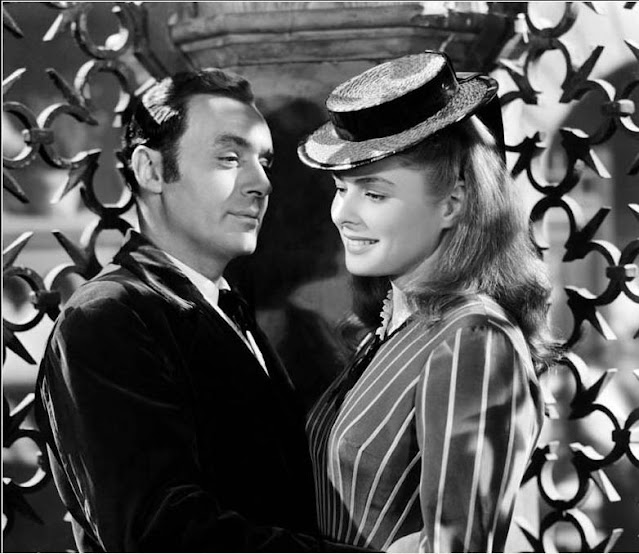
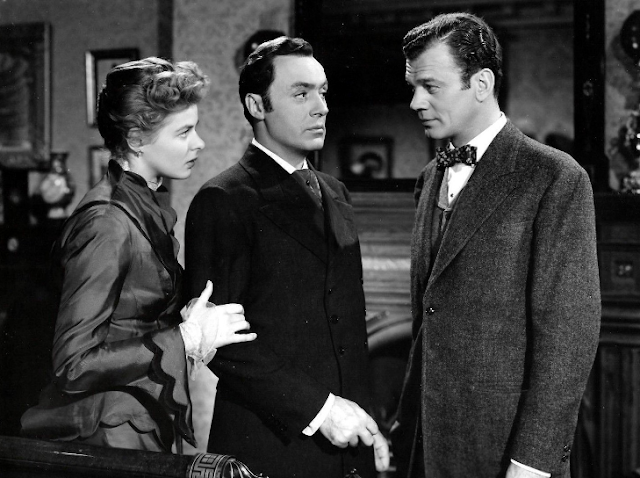
The hot house atmosphere of 1944's "Gaslight" gets much of its heat from these
great stars: Ingrid Bergman, Angela Lansbury, and Charles Boyer.


As a suspense film fan, it’s amazing to me that I've only seen clips of 1944's Gaslight in my 50 years of watching movies. With the recent death of Angela Lansbury, plus the 40th anniversary of Ingrid Bergman’s passing on Aug. 29, I thought it was high time to remedy this.

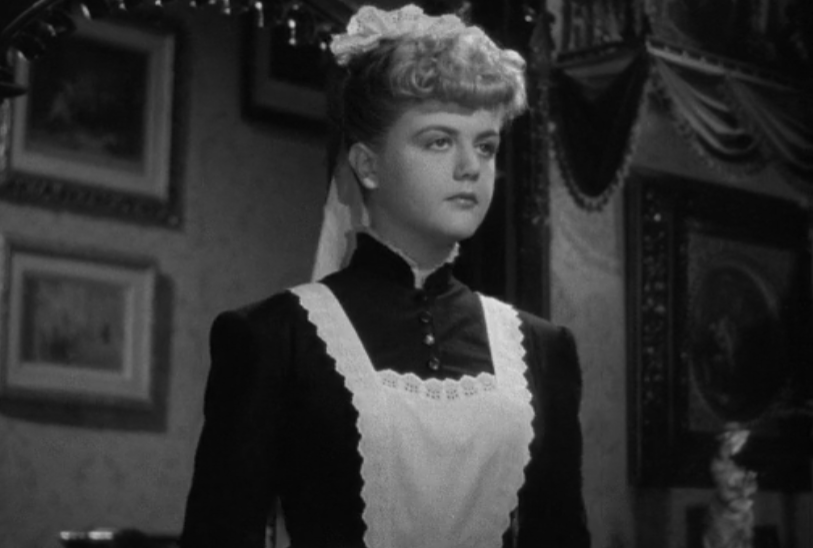
Ingrid Bergman is the lady of the house who's so fragile that even the malicious maid
 (Angela Lansbury) gets under her skin, in MGM's "Gaslight."

Based on the Broadway hit 1938 Angel Street, MGM then bought U.S. film rights and tried to bury the British version that was made in 1940. They didn't succeed, but more about that later.

MGM glamorized Gaslight like they did to many period stories—Pride and Prejudice, Madame Bovary, and Little Women—all made to look super wealthy, though they weren't. Metro does so here, too, though it's not quite as intrusive. 

Ingrid Bergman in one of many striking shots from 1944's "Gaslight."

What MGM does well in this version, which makes me prefer their Gaslight as a suspense film, is a certain amount of ambiguity (partly due to censorship) and by not overtly giving away the husband's villainy from the get-go. 

A huge plus is the cast, particularly the stars whose characters inhabit this hot house household: Ingrid Bergman, Charles Boyer, and Angela Lansbury—in her first film. Their personas say much that dialogue can't. Bergman and Boyer have so much natural sensuality, much can be implied regarding what flamed their relationship. And Lansbury had that saucy and impudent look that could turn sour and bitchy in a blink of her huge eyes as the maid on the make.

Charles Boyer surround by his tall co-stars, Angela Lansbury & Ingrid Bergman,
on the set of MGM's "Gaslight."

The changes made in the MGM version work well, overall. Though it's an excuse to slather on some more Metro gloss, the prologue where young Paula meets and is swept off her feet by Gregory in Italy shows that this is her first love, with Boyer in full romantic mode. They also flipped certain plot points from the leading man to the leading lady, which works, too. The biggest change is the murdered relative and empty house now comes from her side of the family, not his.

The prologue to MGM's "Gaslight" shows Boyer & Bergman in love, on their honeymoon.

Though you know Boyer is the bad guy, the fact that he's played both heroes and villains has you hoping against hope he's not a total rat. That we don't see him actually setting up his tricks on Bergman, or that he's not blatantly abusive or adulterous, as in the British version.

MGM's version of "Gaslight" cleverly plays on Charles Boyer's romantic image
to create suspense as to his character's later villainy.

The great trio of performances gives the edge to this Gaslight. Ingrid Bergman's naturalness and emotionalism was her calling card as an actress, which is perfect for the role of Paula. That she has suffered trauma finding her murdered aunt makes great plot sense, and gives further authenticity to her fragility. When Boyer's Gregory subtly toys with her to the point where she begs not to be shamed in front of the servants, her humiliation is palpable. As the heroine questions her own sanity as the movie goes on, Bergman is utterly believable. Hedy Lamarr was the studio’s choice as Paula, but director George Cukor rightly rejected the idea. Most of MGM’s great dramatic divas had already left, leaving mature newcomer Greer Garson. British Deborah Kerr, who could have been great, didn’t arrive to Metro until ’47.

One of cinematographer Joseph Ruttenberg's amazing closeups of Ingrid Bergman
as Paula, who begins to question her own sanity, in MGM's "Gaslight."

Charles Boyer had already scored as charming cads in Algiers and Hold Back the Dawn. But he also played warm, romantic roles like All This, and Heaven Too. That duality adds to his fine performance. Those great dark eyes and deep romantic voice transfix you as much as Paula. The moments where Boyer’s charm turns cold are utterly chilling. As Gregory, Charles Boyer runs nearly the same range of emotions as Bergman’s, except his are those of a sociopath, and he’s a memorable villain.

Charles Boyer used his aristocratic looks, soulful eyes, and beautiful speaking voice
to help create the most manipulative villain in 1944's "Gaslight."

It's hard to believe that Angela Lansbury turned just 18 during the making of Gaslight. Her saucy, sharp-tongued maid reminded me a bit of Bette Davis as Mildred Rogers in Of Human Bondage. Which always made me think that Angela should been cast as a Bette Davis-style leading lady at MGM, which had more glamour girls than great actresses, frankly. But what a great start this was for Angela, and she's most subtle here. Nancy is tart with the missus and slightly tarty with the master. She’s very street smart and self-possessed. When Boyer’s master comments that she’s much too charming for the mistress of the house, Lansbury’s Nancy slyly replies, “She’s not the only one in the house, is she?”

Angela Lansbury as Nancy, the domestic who seems to be untamed! Angela was not yet
 18 when she worked on 1944's "Gaslight," but holds her own with Bergman & Boyer.

All three of these actors got Oscar nominations and Bergman deservedly won, I thought. Even Barbara Stanwyck, nominated for her classic performance in Double Indemnity, publicly lauded Ingrid’s victory. Watching the arc of Bergman’s character start off as bright and girlish to tormented and finally, nearly emotionally beaten, is fascinating to watch.

A fresh-faced Ingrid Bergman as young Paula at the beginning of MGM's "Gaslight."

This is one of those movies that more than a few have mistakenly attributed to Alfred Hitchcock. Indeed, since two of the stars—Bergman and Cotten—were under contract to David Selznick, it's a wonder that his director didn't come along to Metro for the ride. That said, MGM director George Cukor was in his prime here, his strengths were getting the best from his actors and in sophisticated storytelling.

Two of producer David Selznick's stars--Ingrid Bergman & Joseph Cotten--were loaned to MGM for "Gaslight." With Charles Boyer here.

I've watched the British version, which has been saved and restored. I notice that the 1940 and ‘44 versions have been pitted in the typical movie critics/movie lovers’ game of which is better. The '40 version gets a lot of sympathy because Hollywood's biggest studio tried to destroy the smaller British version. I believe MGM also tried to do the same with the Italian version of The Postman Always Rings Twice. Well, the 1940 version is more faithful to the Patrick Hamilton play and it is much more straightforward—in fact it barely runs 90 minutes. Does that necessarily make it better? The Mildred Pierce remake was more faithful, but I really prefer the 1945 film version.

Ingrid Bergman is radiant as a woman in love in 1944's "Gaslight."

What the British version offers are British leads whose characters live a more upper middle class British life. Also, playwright Patrick Hamilton offers side commentary on the British social hierarchy, especially when it comes to marriage and money. The two leads are Diana Wynyard and Anton Walbrook. Their performances are fine by their film era's standards. While her character stands up to her husband on occasion, Diana Wynyard’s performance feels very leading lady-ish, with much wide-eyed displays of  fear and disbelief. There’s very little of the raw emotion that Ingrid Bergman evinces as the beleaguered wife here. And while I enjoyed the expert mustache twirling of Anton Walbrook as the heartless husband, he feels a bit campy, and I wondered if Kevin Branagh’s mad “Maestro” was inspired by him later in Dead Again. Laurence Olivier and Vivien Leigh would have been wonderful—and British, but they didn’t get cast in either version. Cathleen Cordell as the maid was strictly one-note, with none of the magnetism or malice that Lansbury possessed. Joseph Cotten made a younger, attractive detective who is on the husband’s case in the ’44 Gaslight, and I found his warm charm preferable to his British counterpart’s aging ham. Yes, MGM does play the hint of romance card at the literal last minute, between Cotten and Bergman, with Dame May Whitty clucking cutely.

Angela Lansbury's maid on the make Nancy is performed with much more depth
in the MGM version of "Gaslight."

The 1940 version seems rather barebones and can’t imagine that the stage play was only 90 minutes. The MGM is 30 minutes longer, and feels more fully fleshed, not merely padded. Joseph Ruttenberg's photography is masterful, particularly depicting Bergman’s gradually growing unbalanced. BTW, though Bergman’s makeup-free, soft close-ups as the young Paula leaving the crime scene are convincing, did it look like they used an actual teenager in long-shot over the 5’9” Bergman? The score by Bronislau Kaper is superbly eerie.

Ingrid Bergman as the beaten-down wife in 1944's "Gaslight."

Gaslight is one of the first movies to depict spousal emotional abuse in a marriage, under the guise of a suspense film. The husband woos the wife, only to isolate and gradually wear down her self-esteem with abuse, is still relevant today. The final monologue, where Paula confronts her tormentor husband, is strongly written and performed by Bergman. Gaslight is a superior thriller with intriguing underlying themes.

Ingrid Bergman's big scene where her abused wife Paula tells off her
tormentor husband, now captured and helpless, in 1944's "Gaslight."