Showing posts with label Mercedes McCambridge. Show all posts

Sunday, March 11, 2018

Suddenly, Last Summer 1959


What happened Suddenly, Last Summer? An aging southern socialite wasn’t able to accompany her son on their travels, so he took his beautiful young cousin instead. The poet son died under mysterious circumstances, and the girl has suffered a mental breakdown. The rich aunt now wants extreme measures to quiet her niece. A doctor, at the institution where the young woman is held, fights to find out the truth. That’s the short take on the over-the-top 1959 film, taken from Tennessee Williams’ one-act play, which is still riveting as hell.
"Truth is the bottom of a bottomless well."

Of the many facets of Suddenly, Last Summer that fascinate, it’s Tennessee Williams’ subliminal self reflection on his life and career that resonates for me. The film and its source material have been criticized for gay self-loathing. True, but it was reflective of what many gays experienced during his era, and shouldn’t be forgotten. The playwright also addresses his eternal struggle, to write about often painful things, countered with anesthetic but counterproductive partying with booze, boys, and drugs. Fading youth is a frequent Williams’ lament. The civilized world versus the more base elements of life is another. Williams’ commentary comes through in some of my favorite lines in Suddenly, Last Summer.   
As I get older, this has become my favorite line from 'Suddenly, Last Summer.'

Wealthy New Orleans matron Violet Venable was the lone unsympathetic role in Katharine Hepburn's long career—and she hated playing the part. Why? Speculation ran the gamut. A few naïve souls said that Kate didn’t realize this was gay material—this seems absurd, as Hepburn worked with gays her whole career, and was most likely a lesbian herself. Others said that while Hepburn strongly wanted to work with Williams, but regretted playing the villain, and she preferred to be the headstrong but likeable heroine.
Still, some thought it was simply ego. Hepburn, accustomed to being the star attraction, was now playing second lead to a younger actress, Elizabeth Taylor. Adding insult was the film’s climax, when Elizabeth is shown in flashback in all her sexy swimsuit glory, contrasted with cruel close-ups of Hepburn’s unfiltered face and wrinkled hands, to emphasize that Aunt Violet’s illusions are shattered.
Hepburn was furious after seeing these shots.
Mankiewicz shot Kate unfiltered at 'Summer's' end.

Hepburn was famous for spitting at director Joseph Mankiewicz on the last day of shooting Summer, allegedly over his treatment of troubled co-star Montgomery Clift. For many years, this was the story told by Hepburn and others. Much later, Kate said it was over the director’s above-described treatment of her. It’s noteworthy that Joe was Kate’s producer on two of her biggest MGM hits, The Philadelphia Story and Woman of the Year. Given their history, Kate was unpleasantly surprised that he favored 27-year-old Elizabeth over her 52-year-old self.
For most of the movie, Hepburn was photographed as a mature beauty, easy to accomplish with her slim figure and still-striking bone structure. But Kate, who liked to give the impression that she had no time for Hollywood glamour, was just as fussy as Joan Crawford or Lana Turner over how she appeared onscreen.
Thankfully, Hepburn, with her distinctive staccato vocals, does not attempt a southern accent. The dragon dowager who wants to shut up a “babbling” young woman with a new “operation” is basically Williams’ mother and his emotionally fragile sister, Rose, who was given a lobotomy to control her outbursts. Hepburn’s natural authority as Violet is combined with a cool charm that barely conceals her rage at a niece whom she blames for her son’s death. Hepburn blazes through Williams’ long monologues as though she wants the promising doctor to bear witness to her pain. As Violet, Hepburn gets to lament life’s unfairness, charm the young doctor, insult her greedy family and most of all, confront her young niece, played by Taylor.
Director Joe Mankiewicz with his star. Notice "Mank" is wearing gloves, due to a skin condition exacerbated by stress!

On Hepburn, Joe Mankiewicz later opined in the early ‘70s that Hepburn was “the most experienced amateur actress in the world…whose performances, though remarkably effective, are fake.” Interestingly, critic Pauline Kael echoed the same sentiments later, on Kate’s TV version of Tennessee Williams’ The Glass Menagerie. I think there’s truth in that statement, regarding Hepburn’s latter day performances, but here, Kate’s larger-than-life persona fits Violet Venable perfectly. And for the record, “Mank” thought Kate was “damn good” in Suddenly, Last Summer.

With Tennessee Williams, it's a thin line between love and hate!
Tennessee Williams wrote in Life magazine that he thought Elizabeth Taylor was too mature and worldly as Catherine Holly, though he did say her acting was a triumph over miscasting. Williams’ take was understandable. Starting with his Cat on a Hot Tin Roof, Taylor was on the tsunami ride of her femme fatale image. Patricia Neal, who played the role on stage in London, wrote in her memoirs that she desperately wanted the movie role. Neal was six years older than Taylor, and if you wanna talk about mature and worldly, Pat was your gal. Like Lansbury and Bacall, Neal always seemed older and world weary before her time. And just two years later, Patricia Neal was playing the aging housekeeper in Hud. Age-wise, I think newcomer Lee Remick would have looked the part—Catherine Holly’s age isn’t given, but I always assumed that she was in her early ’20s. Remick was sly that same year in Anatomy of a Murder, but I don't think she was ready yet for such a demanding role. 
Yes, please!

Though Hepburn and Taylors's first monologues are terrific, the film comes to life when Mankiewicz stops treating the movie like a filmed play. The climactic scene, where Catherine is induced with ‘truth serum’ to recall what happened last summer, is visually brilliant. Some unkind souls at the time felt the recreation of events were designed to bolster Elizabeth’s emoting. Later, a few film buffs have sneered that her performance is simply over-acting. I think Taylor’s performance is the right balance between naturalistic and theatrical, which is perfect for Tennessee Williams. Taylor’s exchanges with Montgomery Clift’s doctor are sly and subtle. Later, Catherine’s sedated by the blonde male nurse, as Taylor sleepily recalls her and Sebastian’s next destination—“We’ll fly north, little bird.” Elizabeth is understated, yet powerful here. The camera goes in for a gradual huge close-up of her face, and it is mesmerizing.
Katharine Hepburn & Elizabeth Taylor square off as the the forbidding aunt & the fiery niece, debating Sebastian's memory.

It’s been condescendingly said that Elizabeth Taylor is only good when she has a great director. My response is that’s true with pretty much ALL actors. Hepburn, Davis, and Crawford all benefited from directors who didn’t let them steamroll through movies with their diva personas. Even Meryl Streep is a better actor when she has a great director and material. Plus, Elizabeth Taylor demonstrated that she was able to carry inferior vehicles, like BUtterfield 8.
Hepburn’s cool, steely demeanor and Taylor’s fiery emotionalism makes a fascinating acting counterpoint and is the foundation of Suddenly, Last Summer.
Elizabeth Taylor and best friend Montgomery Clift on the set of 'Suddenly, Last Summer.'

Montgomery Clift was nearly replaced with newcomer Peter O' Toole, by producer Sam Spiegel, due to Monty’s drug and alcohol problems that accelerated after his famous car accident two years prior. Best pal Elizabeth Taylor's response to Spiegel and Mankiewicz, who both wanted him replaced: “Over my dead body.”
While Monty seemed sedated, his intelligence and intensity still shines through. Especially when compared to Rob Lowe's single dumbfounded expression in his amateurish performance as the doctor in the 1993 BBC remake. I’ll never forget when Rob was on Live! With Regis & Kathy Lee, promoting his version of Suddenly, Last Summer. Kathy Lee, like Catherine Holly, was given to “babbling,” and kept interrupting to talk about the Elizabeth Taylor version. Lowe pompously commented that the BBC version, with Maggie Smith as Aunt Violet and Natasha Richardson as Catherine, wasn’t like “the glossy Hollywood version.” And Kathy Lee just went right on talking about how haunting the original version was!
Monty, Mank, Kate & Liz prove there's no problem on this set!

 I’ve seen the ‘93 version again recently, and it is indeed a faithful adaptation of Williams’ one-act play. Yet, the Rob Lowe remake is also dull as dishwater. The wonderful Maggie Smith is dotty right from the get-go as Violet, in a surprisingly one-note, shrill performance. While Richardson is naturalistic and appealing as Catherine, she is often whiny and dull. The dramatic tension between the two women here is zilch. It reminded me a great deal of the TV remake of Whatever Happened to Baby Jane? The ‘91 TV version had two great actresses who were actually sisters, Vanessa and Lynn Redgrave, and yet the more “natural” version had absolutely zero tension.

The 1959 version of Suddenly, Last Summer has been praised, condemned, deemed dated, called camp, and everything in between. The two hour expansion of a one-act play, filmed during the last gasp of Hollywood censorship, is not perfect. Yet, it was groundbreaking and a sign of things to come in ‘60s cinema. Watching Hepburn and Taylor share the screen, speaking some of Tennessee Williams’ most memorable lines, guided by one of Hollywood’s most literate directors, is something to behold.


Catherine finally remembers what happened to Cousin Sebastian last summer.

Sunday, November 27, 2016

Giant: 1956's Timely and Timeless Epic

'Giant' with '50s icons Jimmy Dean, Liz, and Rock. Please don't remake this, Hollywood!

Giant is often described as sprawling. Released Thanksgiving weekend in 1956, the Texas-sized saga certainly has one foot in Hollywood’s golden era and the other in modern film-making. Yet, it’s due to director George Stevens’ stellar storytelling that Giant is both entertaining and intelligent. The more traditional movie epic moments cause some critics to dismiss the film entirely, missing the sharp social message in the tale of the super rich Texans.
Bick and Leslie, either bickering or loving up to each other!

The Edna Ferber behemoth bestseller was snapped up by Warner Brothers, intended as the Texas answer to Gone with the Wind. The book had it all: A hard-headed hero, a charismatic bad boy, and a feisty female that they both love, set against three decades of changing times and fortunes in colorful Texas cattle and oil country. Director George Stevens cast Rock Hudson in his best role, James Dean in his last, and Elizabeth Taylor in the film that made her a superstar. Stevens cannily mixed the crowd-pleasing aspects of Giant with an honest look at the downside of the American Dream: poverty, politics, racism, sexism, materialism, and greed.
This famous still from 'Giant' was not even in the movie.

Some critics at the time, even now, sometimes focus on Giant’s epic aspects, citing it as a super soap opera. Giant came out in an era when epics about strong, self-made men and their imported brides were all the rage.
I also happened to catch 1954’s The Naked Jungle as well as Giant over Thanksgiving. This cinematic turkey starred comatose Charlton Heston and posturing Eleanor Parker as at-odds newlyweds who finally bond over fighting soldier ants that invade their Brazilian chocolate plantation. That’s it, that’s the whole story! Also in ’54 was Elephant Walk starring Elizabeth Taylor, in a dry run for Giant. Taylor played a British bride swept off her feet by moody Ceylon tea plantation owner Peter Finch. The couple also has a rocky honeymoon, but team up while fighting off rampaging elephants, headed right through their plantation. These films are typical of their era, empty escapism with none of Giant’s three-dimensional characters and dramatic realism.
Giant aims for the greater picture. After a whirlwind romance with over-aged bachelor Bick Benedict, Leslie Lynnton is whisked off to Texas as his bride. No angry elephants or relentless ants here.  However, Leslie encounters a hard-ass sister-in-law, rowdy ranchers, prejudice toward Mexicans, greed, and macho men who resent strong-minded women.

George Stevens was at the peak of his cinematic skills with Giant. Intimate moments mix with scenes of grandeur. The opening Virginia fox hunt racing with a locomotive mingles with Liz’ belle alternately flirting and tangling with visiting Texan Rock over breakfast: “We really stole Texas, didn’t we? I mean, away from Mexico.”
Liz as Leslie: Both star and character were outspoken!

Upon returning to their Texas ranch, Reata, Bick and Leslie’s differences are obvious. As the bride gushes over the bouquet his Mexican workers gave her, the rancher’s racism comes out.
Bick: “Leslie, don’t behave like that… Here we don’t make a fuss over those kind of people. You’re a Texan now.”
Leslie: “Is that a state of mind? I’m still myself.”
Not only is the frank exchange still startling for a ‘50s movie, but so is a wife who doesn’t simper over her manly husband like a June Allyson.
Leslie about to give Bick and his buddies a piece of her mind!

The set-piece of Giant’s first half is when liberal-minded Leslie squares off with Bick after electing to join the men folk talking politics, instead of the wives’ sewing circle. When told that she’d be bored by their “men stuff,” Taylor is in fine fiery form: “Men stuff! Lord have mercy! What is so masculine about a conversation that a woman can’t enter into it?”
Later the debate is taken upstairs, with a funny shot of the guest rooms’ lights popping on as Leslie and Bick continue their fight. The next morning, after the bickering Benedicts have kissed and made up, their banter heats up again when Bick pronounces that their Reata ranch will be run his way, and by his future son, as well.
Bick: “Everything that has a Reata brand on it is run by me!”
Leslie: “Does that include me?!”
This is Stevens neat way of letting Leslie tell her husband a baby is actually on the way, but also letting us know that their differences will not be easily solved. As Leslie consolingly cradles Bick’s head, the scene ends with a closeup of her saying that their son will be “a boy very much like his father. In many ways. But not all.”
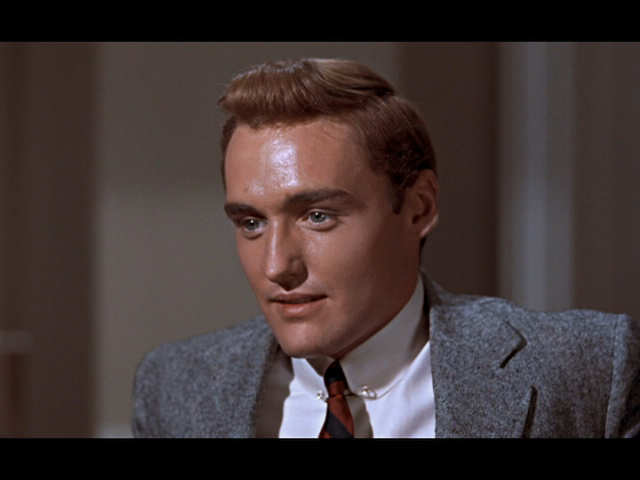
Dennis Hopper as Liz and Rock's son in 'Giant'...what a family!


Giant was one of those ensemble epics that were a spring board for promising stars Taylor, Hudson, and Dean and newcomers Carroll Baker, Dennis Hopper, Sal Mineo, Rod Taylor, and Earl Holliman, yet also benefited from great character actors such as Chill Wills, Mercedes McCambridge, and Jane Withers. Wills is especially good as Benedict family confidante Uncle Bawley.

The aging makeup seems basic today, but it was a departure from depicting age with merely a silver streak running through the stars’ hair or trying to make a “mature” star look young. Of the three leads, Hudson is the most convincing as middle-aged. Rock was beefy and laid-back even then, plus wardrobe padded his middle and outfitted him a weighted belt. Rock’s steady persona and resonant voice were well-suited for the old-school Bick. Often mocked as the typical studio-created movie star and obsolete as an Edsel by the time ‘60s movie realism took hold, it’s important to remember that there’s always been a crowdpleaser cinema star. Today’s version of Rock Hudson is now the equally memorably-named Channing Tatum.
Leslie is a tough Texan with attitude, with Bick looking on.

At 23, Taylor’s make-up as middle-aged Leslie is the most noticeable, but Stevens tapped into Taylor’s strong maternal quality and simmers down her younger, outspoken self. Though Taylor later received accolades for more theatrical roles, Elizabeth is actually at her best when she is under-stated. There are many scenes that show film skills Taylor began learning as a child star: the subdued confrontation with her overbearing sister-in-law; the son’s birthday party where Leslie watches with increased exasperation at Bick’s insistence that their boy ride his new pony; and especially when parents’ Bick and Leslie are at cross purposes while discussing their children’s futures. Notice in this scene, Stevens filmed the scene with the couple in twin beds, Hudson’s newspaper blocking out Taylor. Stevens made Taylor rely on her voice in her performance, an attribute Liz was often criticized for.
James Dean as Jett Rink: His well comes in at last!

James Dean starred in only three movies, yet his name conjures up many myths, might seem overrated. Watching Giant again, Jimmy practically jumps out from the screen as stubborn, sexy, and ultimately sad, as Jett Rink. Often observing from the sidelines, Dean steals nearly every scene he’s in.
Mooning over his former boss’ wealth and wife, Leslie stops by Rink’s ramshackle ranch for tea. Jett also pours out his dreams for riches.
Leslie: “Money isn’t all, you know.”
Jett: “Not when you’ve got it.”
Leslie is dismayed to find underdog Jett not all that different than her husband.
Jett: “I'm just as much a Texan as Bick Benedict is. I'm no wetback.”
Leslie: “You're very like Jordan in that respect. Attitude, everything.”
When Rink strikes it rich, Jett becomes top dog at last. The latter scenes require Dean to play Rink as a dissolute drunk, which some criticized as a caricature. Considering the flamboyant character, Dean does just fine. And it was while finishing up work on Giant back in Hollywood that James Dean died in show biz’ most famous car crash.
James Dean, in front of Reata, the Benedict ranch. This was actually a three-sided facade.

Giant was Warner’s biggest hit until Christopher Reeve’s Superman. The film received 10 Oscar nominations, including best actor for both Hudson and Dean. Giant confirmed Hudson’s leading man status; Dean’s nomination was posthumous. In fact, Rebel Without a Cause and Giant came out after Dean’s demise. Taylor was overlooked by Oscar, despite getting excellent reviews and rising to top leading lady status. However, this was the same year that Marilyn Monroe was passed over for her praised performance in Bus Stop. Taylor could take consolation when she won the first of four consecutive nominations the following year for Raintree County.
There are so many memorable moments in Giant: Jett Rink hitting a gusher on his tiny property, rushing over to Reata covered in oil, to boast to the Benedicts; a military funeral for the first soldier from Reata, a Mexican boy Leslie once nursed to health; the showdown between middle-aged Bick and Jett; and finally the epic fist fight between Bick and a racist diner owner over not serving Mexicans.
Bick: “Look here, Sarge. I'd sure appreciate it if you were more polite to these people.”
Sarge: “You would, eh?”
Bick: “I'm Bick Benedict. Your neighbor, you might say.”
Sarge: “Does that give you special privileges?”
Bick: “The name Benedict's meant something to people around here for a long time.”
Sarge: “That there papoose down there...is his name Benedict, too?”
Bick looks at his family, then turns back to Sarge: “Yes. Come to think of it, it is.”
The brawl is on, memorably set to The Yellow Rose of Texas, blasting from the jukebox. The excruciating match ends with Bick losing the fight, but winning wife Leslie’s admiration at last.
Leslie and Bick, happy at last, 25 years later!

I have seen Giant many times since childhood, but haven’t watched the film in a decade. The story and stars were as enthralling as ever, but I was amazed at how sharp the social commentary was still, after all these years. What’s even more amazing is Giant was made 60 years ago and we’re still fighting over the same issues today.
'Giant' ends with a close-up of the next generation of Benedicts.