Showing posts with label Robert Cummings. Show all posts

Monday, January 30, 2023

Stars, Style, & No Substance! ‘What a Way to Go!’ 1964


Shirley MacLaine stars as Louisa May Foster, who marries and loses most of her
 five husbands in 1964's comedy, "What a Way to Go!"


One of the many '60s all-star spectaculars that was heavy on stars and style, but light on solid story or scintillating dialogue, was 1964’s What A Way to Go! Movies like this are often fun for star gazing and glamour. Yet such films are often dull and don't age well, and here’s just a few: Let's Make Love, The V.I.P.s, The Yellow Rolls-Royce, and What's New, Pussycat?

Shirley MacLaine's widow tells shrink Robert Cummings about EVERY husband
in "What a Way to Go!"

This 20th Century Fox fluff is a comedic story of a woman who’s looking for true love but is always left widowed—and richer. Money doesn't buy happiness, but it brings 70-plus Edith Head costumes, Sydney Guilaroff wigs, Harry Winston jewels, and fabulous sets in What a Way to Go! The featherweight romp also features some diverse husbands: Dick Van Dyke, Paul Newman, Robert Mitchum, Gene Kelly, & Dean Martin. 

The super-size comedy was originally meant for superstar Marilyn Monroe, when Fox decided to take Marilyn back after Something's Got to Give. Marilyn certainly could have elevated this mild vehicle with her natural comedic charms. But it was not meant to be, as Marilyn died soon after. Continuing in the same daft logic, Fox then offered the role to their other diva headache, Cleopatra aka Elizabeth Taylor. The part of a woman who marries five times and becomes richer, with bigger wardrobe and bigger hair with each marriage... what a stretch! But ET’s world now revolved around Richard Burton.

Can't imagine why Fox offered this movie to Elizabeth Taylor! Actually,
Robert Cummings plays the shrink in "What a Way to Go!," not a husband...

The sensible choice of Shirley MacLaine as Louisa May Foster was finally made. Was MacLaine as a brunette here a hangover from the prior choice of Liz? Regardless, while Shirley presents a model slim figure that was more in keeping with the '60s than either curvy MM or ET, MacLaine seems at times dwarfed by the outlandish costumes, towering wigs and Christmas tree jewel sparklers.

Naturalistic Shirley MacLaine & '60s glamour didn't seem to go together.
Note the pancake makeup on her face, then her freckled arm in "What a Way to Go!"
With Robert Mitchum as her tycoon husband.

While MacLaine is a natural comedic actress, a strong director like Billy Wilder was needed to keep her from going from Shirley to shrilly. There's more than a few screaming Mimi moments in this broad comedy, but MacLaine also gets some laughs. It's fascinating to see her play the child Louisa with a wink, without the '60s pancake foundation, false eyelashes, stenciled brows, and overdrawn lipstick—though I do detect mascara. 

Shirley MacLaine as little Louisa in an amusing moment from "What a Way to Go!" 

Most of Shirley MacLaine’s co-stars were old pals or lovers, so Shirley has a nice rapport with each "husband" in What a Way to Go! In a nutshell, in order:

Dick Van Dyke is a very energetic match for Shirley. As Edgar Hopper, Dick is a small-town guy whose hero is Thoreau. But when his love rival mocks his and wife Louisa’s low-budget lifestyle, Hopper hops to, and becomes a big success as a businessman. And promptly keels over from overwork!

Dick Van Dyke as Shirley MacLaine's first husband in "What a Way to Go!"

Paul Newman is next up, as the artist in Paris, where Louisa goes to grieve. Paul gives one of his more relaxed comedic performances, unlike the leering Rally Round the Flag Boys and A New Kind of Love. Amusingly, his character’s name is Larry Flint, but not that Larry Flynt. Paul looks great with a beard, as the starving artist who's always eating! Slim and slight Paul and Shirley are dwarfed by the lavish contraptions and sets in their marital sequence. As Larry’s painting machines finally create successful works, Flint is consumed by the cash rolling in. As he and the machines become more frenzied, they turn on their creator.

Shirley MacLaine's Louisa seems to adapt to each husband's life.
Here, she is Paul Newman's artist wife in "What a Way to Go!"

Next, widowed again Louisa meets Robert Mitchum as a Howard Hughes-type tycoon, Rod Anderson, Jr., at the airport (remember Hughes once owned an airline). MacLaine’s unlucky in love lady figures this latest love is already rich, so what can happen? Ironically, their attempt at living simple down on his farm turns out to be a kick in the head for Rod. Mitchum is laid-back and droll, as always.

I never miss a Nina Foch movie! Kidding! Shirley MacLaine goes platinum for a
hot minute in "What a Way to Go!" With hubby #3 Robert Mitchum.

Shirley’s perennial widow meets Pinky Benson at a local diner. Gene Kelly parodies his Singin’ in the Rain persona here as the small town entertainer, who finally makes it big. Though criticized by some folks as too old, Kelly looks fine for 50, is quite funny, and dances beautifully, of course. Pinky’s fate is getting fatally mobbed by his fans!

Shirley MacLaine's Louisa envisions her marriage to Pinky Benson as a Hollywood musical number. Gene Kelly, aptly cast as hubby #4 in "What a Way to Go!"

At this point, once again widowed Louisa is telling her woes to her shrink, when an old beau walks in. Once her small town’s richest guy, the man is now the building’s janitor! Dean Martin plays comedic jerk Leonard Crawley quite well, and his nonchalant demeanor is perfect here. As the one husband that Louise doesn’t initially love, the creep turns out to be the keeper.

Dean Martin bookends "What a Way to Go!" as first a foiled suitor, then as
Shirley MacLaine's final husband.

Finally, there is Bob Cummings, his usual unctuous self as the smarmy shrink who nearly becomes a husband to Louisa, as well.

One surprise was Margaret Dumont, of the Marx Brothers movie fame, who is bizarre and unfunny as Shirley's mother. Plus, Dumont’s dressed like she’s from a guest shot on The Beverly Hillbillies!

The Edith Head costumes and the sets are meant to be over the top but sometimes veer into awesome ugliness. Head cleverly uses the clothes to further Louisa's story, but I was surprised how many costumes were visions of monochromatic vivid colors. I was getting visions of Liz Taylor's Vincente Minnelli-supervised wardrobe in The Sandpiper. And the Pepto Bismol pink mansion of Gene Kelly’s Pinky is truly stomach churning.

Husband Pinky Benson decrees that his mansion be painted in his honor, in
"What a Way to Go!" Wafer slim Shirley MacLaine sports a contrasting black bikini.

Broadway’s Adolph Green and Betty Comden, the couple that wrote this story, also gave us Singin' in the Rain and Auntie Mame. Sadly, their script and wit seems very broad and sporadic in their last feature film together.

There are few zingy lines and most of the movie parodies of each marriage are mildly amusing, except the Ross Hunter-esque "Lush Budgett" sequence, which is so one-note that it quickly becomes tedious. The musical number with Gene Kelly is a great take off on MGM numbers, and still fun in its own right. Shirley and Dick Van Dyke’s expressive faces and graceful forms make their silent movie spoof fun. And Paul Newman and Shirley are certainly sexy enough in their French “art” film parody, though it’s pretty tame.

Shirley MacLaine & Dick Van Dyke are charming in the silent movie fantasy scene that symbolizes their marriage in "What a Way to Go!"

The director J. Lee Thompson was an odd choice for comedy as he previously helmed The Guns of Navarone and Cape Fear. He next directed Shirley in the 1965 bomb John Goldfarb, Please Come Home! Written by William Peter Blatty, who rewarded his friendship with Shirley by modeling her for his heroine in The Exorcist, thus creating the urban myth that MacLaine's daughter needed an exorcism!
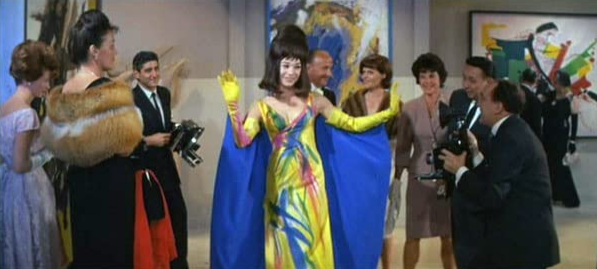
Shirley MacLaine's Louisa in wearable art, courtesy of artist husband Paul Newman
 in "What a Way to Go!"

While I hardly laughed out loud during the entire movie, What a Way to Go! is generally amusing. But it all feels like a pile of frosting—on a cupcake! Shirley MacLaine didn’t carry another hit movie until The Turning Point over a dozen years later. Even then, Anne Bancroft was pulling equal weight. Frankly, Shirley never carried a movie on her own during MacLaine’s leading lady heyday.

There are worse ways to go than watching What a Way to Go! Watch the stars and lavish production, with your brain turned off.

Actress Gari Hardy with Paul Newman, in a deleted scene from "What a Way to Go!" Is it my imagination or is she supposed to resemble Marilyn Monroe? If so, that seems in bad taste as this film was intended for Monroe, before she died two years earlier.


Wednesday, April 11, 2018

The Carpetbaggers 1964

This is about as close to swingin' as 'The Carpetbaggers' gets!

Harold Robbins’ The Carpetbaggers was a “bad” book that was made into “dirty” movie. Like Jacqueline Susann’s Valley of the Dolls’ and its movie version, I always wondered as a kid how much of the “good parts” got cut when they were shown on TV.
Today, I can say there aren’t any truly “good parts” to either movie! The Carpetbaggers is all 1964 T & A tease, there’s no bad language, and the one “nude” scene filmed with Carroll Baker never made to the screen.
One of the few times George Peppard cracks a smile as ruthless tycoon Jonas Cord.
The Carpetbaggers is just a soft core cartoon of the life of Howard Hughes, the rich kid who ran with the ball—making airplanes, movies, and business deals. Hughes was famous for the women in his life, though what actually went on behind doors has been questioned over the last few decades. In real life, even the young Hughes was shy and eccentric, which made women want to mother him. However, in The Carpetbaggers, Jonas Cord is a cool, cruel stud who is catnip to the ladies and a ballsy business man and innovator. He works hard, plays hard, and drinks hard. In short, Jonas Cord is a cartoon daydream of what every man dreamed to live like back in the early 1960s. Except that this movie takes place during the ‘20s & ‘30s.
The Carpetbaggers’ plot and dialogue are cartoonish. The women always seem to be in negligees or nude under furs, the men are hard-drinking and dirty-dealing, and it all feels more like Hugh Hefner than Howard Hughes. John Michael Hayes, who started off screenwriting for Hitchcock, later became the go-to guy to “clean up” all those “dirty” books like BUtterfield 8 and that other Robbins epic, Where Love Has Gone.
Nevada Smith and Rina Marlowe goin' Hollywood in 'The Carpetbaggers.'
The Carpetbaggers abounds with amusing moments, such as the pompous opening narration that sounds more suited to a biblical epic, which aptly describes Jonas Cord, Jr. as “fabulous and fictional!”
Or the early scene that establishes Jonas’ source of pain, where he enters the room of his long-lost twin brother, who apparently went insane. His father had the other brother banished to an institution. When Jonas opens the long-sealed off room, a cloud of dust emanates that resembles a small atomic bomb going off.
To give you an idea how phony this movie is, there’s the scene where Jonas Cord reacts to the death of stepmother/sex bomb Rina Marlowe by going on a bender. He wakes up in a whorehouse a week later, worse for wear. Peppard hilariously sports shiny grey greasepaint that’s supposed to be unshaven stubble—he looks like a weary clown.
George Peppard, as Jonas, with then real-life wife Elizabeth Ashley, as long-suffering Mrs. Cord.
 Adding to the artificiality of all this is that except for the opening aerial scene, the entire movie seems to have been filmed on Paramount’s sets or back lot, and looks it.
Edith Head's hybrid creations—the costumes have just barely enough period detail to depict the ‘20s and ‘30s era, but veer toward ‘60s style—add to the unreality. This isn’t Head’s fault: Edith once spoke about getting berated by producer Hal Wallis, for trying to sneak period details into her costumes for 1965’s The Sons of Katie Elder. Authenticity was not the order of the day for ‘60s period movies.
The one true highlight of The Carpetbaggers is the swaggering Elmer Bernstein score, especially over the opening credits. Bernstein rocks, as always.
George Peppard gives a committed if one-dimensional performance as Jonas Cord, Jr. The blonde actor with the piercing blue eyes was a bit like Paul Newman, but without his sculpted face and abs, much less his empathic qualities. While Peppard played similar cynical roles as Paul, George’s sneering cads were closer to Laurence Harvey than Paul Newman. Peppard, a heavy drinker, already looks soft here. And the scenes of 35-year-old George as a college-age daredevil are a bit much.
'The Carpetbaggers' was Alan Ladd's last film, who died at 50, a decade after his greatest role as 'Shane.'
Alan Ladd, in his last performance as Nevada Smith, is a bit like watching Clark Gable in The Misfits, a welcome yet sad sight. Like other older icons playing guest starring roles in the ‘60s, Ladd is the most interesting and authentic thing about The Carpetbaggers. Laconic and weary, Ladd is the observer of the action, and is fascinating to watch. After the climactic brawl between Jonas and his mentor, Cord asks Nevada what he can do to make amends. Before walking out, Ladd, in a nod to Gable’s Rhett Butler, replies, “Junior, I haven’t the faintest idea.”  Sadly, Alan Ladd died shortly after making the film, from a mix of alcohol and sleeping pills.
Carroll Baker as Rina isn't guessing Ladd's Nevada Smith's weight, but his age! And guesses wrong.
However, the love scene that brings Nevada Smith and Rina Marlowe together—Alan Ladd and Carroll Baker—is cringe-worthy. When Rina asks how old Nevada is, Smith says 43. Ladd was only 50, but after years of cigarettes, booze, and pills, he frankly looks closer to 60. Even more eye-rolling is when Baker replies that he looks 30, as Ladd tries to button up his shirt, her pawing his chest, with a clear side view of his jowls.
Capping this ludicrous scene is when Nevada asks Rina how old she is. Baker purrs that she’s 20—and Ladd replies that she looks 30! Baker had been kicking around Hollywood nearly a decade when it was decided to give her a Marilyn Monroe-type sex symbol build up at age 33.
After a decade as a "serious" method actor, Carroll Baker got the sex symbol build up at 33.
This came courtesy of Carroll’s studio, Paramount, and producer Joseph E. Levine. Other actresses claimed they were offered the role of Rina Marlowe aka Jean Harlow, including Joan Collins and Angie Dickinson. No knock on Baker, but after starting off in Hollywood as an imported Actors Studio “serious” actress—a decade later she was getting groomed as a sex goddess? This seems a bit ass backward—which is how it came to pass, as Baker bumbled through later sexy roles Sylvia and most notoriously, Harlow. I recall acerbic critic Judith Crist saying that The Carpetbaggers’ Carroll Baker had “all the sex appeal of a whole wheat muffin.”
Carroll was no cat on a hot tin roof: "Junior! Junior! Junior!"
In this type of role, Carroll Baker’s style always came across like Elizabeth Taylor-Lite. After a failed attempt at seducing Jonas Cord, Jr., following the death of his father, Baker shrieks after him, “Junior! Junior! Junior!” Carroll sounds puny and petulant, lacking the verve in which Taylor put over the equally junky BUtterfield 8.
40-year-old Martha Hyer's Jennie Denton as the young successor to Baker's late Rina Marlowe.
The studio star system was pretty much over at this point and Hollywood had many sexy young starlets all dolled up and nowhere to go. So, why was 40-ish Martha Hyer cast as a Jane Russell kind of starlet with a Joan Crawford kind of past? Russell was tapped by Hughes at 19 as his next sex symbol. Hyer benefited as the fiancée, later wife, of super producer Hal Wallis, whose films were released through Paramount. One of the most synthetic of Hollywood's ‘50s blondes, Hyer was neither sexy enough to suggest Monroe, nor classy enough to suggest Grace Kelly. Except for Martha's plusher curves, Baker and Hyer are interchangeable, bleached blonde ‘60s Playboy bunnies, playing dress up as ‘30s starlets. Baker became more interesting later, as a character actress; Hyer didn't, and eventually retired.
Elizabeth Ashley has always grated on my nerves, especially as she grew older and hammier, in the Kathleen Turner self-aggrandizing mode. But here, Ashley is young and gamely appealing, and about the only person resembling a human being among the younger cast.
Robert Cummings oozes more camp than sleaze as the agent negotiating with Martha Hyer.
Robert Cummings is laughable as sleazy, wolfish agent Daniel Pierce. I don’t know what Bob’s deal was off-camera, but on-camera, he comes across as such a flamer that the only pants that he would be believable trying to get into are Jonas Cord’s!
There’s a great supporting cast, but they’re stuck in stock roles: Lew Ayres as the long-suffering family lawyer; ‘40s femme fatale Audrey Totter has one scene as the hooker with a heart of gold; Leif Ericson appears in the opening, as the overbearing Jonas Cord, Sr.; and Martin Balsam as the crass studio head.
The colorful cast of The Carpetbaggers.
Like Valley of the Dolls, The Carpetbaggers got terrible reviews but made a fortune, from the public flocking to see if the film version was as dirty as the book. Today, The Carpetbaggers is just a mildly entertaining cartoon of a movie that milks every cliché about Hollywood. Enjoy!

FYI: I put all the movie overflow on my public FB  movie page. 

Saturday, January 28, 2017

'Kings Row' More Than Reagan's Personal Best 1942

The welcome sign to Kings Row serves as a warning--the fact that "good" is used FOUR times raises a red flag!
Kings Row, a fondly remembered ‘40s movie, turns 75 this year. Kings Row was a shocking bestseller by Henry Bellamann about the sordid secrets of a Victorian-era small town. The film version was “cleaned” up for 1942 movie audiences, who flocked to Kings Row, reading between the lines where the dirt was scrubbed out. Kings Row later served as a direct inspiration for Peyton Place.

Robert Cummings, Ann Sheridan, and Ronald Reagan lead the large cast.
In all my decades of movie watching, I somehow missed this Warner Brothers epic. I was surprised by several elements of Kings Row—the first was right over the opening credits. Erich Wolfgang Korngold’s famous score apparently “inspired” John Williams’ Star Wars and also Superman. My ears perked right up when I heard Korngold’s musical fanfare. Now, Hollywood’s golden era composers often “borrowed” from classical composers for their scores, so why shouldn’t John Williams? I guess this was the original version of musical sampling.

The second surprise was the cast. This movie cemented Ann Sheridan’s and Ronald Reagan’s pre-WW II popularity. Kings Row’s young stars are indeed front and center, though Ann Sheridan, the one who truly delivers a great performance, doesn’t even appear until half way through the movie. Yet, she gets top billing.

Kings Row was a best-seller based on a real-life small town-- and yes, scandalous!
Another surprise was reading what was left out of the movie—homosexuality, nymphomania, and incest! As it is, sadism, insanity, a murder-suicide, and cancer were all shocking plot points for a ‘40s flick. One way veteran screenwriter Casey Robinson keeps this saga moving is to recap the story’s most memorable events, which take place off-screen.

What I thought most striking about Kings Row was that it’s not just another small town melodrama. It’s genuinely haunting. The camerawork by James Wong Howe is fluid, going from sharply realistic to shadow-filled and sinister, with actors moving into their close-ups for key dramatic points, instead of just posing. Director Sam Wood left the camera setups and angles to cinematographer Howe and set designer William Cameron Menzies. Kings Row often has a dream-like feel to it—at times, nightmarish.

Reagan's big acting moment, brilliantly captured by James Wong Howe.
The party line on Ronald Reagan regarding Kings Row is that it’s his best performance. My response: that’s not saying much. A more accurate take is that Drake McHugh is Ronald Reagan’s best role. In early scenes, as the happy-go-lucky small town playboy, Reagan is just adequate. Like many actors of his era, Reagan relies on shtick, because he has little charisma. Striving for high spirits, there’s hollowness to Reagan’s line readings, and you are always aware that he is “acting” and not “being”—unlike true greats such as Fonda, Tracy, or Stewart. When Drake’s character is down on his luck and isn’t so happy, Reagan is sincere, if not dynamic. Still, in the famous scene when Drake finds out the results of his railroad accident, Reagan’s anguished call out to Sheridan feels real, “Randy! Randy! Where’s the rest of me?!”

Errol Flynn, a fellow Warner’s star, had genuine charm and sex appeal to burn. Flynn could have played playboy Drake in his sleep, plus Flynn was only two years older than Reagan. Jack Warner gave up on trying to “borrow” Tyrone Power from 20th Century Fox for Parris, whose quiet sensitivity would have been marvelous against brash Flynn. Once that failed, Kings Row was to showcase newer stars like Reagan and Sheridan, supported by an ensemble cast. Robert Cummings was borrowed from Universal to play Parris, likely in exchange for WB star Priscilla Lane, who was loaned to Universal the same year for Hitchcock’s Saboteur.

Robert Cummings & Ronald Reagan are bland as best buds Parris & Drake. Tyrone Power & Errol Flynn--YES!
Next to Robert Cummings as Parris, Reagan comes off like Clark Gable. For starters, Cummings wears so much make up that, at times, he looks like a kewpie doll. The big issue here is that a bland second lead has been cast as the leading man—he can’t even fake it like Reagan! As Parris, Cummings mugs during scenes of comic relief, and is bland and vaguely whiny during dramatic moments. However, like Reagan, Cummings is better in the quiet scenes. But when he tries for charm, as when Parris tells his Grandma, “I’m crazy about you, lady!” in his game show host voice, Cumming is slightly ludicrous.

It doesn’t help that Cummings is saddled with much of the film’s explanatory lines. The scene where Parris prepares to tell Drake the truth behind his accident is hokey and hilarious. First Cummings puffs himself up, gives a flowery speech, and THEN recites the poem “Invictus!” As Cummings and Sheridan cringe and cry, awaiting Reagan’s response, it feels like a silent movie—Parris and Randy all but putting a hand to their brow. Reagan’s Drake stuns them with cathartic laughter! You will be laughing, too, as the music swells, with Cummings literally running to the waiting arms of his girl.

Ann Sheridan as Randy Monaghan: the real star performance in 'Kings Row.'
I often wondered why Ann Sheridan wasn’t a bigger star. Popular in her day, Sheridan never hit the truly top tier. Was it because she was sexy and glamorous, and not to be taken seriously? Studios and audiences were often dismissive of glamour girls who wanted to “act.” Was it because she wasn’t a “great actress” by the era’s conventions? Perhaps that’s why Sheridan seems so fresh and naturalistic here. Sheridan has the least showy role of Kings Row, yet she is warmly real against the artificiality of Cummings and Reagan. Ann Sheridan is a pleasure to watch as Randy Monaghan, the “bad girl” from literally the wrong side of the tracks, who is actually the heroine.

Sheridan’s no-nonsense acting is also a stunning contrast to Nancy Coleman and Betty Field’s “acting” turns as small town girls gone crazy. Coleman plays the doctor’s daughter, Louise, who lets Reagan’s Drake get away. Louise loses it when she loses Drake, especially when, because of her father, Drake loses his legs. Coleman’s acting is typical of the movie era, which emulated stage acting: lots of telegraphing emotions, but little real feeling.

Attempts to turn Betty Field into a leading lady were mixed. She'd fare better
later as a character actress in 'Picnic,' 'Peyton Place,' and 'Butterfield 8.'
Whose idea was it to cast Betty Field as Cassie Tower, the prettiest girl in Kings Row, as she is referred to several times? The long, curly blonde wig, glamour makeup, and soft lighting don’t disguise her dumpy figure and sharp, scowling features. Oddly, Field looks like a funny-faced version of Ann Sheridan. Cassie is an unstable girl whose father—another doctor yet!—feels it best to keep her locked away at home. Fields’ idea of playing crazy—eyes darting from side to side—as Cassie carries on a secret affair with Parris, is right out of the silents.

The supporting cast really makes this movie, as often is the case with these episodic epics. They breathe life here, from Maria Ouspenskaya as Parris’ nurturing grandmother, to Charles Coburn and Judith Anderson as the heartless doctor and stone cold wife, to Harry Davenport and Minor Watson as knowing locals, and especially Claude Rains as Henry Tower. His doctor is haunted by an insane wife and a daughter who seems to be following suit. Rains was a great character actor who was allowed to show his versatility, seldom the case during the studio era.


Claude Rains, wonderfully nuanced as the tormented Doctor Tower.
Kings Row is more American gothic than later colorful small town movies like Picnic or Peyton Place. Despite some lacking leads, this is studio filmmaking at its best, when skilled studio technicians and performers came together and made movie magic.

FYI: I put all the movie overflow on my public FB  movie page.