Showing posts with label Peyton Place. Show all posts

Wednesday, November 9, 2022

Kathy Bates’ Stephen King Encore: ‘Dolores Claiborne’ 1995

The battle cry of Dolores Claiborne: "Next time, one of us is going to the boneyard!" 


I loved Stephen King’s suspense novel Dolores Claiborne and was pleased when I saw the film version onscreen back in ’95. Director Taylor Hackford and screenwriter Tony Gilroy did a stellar job telling King’s story.

This blog post is part of the Classic Movie Blog Association’s Blogathon “Movies Are Murder.” Here’s the link to the lineup! http://clamba.blogspot.com/

Click here: http://clamba.blogspot.com/

***A few spoilers ahead***

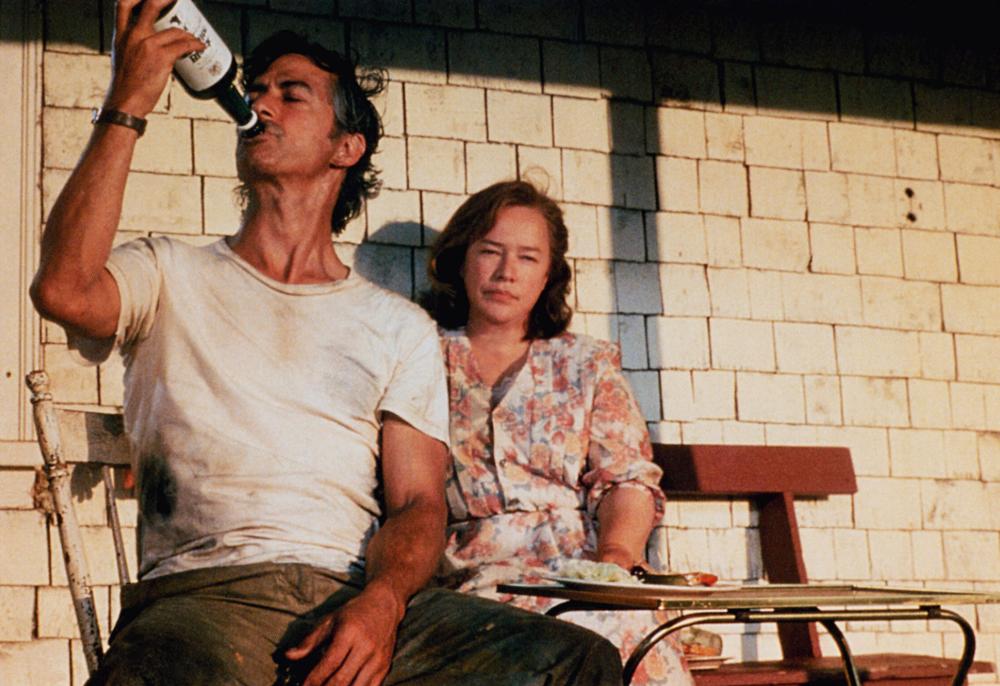
The title character is a small town Maine woman who is abused in varying degrees by both her boozing bastard husband and rich bitch employer. Dolores endures all of it to save as much of her earnings as possible for daughter Selena to go to college. Things come to a head when Dolores discovers that hubby Joe has cleaned out Selena’s savings account and more alarmingly, is also molesting the girl. Desperate, domestic Dolores turns to employer Vera, who’s surprisingly sympathetic, and offers a drastic solution.
Kathy Bates as the younger, then Dolores St. George. Bates has said that
"Dolores Claiborne" is her favorite role and I agree!


New Englander Stephen King, a Peyton Place fan, seems to have been inspired by the white trash Cross family from the Grace Metalious novel and the 1957 20th Century Fox film adaptation. Remember drunken lout Lucas Cross, who beats his housemaid wife and molests his daughter, Selena Cross? It's no coincidence that the abused daughter of Dolores Claiborne is also named Selena. However, beaten down maid Nellie Cross is no Dolores Claiborne. Instead of fighting back, Nellie hangs herself at lady-like employer Constance McKenzie's home. Dolores Claiborne feels beaten down with her lot in life, especially after getting screwed over one last time by husband Joe. Luckily, employer Vera is much more vengefully practical than prissy Constance. In Peyton Place, it’s daughter Selena who must defend herself against the drunken father.

The poor and unhappy Lucas Cross family of "Peyton Place" seemed to inspire
 Stephen King with his dysfunctional family in "Dolores Claiborne."

I recall one critic at the time saying that Dolores Claiborne recalled the mid-career melodramas of Joan Crawford and Bette Davis. I immediately imagined ‘50s Bette Davis playing this role opposite Ernest Borgnine, her co-star from The Catered Affair, where they played a bickering Boston couple. I also amusingly envisioned Bette as the dumpy Dolores to Joan Crawford in Harriet Craig mode as demanding perfectionist Vera Donovan: “Six pins, Dolores! You know that’s the way I like it. Six pins, not five!”

Imagine Bette Davis as "Dolores Claiborne" & Ernest Borgnine as Joe!

Or Joan Crawford as Vera Donovan, who was pretty good
at giving the help a hard time in "Harriet Craig!"

Director Taylor Hackford directs what would have once been called a "woman's picture" with great style, set pieces, and highlighting the actors performances and characters. It's a suspense film/soap opera, with a lot of plot. But the story is that of small town secrets and scandal—and as somebody who grew up in one, I found it totally believable!
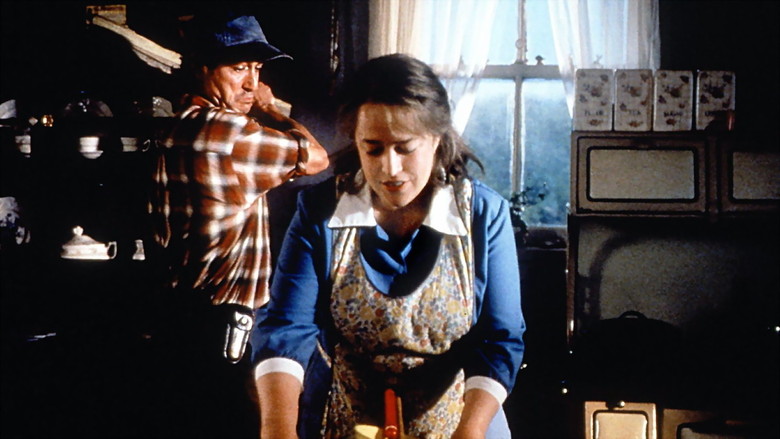
"Dolores Claiborne" is unflinching in it's look at small town dysfunctional families.

Dolores Claiborne is a gutsy Maine character who chooses her battles. The book and movie are direct about child sexual abuse, spousal abuse, elder dementia—the stuff of real life, and of Delores’ life. Oscar winner Kathy Bates (Misery) is on record saying that Dolores Claiborne is her favorite role. It’s easy to see why. Kathy as Dolores is salty but good-hearted, innately decent but sometimes tough, and is both the victim and reluctant villain. Claiborne is a character who life has left its mark on, which is beautifully conveyed here by Bates. I also love Dolores Claiborne because she and Kathy Bates remind me of my paternal grandmother, who also had a hard life and was equally plain-spoken. Grandma Alvera’s favorite saying could have been Dolores Claiborne’s: “Quit your pissing and moaning!”

Kathy Bates as the older "Dolores Claiborne," with Jennifer Jason Leigh as Selena.

British actress Judy Parfitt was unfamiliar to American audiences at the time, but her performance as piece of work Vera Donovan is now among her most memorable. Bates and Parfitt make a great team as the no-nonsense maid and the imperious lady of the house. There are a number of memorable lines from this movie, but Parfitt’s waspish Vera has the very best of them! Though Vera wears her bitchiness like a badge of honor, other aspects of her personality and past are held close.

Judy Parfitt is most memorable as the rich employer in "Dolores Claiborne."
Vera Donovan: "Sometimes, Dolores, an accident can be an unhappy woman's best friend!"

In King’s novel, Selena St. George is depicted as a child, but only referenced as an adult. Tony Gilroy’s screenplay does a solid job of fleshing out Selena as an unhappy young woman. She’s now a writer in New York City, just like Peyton Place’s Allison MacKenzie, who is traumatized by family scandal and runs off to the Big Apple to write and have affairs. Jennifer Jason Leigh is perfectly cast as the dysfunctional, depressed, drinking and drugging daughter, who somehow manages to be high-functioning, professionally. Leigh’s Selena is understandably detached and morose coming back to her unhappy childhood home, and falls into dysfunctional traps. Leigh’s coolness is a great counterpoint to Bates’ warm-hearted and sometimes hot-headed mother.

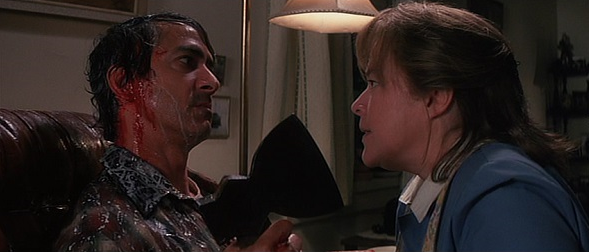
David Strathairn, in a villainous turn as worthless husband Joe St. George.
Watching Strathairn as slimy Joe reminded me of Arthur Kennedy
as equally vile Lucas Cross in "Peyton Place!"

David Strathairn is a great villain as Joe St. George, Dolores’ worthless husband. Strathairn has played both distinguished and despicable men with equal skill and conviction, much like Arthur Kennedy did in his long career. Kennedy won an Oscar nomination for his drunken sexual predator Lucas Cross in Peyton Place. Had Dolores Claiborne been a big commercial hit at the time, it’s likely that Bates, Parfitt, Leigh, and Strathairn would have all received nominations. Also, Christopher Plummer is in sneering and steely mode as the local detective who’s determined not to let Dolores Claiborne get off the hook.

Christopher Plummer in supercilious mode as Detective Mackey, who has it in for
Kathy Bates' "Dolores Claiborne."

Dolores Claiborne is one of those films that enjoyed an afterlife on video and television. It got solid reviews upon release, but was only a modest hit. The year before, the adaptation of King’s The Shawshank Redemption was a male-oriented story that became a sleeper success. With home viewing, both Dolores Claiborne and The Shawshank Redemption have become popular favorites.

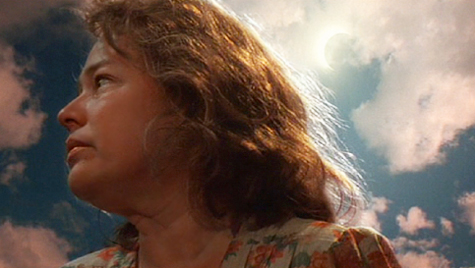
Vera Donovan offers "Dolores Claiborne" some parting advice before the big eclipse!

Director Taylor Hackford deserves praise for his handling of the current day story of Vera Donovan’s mysterious death with the equally weighted flashback scenes of Dolores and Vera’s unhappy lives. The set piece of the eclipse and Dolores leading Joe to his fate is wonderfully done. Selena’s repressed memory of her father’s abuse is strongly but subtly handled.
Setting a trap for her abusive husband isn't exactly rocket science for "Dolores Claiborne."

There are many memorable scenes in Dolores Claiborne—alternately harrowing, suspenseful, darkly humorous, and touching. A throw back to a classic movie-movie, but with enough reality to engage modern audiences, this movie stays in your memory. Dolores Claiborne is both an atmospheric suspense film and engrossing character study, with strong, naturalistic performances and stylish storytelling.

The beautifully executed eclipse/death scene in "Dolores Claiborne."


Friday, April 2, 2021

Lee Grant’s Great Comeback: 'Peyton Place'

Lee Grant's Stella Chernak won her an Emmy two years after she got off the blacklist.


Lee Grant's future got even brighter with movies like '67's "In the Heat of the Night."


Lee Grant’s 1965 Emmy-winning turn as Stella Chernak on Peyton Place, TV’s then-phenomenon, was her big comeback after a dozen years on Hollywood’s blacklist. This was a bittersweet victory for Grant, who had made an equally big splash recreating her Broadway role in 1951's Detective Story. Lee nabbed a Best Supporting Actress Oscar nomination for her first movie and won a Golden Globe. A year later, Lee Grant found herself in Red Channels’ blacklist after speaking at a “communist” actor's funeral.

"Just don't ask my age!" Lee Grant's debut in "Detective Story."

Grant got by as an acting teacher, grabbing roles in NYC-made TV shows, for whoever was brave enough to hire her. Once the blacklist was lifted, Lee Grant was determined to make up for lost time. A dozen years older than she started—and Lee says they were hard years—Grant first got a face lift and then got busy. PS—Lee Grant has the most variable birth date since Joan Crawford, but let’s just agree with Lee that she went from promising starlet to early middle age, losing prime acting years in between. She made guest appearances on top dramatic TV shows and also a feature film, The Balcony.

Lee Grant as Stella Chernak in TV's smash hit "Peyton Place."

Then Grant landed a recurring guest role on TV's first night time soap, Peyton Place. A runaway hit, with its youthful cast, Lee was 40ish and playing 30ish as Stella Chernak, a bitter woman who returns home. Grant later said in interviews that she put all her frustration and fears from getting branded by the blacklist into the role of this woman from the wrong side of the tracks.

As hard-bitten Stella, Lee is fierce as the biochemist that’s learned more from the school of hard knocks than college. Her alcoholic father Gus toils at the Peyton Mill while nursing the bottle and a large chip on his shoulder from working for “the man.” When Gus wasn't knocking around or mocking his children, Stella and her little brother Joe, he instilled in them his dysfunctional attitude. 

Stella and her little brother Joey ponder the screwed-up Chernak family.

Stella Chernak is a fascinating character, especially for a 1965 TV show. While considered a soap opera, Peyton Place had surprisingly strong writing and characters. Though the show had a number of great villains, what Lee Grant brought to the role of Stella was not just a memorable bad girl, but a complicated woman. This dynamic duality made Lee Grant Peyton Place’s only Emmy-winning performer. Lee’s performance reminds me much of Bette Davis’ star-making turn as Mildred Rogers in Of Human Bondage. After several years of getting stuck in junk roles, Davis begged to play the role of the bitter waitress, and gave it her all—knowing she had nothing to lose. Lee took the same tact with Stella and gives the same type of startling, powerful performance. In fact Stella and Mildred have a few similarities: both are working class and are prickly about their class status; both women are courted by kindly men in the medical field; and both respond to kindness with mistrust. I can’t imagine how 1965 TV audiences took to Stella Chernak. Even today, with YouTube’s uploads of the show, in the comment sections, Peyton Place fans are often taken aback by surly Stella. However, it’s not the ingénue or leading lady that gets all the kudos or awards. Aside from Lee Grant’s win, the only other acting nominations Peyton Place got were for Barbara Parkins as snippy, ambitious Betty Anderson and Ruth Warrick, brilliant as the show’s own Mrs. Danvers, Hannah Cord.

Lee Grant looks more like her unglamorous ‘50s self when she first shows up in Peyton Place as Stella. Grant said she had to put her foot down to get time and care from the camera man, like the younger stars. I’m not sure why Grant's sporting what looks like a helmet-like black wig, but by the time she leaves Peyton Place a year later, she looks closer to the auburn beauty who looked the same from the late '60s through the '70s.

Stella comes to the forefront when her younger brother Joe is accidentally killed in a fight with local golden boy Rodney Harrington (Ryan O' Neal). Though a part of Stella has a very blunt and clear-eyed view of her family's problems, the dysfunctional side of Stella falls into the blame game trap and misguided family loyalty. Officially, she claims Rodney called on her, and said he would kill Joe. This lie is a major obstacle when Rodney goes on trial for murder.

Stella Chernak body slams Rodney Harrington on the witness stand, "Peyton Place."

Meanwhile, Stella has started to fall for nice guy doc, Michael Rossi, played by Ed Nelson. But her prickly personality makes it hard to break through. Nelson, a solid and warm actor, is a great balm to Stella’s often brusque personality. To see Stella occasionally warm to Rossi also shows Nelson and Grant’s rapport.

It’s amusing to also see Grant’s Stella rubbing elbows with the locals, who are curious about the working class girl who made good as biochemist. However, Stella seems to prefer throwing elbows, with snarky replies to the townspeople’s questions.

The creators of the Peyton Place series deserve credit for creating not just a scandalous soap, but a show with complex characters, and issues that are still problems today: dysfunctional families, alcoholism, drug theft, gangs, sexual abuse of young women, etc. Then there are Grant’s great scenes as Stella: the ferocious showdowns with her deadbeat brother Joey and drunken dad Gus. Yet, Stella gets to show affection and frustration with her onscreen little brother. When “Papa” goes too far with his excuses, Lee’s Stella tears into him and his self-deceptions. And Lee is just as convincing when Stella spouts the family’s official line, when she reacts to her dad's death with denial at Martin Peyton's house, who sets her straight. Grant knocks all these big scenes right out of the ball park.

Stella with "Papa" Gus Chernak in "Peyton Place." At times, pre-glam Lee Grant
 looks like "Dark Shadows" Grayson Hall!

Lee Grant’s working class grrrl has some lovely smaller scenes, too. My favorite is when bar keep Ada Jacks calls Stella to say papa Gus has ordered a drink and is spoiling for trouble. Lee’s Stella walks in—sooo over it—and treats Gus like a kid caught skipping school. After the usual Chernak family bickering, Stella tells him to make up his mind about the drink. Gus knocks the shot glass over, instead. With weary humor, Stella says, “Beautiful. Now you just made a lot of work for Ada. All you had to do was leave it alone.” Stella gets ready to go. “Come on, Papa!” Stella slaps her purse like a tambourine. “Let's go home! So long, Ada. Sorry about the mess.” Stella even gets her own Butterfield 8-esque jazzy theme, which cues up every time Chernak is saunters into a scene or makes a memorable exit! Even in this quieter encounter, Grant’s line readings are so versatile and authentic, that she’s riveting.

Michael Rossi has the thankless task of consoling Lee Grant's Stella in "Peyton Place."

Grant is intense and powerful as Stella, but also shows warmth and vulnerability beneath the tough cookie façade—she’s no ingénue, but she’s a sexy, sharp woman. The strong script is already there, but Lee takes it to the next level and plays some clichéd moments in a striking departure from the usual soap suds.


FYI: I put all the movie overflow on my public FB  movie page. 

Check it out & join!  https://www.facebook.com/groups/178488909366865/

Lee Grant won an Emmy for Best Supporting Actress in ‘66, just two years after she got off the blacklist. The acting roles, which had just started to roll in, really kicked in after the Emmy win. Grant next made the most of roles in two film hits, Valley of the Dolls and In the Heat of the Night. From then on, Grant alternated between TV, film, and theatre as an actress and director the next couple of decades. While the journey wasn’t always easy, Lee Grant proved that there was life after 40 for women in show business.

Here's my look at Lee's '67 classic, In the Heat of the Night:  https://ricksrealreel.blogspot.com/2020/06/in-heat-of-night-1967.html

Lee Grant with her much-deserved Emmy for her role as Stella in "Peyton Place."

Monday, August 19, 2019

‘A Summer Place’ Still Steamy & Silly 1959

"You can't ever let him think your kisses come cheap!" Troy Donahue & Sandra Dee... *Batteries not included!


A Summer Place was a smash in 1959, due in equal doses of Percy Faith’s pop take on Max Steiner’s music, dream team Sandra Dee and Troy Donahue, and the titillating teen sex story line.
Triple threat director, producer, and screenwriter Delmer Daves moved from western flicks to glossy soaps starting with A Summer Place. This daring melodrama was also his most successful.
The cast of 'A Summer Place,' with appropriate facial expressions: Dee & Donahue as the teen lovers;
Richard Egan & Constance Ford as the Jorgensons; and Arthur Kennedy & Dorothy McGuire as the Hunters.

Adapted from the novel by Sloan Wilson (The Man in the Gray Flannel), the Warner Brothers’ film version of A Summer Place was obviously inspired by 20th Century Fox’s recent racy novel-to-movie hit, Peyton Place. Like that ’57 sexy soap, there’s the nostalgic New England setting, glossy production values, heart-tugging score, plus a cast comprised of fresh young stars and familiar favorites. And after salivating over the sizzling stuff, audiences get a reassuring moral message by the veteran male star at the finale.
Molly Jorgenson: “Remember that family that lived next door to us back home?”
Ken Jorgenson: “Yeah.”
Molly Jorgenson: “Their son used to look at me.”
Ken Jorgenson: “Without you knowing it?”
Molly Jorgenson: “Well, his bedroom was right across from mine and... one night, I felt naughty and went right on undressing so he could see. Then all of a sudden I... I got terribly ashamed and I ran and pulled the curtains down. I'll never forget... I had hot and cold flashes all over me afterwards. Wasn't that awful?”

Despite the 2 hour and 10 minute running time, A Summer Place squeezes a lifetime into one year. (The novel takes place over 20 years.) The story starts with a splash as lush Bart Hunter (Arthur Kennedy) sets up the stakes in his snide way. Former love rival for his wife, Ken Jorgenson (Richard Egan), is bringing his family back, years later, for a summer visit. They plan to reside at the Hunter family estate, now run as the Pine Island Inn. Bart wants to say no, but wife Sylvia (Dorothy McGuire) protests that they are buried in debt and need to take in these summer guests. Kennedy’s pompous response: “Just because we’re broke doesn’t mean we have to lose our dignity!” Let’s just say more than dignity is lost in A Summer Place.
Charming host Bart Hunter to his guests: “Do you and your husband often swim in the raw, Mrs. Jorgenson?”

Whatever possessed Ken, who went from island summer help to successful chemist, to marry Helen (Constance Ford) is never explained. (In the novel, she’s the daughter of his business partner). Helen is a frigid, pious, pretentious, overbearing, and humorless shrew. In the first scene, she tries to control her family by dressing Ken up like Gilligan’s Island’s Thurston Howell III in a yachting get up, and daughter Molly (Sandra Dee) like Shirley Temple in a sailor dress. Not only that, Helen wants Molly to wear an iron clad bra and girdle that would be more suitable for the ample mama.

Molly Jorgenson: [to Ken] “She says I bounce when I walk. Do I?” 
Helen Jorgenson: "When we arrive at the inn, I want her to look completely modest."
Molly: "She means like a boy. Flat as a pancake!"


There’s a voyeuristic tone to the whole movie. First, the locals are checking out the Jorgenson family as they arrive on their yacht. Then Dee’s Molly and Johnny Hunter (Troy Donahue) are scoping each other out through binoculars. At the end of day one, the smitten teens peer through their bedroom windows at one another good night. Their respective parents, Ken and Sylvia, once teen lovers, are also wistfully doing the same. The handyman is hired to spy on them by suspicious Helen. Once Molly and Johnny fall madly in love, everyone is spying on the teens. Most of all, audiences were eating this all up, along with their popcorn!
“You have to play a man like a fish.” No problem here!

A Summer Place made a star of Troy Donahue. The teen idol possessed striking blue eyes, set off with a mane of blonde hair, with the soft jaw line of George Peppard. Apparently, Donahue wanted to be an actor since he was a kid, with the family background in showbiz. Sadly, it doesn’t show. Donahue is so wooden, there’s absolutely no conviction to his line readings, and in his big scenes, the camera cuts away, and comes back to him in tears. Troy’s voice sounds like a disembodied Tony Curtis—when Tony was trying to sound like he wasn’t from the Bronx! It also doesn’t help credibility that 6’ 3” Donahue towers over the rest of the cast, who treat Troy like a troubled boy, even though he was 23.
Bart Hunter: “Oh, Johnny, stop being a silly sentimentalist. It's stupid! Molly is merely
 a succulent little wench!” 
Johnny: "She's not a wench! She's everything I've ever dreamed of in a girl."


Sandra Dee on the other hand, has her moments, but whether by her choice or the studio’s, falls back on her perky persona that borders on hyperactive. This was a major debit in the same year’s Imitation of Life; depending on your taste, it’s either endearing or unendurable. I am of the latter camp. Still, Sandra shines in comparison to dull Donahue. They make a pretty, white bread screen team.

Helen (about daughter Molly): “I don't want her stared at.” 
Ken: "So you insist on de-sexing her, as though sex was synonymous with dirt."


The veteran actors save the day in A Summer Place. While Richard Egan’s dialogue is often speechy—though Ken’s papa actually preaches in defense of the teens—he plays it as straight as possible. Some of Ken’s most high-minded speeches sound just like Lloyd Nolan’s Doc Swain in Peyton Place. Physically, Egan’s rugged masculine looks are a pleasing contrast to the elegant Dorothy McGuire. As Sylvia, the long-suffering wife of Bart, McGuire comes off with the most dignity intact. That’s because her dialogue doesn’t contain as many clinkers as the script as a whole contains.
Richard Egan and Dorothy McGuire as the sane parents...they only committed adultery!

However, it’s the two dysfunctional parents who have the most delicious dialogue. Arthur Kennedy, at this point in his career, was adept at playing slime balls, such as Peyton Place and Some Came Running. As Bart, he is never without a drink or dirty quip as the drunken father of Johnny and spouse of Sylvia. Some of the lines are so sleazy, that I wonder how they ever slid the censors. Kennedy is nearly a comic villain, and he has a field day.
Constance Ford as Helen: “No decent girl lets a boy kiss and maul her the very first night they meet! I suppose it's your Swedish blood in her. I've read about how the Swedes bathe together and... and have trial marriages… and free love. I've read all about that. Anything goes.”

The real scene stealer is character actress Constance Ford, as Molly’s monstrous mother and Ken’s witch of a wife. Later, Ford was a favorite on daytime TV for 25 years as Ada, the no- nonsense mother of willful Rachel, on NBC’s Another World. Here, as Helen, she is a bulldozer, burying her husband and daughter alive. With her dour face, dumpy figure, and a whiny voice that rises to caterwauling, she’s like Shelley Winters long-lost sister—but without the humor! Ford makes the most of her moments and over the top dialogue.
The infamous "Look at me, I'm Sandra Dee, got knocked over with the Christmas tree!" 

Constance Ford's sister in cinema Shelley Winters serves up some Mama slaps in "A Patch of Blue!"
Divine ain't gonna go down like Sandra Dee and the Xmas tree!

A Summer Place’s Delmer Daves deserves much credit for not bending to censorship in trying to tell a positive story about teenage love and sex. Though there are consequences, neither Dee nor Donahue’s characters must “suffer” for their sins. No convenient miscarriages. No running away. No car crashes. Audiences can appreciate that message while wallowing in the glossy suds—enjoy!
Molly Jorgenson: “Are you bad, Johnny? Have you been bad with girls?”

Film footnote: Though the Hunters’ home turned inn and Ken and Sylvia’s later modern home are set on the New England coast, the Pine Island Inn exteriors were filmed at an actual home in Pacific Grove and the latter day Frank Lloyd Wright house is in Carmel, both in California.
"Pine Island Inn" house was actually in Pacific Grove, CA.
The Frank Lloyd Wright House is actually in Carmel, CA.


Saturday, September 17, 2016

Performances Make 'Peyton Place' Worth a Visit 1957


"Peyton Place" became the password for small town gossip and scandal. In the 1957
 film version, Lana Turner & Diane Varsi play the problematic mother & daughter.


Peyton Place was forever equated with small town scandal the moment Grace Metalious’ novel was published September 24, 1956. Peyton Place was an instant sensation and huge bestseller, eventually selling 12 million copies. A year later, the film version of Peyton Place was released, and audiences were dying to know if the movie was half as steamy as the book.

An estimated 1 in 29 people had read 
"Peyton Place"at the height of its popularity.
In truth, Peyton Place the movie was about half as steamy, but that was still mighty hot for 1957. On a recent re-viewing of Peyton Place, I was amazed at how much did make it onscreen. Particularly, the rape of Selena Cross by her alcoholic stepfather—it is subtle, but still powerful. And the big showdown between uptight mother Constance MacKenzie and angst-ridden daughter Allison doesn’t water down the fact that Connie was not a widow, but a mistress. Though the screenplay toned down or tweaked certain plot points, as when Betty Anderson’s method of cock-blocking Rodney Harrington becomes verbal rather than literal, or how Selena’s abortion becomes a miscarriage—they are diluted, but not deleted. Audiences already read the book and were movie-wise to censorship substitutions, with the original action burned in their dirty minds. The film version still pushed the envelope, but had its eye on the Oscar envelope, which rewarded “good” films, not trash—at least in theory!

Off-screen, Lana Turner wasn't exactly a wallflower!
Jerry Wald was a pistol of a producer, who gravitated toward material and stars that generated class or cash, preferably both. Wald had created the sizzle in casting Joan Crawford as a mother in her Oscar-winning Mildred Pierce comeback. When he snapped up film rights to Peyton Place over a decade later, he talked another former MGM star into playing a mother with a problem daughter: 36-year-old Lana Turner. 20th Century Fox preferred Olivia de Havilland or Jane Wyman as Constance MacKenzie, the small town shop owner with a secret past. Both actresses were Oscar winners, certainly better actresses than Lana, and a bit closer to the character’s age. At this point, Lana’s public began to prefer reading about her romances, marriages, and divorces rather than paying to see her perform onscreen. 

Lana Turner as upright and uptight Constance MacKenzie in "Peyton Place."
But Jerry Wald was canny about casting and publicity. First, Wald knew that everyone loves a comeback.  Like Crawford before playing Mildred Pierce, Turner hadn’t had a hit several years, since The Bad and the Beautiful—which was also a comeback! Plus, the public and the press would eat up the scoop that love goddess Lana was playing a mother for the first time. So what if Lana had a teenage daughter in real life, one who would make headlines of her own shortly after Peyton Place’s release. Mother roles were considered the last hurrah for Hollywood glamour girls. But this wasn’t just any maternal role, this was Constance, a hot mama underneath the cool demeanor. Wald figured that audiences, who often equated stars with the character they played, would use movie short-hand in filling in the blanks of what was suggested on-screen with Lana’s own scandalous off-screen behavior.

Welcome to Peyton Place! Lee Phillips as Michael Rossi,
the one uninspired performance in the movie.
Wald also used a popular method of casting in mid-century movies, when audiences young and old were now watching television at home, to attract both audiences. Lana Turner was still very much a star and Wald backed her up with veteran character actors like Lloyd Nolan, Arthur Kennedy, Betty Field, Leon Ames, Lorne Greene, and Mildred Dunnock. But the producer also cast up-and-coming young stars like Hope Lange, Russ Tamblyn, and David Nelson in featured roles. Wald also chose an unknown Diane Varsi to play Constance’s dreamer daughter, Allison. At 18, Varsi was certainly a more forward-thinking choice for the role than Debbie Reynolds, who was considered—and six years older.

L: Lloyd Nolan as no-nonsense Doc Swain, telling some tough truth to the people of Peyton Place!
As often the case with all-star movies, it’s the old pros who steal the show: Nolan, as plain-spoken Doc Swain; Kennedy as despicable drunk Lucas Cross; Field as rightly depressed Nellie Cross; Leon Ames as the blowhard bigshot; Lorne Greene as the fiery D.A.; and Mildred Dunnock as the passed-over teacher. These veterans are terrific troupers here.

Diane Varsi & Russ Tamblyn as shy kids Allison & Norman.
The young folk of Peyton Place are a mixed bag. Diane Varsi’s awkwardness actually works as Allison, the teen who dreams of writing a novel—about guess what? Russ Tamblyn as Norman Page, her comrade in shyness, gives a genuinely excellent performance. And Hope Lange is heartbreaking as Selena Cross, the sad girl from the wrong side of the tracks. But the others, like David Nelson of Ozzie and Harriet, are bland. And at 28, Terry Moore comes across like an aging starlet than a high school age fast girl, Betty Anderson.

Constance gets her comeuppance from daughter Allison. Lana Turner's best moment.
Last but not least, there’s Lana. For her role as Constance MacKenzie, Turner received her first and only Oscar nomination. Though Lana’s role was not the showcase that was Crawford’s Mildred Pierce, Turner gives it her MGM best, suffering and insinuating, with chin tilted and eyebrows arched to the heavens. It’s easy to laugh at acting styles from another era, but Lana has a number of genuinely effective scenes in Peyton Place. The scene where the new man in town puts the moves on near-frigid Connie, Turner’s reaction of disgust rings surprisingly true, considering the real Lana was quite hotsy-totsy. Another authentic moment is after an argument with Allison, who throws her mother’s past in her face, which ends with Lana leaving the room. Grandly walking down the stairs in despair, Turner crumples on the steps, sobbing in semi-darkness, gasping, “Oh, God!” It is a genuinely great bit of acting by Lana. And of course, Turner turns it on during the courtroom scene, during the trial of Selena Cross.

Turner as Constance, on the witness stand. Lana would appear in a real courtroom
 the following year!
20 Century Fox, with their widescreen Cinemascope, was the first studio to embrace location filming. Peyton Place exteriors were filmed mostly in Camden, Maine and a few other New England locations. The panoramic locales against Franz Waxman’s memorable score rather romanticized Grace Metalious’ seamy small town. This irritated the author, though she liked the performances from the cast.
The Cross family's subplot in 'Peyton Place,' the toned down, is still a shocker.

The greatest task for solid studio director Mark Robson and his screenwriters was to “clean up” the scandalous story for the silver screen. This was Hollywood hypocrisy at its best: Let’s buy a salacious book, turn it into a whitewashed movie, and then promote it as shocking!

28-year-old Terry Moore is less than believable as hot teenager Betty Anderson.
The critics condescendingly praised the “classy” screen version of Peyton Place as a vast improvement over the “dirty” book. Yet a few critics at the time called the adaptation sanitized or antiseptic. The truth falls somewhere in the middle: Peyton Place was run through the Hollywood Hayes Code whitewash cycle, though it managed to keep key events intact. There was no way in 1957 that the movie could have depicted the book’s dirt intact. Metalious may have disliked her book’s adaptation, but then, the depressed author didn’t like much of anything. Peyton Place was one of the year’s top-grossing films and received nine Oscar nominations—though it won none.

Finally, Peyton Place was still playing in theaters when Lana Turner’s latest boyfriend, gangster Johnny Stompanato, was fatally stabbed by her daughter, Cheryl. The details that flowed after the murder made Peyton Place look like a small-town picnic. When Lana was going through her real trial the following year, some audience members were heard to call out their support to Turner as she testified onscreen in Peyton Place.


Blood, sweat, & tears: Lana at the inquest over the stabbing death of gangster boytoy Johnny Stompanato.
After her latest scandal, Lana was forced to, yes, make another comeback! Turner took a small salary against a huge potential share of the profits and starred in a film even soapier than Peyton Place. 1959’s Imitation of Life was one of the biggest hits of Lana’s career, making a fortune, and extending her career as a leading lady for nearly another decade. And that’s about as happy of a Hollywood ending that Lana Turner ever got in her long career.
After the Johnny Stompanato scandal, Lana would get the call for another comeback opportunity. This time it would be from producer Ross Hunter, for 'Imitation of Life.'

FYI: I put all the movie overflow on my public FB  movie page.