Showing posts with label Gig Young. Show all posts

Sunday, April 3, 2022

'Teacher’s Pet' 1958

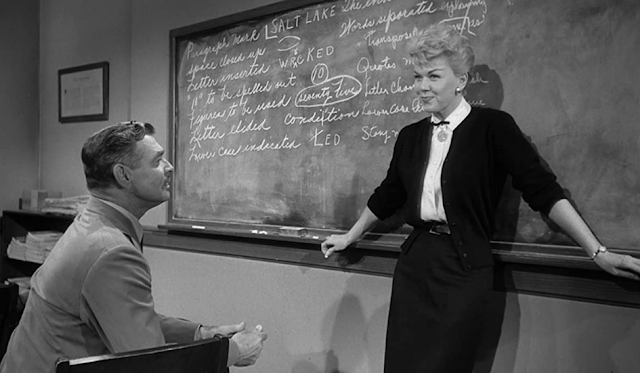
Both Clark Gable & Doris Day's characters have lessons to learn in "Teacher's Pet."


Teacher’s Pet was made in the midst of Doris Day’s 20 year movie career. Hollywood’s girl next door starred opposite almost all of the golden era’s leading man greats. Doris worked well with them all, and Clark Gable was no exception. In 1958’s Teacher’s Pet, as modern journalism teacher Erica Stone, Doris is warm and intelligent; Clark is playful but pragmatic as the old-style news editor. While both play to their very specific personas, Day and Gable are completely natural in front of the camera and totally believable as their journalist characters.

Doris Day's DA hairdo in "Teacher's Pet" would soon be DOA with "Pillow Talk!"

Clark is Jim Gannon, an old-school city desk editor. As an old-school Hollywood icon, Gable was perfect casting. Though a life of cigarettes and alcohol made him look older than 56, this was not unusual for classic Hollywood heroes. Sadly, Gable was dead less than two years after Teacher’s Pet was released. It was still common to cast much younger actresses as co-stars. Doris Day was 35 when this rom-com was filmed, and clean-living Day lived to be 97.

Doris Day & Clark Gable make a solid team in "Teacher's Pet."

I was a former newsroom journalist and there was some smart stuff in this film, issues that exist to this day. I came into news at the tail end of this movie’s depicted era. The whiff of old-school journalism, where some staff reeked of cigarette smoke and longed for the good old days of a bottle in their desk drawer. In Teacher’s Pet, papers were trying to stay in the black, losing space to the ads that kept the lights on. And the battle of opinions over whether to get a college education versus on-the-job training is still a relevant topic.

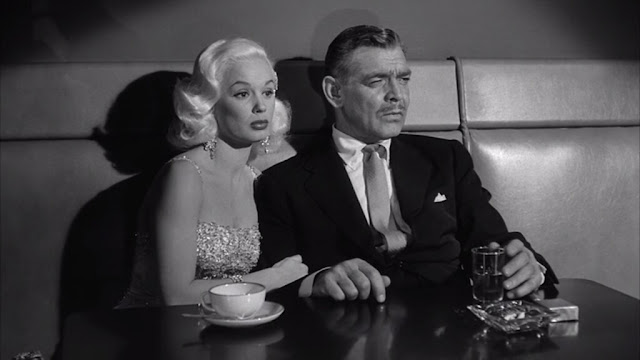
Clark Gable's city editor with hot news item Mamie Van Doren in "Teacher's Pet."

Teacher’s Pet was more of a comedy-drama than a flat-out farce; perhaps this was why it wasn’t filmed in color. This is one of the few Doris Day movies shot in B & W. Cinematographer Haskell Boggs (who worked mostly on TV) doesn’t do either star any favors in the glamour shots department, either.

The following year, Doris got the Ross Hunter glamour makeover and soft lenses in Pillow Talk, and the die was cast for “Doris Day lighting!” Ironically, despite the common perception that Pillow Talk was a big departure for Day, the basic plot mimics Teacher’s Pet: Career girl Doris fights off old-school wolf. She’s appalled by his lifestyle. Wolf then pretends to be someone else, to play Day. There’s a sidekick commenting on the action. Booze figures prominently, there’s a song or two. Day discovers the ruse, but a happy ending ensues. The big difference is Teacher’s Pet is far more realistic and both characters compromise by the end.

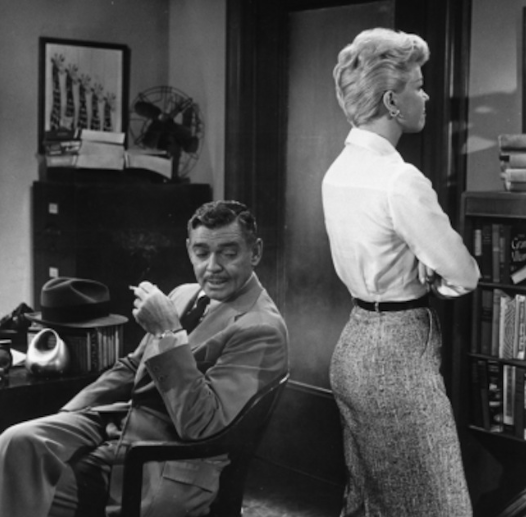
Gable's old-school in every way, especially when it comes to the chassis of Doris Day!

Though Gable plays Jim a bit broadly in the comic moments, he’s quite at ease in the serious scenes. Clark brings great authority as the voice of experience, who’s ill at ease under it all, for his lack of education. Perhaps it’s the smart Oscar-nominated script by Fay and Michael Kanin, but as the typical comedic battle is fought, eventually both Day and Gable’s characters learn, and to give a little.

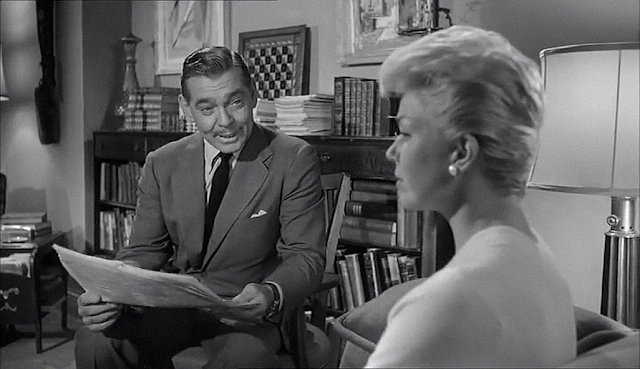
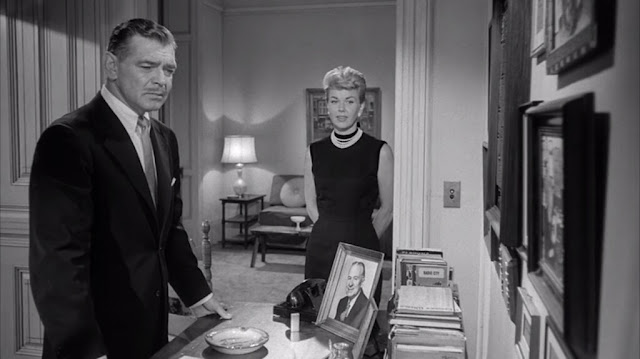
A lovely scene in "Teacher's Pet," when editor Gable discovers who's the father
of journalism teacher, Doris Day.

As the journalism instructor, Doris Day plays it more straight than usual. Day loses the early ‘50s ingĂ©nue attitude and tones down the comedic squawks of indignation that came in later comedies. When Erica discovers the late bloomer in her journalism class is the newspaper jerk who wrote her an insulting letter, Day’s teacher is genuinely hurt. Both characters learn to appreciate the other, and this gives Teacher’s Pet more heft than the typical Day movie. Doris is natural in her dramatic moments, and gets to be playful when sparring with Gable.

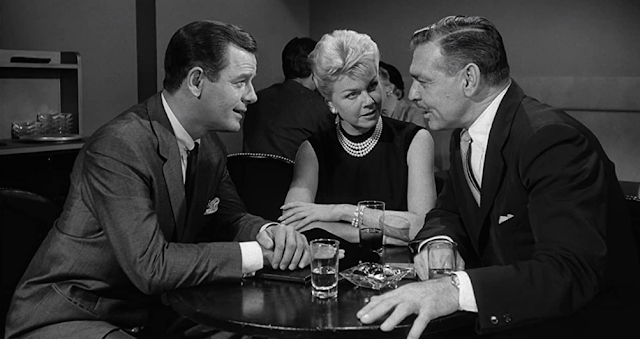
Are Gig Young & Clark Gable vying for Doris Day's attention in "Teacher's Pet?"

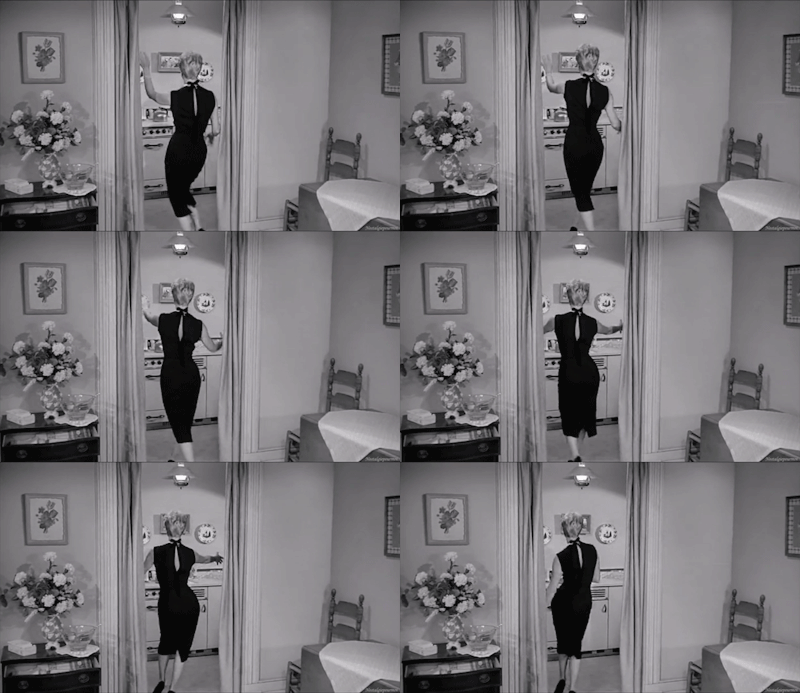
One of Doris Day’s funniest moments is when mimics Mamie Van Doren, who plays Gable’s performer gal pal. After viewing Mamie sing and dance to “The Girl Who Invented Rock and Roll,” she tweaks Gable with her own version later. And aside from Doris’ good humor, Day demonstrates that her figure is every bit as impressive as Mamie’s! In fact, the movie gives us several appreciative views of Day’s assets. BTW, Doris was tall at 5’7”, in an era of petite movie divas.

Doris Day's teacher proves she's got a few moves of her own in "Teacher's Pet!"

Gig Young got a Best Supporting Actor Oscar nomination for his role as the psychiatric professor, Dr. Hugo Pine, who Gable first views as a threat. Young was an excellent dramatic actor, but a natural at romantic comedy. He’s quite charming and funny here, with some wonderful bits of business, and gets to play some “comic” drunk scenes once again.

Gig Young is charming & very funny as Doris Day's fellow professor, "Teacher's Pet."

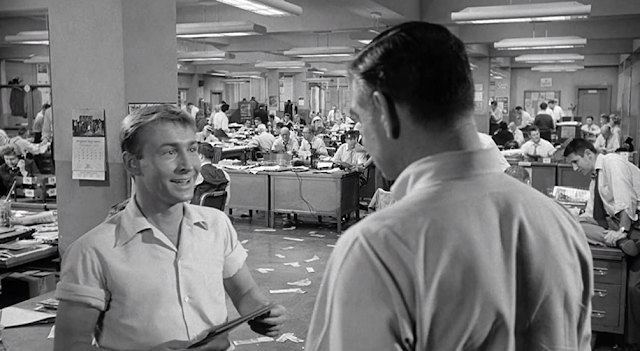
Nick Adams is energetic and sincere as the young hot shot, Barney Kovac. He looks up to old-school Gable—literally. When Nick stands next to Clark, Hollywood’s “King” looks like he could snap the boy in half! Also, Vivian Nathan who plays Nick’s mama, who wants him to go back to school, stands out for her strong, believable performance. Mamie Van Doren spoofs her sex bomb image to amusing effect. Note Marion Ross of Happy Days as Day’s secretary!

Spark plug Nick Adams is dwarfed by Clark Gable in "Teacher's Pet."

A smart gimmick was to cast real-life show biz reporters in cameos in this film, thus assuring good publicity for Teacher’s Pet: Army Archerd, Vernon Scott, Sidney Skolsky, and Joe Hyams, to name a few.

There are as many touching moments as there are funny ones in Teacher’s Pet. Enjoy Doris Day in one of her strongest vehicles, starring opposite of “The King” of Hollywood!

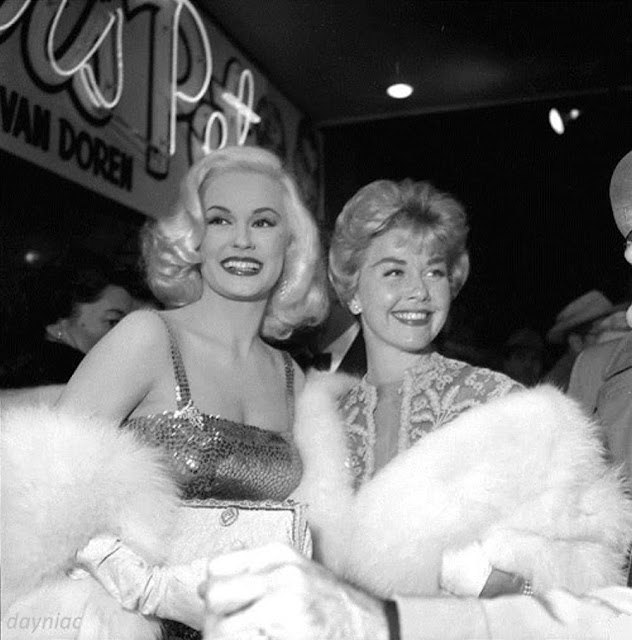
Hollywood blondes, bombshell & girl next door, promoting "Teacher's Pet."

Here’s my tribute to Doris Day and how I belatedly became a fan: https://ricksrealreel.blogspot.com/2017/04/a-latter-day-doris-day-fan-fesses-up.html

My look at Doris Day in the lovely, lively musical, The Pajama Game: https://ricksrealreel.blogspot.com/2017/10/the-pajama-game-1957.html

FYI: I put all the movie overflow on my public FB  movie page. 

Check it out & join!  https://www.facebook.com/groups/178488909366865/


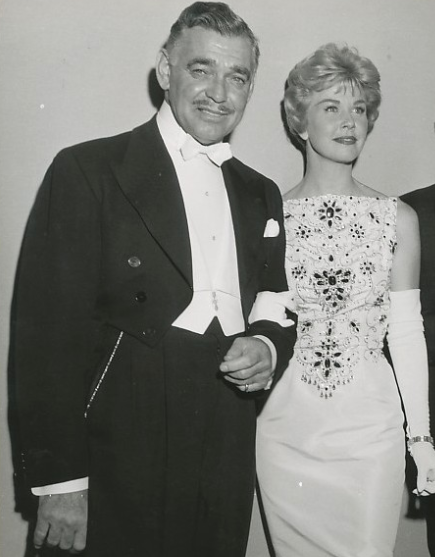
Clark Gable and Doris Day looking like the Hollywood royalty they are
at a premiere for "Teacher's Pet."


Sunday, January 2, 2022

Bette VS Miriam: “Old Acquaintance” 1943


Bette Davis & Miriam Hopkins toast each other at the end of "Old Acquaintance." 
AFTER their two hour acting bout!


I never saw 1943’s Old Acquaintance until I wrote this essay—gasp!—but have caught the famous shakedown scene between sparring stars Bette Davis and Miriam Hopkins. I tend to gravitate toward Davis in her “bad Bette” roles and this movie seemed soapy and sappy. The WB film was based on the Broadway hit by John Van Druten, famed for smart stage comedies, so I was pleasantly surprised. 

The famous moment from "Old Acquaintance." Bette shakes Miriam like a Polaroid camera!

Old Acquaintance takes place over a near two decades in the rocky course of Kit Marlowe and Millie Drake's friendship. Davis’ Kit is a smart, no-nonsense writer of critically acclaimed but commercially-challenged books. Hopkins’ Millie, an indulged young wife, is forever competitive with Kit. With her bestie’s help, Millie wants to be a published author, too. However, the silly but steel-willed Millie wants to write commercial crowd-pleasers, and eventually succeeds.

Miriam Hopkins & Bette Davis as life-long friends & rivals in "Old Acquaintance."

Over the years, Kit becomes close to Millie's husband Preston, and daughter Deirdre, which becomes a bone of contention. Millie manages to wreck her marriage all by herself, yet has no problem in trying to pin the blame on Kit. In the final act, Millie's husband plans to remarry, her daughter is a grown woman, and Kit has a younger beau. All comes to a head when Millie discovers Preston professed his love to Kit, and daughter Deirdre is in love with Kit's young man. 

The roles of Kit and Millie offer a field day for Bette Davis and Miriam Hopkins. The stars were re-teamed for Old Acquaintance after their 1938 hit, The Old Maid. Once again, Bette is the subdued, more sympathetic one, and Miriam is the glamorous gadfly. Interestingly, these two movies were the biggest hits from Miriam Hopkins' leading lady days. Hopkins has a ball as the high-strung trash novel writer. Miriam’s performance as a comic bitch is much more on-target than Candice Bergen's hit-and-miss performance in the remake, Rich and Famous. Miriam’s kinetic energy is funny, yet fearsome. Hopkins, a bigger star during the first half of the ‘30s, was also six years older than Davis, but now Bette was the bigger star. However, Hopkins more than held her own in Old Acquaintance!

Art imitating life? Miriam Hopkins & Bette Davis dig deep into their psyches to play frenemies! 

As for Bette Davis, I particularly enjoyed her relaxed performance as Kit in the character’s younger years. An idealized portrait of the Davis persona, Kit is wryly humorous, smart, straightforward, and sympathetic. Davis plays with restraint against Hopkins' dervish of a diva. This works for the movie and their performances.

Bette Davis as young Kit Marlowe in "Old Acquaintance." If that name sounds familiar, it's because that's what Columbia's Harry Cohn wanted to name Kim Novak!

While Bette has great moments as the 40-something Kit, Davis turns rather first lady-ish, as critic James Agee noted of her later WB performances. Bette snaps her lines as crisply as when Margo Channing chomps that celery stick in All About Eve. Also, why would sensible Kit slather on more makeup and sport a candy cane-style silver streak in her hair? Still, Bette has some stellar scenes, as when Kit and the young beau are at cross purposes regarding marriage. Davis’ finale with Hopkins, as they toast each other in friendship, is genuinely satisfying. Some critics carped as to why these two women were friends in the first place. Well, I've had some unlikely friendships that I've sometimes questioned, too!

Shellacking Bette Davis with makeup and a silver streak seems out of
character for the older Kit Marlowe. With Gig Young.

I found Old Acquaintance's story surprisingly adult for the era, with some great lines, and plot turns. The one major beef I have is with the last act. I realize older movies and plays had conventions that were less than realistic. But Old Acquaintance has one that’s just illogical: Kit puts off younger beau Rudd's marriage proposal. Rejected, he immediately is charmed by Deirdre, who he has just called a spoiled brat. They now instantly fall in love. Beau goes back to Kit, to tell her he will now marry Deirdre. And the young woman is hurt when she finds out Rudd had planned to marry Kit. If the former romance was a secret, I missed that plot point! If this had been presented gradually, it would be more believable. 

Though Kit acts as a surrogate mother toward Dolores Moran's Dierdre, she later is shocked that Gig Young's Rudd was romancing Bette's writer. John Loder at left.

John Loder as Preston Drake is solid if not exciting; Delores Moran is decent as daughter Diedre, but I can see why her career didn't go anywhere. Anne Revere has a delicious bit as a sharp reporter. I was shocked to find that Kit’s handsome young beau was Gig Young. Just five years younger than Davis, Young is impossibly youthful and gorgeous; a far cry from his later craggy good looks that were marred by alcoholism.

Gig Young was always distinguished, but I had no idea he was so handsome.

Vincent Sherman does another good job with a "woman's picture" as they were once called. He keeps the episodic story moving and stylish, to boot. Sherman keeps the ladies from chewing the scenery. I'm sure the WB director had his work cut out for him, as this was Bette and Miriam’s acting bout all the way.

Bette Davis & Miriam Hopkins feud was thus publicized on their first film, "The Old Maid!"

Old Acquaintance is far superior to the dreary remake, 1981’s Rich and Famous. Star and producer Jacqueline Bisset opted for the Davis role, with Candice Bergen cast as the crass pulp writer. While Bisset is a subtle actress and Candice has a flair for comedy, their remake felt even more old-fashioned than the original, despite the sex scenes. Bisset's writer isn't just serious, but morose through much of the movie. While Candice is often fun as the catty rival, Pauline Kael rightly pegged Bergen as giving a drag queen performance and that Bisset's character is more of a gay male fantasy. I thought this watching Rich and Famous because it reminded me of criticism about Sex and the City. Perhaps this is because gay men were at the helm of the respective productions?

All eyes back on Old Acquaintance: If you want to watch a stylish comedy-drama, with two great stars creating sparks, Old Acquaintance is a great match. 


FYI: I put all the movie overflow on my public FB  movie page. 

Check it out & join!  https://www.facebook.com/groups/178488909366865/


Bette as older Kit in "Old Acquaintance." Off-screen, Davis was working to form
the Stage Door Canteen, to benefit WWII troops.

Tuesday, May 12, 2020

Doris & Cary’s Class Carries ‘That Touch of Mink’ 1962

Grant & Day were at the peak of movie stardom when they teamed. Cary retired in 1966 & Doris' last film was in '68.


Doris Day and Cary Grant are the opposite of Doris and Rock’s easygoing chemistry in their only movie teaming, 1962’s That Touch of Mink. Doris is sunny and outgoing; Cary is wry and remote. They “meet cute” when Phillip’s limo splashes Cathy’s outfit when he passes by her on a NYC street corner. He sends gofer Roger (Gig Young) over to the automat across the street to make amends. Roger, who comically resents Shayne’s charmed life, ends up bringing Cathy back to the office to give him a piece of her mind. Her waitress pal/roommate Connie (Audrey Meadows), full of sisterly advice, warns Cathy off. Spoiler alert—hardly! Instead of giving Philip what for, Cathy instantly goes gaga for him.
Day's career girl gets more than a cheap lunch from roommate pal Connie (Audrey Meadow.)

Doris’ Cathy Timberlake is written as agog of Grant’s Philip Shayne. And Cary’s millionaire goes to great lengths to win Cathy over. Today’s viewers may wonder why. That’s because the script—which somehow got an Oscar nomination—says so.
Cary Grant, nearly 60, aged far better than nearly all the male stars of his era.

While That Touch of Mink goes down smoothly, with its skilled stars and lavish production, it’s also beyond predictable and dated. The first problem is the stars’ collective age. Cary a rich playboy looking for a plaything. Grant was soon 60 shades of gray and this makes Phillip a bit creepy. Doris was 40 and she is playing a “career girl” hesitant to sleep with a man out of wedlock. Doris’ pal Connie constantly refers to herself as old; Audrey Meadows is the same age as Day! And Gig Young, as Grant’s insecure underling, is 50, just decade younger than Grant, though they look the same age. All are well-photographed, but cinematographer Russell Metty reserves for Doris Day that soft focus that makes viewers realize there is also Doris Day photography, as well as parking!
Doris Day positively glows in 'That Touch of Mink!'

That Touch of Mink has superbly attractive stars, beautifully styled, great clothes for both Day and Grant, lavish sets, locales—everything except content. I will say this: Back when studio era stars worked hard and played hard, they often looked rode hard and put away wet by the 1960s. However, Doris Day and Cary Grant both took great care of themselves and looked like a gorgeous, mature couple here. Doris Day had a better bod than most sex bombs, notably on display in a form-fitting black spaghetti strap evening dress. And when Grant leaves the NYC Athletic Club in nothing but a towel, Cary shows he could still carry that stuff off. But realistically, they are playing 20-something and 40-something, respectively, and it adds to this movie’s artificiality.
Cary was still a hard-body heart throb four years before Grant retired from film.

This is a one joke movie: Will she or won’t she? Okay, maybe a three or four joke movie! There are several running gags that would not fly in today’s movies, which I don’t take offense, because that was humor back in the ‘60s. And it’s not mean-spirited, just silly. After a point though, it also feels tiresome.
Doris Day, in fine form at 40!

 Doris’ Cathy is constantly worried that ‘everyone knows’ she’s on vacation with an unmarried man. There’s the subplot with Gig’s character talking to his shrink. Dr. Gruber has mistaken Roger’s obsession with Cathy’s romantic problems with the millionaire as his own. This leads the shrink to think Roger’s on romantic weekends, contemplating marriage, and so on, with Phillip. At the end, spotting Young with Grant and Day’s baby carriage, the shrink finds Roger bubbling over about babies and wedded bliss. This must have seemed hee-larious back in ‘62. Or maybe not, since this shtick was already done in Pillow Talk. Then there’s John Astin as the unemployment clerk who tries to weasel a sex date with Day’s Cathy by withholding her check. What a knee-slapper! What makes Day’s dated sex farces tolerable is that Doris is strong and outspoken, plus nobody’s fool.
A bit of jolt to realize Gig Young was nearly a decade younger than Cary Grant!

Also, PC movie watchers will not enjoy the fur coats flung around this movie in the name of luxury. This is back when animal lover Doris still loved fur. It is strange that Grant lavishes a full wardrobe on Cathy for a trip to Bermuda. But as any Day fan knows, Doris movies at this point were glorified fashion shows, there’s even a real one in an early scene. Also not PC today, but Doris’ drunk scene is pretty funny, with such nasal, loosey-goosey answers to an agog Grant: “Sure beats hot milk with butter!”
Day's Cathy steels her courage by chugging a bottle of Scotch! 

There are some sadly ironic plot points in That Touch of Mink. Gig Young again plays a comic drunk, something he had seriously become in real life by this time. Young attempted many forms of therapy to alleviate his deep-seated problems, so it’s a wince to see him playing therapy for laughs, considering his life ended in a murder-suicide. Then there’s a slapstick scene where drunken Doris falls out a hotel window and lands on a canopy. In an eerie coincidence, Irene, Doris’ dear designer friend, holed up at the Knickerbocker Hotel on Nov. 15, 1962, got drunk, left suicide notes, jumped out the hotel window, also landing on the canopy, to her death.
I love the automat scenes in this movie! Connie feeds Cathy a personal chicken pot pie,
 baked potato, carrots, jello salad, and cake ...for lunch!

Mink is a movie that shows the early‘60s at its most fun: the clothes and styles, the automat, and even cans of color-changing hairspray. Or that new innovation, charge cards, and how someday, people are going to charge everything! The movie’s attention to luxury also includes plugs for Bergdorf-Goodman, Cardinal Clothes, Pan Am, Grey Hound, and those boutiques who supplied the furs, jewels, etc. And there’s even a guest appearance by Mickey Mantle and the New York Yankees.
Movies like That Touch of Mink have fans who just want to watch charismatic stars in beautiful fashions and locations, that’s fun and has a happy ending. That Touch of Mink is the cinematic equivalent of cotton candy. Enjoy!
A pretty, pastel publicity photo of the stars of 'That Touch of Mink.'
FYI: I put all the movie overflow on my public FB  movie page. 


Thursday, December 7, 2017

'Torch Song' 1953

'Torch Song' is when Joan Crawford crossed the line from mature to caricature.

FYI: I put all the movie overflow on my public FB  movie page. 
Before there was Cher or Madonna, Joan Crawford was the original Queen of Reinvention. By 1953, Crawford had survived “silents” turning into “talkies,” getting labeled box office poison in ‘37, leaving MGM in ’43 after nearly two decades, and now, ending her contract with WB in ‘52. And that was just her professional life! Crawford’s first film as a freelancer was Sudden Fear, which became a sleeper hit, and nabbed her third Oscar nomination.
Joan poses for a glamour shot.

Next up was Torch Song, the closest Joan Crawford ever got to make like Margo Channing in All About Eve. Joan played Jenny Stewart, the Broadway musical legend who walks all over anybody within range of her ankle strap heels.
Whether you believe Joan was born in 1903 or her official birth date in ‘08, at 45 or 50—or anywhere in between—she was still in great shape. A forerunner to the buff stars of today, Crawford was trim, taut, and her legs looked like they could crack coconuts.

MGM’s promotion heralded yet another “new Joan Crawford!” However, like many great film stars, Joan Crawford was a study of fascinating contradictions. Though famous for reinventing herself, Crawford had fallen into the star trap, stuck in past styles and personas, all in an effort to remain “ageless.” Shoulder pads, ankle strap shoes, magic marker eyebrows, and grand acting in overwrought vehicles got Crawford gradually labeled passĂ©. Joan occasionally toned down her style or tried something new, but Crawford’s comfort zone toward overstatement would eventually overrule. Like many studio system stars, few had genuine good taste, and Crawford came off best when she heeded her stylists’ or designers’ advice.

Joan agreed to candid shots by Sanford Roth on the set.
MGM’s publicity machine and the press got all mushy about Joan’s return “home.” Joan, at least publicly, did the same. However, MGM in 1953 was very different from the magnificent Metro studio Crawford had left a decade before. Studio head “Papa” Louis B. Mayer was gone. Few of Crawford’s contemporaries were still there, and many of the next generation stars, who came after Joan, were now slowly on their way out.
Joan’s return engagement, Torch Song, was in reality, a B+ picture. Musical dramas were all the rage in the first half of the ‘50s. With a Song in My Heart and three that were made at MGM: Interrupted Melody, Love Me or Leave Me, and I’ll Cry Tomorrow. They all had bigger budgets, better stories, and the best box office returns, whereas Torch Song was filmed in a mere 24 days. Bette Davis had recently played a theatrical star in All About Eve, for Crawford’s old MGM producer Joseph Mankiewicz, in just over three weeks, too. The difference? Bette was part of an ensemble in Eve, whereas Joan was the whole show in Torch Song.
When Joan Crawford was young and eager to learn, her best work was often in ensemble pieces with actors and directors she admired—Grand Hotel, Dancing Lady, The Shining Hour, The Women, and A Woman’s Face. After her Mildred Pierce comeback at Warner’s, Crawford went from Humoresque, Daisy Kenyon, and Possessed to movies that veered into vanity vehicles.
From Joan Crawford to 'Eternity': 'Autumn Leaves' in '56.


Sadly, Joan turned down a chance to star in From Here to Eternity during this time, in the part Deborah Kerr ultimately played. Rumor has it Joan rejected Eternity over wardrobe issues. Though Joan was at least a dozen years older than Kerr, she was fairly close to Burt Lancaster’s age. Crawford might have made a touching Karin Holmes, tough on the outside, vulnerable deep down—right up her acting alley. Though Fred Zinneman started at MGM, he was a modern filmmaker, and not the man to cajole Crawford into dropping her act, and get her to genuinely act. Still, Joan did get a chance to roll around the surf with a leading man a few years later, a young Cliff Robertson, in Autumn Leaves. What a pity that Joan’s tunnel vision caused her to reject a juicy role from the year’s biggest best-seller.
Joan gets gorgeous for 'Torch Song.' My advice for Crawford would have been ditch that carrot-colored wig, at right.
Though Joan put on her best game face for Torch Song, I don’t think that Crawford had cosmetic surgery on her face and bosom for this minor film, as rumored. I think Joan just pulled back the skin tapes, slapped that orange wig over them, put a pair of her fabled falsies in a bullet bra, and soldiered on. What resulted was typical of Joan Crawford’s latter day work: fans and friendly press marveled over her ageless glamour, great figure, and larger than life persona; non-fans and more discerning showbiz writers wondered how much longer Crawford’s cinematic self-belief could carry her.

A portrait of Joan...and Michael Wilding.
Torch Song’s story is as slim as the star’s sleek figure: Broadway legend Jenny Stewart is in the throes of mounting a new show; her way of working is to throw tantrums and insist everything be done her way. The diva wears everyone down as she changes choreography, dialogue, costumes, and co-workers… enter blind pianist Tye Graham, who refuses to kowtow to Crawford’s go-for-the-jugular Jenny.

Critics of Christina Crawford’s Mommie Dearest claim that Joan’s adopted daughter recycled aspects of Crawford’s latter day bitch roles for her tell-all tome. I think the exact opposite is true. Hollywood studios were notorious for blurring their stars’ personal lives and onscreen roles. Especially MGM divas like Joan, Judy, Lana, and Liz, who often played roles—usually in late career—that echoed their own lives.
Christina Crawford gives her mother a foot massage in this 'candid' shot, after one of Joan's dance numbers in 'Torch Song.'

Joan Crawford’s on-screen "star" is so tough and autocratic, and obviously based on the latter day JC herself. I find it fascinating Crawford agreed to come back to her home studio, after a decade away, for this unflattering portrait of Joan. For such a formula Joan Crawford picture, there's so much subtext going on that the surface story is superfluous. 

Joan Crawford with loyal fans. In 'Torch Song,' they are played by teens!
Torch Song is a prime example of the superstar as self-parody. Joan used her personal life to publicize her career, and specifically, to bolster this film: Crawford’s tough climb to the top, perfectionist ways, tantrum throwing temper, boyfriends as accessories, freeloading family, fawning fan love, and overall lonely way of life. There’s a telling scene toward the end of Torch Song: The pissed off pianist predicts that if Jenny doesn’t change her witchy ways, she’ll end up alone, a boozy self-parody of her former superstar self.

Chuck Walters, a reliable MGM studio hand, was chosen to guide Crawford through her turn as a Broadway singing and dancing diva. In Crawford’s memoir Portrait of Joan, she commented on the challenge of “all the singing and dancing” in Torch Song, after all those years. Joan started out as a Charleston queen, sang and danced a little in a few of her 1930s films, and was humored by Mayer in an attempt at a singing career—but the fact is Crawford hadn’t done either since the late ‘30s. While Crawford was graceful and had great energy in her youth, Joan wasn’t a professional dancer. And though the songs warbled by Joan during her Metro years were serviceable, after hearing her rejected vocals for Torch Song, I suspect she got a lot of help from the recording studio gurus. On one YouTube clip, with Crawford’s raw vocals dubbed back in, Joan begins pleasantly, but is unable to sustain singing more than a line or two. By the end of the series of takes, Crawford’s confidence is as wobbly as her vocals.
Crawford in Technicolor for the first time... not quite.

India Adams was brought in. The singer had already dubbed the track Two Faced Woman for Cyd Charisse in The Band Wagon, never used, and it was recycled in Torch Song. So, Adams dubbed the remainder of Crawford’s musical cuts. Unfortunately, though throaty Adams’ voice was as dramatic as Crawford’s studied “MGM English,” their voices don’t even sound remotely alike. The disembodied vocals boom out of Joan’s mouth to comic effect, much like silent star Lina Lamont in Singin’ in the Rain.

Marjorie Rambeau manages to steal the three scenes she's in 'Torch Song!'
Torch Song gave Joan a great supporting cast: Michael Wilding as Tye Graham, the blind pianist and Joan’s sparring partner; Harry Morgan as the seen-it-all producer; Marjorie Rambeau as Joan’s working-class mother; Gig Young as her boozy boy toy; and Maidie Norman as Crawford’s gal Friday (who later played Joan’s housekeeper Elvira in Baby Jane). Aside from Wilding’s philosophizing pianist, the rest of the characters just disappear, after a scene or two with Joan. Wilding, though his faraway gaze and lofty sentiments reminded me of mystical Tyrone Power in The Razor’s Edge, he’s soothing in contrast to Crawford’s relentless carping. However, Marjorie Rambeau is the real scene stealer here. With only three scenes, Rambeau somehow snagged a best supporting actress Oscar nomination. Majorie has some great moments as Joan’s lower class mama, as when she laments the lack of hops in beer and salt on pretzels! Nancy Gates, as Joan’s “kid sister,” is right up there with Mimi Rogers as Barbra Streisand’s baby sis in The Mirror Has Had Two Face Lifts. Gates was 27 at the time, as the younger sibling in need of cash from her big sister, for piano lessons—with Joan at least 45 here.

Joan is a 'Torch-Faced Woman' in this infamous number.
Surprisingly, there’s only one full musical number in Torch Song, and it’s become infamous. “Two-Faced Woman” showcases Joan as she swans around a sea of singers and dancers, not doing much real dancing, and lip-synching to Adams’ near-operatic vocals. Decked out in a mink stole and aqua blue spangles and fluff, Joan tops the tacky look off with a black face and wig. In That’s Entertainment 3, Debbie Reynolds’ narration discreetly describes Crawford’s makeup as “tropical.” In Joan’s memoirs, Crawford called the makeup “high yellow.” Movie fans have called it high camp. 

Lena Horne in her 'Light Egyptian' makeup as a MGM star.
Some film folk claim it’s the same makeup created for fellow Metro star Lena Horne. Horne never appeared in such a dark hue on film, whereas Joan looked like she fell asleep while eating a bag of Hershey bars. If the number was deleted, as some say it should be, there would be NO song and dance numbers in this musical, save for Joan’s sashaying in the film’s opening, and one song sung by Joan while leaning against a wall. Just as insulting as the blackface are the many digs Joan’s Jenny takes toward the pianist’s blindness, as if it’s a character defect. The low point comes when Jenny glares at his dog and snarks that Tye needs a nice seeing-eye girl.

When Tye Stewart heatedly argues over Jenny’s single-minded drive for stardom, he refers to her youthful self as a Gypsy Madonna. Later, that phrase comes up in a heart to heart with Mom, and she digs up Joan/Jenny’s first scrapbook of clips. Lo and behold, before Tye went off to war and lost his eyesight in battle, he saw Jenny when she was first making it big in showbiz, and wrote a love letter of a review. Yes, that’s World War Two we’re talking about! Time is subjective in a Joan Crawford movie.
Well, not until Bette Davis treated Joan like a soccer ball in 'Whatever Happened to Baby Jane?'

Crawford’s Jenny Stewart is an unrelenting shrew to just about everyone in her orbit. Yet in the final scene, when the pianist finally naps, Crawford condescendingly asks if this is finally a crack in his façade. The implication is that her prior behavior was just an act, to break through his aloofness. This makes zero sense, since it’s been established that Jenny Stewart is a bitch on wheels from the film’s first frame. Hey, this is Joan’s revisionist world, and we’re just watching. This and all the other twisted inconsistencies add up to make Torch Song the biggest camp fest this side of a Boy Scouts Jamboree.
It's lonely at the top...especially when you wear canary yellow adult "One-sies" while lounging in the bedroom!

Crawford certainly enjoyed playing this type of role, which she repeated in Queen Bee and The Best of Everything. Nearly 15 years later, when Valley of the Dolls, another show biz soap opera, was casting, Joan reportedly expressed interest in playing another battleaxe, Helen Lawson. I’m sure Joan would have been great and not the least bit deterred that the young dolls were all 20-something, because Joan would have insisted on establishing that Helen was only 47, like Straitjacket!
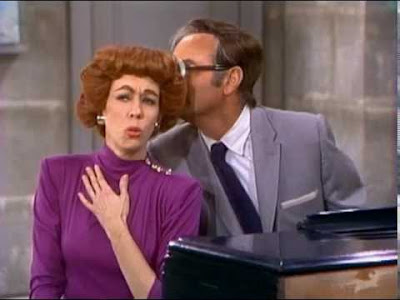
Carol Burnett and Harvey Korman in her spoof,  'Torchy Song.' 
Carol Burnett parodied this Crawford vehicle, hers dubbed Torchy Song. Joan previously had called Carol and praised her other take-off on Crawford, re-titled Mildred Fierce. This time, Joan was hurt by what she considered a mean-spirited spin on Torch Song. Today’s satire of pop culture is pretty merciless compared to the ‘70s, but even in its time, The Carol Burnett Show and its send ups were good natured. Burnett, a one-time usherette, was a huge movie fan, and often invited old time Hollywood stars on her show, like Lana Turner, Rita Hayworth, and even Gloria Swanson, who Carol often spoofed in the silent star’s Sunset Boulevard role. I’m surprised that Crawford never guest-starred on Carol’s show, as she appeared on many variety shows, including The Tim Conway Show. As for Joan’s hurt feelings, I think it was a case of Crawford’s moods being like a weather vane, much like that notorious two-faced woman!
Here's my take on the anti-Mildred Pierce, the notorious Mommie Dearest starring Faye Dunaway: https://ricksrealreel.blogspot.com/2021/09/the-making-aftermath-mommie-dearest-1981.html

Torch Song is a train wreck of a film, but it is great fun for Joan Crawford fans, to watch the determined diva give her considerable all. Mainstream movie fans may want to stick with Mildred Pierce!
"Superstar!"