Showing posts with label Dean Martin. Show all posts

Monday, December 30, 2024

Rat Pack Mythology Overshadows ‘Ocean’s 11’ 1960


Dean Martin, Frank Sinatra, Peter Lawford, & Sammy Davis, Jr. are the key players
 in 1960's heist film, "Ocean's 11."


There's much heavyweight Hollywood talent involved in the lightweight 1960 version of Ocean’s 11.

Right at the start—and closing—legendary Saul Bass designed the Vegas-bright opening titles for Ocean’s 11. Lewis Milestone (All Quiet on the Western Front) directed but really played traffic cop for the Rat Pack. Ocean’s 11 was a cakewalk compared to directing Marlon Brando in the notorious 1962 remake of Mutiny on the Bounty, Milestone's last feature film. William H. Daniels, who photographed nearly all of Garbo’s films, and 10 of Frank Sinatra’s from the late ‘50s through the ‘60s, contributed the stylish cinematography; Sinatra fave Nelson Riddle composed the lively score. 

Saul Bass created the neon bright titles for 1960's "Ocean's 11."

Then there were “The Three Crooners.” Frank Sinatra, Dean Martin, and Sammy Davis, Jr. were all iconic singers who could act and had a flair for comedy. And Peter Lawford provides the class as their wartime pal. This all helps the high-concept plot immensely. The pitch: WWII soldier pals reunite to knock over five Las Vegas hotels on New Year’s Eve and win big.

These five hotel/casinos are the New Year's Eve targets of the "Ocean's 11," from 1960.

An admirable plus about this movie is that it shows mega star Sinatra's generosity toward other performers. Dean and Sammy get musical numbers, plus a reprise, yet Sinatra doesn't sing a note. Most stars would demand equal time.

Ocean's 11 is unique because it represents a moment in time, much like the previous year's Pillow Talk. Both films were huge hits and a zeitgeist. Pillow Talk caught the wave of sex comedies with its iconic stars and is remembered as the prime example of the genre. And Ocean's 11 snapped the Rat Pack/Las Vegas era at its absolute peak. And yet, by the early '60s, both sex comedies and Rat Pack antics were already becoming passé. Each year of the '60s was like dog years in United States’ society. In the case of the Rat Pack, Marilyn's death, Frank falling out with the Kennedys and dumping Lawford, JFK’s assassination, the Beatles invasion, etc. all made these 40-something guys look increasingly irrelevant. Yes, Rat Pack fans will die on that sword that they were eternally cool cats. But seeing middle-aged men booze, chain smoke, chase broads, and making like frat boys got old really fast. Burt Reynolds did the same thing in the '70s with his hillbilly version of the Rat Pack, with all those car chase comedies and corny cop movies.

Frank Sinatra, far left in his favorite color orange, is Danny Ocean. The other 10 guys 
make up the "Ocean's 11," in this 1960 heist caper.

The surprise of Ocean's 11 is that while it is smoothly made, it's not very snappy, clocking in at a leisurely 2 hour and 8 minute movie. The “humorous” dialogue, supposedly improved by these real life pals, wasn't very funny or witty, even for its time. The lightly sexist, racist dialogue didn't bother me that much, as I know this came from 40-something men in 1960, more of an eye roll.

Laid back Dean Martin, with pal Frank Sinatra, who gives the look of when
he's been crossed, in 1960's "Ocean's 11."

Another drag is that it takes an hour just to introduce all the characters. They are not all that interesting, as written. While the stars are all charismatic, it feels like they are on autopilot. It's been said that the three crooners, plus Bishop and Lawford, performed in Vegas at night and made this movie during the day. If so, it shows. And you can practically smell the second hand smoke just from watching Ocean’s 11. The last half of the movie is setting up the heist and its outcome.

The main stars of 1960's "Ocean's 11" played on stage at night and before the cameras
 during the day, which may explain the laid back performances.

Frank is understated here. Dean offers his deadpan humor. Sammy is energetic and gets a great music number that echoes through Ocean’s 11. Peter as the charming waster has always left me cold, but he does well enough here. 

All the world's a stage for Sammy Davis, Jr. as a singer/trash collector,
in 1960's comedic heist, "Ocean's 11."

Interesting that Sinatra fave Richard Conte ended up in The Godfather. Hope Frank didn’t hold that against him! And that Henry Silva always creeped me out after first seeing him in 1962’s The Manchurian Candidate.

One dud is Joey Bishop, who I always thought was the cliché of the unfunny Vegas comedian, and here he’s just as flat a film performer. A shame the film starts with Joey carrying the ball. His deadpan, hangdog demeanor reminds me of Norman Fell, who’s also in the film!

Joey Bishop, far left, uses his deadpan expression to convey the rest of his gang's
 feelings at the funeral finale of 1960's "Ocean's 11."

The real surprise is that Angie Dickinson is barely in Ocean’s 11. The then-rising starlet appears in the opening as Frank's ex-wife. She has a long scene with Dean Martin, who wants them to reconcile. Angie has a second scene with Sinatra, sporting a nifty chemistry; what a shame they didn't equally co-star in a film. That's it—except for a brief scene on the phone with Sinatra's most recent dame, which could have easily been cut in this overlong movie. The women in this movie are made up and coiffed like mannequins, a Vegas version of The Stepford Wives. 

Frank Sinatra as Danny Ocean & Angie Dickinson as Bea, his ex-wife,
in 1960's "Ocean's 11."

There's a great cast of supporting actors who give Ocean’s 11 some oomph, though they’re typecast: Cesar Romero, Richard Conte, George Raft, Ilka Chase, Patrice Wymore, etc. There are a couple of unfunny, unbilled cameos that last nearly as long as Angie Dickinson’s scenes: Red Skelton as himself, futilely trying to get his credit extended. Shirley MacLaine appears as a drunk. Both scenes meander, add nothing to this lengthy film, and could easily have been cut.

Ocean's 11 is the forerunner to the heist movie set at Christmas, like Die Hard. And the film's climax is at New Year's, when they pull off the heist. Of course human frailty and error fouls the perfect crime, with a twist ending.

That final scene, with Danny Ocean's crew walking away, is the Rat Pack so effortlessly cool. The finale is more than a bit bittersweet, when you think of the legends in their ensuing years, walking away here at their zenith. The ending’s morale is literally that you can't take it with you. And Rat Pack leads Sinatra, Martin, Davis, and Lawford all lost a lot in their last years. In 1960’s Ocean’s 11, the stars are captured at their peak, for posterity.

The bittersweet finale of 1960's "Ocean's 11."

Here’s a very entertaining melodrama featuring several of the Rat Pack, 1958’s Some Came Running. My look here:

https://ricksrealreel.blogspot.com/2019/04/stellar-cast-helps-some-came-running-go.html

Frank Sinatra & Peter Lawford were the best of friends when they made
1960's "Ocean's 11." 


Monday, January 30, 2023

Stars, Style, & No Substance! ‘What a Way to Go!’ 1964


Shirley MacLaine stars as Louisa May Foster, who marries and loses most of her
 five husbands in 1964's comedy, "What a Way to Go!"


One of the many '60s all-star spectaculars that was heavy on stars and style, but light on solid story or scintillating dialogue, was 1964’s What A Way to Go! Movies like this are often fun for star gazing and glamour. Yet such films are often dull and don't age well, and here’s just a few: Let's Make Love, The V.I.P.s, The Yellow Rolls-Royce, and What's New, Pussycat?

Shirley MacLaine's widow tells shrink Robert Cummings about EVERY husband
in "What a Way to Go!"

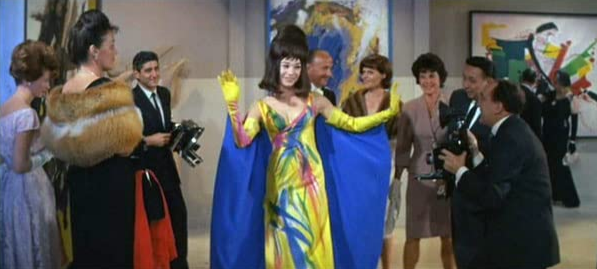
This 20th Century Fox fluff is a comedic story of a woman who’s looking for true love but is always left widowed—and richer. Money doesn't buy happiness, but it brings 70-plus Edith Head costumes, Sydney Guilaroff wigs, Harry Winston jewels, and fabulous sets in What a Way to Go! The featherweight romp also features some diverse husbands: Dick Van Dyke, Paul Newman, Robert Mitchum, Gene Kelly, & Dean Martin. 

The super-size comedy was originally meant for superstar Marilyn Monroe, when Fox decided to take Marilyn back after Something's Got to Give. Marilyn certainly could have elevated this mild vehicle with her natural comedic charms. But it was not meant to be, as Marilyn died soon after. Continuing in the same daft logic, Fox then offered the role to their other diva headache, Cleopatra aka Elizabeth Taylor. The part of a woman who marries five times and becomes richer, with bigger wardrobe and bigger hair with each marriage... what a stretch! But ET’s world now revolved around Richard Burton.

Can't imagine why Fox offered this movie to Elizabeth Taylor! Actually,
Robert Cummings plays the shrink in "What a Way to Go!," not a husband...

The sensible choice of Shirley MacLaine as Louisa May Foster was finally made. Was MacLaine as a brunette here a hangover from the prior choice of Liz? Regardless, while Shirley presents a model slim figure that was more in keeping with the '60s than either curvy MM or ET, MacLaine seems at times dwarfed by the outlandish costumes, towering wigs and Christmas tree jewel sparklers.

Naturalistic Shirley MacLaine & '60s glamour didn't seem to go together.
Note the pancake makeup on her face, then her freckled arm in "What a Way to Go!"
With Robert Mitchum as her tycoon husband.

While MacLaine is a natural comedic actress, a strong director like Billy Wilder was needed to keep her from going from Shirley to shrilly. There's more than a few screaming Mimi moments in this broad comedy, but MacLaine also gets some laughs. It's fascinating to see her play the child Louisa with a wink, without the '60s pancake foundation, false eyelashes, stenciled brows, and overdrawn lipstick—though I do detect mascara. 

Shirley MacLaine as little Louisa in an amusing moment from "What a Way to Go!" 

Most of Shirley MacLaine’s co-stars were old pals or lovers, so Shirley has a nice rapport with each "husband" in What a Way to Go! In a nutshell, in order:

Dick Van Dyke is a very energetic match for Shirley. As Edgar Hopper, Dick is a small-town guy whose hero is Thoreau. But when his love rival mocks his and wife Louisa’s low-budget lifestyle, Hopper hops to, and becomes a big success as a businessman. And promptly keels over from overwork!

Dick Van Dyke as Shirley MacLaine's first husband in "What a Way to Go!"

Paul Newman is next up, as the artist in Paris, where Louisa goes to grieve. Paul gives one of his more relaxed comedic performances, unlike the leering Rally Round the Flag Boys and A New Kind of Love. Amusingly, his character’s name is Larry Flint, but not that Larry Flynt. Paul looks great with a beard, as the starving artist who's always eating! Slim and slight Paul and Shirley are dwarfed by the lavish contraptions and sets in their marital sequence. As Larry’s painting machines finally create successful works, Flint is consumed by the cash rolling in. As he and the machines become more frenzied, they turn on their creator.

Shirley MacLaine's Louisa seems to adapt to each husband's life.
Here, she is Paul Newman's artist wife in "What a Way to Go!"

Next, widowed again Louisa meets Robert Mitchum as a Howard Hughes-type tycoon, Rod Anderson, Jr., at the airport (remember Hughes once owned an airline). MacLaine’s unlucky in love lady figures this latest love is already rich, so what can happen? Ironically, their attempt at living simple down on his farm turns out to be a kick in the head for Rod. Mitchum is laid-back and droll, as always.

I never miss a Nina Foch movie! Kidding! Shirley MacLaine goes platinum for a
hot minute in "What a Way to Go!" With hubby #3 Robert Mitchum.

Shirley’s perennial widow meets Pinky Benson at a local diner. Gene Kelly parodies his Singin’ in the Rain persona here as the small town entertainer, who finally makes it big. Though criticized by some folks as too old, Kelly looks fine for 50, is quite funny, and dances beautifully, of course. Pinky’s fate is getting fatally mobbed by his fans!

Shirley MacLaine's Louisa envisions her marriage to Pinky Benson as a Hollywood musical number. Gene Kelly, aptly cast as hubby #4 in "What a Way to Go!"

At this point, once again widowed Louisa is telling her woes to her shrink, when an old beau walks in. Once her small town’s richest guy, the man is now the building’s janitor! Dean Martin plays comedic jerk Leonard Crawley quite well, and his nonchalant demeanor is perfect here. As the one husband that Louise doesn’t initially love, the creep turns out to be the keeper.

Dean Martin bookends "What a Way to Go!" as first a foiled suitor, then as
Shirley MacLaine's final husband.

Finally, there is Bob Cummings, his usual unctuous self as the smarmy shrink who nearly becomes a husband to Louisa, as well.

One surprise was Margaret Dumont, of the Marx Brothers movie fame, who is bizarre and unfunny as Shirley's mother. Plus, Dumont’s dressed like she’s from a guest shot on The Beverly Hillbillies!

The Edith Head costumes and the sets are meant to be over the top but sometimes veer into awesome ugliness. Head cleverly uses the clothes to further Louisa's story, but I was surprised how many costumes were visions of monochromatic vivid colors. I was getting visions of Liz Taylor's Vincente Minnelli-supervised wardrobe in The Sandpiper. And the Pepto Bismol pink mansion of Gene Kelly’s Pinky is truly stomach churning.

Husband Pinky Benson decrees that his mansion be painted in his honor, in
"What a Way to Go!" Wafer slim Shirley MacLaine sports a contrasting black bikini.

Broadway’s Adolph Green and Betty Comden, the couple that wrote this story, also gave us Singin' in the Rain and Auntie Mame. Sadly, their script and wit seems very broad and sporadic in their last feature film together.

There are few zingy lines and most of the movie parodies of each marriage are mildly amusing, except the Ross Hunter-esque "Lush Budgett" sequence, which is so one-note that it quickly becomes tedious. The musical number with Gene Kelly is a great take off on MGM numbers, and still fun in its own right. Shirley and Dick Van Dyke’s expressive faces and graceful forms make their silent movie spoof fun. And Paul Newman and Shirley are certainly sexy enough in their French “art” film parody, though it’s pretty tame.

Shirley MacLaine & Dick Van Dyke are charming in the silent movie fantasy scene that symbolizes their marriage in "What a Way to Go!"

The director J. Lee Thompson was an odd choice for comedy as he previously helmed The Guns of Navarone and Cape Fear. He next directed Shirley in the 1965 bomb John Goldfarb, Please Come Home! Written by William Peter Blatty, who rewarded his friendship with Shirley by modeling her for his heroine in The Exorcist, thus creating the urban myth that MacLaine's daughter needed an exorcism!

Shirley MacLaine's Louisa in wearable art, courtesy of artist husband Paul Newman
 in "What a Way to Go!"

While I hardly laughed out loud during the entire movie, What a Way to Go! is generally amusing. But it all feels like a pile of frosting—on a cupcake! Shirley MacLaine didn’t carry another hit movie until The Turning Point over a dozen years later. Even then, Anne Bancroft was pulling equal weight. Frankly, Shirley never carried a movie on her own during MacLaine’s leading lady heyday.

There are worse ways to go than watching What a Way to Go! Watch the stars and lavish production, with your brain turned off.

Actress Gari Hardy with Paul Newman, in a deleted scene from "What a Way to Go!" Is it my imagination or is she supposed to resemble Marilyn Monroe? If so, that seems in bad taste as this film was intended for Monroe, before she died two years earlier.


Tuesday, August 3, 2021

MM’s Unfinished Finale: ‘Something’s Got to Give’ 1962

Marilyn Monroe in "Something's Got to Give."
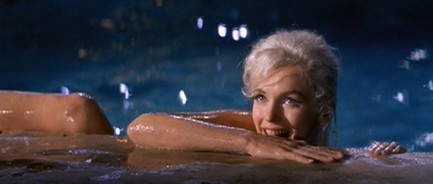
What should have been a quick dip turned into a debacle.


Marilyn Monroe, from her last, unfinished film, 1962's "Something's Got to Give."


This essay isn’t just about the making of Marilyn Monroe’s Something’s Got to Give or the partially finished results. What I find most fascinating is how this no-brainer, assembly line remake became so fraught with off-camera drama. Much has been said about the making of the ‘62 sex comedy, with wildly differing views, all of which would be worthy of a film in itself.

The title of Marilyn Monroe’s final, unfinished film, Something’s Got to Give, has long been a go-to reference point for the last year of her life. Less commented upon is that Marilyn plays a woman who everyone thought was dead!

Wardrobe tests showed Marilyn Monroe in fine form for "Something's Got to Give."


Something’s Got to Give was a 1962 remake of the classic comedy, 1940’s My Favorite Wife, which starred Irene Dunne, Cary Grant, Randolph Scott, and Gail Patrick. The new version cast Monroe in the Dunne role, with Dean Martin, Thomas Tryon, and Cyd Charisse replacing the above cast, respectively. Monroe’s missing wife is presumed dead after she’s swept away in a yachting accident. MM turns up five years later, just as her husband Martin remarries, to neurotic Charisse. Tryon plays the hunk that was stranded on a desert island with her.

Marilyn Monroe with friend/co-star Dean Martin in "Something's Got to Give."

While not the dramatic type of role that Marilyn craved, this George Cukor-directed froth was film fodder that was very much in style, thanks to the Doris Day/Rock Hudson sex comedy, Pillow Talk. Monroe owed Fox two films on her old contract, so Marilyn was assigned yet another sex comedy. And since Cukor also owed the studio a film, he accepted the directorial task. So what if Marilyn and George had already teamed up for 1960’s limp Let’s Make Love. Something’s Got to Give, indeed: A rehash of a classic, with talent that didn’t click, who took part only to fulfill old studio obligations—what could go wrong?

Ava Gardner once said, that in Hollywood, the only reason they kiss so much, is that
 otherwise, they'd be at your throat! George Cukor did both with Marilyn Monroe.

George Cukor was one of Hollywood’s most literate, intelligent directors, with a reputation for helping actors deliver award-worthy performances, especially female stars. But that old Hollywood line, you’re only as good as your last picture, aptly applied to aging talent like Cukor. Aside from winning a career Oscar for the piece of cake assignment, 1964’s My Fair Lady, Cukor had been on the decline for years, like many golden era directors. Still, George had much less at stake than Marilyn. I wonder why he didn’t take a pass on working with Monroe again, after enduring a low-energy Marilyn and her foolish affair with co-star Yves Montand, on the aptly titled Let’s Make Love. Still, George accepted, perhaps ready to clear the slate for better movie offers.

Making "Something's Got to Give" should have been a breeze for Marilyn Monroe.

As for Marilyn, her ambivalence over Something’s Got to Give seems symbolic of her attitude toward her own stardom. First, while not challenging, the film would have brought Marilyn closer to finishing with 20th Century Fox. And SGTG was a way to prove to Fox and Hollywood that she could still work. Also, Marilyn Monroe, an icon of ‘50s sexuality, had recently slimmed down and gotten a makeover with her white blonde bouffant, looking the height of early ‘60s sexiness. Yet, Marilyn felt deflated that she was still appearing in the same type of sex comedies that made her famous a decade earlier. While Monroe blamed Fox for exploiting her as the sexy, dumb blonde, Marilyn also did the same, with her choices to film a skinny dip, pose nude again, and perform for the President of the United States wearing little save for sequins and see-through “soufflé” material. Marilyn yearned to move forward, yet when in doubt, she fell back on her sex symbol image, and 36 years was close to the sell-by-date for cinema cheesecake.

Marilyn Monroe looked '60s chic and sexy in "Something's Got to Give."

After cast-approving friends Dean Martin and Wally Cox, Marilyn was comfortable with the Nunnally Johnson script—he had scripted earlier comedy successes. Marilyn looked great in her elegant Jean Louis outfits. Plus, Monroe would play a wife and mother, a rarity for the sex symbol. And MM would speak in her normal voice and not the breathy bombshell shtick that Jayne Mansfield turned into a stale joke. There were some upsides to Something’s Got to Give.

Then the showbiz machinations began. And the chaos of Something’s Got to Give still gets big play today. After MM’s firing and shortly after her death, all the blame was laid at Marilyn’s pedestal. But like many other showbiz scandals and tragedies, the blame has shifted over the years, to the studios and their “suits.” Especially when Something’s Got to Give footage was discovered and restored, and showed Marilyn looking radiant and trying her best.

Co-star Dean Martin was a good friend, too. When Fox fired Marilyn Monroe,
Dean refused to continue film "Something's Got to Give" with anybody but Marilyn.

The thing is that both sides are right. Marilyn fans point to MM’s fine figure and game face while trying to put over familiar film material. And those who counter that Marilyn held up shooting over illness, while jetting across the country to JFK’s birthday bash, also have valid points. Marilyn looked great, performed well, with an impatient George Cukor—but also showed up for only 13 out of 30 shooting days. This caused Marilyn to rightly lose much good will to those who stood around and played the waiting game. In context, when the film was later revamped as Move Over, Darling, with Doris Day and James Garner, the total schedule was two months—standard for a non-epic film. After six weeks, Something’s Got to Give had only shot a handful of scenes. The unfinished compilation was just shy of 40 minutes, of which Marilyn appeared in about half of said scenes!

Waiting for Marilyn? Cyd Charisse & Dean Martin in "Something's Got to Give."

Director Cukor didn’t bother to oversee insecure Monroe’s wardrobe, hair, and makeup tests. The next day, when the new producer was to meet with MM over the results, she was the no-show. He went to her house, only to find her overdosed!

No wonder that the actual shooting seemed like a war of egos, with a bitterly complaining Cukor and a passive/aggressive no-show star. On the SGTG set, it was a contradictory but not unusual set of studio attitudes: the bottom line tunnel vision of time and money spent versus coddling the talent. On the one hand, studios long accepted granting the stars their favorite cameramen, designers, hair and makeup people, etc. But Marilyn went one further. MM’s final acting coach was Paula Strasberg, wife of Lee Strasberg of the Actors Studio. Monroe paid Paula $5,000 per week, to offer Marilyn her acting expertise for a silly comedy like Something’s Got to Give. If Strasberg had worked the entire eight weeks, Paula would have made nearly half of Marilyn’s salary! Then Monroe’s latest analyst got into the act. Ralph Greenson recommended that producer David Brown be fired and replaced with Greenson’s friend, newbie producer Henry Weinstein.

This was director George Cukor's home. He had the exterior recreated for
 "Something's Got to Give." Why? That's show biz, baby!

Director Cukor had his demands, too. Instead of the Fox crew likely building or redressing an old set for such a modest film, Cukor had the crew create a lavish exterior set that was the exact replica of his own home. WHY? Perhaps for the same reason Cukor had Fox’s resident comedy writer Nunnally Johnson’s script tossed out. George insisted that Walter Bernstein re-write Johnson’s script, upsetting Marilyn. Bernstein had prior worked on two Sophia Loren film duds, Heller in Pink Tights (with Cukor) and A Breath of a Scandal. Fox should have titled this troubled comedy All About Ego.

When Monroe started missing work, nearly everyone started to turn against Marilyn, except Dean Martin. The cardinal rule in the movie biz is you don’t hold up the shooting schedule. About the time the filming was abandoned, Cukor banned celebrating Marilyn’s 36th birthday until 6 p.m., after the work day was done—pennywise and pound foolish. Cukor didn’t help matters by anonymously dishing to gossip ghoul Hedda Hopper about Monroe’s behavior.

It must be 6 o'clock somewhere! Fox & director Cukor decreed that Marilyn Monroe's
 birthday could not be celebrated on-set until 6 p.m., to get a full day's work from her.
 Sadly, Marilyn's 36th birthday would be her last.

As for Fox, they blamed Marilyn Monroe and Elizabeth Taylor for the chaos during the making of Something’s Got to Give and Cleopatra respectively. Yet, Fox was equally guilty—out of corporate greed. Both films went into production with dated, problematic scripts. And both projects started shooting with stars that were physically ill and emotionally precarious. Though Monroe hadn’t made a film in 18 months, her personal life had worn her down, and was going from slim to thin as shooting progressed. And Marilyn was physically ill with sinusitis right from the start. Fox was warned off of Monroe by the producer but they turned a deaf ear. As for Taylor, Elizabeth was seriously ill with a number of ailments before shooting commenced on the Egyptian epic during a cold, rainy, autumn in London. All that trouble for a tax break to film in England. The mantra was the same for both Fox productions: get the stars in front of the camera, no matter what.

While Marilyn Monroe would have been the first American film star to do a nude scene, her skinny dip in "Something's Got to Give" didn't send everyone into shock,
as has sometimes been reported. MM with Dean Martin & George Cukor.

Much was made of “fading” Marilyn working at her home studio for $100,000 while Fox made Elizabeth Taylor the first star to earn $1 million dollars per film, with all the contractual trimmings. The media picture painted Marilyn as Cinderella, scrubbing floors, while Elizabeth was the belle of the ball. However, before Taylor could accept the Cleopatra offer, Elizabeth had one more film to make on her old MGM contract, a similarly paltry $125,000, to make the boring soap, BUtterfield 8. The big difference between the two, as always in Hollywood, was profits. Both Marilyn and Elizabeth had major career breakthroughs in 1956, Bus Stop and Giant, respectively. Both stars made five films by ’62. The difference was Elizabeth’s films were all smash hits, two of which were epics. Marilyn had a hit with Bus Stop and a smash hit with Some Like it Hot, but The Prince and the Showgirl, Let’s Make Love, and The Misfits, were considered “disappointments.” Also, while Taylor could be spoiled and difficult toward MGM brass, she was “One-Take Liz” on the set. Also noteworthy is that Elizabeth was a trouper during this time under trying circumstances: new friend James Dean died in his car crash near the end of Giant’s shooting; best friend Monty Clift nearly died a car accident in the midst of making Raintree County; Elizabeth’s beloved Mike Todd died in a plane crash near the start of Cat on a Hot Tin Roof; Taylor was unhappily married to Eddie Fisher and trying to keep the suits from firing Monty Clift on Suddenly, Last Summer; and Elizabeth was forced to make BUtterfield 8 or stay off screen for two years. And finally, Taylor herself nearly died while making Cleopatra, topped by her scandalous affair with Richard Burton. Yet, ET got the job done, no matter what was going on. And these films all made a pile of money—the true bottom line in Hollywood. Marilyn by contrast, got by with minor skirmishes over co-stars in Bus Stop, but clashed with Olivier on The Prince and the Showgirl, along with director Billy Wilder and Tony Curtis on Some Like It Hot, was a total mess on the set of The Misfits, and got mixed up with married Yves Montand on Let’s Make Love. These last two films got horrible publicity and while MM had her moments in each, her lethargy showed in both her film performance and figure.

Marilyn Monroe's skinny-dipping scene was more like a slow strip tease
in "Something's Got to Give." MM started with flesh-colored garments,
but gradually peeled them off.

Interestingly, when Monroe was fired from Something’s Got to Give, she gave a flurry of interviews and photo shoots, as a rebuttal to the bad studio publicity. Marilyn’s mantra was that it was okay if fame as a sex symbol was passing her by, that she was ready for something new. Yet, at the same time, her photo shoots were often scantily clad, along with the barrage of nude skinny dipping photos. Once again, Marilyn was sending out mixed signals.

Marilyn Monroe in her only scene with both co-stars at the same time,
Cyd Charisse and Dean Martin in "Something's Got to Give."


I have wondered what would have become of Marilyn Monroe had she lived, and embraced maturity. This is unlikely, as the general consensus now is that Marilyn was an untreated bi-polar personality. Yet, could she have become an enduring star no matter what, like Elizabeth Taylor? Could she have become a star character actress like Shirley MacLaine or Lauren Bacall? Or could she have found happiness and solitude by leaving Hollywood, like Kim Novak? I think she could have opted for any of these possibilities, but given her instability, would she have? Instead Monroe became part of the trio of legendary slow suicides who died in the ‘60s: Marilyn, Monty, and Judy …sad, sad, sad.

Love this shot of Marilyn Monroe, with the family dog in "Something's Got to Give."
The pooch is the only one who remembers her!

As for the finished product, Something’s Got to Give, if it had been made and released in a timely manner, it might have been a modest hit. At the very least, it would have shown Marilyn Monroe in a fresh, modern light, and having completed some contractual obligations. I found Marilyn’s scenes to be warm and natural with the children, and amusing as the “Swedish” servant. But the few scenes MM performed were undemanding, with little dialogue. And Marilyn’s performance was at odds with the typical, stylized comedy performances of Martin, Charisse, and the character actors—funny, but in a more ‘50s way. There are literally two different movies going on in Something’s Got to Give.

Whatever else happened during Marilyn’s last summer, at least Monroe knew that her studio still wanted her. After friend Dean Martin refused to work with anybody but Marilyn, Fox had hired her back, to complete SGTG, and at a higher pay rate. The studio also offered their star a big salary increase to make her final picture for them, What a Way to Go! Another ironic title, this lavish comedy was later made with Shirley MacLaine. Realistically, the outcome probably would have been the same, regarding Marilyn and movies. But on a positive note, what there is of Something’s Got to Give shows off Marilyn, who looks and acts incandescently, a goodbye gift for her fans. 

FYI: I put all the movie overflow on my public FB  movie page. 

Check it out & join!  https://www.facebook.com/groups/178488909366865/


Would Marilyn Monroe have ever been ready for her close-up in
"Something's Got to Give?" Probably not, but isn't it pretty to think so?