Showing posts with label Bill Kennedy. Show all posts

Saturday, November 4, 2017

Mr. Skeffington 1944

Bette Davis' famed portrait as Fanny Skeffington, her society belle at age 20.
Bette Davis is definitely the belle of the ball in Mr. Skeffington, but Claude Rains in the title role is the heart of this 1944 film. Mr. Skeffington is remembered as one of Bette Davis’ big hits for Warner Brothers, but there were also telltale signs that Queen Bette’s rule at WB was beginning to wane.
Mr. Skeffington was one of those episodic bestsellers that Hollywood loved to turn into epic movies. The book was obliquely titled, because Mr. Skeffington never actually appears in the book, only recalled by his wife, Fanny Trellis Skeffington. Once Bette Davis got wind that WB optioned the novel and expressed her desire to play Fanny, I’m surprised the title wasn’t changed to MRS. Skeffington
Bette, nearly as painted up as the portrait, as Fanny at 20.
Never mind that Fanny was a beautiful belle of 20 at the book’s beginning—Davis was 36 and frankly, looked every year. While attractive, nobody ever considered Bette a great beauty, either. In fact, WB planned on borrowing MGM’s gorgeous Hedy Lamarr to play Fanny Skeffington. However, at early ‘40s WB, whatever Bette wanted, Bette got.

Another negating factor during Mr. Skeffington’s pre-production was that Bette Davis’ husband, businessman Arthur Farnsworth, collapsed on a L.A. sidewalk and died shortly after. Despite being extremely distraught, Davis insisted that the show must go on, with her. Amazingly, Bette came back to work a week later. 15 years later, when Elizabeth Taylor’s husband, Mike Todd, was killed in a plane crash, Taylor was back on the set of Cat on a Hot Tin Roof less than three weeks later. That’s how divas rolled back in Hollywood’s golden era!

Bette, in old-age makeup, putting out 
good vibes on 'The Mr. Skeffington' set.
Whereas Liz was vulnerable on Cat, Bette was venomous, and took out all her grief on the set of Mr. Skeffington. Davis herself admitted in her memoirs, The Lonely Life, that at that point, she was somebody “only a mother could love.” Between her age and Bette’s stressful life, Davis’ favorite makeup man and cinematographer, Perc Westmore and Ernest Haller, had their work cut out for them. First, these two long-time Davis collaborators had to make her look like the 20-ish toast of New York, circa 1914. Much has been made of the makeup Bette Davis wears when she plays 50-year-old Fanny. But Davis also looks heavily made up as the younger Fanny, especially in close-up. Davis once told a film writer, that on the set of Deception two years later, Bette cried when she saw Haller bring on the gauze covered lights for her. Well, Bette must have been butting in elsewhere on Mr. Skeffington, because Bette’s Fanny is swimming in a glowing soft haze that Barbara Walters would envy. That said, Davis was frank in her memoirs 15 years later, stating that she was no raving beauty, they used every trick in the book to convey the illusion, giving Bette the confidence to feel lovely as Fanny Skeffington. I agree, to a point. But buying Bette as the most beautiful woman in New York City is still a stretch, no matter how much makeup Perc painted on her and the gauzy haze that Haller employs.

Bette as Fanny, & Claude Rains, aptly named Job!
As Fanny Skeffington, Bette’s character is like Scarlett O’ Hara, but without brains: charming, vain, and shallow, but with no depth of character or survivor’s instinct. This must have been a difficult character to play, in terms of audience sympathy. Bette never worried about the audience adoring her, and like Vivien Leigh and later, Elizabeth Taylor, managed to create empathy for playing women dissatisfied with their men or lot in life.

Bette as flapper Fanny, & director Vincent Sherman.
Bette pulls out all the stops as Fanny, fluttering her long lashes and speaking in a high-pitched, girlish voice. It’s a trick Bette used play another flirty, younger character, in 1942’s In This Our Life. Later Davis used a similar tact, when she played another character that she was too old for, small-town sex bomb Rosa Moline in Beyond the Forest. Unfortunately, by mistake or design, Davis’ Fanny affects those mannerisms right up to her middle years.

What brings balance to Bette’s grand performance is the warm, wry performance by Claude Rains as the title character. Bette’s society belle is actually broke and marries the rich, Jewish Job Skeffington for his money. While Fanny is fond of him, she seeks fun elsewhere, with a succession of suitors—just like when she was single. Job goes gradually from indulgent to disappointed, and finally, fed up. Claude Rains was Bette’s favorite leading man, probably because he didn’t try to upstage her, but also because of his versatility. Here, as Job Skeffington, he is wounded by her hurtfulness, but not a wimp. Rains also worked well with Davis on Juarez, Deception, and especially, Now, Voyager. The Skeffingtons’ story spans three decades, starting just before World War l through the middle of WW ll.

Davis as Depression-era Fanny Skeffington.
Like many golden era movies, personal crises conveniently happen during the same time as historical moments. However, director Vincent Sherman keeps things moving at smooth clip and Mr. Skeffington never drags during its 2 ½ hour running time.
The script, by twins Julius and Philip Epstein, is clever and adult for its era. Mr. Skeffington manages to avoid the censorship trap that adulterous Fanny must pay for her sins. Near the end of the film, Fanny contracts diphtheria and loses her looks practically overnight. I guess this was considered punishment enough in during Hollywood’s glamour era!
Also noteworthy are costumes that Orry-Kelly, another Davis devotee, designed. They range from dramatically wow to drag queen wowza.
Backed by the studio system resources—lavish sets and costumes, a great cast, a skilled studio director and screenwriters—all help Mr. Skeffington richly recreate an era. Mr. Skeffington was a big success for Warner Bros., plus Bette Davis and Claude Rains rightly received Oscar nominations.

However, in retrospect, Mr. Skeffington shows the beginning of Bette’s decline. The film took forever to make, because of off-camera drama by Davis. It’s noteworthy that Bette never received another Academy Award nomination during her Warner years, especially for her subtle turn in The Corn is Green the next year. And it’s especially notable that the new gal at Warner Brothers, Joan Crawford, won the Oscar that year for Mildred Pierce. Don’t think that went unnoticed. Also, when Bette insisted on playing a young and beautiful character at 35, she may have prematurely planted the seed that Davis was swiftly becoming past her prime.

Fanny at 50, trying to hide the after-effects of illness.
Another huge debit was that both Jack Warner and director Vincent Sherman hated the old age makeup Bette insisted on as the withered Fanny. Since Bette’s character insists on trying to fool everybody by wearing heavy makeup to disguise illness, audiences are treated to Davis sporting gaudy glamour makeup on top of old age makeup. The look eerily predicts her look as Baby Jane Hudson. Also, Davis’ character loses most of her hair, so Bette sports a tightly curled wig. In short, Bette looks startling, especially surrounded by fellow cast members—even those in their old age makeup!

It’s a sign of how much power Davis wielded that tough studio head Warner deferred to her during this time. And while Sherman is a far more talented director than Hollywood historians give him credit for, he was no William Wyler. When Davis sported extreme makeup playing older in 1941’s The Little Foxes, Wyler and Davis came to such blows that they never worked together again. After Mr. Skeffington, Davis never worked with a strong director like Wyler again for the duration of her Warners’ contract.

Fanny at 40 looks like a young Baby Jane!
Bette insisted, saying her audience loved seeing her play roles that required “character” makeup. Hmmm, maybe… Still, nobody can accuse Bette of being afraid to go there, playing an unlikeable character, no matter how extreme. If the final result is somewhat indulgent, Bette Davis’ commitment to creating a full-bodied character and not just coasting on glamour is admirable. The fine supporting cast also balances out Davis’ diva performance.
For those Bette Davis critics who think she went too far, can you imagine if Hedy Lamarr had played Fanny Skeffington? Hedy was heavenly looking, but she seemed to mistake sedate for sedated. Lamarr was no actress, and I can’t even imagine her playing a 50ish ex-beauty.

Vivien Leigh, when 'Mr. Skeffington' was filmed.
Still, in my alternative casting universe, here’s my choice for the perfect Fanny Skeffington: Vivien Leigh. A great beauty and actress, playing a high-strung, vain vixen would have been right up Viv’s alley. Plus, Leigh was five years younger than Davis, and still gorgeous. In real life, Leigh and husband Laurence Olivier chose to tough it out in England during WW ll. Ironically, two years later, Vivien co-starred opposite Claude Rains in a British production of Caesar and Cleopatra. I can totally see Vivien as Fanny, coming down the top of those stairs, fending off suitors—and a brave enough actress to play her later, when Fanny’s looks have vanished. It was only six years later when Leigh played the ravaged Blanche DuBois in A Streetcar Named Desire—coincidentally, a role that Warners’ considered Bette for. Film history checks and balances have a way of working out, I guess.

Bill Kennedy, kissing Bette's hand, as one of Fanny's suitors.
P.S.—When I was a kid, I watched Bill Kennedy at the Movies on Detroit’s superstation, TV-50. Kennedy introduced me to all these great old movies and he was once an actor himself, at Warner Brothers. Bill appears in Mr. Skeffington as one of Fanny’s many beaus. Bill Kennedy looks very handsome in a Robert Taylor way, and every time Bill showed this or other movies that he appeared in, the TV camera guy would spotlight his scenes with a halo. Now, that’s lighting Bette Davis would envy!
Claude Rains, whose warm performance as Job Skeffington is the heart of 'Mr. Skeffington.'


Friday, March 17, 2017

TV 50's King & His Most Loyal Subject


I got turned on to Detroit’s WKPD-TV 50 from Upper Michigan, as a nerdy 7th grader in the early ‘70s. Cable television was like Christmas morning 365 days a year, and TV 50 was the best present of all.

WKPD-TV 50 reigned as Detroit’s superstation during the ‘70s and ‘80s. Endless reruns of beloved sitcoms—The Munsters, Gilligan’s Island, and The Brady Bunch—were after school treats. Star Trek and William Shatner’s over-acting was out of this world compared to Perry Mason’s precision formula and Raymond Burr’s fierce stare. I gobbled up all this pop culture—along with Chips Ahoy!, Little Debbies, buttery popcorn, all washed down with Faygo’s Rock N’ Rye cream soda—also from Detroit. I was not just a babysitter for my aunt and uncle’s kids—I was also a tubby TV fan.

Bill Kennedy was Detroit's top TV movie host.
His sets got more elaborate as time went by!
For me, the best was Bill Kennedy at the Movies. Before Turner Classic Movies (TCM), local TV stations ran afternoon movies, often with a host. TV 50 showcased Bill Kennedy, a one-time actor and life-long ham. Bill loved reliving his glory days as a contract player at Warner Brothers. Sometimes, Kennedy featured a film where he played a bit part, like Now, Voyager or Mr. Skeffington, as one of Bette Davis’ suitors in both classic soaps. In Kennedy’s scenes, his cameraman put a halo of light around Bill’s head, a Hollywood deity at last. Kennedy had substantial scenes in Cary Grant’s only war movie, Operation Tokyo and he played the executioner who lit a fire under Ingrid Bergman in Joan of Arc. Kennedy’s last claim to fame in Hollywood was the announcer on the 1950s’ Superman series: “Faster than a speeding bullet…”

Voice-overs and radio work got Bill Kennedy through the lean years. Then Kennedy got a break as a movie host, first in Windsor and finally, Detroit. Kennedy joked that his show’s theme song was Just in Time because he was in dire need for a gig. Bill’s new audience wanted their daily dose of his memories and movies, which later included me.

Bill kisses Bette Davis' hand in 'Mr. Skeffington.'
I was an indifferent school student, and Bill Kennedy at the Movies was my reel education. Cozy on my aunt and uncle’s plaid sofa, candy and pop within reach, I’d enter a world of Technicolor or shimmering black-and-white. I learned about each studio, their directors, and stars. Gradually, I noticed the films’ cinematographers, screenwriters, music composers, and costume designers. Instead of doing my homework, I’d consult my best friend, TV Guide, for more movies to gorge on. Old-time flicks were a world filled with snappy dialogue, plot twists, and dramatic confrontations that made real life in Manistique, Michigan look dull.

Bill Kennedy, far right, in his biggest role, 'Operation Tokyo,' with Cary Grant.
Sometimes I watched movies at my aunt and uncle’s house alone. Afterward, I’d walk home. The scenery was stellar: Indian Lake and the summer greenery of pines mingling with maples, later a kaleidoscope of fall leaves; the fields, clover or hay, along the secondary roads home. Yet my mind always drifted, as I replayed movie moments, often involving co-stars kissing, slapping, or shooting each other in beautiful black and white.

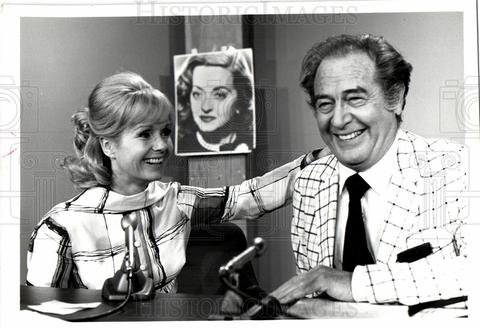
Bill with Debbie Reynolds, both getting photobombed by Bette Davis!
When Bill Kennedy’s young self popped up in old pictures, he looked like the typical handsome actor of his day: square-jawed, strong brow, and distinguished profile. When I started watching Bill Kennedy at the Movies, he wore suits and wire rim glasses, and looked like an aging ad man. Business suits were eventually retired for leisure variety. He later wore glasses the size of welder shields, the norm for that era. Kennedy sometimes sported a nautical-themed jacket to go with his boating cap, reminding me of Thurston Howell on Gilligan’s Island. My own ‘70s style mainly was growing shaggy hair and getting “husky.” I faithfully watched Bill’s show through high school and was growing up to be a big—in every sense—film buff.

Bill showing one of his own movies, this one starred Robert Alda--Alan's dad!
Kennedy’s set underwent periodic makeovers, but my favorite featured pillars, wrapped in mock-celluloid frames of stars in their greatest roles, like Bette Davis in All about Eve or Bogart in Casablanca. And that huge yellow desk phone, which he worked like a prop: “Hello, Bill Kennedy at the Movies! Your question, please!”

I marveled at Bill’s bravado. I hated answering the phone, especially when my uncle’s work crew called the house, and I’d get mistaken for my aunt. As a kid, I’d quietly lurk around rowdy relatives at family gatherings, eavesdropping while making myself useful, like emptying ashtrays and on one memorable night, topping a glass of beer with a few shakes of salt!

Bill Kennedy was like those aging relatives, one-time pistols who were still good for a few more explosive rounds. Bill constantly had a cigarette going, smoke wafting from his ashtray, while he rambled on. Sometimes Kennedy seemed tipsy—my suspicions sparked by isolated news stories about him getting pulled over for drunk driving.
Bill was still big! On the small screen, that is. With guest Gloria Swanson.

During breaks, Bill’s showbiz stories ran from sentimental to sassy to sometimes sour. I was in stitches when Kennedy recited quotes from movie star memoirs, grandly emoting with each syllable. If a phone caller hemmed and hawed while asking a showbiz question, Bill got irate, as if he had received a solicitation call, barking: “Why are you calling?”

Bill Kennedy was in Hollywood hog heaven when celebrities visited his show!
Kennedy’s imitations of movie stars were a hoot, bellowing as Charles Laughton’s Captain Bligh: “Mr. Christian!” Or Bill’s droll take on Bette Davis’ camp classic line in Beyond the Forest: “Whaaat a dumppp!”

Gable's acting wasn't as good as
my Grandma Leone remembered!
My Grandma Leone couldn’t stand Bill Kennedy. She thought Bill was a showboater—I thought he was a showman. Grandma was a high school secretary between marriages when she fell down the icy steps of her upstairs apartment, and broke her leg. My grandmother hated the soaps, so I suggested that she enjoy the movies Kennedy showed, and ignore him.  Recovering that winter, the ice broke between Grandma and Bill Kennedy. She realized that beneath his bluster, Bill was a softie who loved movies, stars, and his audience. From then on, Grandma chuckled at his antics.

Grandma and I compared our favorite movie stars. She was amazed that some of her once-favorite actors now seemed hammy, laughing about Clark Gable’s cartoonish persona. My grandmother was reserved, so it was no surprise that she didn’t care much for alpha actresses like Bette Davis and Joan Crawford, acting with a capital A. Grandma thought Cary Grant was utterly charming and adored Frank Sinatra not just as a singer, but also his natural acting style. Grandma enjoyed revisiting the movies of her youth, a respite from her dreary circumstances as a financially struggling divorcee.

Grandma Leone was amused by my knowledge of old time movies, stars, and singers. The nostalgia boom was just kicking in during the early ‘70s, so imagine Grandma’s surprise when her oldest grandchild started asking what folks in her heyday thought about Frank Sinatra and Ava Gardner’s ricochet romance or Bette Davis and Joan Crawford’s infamous feud.

Before there was TCM, syndicated stations like TV 50 showed the classics.
In 9th grade, I joined The Nostalgia Book Club. Making my book binge a double feature, I joined The Movie Book Club, where I received a dozen free books. When that big box arrived by mail, my siblings surrounded me. After I opened the package and they only saw books about old movies, they quickly scattered. My school books now took second-billing to film books. I even snuck movie memoirs with my textbooks to school, though I was careful to hide them from teachers or fellow students.

Elizabeth Taylor & Richard Burton were in their breaking up/making up heyday, which gave Bill a field day!
Thirty years later, I owned over two dozen large boxes of books. When I moved to Portland, OR, I sold all but two boxes. The contents of every single memoir, film genre book, coffee table tome, and movie magazine that I ever read was imbedded in my head.  I yearned for none of the many other possessions I sold, but later missed holding actual copies of my favorite film books. In researching Bill Kennedy, I found that the books, magazines, and papers he often used on his show have been donated to the Detroit Institute of Art (DIA). Maybe someday, I will hold Bill’s books and papers in my hands.

Bill Kennedy at the Movies was a starring part of my coming of age. I was not an outdoorsy boy growing up in rugged Upper Michigan. The men in the family worked and hunted out in the northern cold, while my brothers and male cousins played in the woods and rode snowmobiles. I stayed toasty warm in front of the television. I preferred warmth, books, baking, snack foods, and most of all, TV shows and movies.
Bill with guest Bob Hope. Note how his set finally got more upscale than a taped glossy of Bette Davis to the wall!

In my research of Bill Kennedy, I found that many baby boomers associate Bill Kennedy with being home sick from school, under blankets on a sofa, and watching old movies with grownups. Others wrote about watching Bill’s Sunday film classics, while listening to their parents’ movie memories, with smells of dinner cooking wafting from the kitchen. People repeatedly said that their love of classic movies started with Bill Kennedy.

Bill Kennedy and toupee heading into their last hurrah!
As the ‘70s ended, I was out of my cinematic cocoon and in the real world—downstate Traverse City—and only occasionally watched Kennedy’s show. Over the next few years, I’d get a bit of a jolt checking in with Bill. The panda print pants and nautical-themed jackets were now joined by tropical floral shirts and pastel leisure suits. This was most appropriate for his later move to Palm Beach, where he hosted movies weekly instead of daily for Detroit TV 50. He wore the most bald-faced lie of a toupee, which looked like a lapdog napping on his noggin. All of this made Bill look like a potential suitor for one of The Golden Girls. Kennedy presented his last movie in December 1983. There were no more comebacks and Bill Kennedy remained retired until his death, January 27, 1997.  I hope those last dozen years were as blissful for Bill as the dozen that I watched Bill Kennedy at the Movies.

Bill Kennedy, easing into retirement from Palm Beach.
Looking back on the past is like a funhouse mirror. You get the distorted feeling that it was only yesterday, yet it also seems so long ago, like it is someone else’s life. Was it really over 40 years ago that I first watched that old hambone Bill Kennedy, when he was rumored to have had hair plugs? Was it over 30 years ago that I spiked my hair like Duran Duran or slicked back, like retro Elvis? Or 17 years ago when I faced the new millennium head on by shaving my balding scalp? No plugs or rugs for me, like my old movie buddy Bill.

Movies comforted and entertained me as a kid, and inspired me to live a creative life as an adult. For that, I owe thanks to Bill Kennedy, my movie mentor, who once ruled the airwaves every afternoon on WKPD-TV 50.
FYI: I put all the movie overflow on my public FB  movie page. 

Bill Kennedy, lookin' good back in his Hollywood days.

Friday, July 8, 2016

We'll Always Have 'Casablanca' 1942

'Casablanca' still casts its classic spell nearly 80 years later.

Critics and audiences still like to argue whether Casablanca is great art or merely great entertainment—let them, I say. Casablanca still captivates, no matter how you define the 1942 Warner Brothers’ war-time romance.

Bill Kennedy, movie host with the most!
I was junior high age when I first watched Casablanca on the late show. From where I sat on my plaid sofa, in 1970s Upper Michigan, it was just another dated war time romance: lots of air sirens, police whistles, patriotism, sneering Nazis, and brave Bogie and Bergman clutching one another in the face of danger.

A few years later, I watched Casablanca again on Detroit TV 50’s Bill Kennedy at the Movies. By then, I was hooked on classic Hollywood and much more impressed. Kennedy was as proud as a peacock whenever the one-time actor got to show and chat about a true blue classic like Casablanca. By high school graduation, I felt like Bill had been my favorite teacher—in film.

What set Casablanca apart from other exotic romances, especially the many cinema copycats to come, was the classic melodrama captured a time and place vital in American and world history. The U.S. had avoided getting into WWII, much like Rick/Bogart: “I stick my neck out for nobody.” 

Everyone comes to Rick's movie blog!
However, Pearl Harbor changed all that on Dec. 7, 1941. Casablanca was filmed the following year, in an atmosphere of uncertainty. Many of the supporting cast members were ex-pats and refugees from all over Europe, who had already suffered in varying degrees from the bulldozing Nazi regime. S.Z. “Cuddles” Sakall, who played Rick’s head waiter—and memorably taught Barbara Stanwyck to flip pancakes in Christmas in Connecticut—lost three sisters to the concentration camps. Cast member Helmut Dantine spent time in a concentration camp before escaping to the U.S.

The plot of Casablanca is a cliché: Resistance fighters are trying to move through Casablanca and not get caught in the occupied city’s Nazi web. It’s a serviceable but straight-forward framework.

The rest, however, is memorable. The studio system was at its peak and Warner Brothers’ best was rolled out for Casablanca: Michael Curtiz, the studio’s # 1 director; Hal Wallis, their most artistic producer; Humphrey Bogart, emerging as WB’s top actor; promising newcomer Ingrid Bergman, “borrowed” from David Selznick; the pick of the studio’s stock company of great character actors; a polished script with some of movies’ most memorable lines; cinematography that was both crisp and dreamlike, a dramatic Max Steiner score, and of course, the ultimate movie love song, As Time Goes By.

Bogart & Bergman in a flashback of happiness as Rick & Ilsa. They'll always have Paris & we'll always have 'Casablanca.'
 Casablanca was a hit, making a leading man out of character actor/movie villain Humphrey Bogart, at age 43. The following year, his new status was confirmed when 19-year-old Lauren Bacall became Bogie’s baby, onscreen and off, in To Have and Have Not. Casablanca cemented Swedish star Ingrid Bergman’s status as a Hollywood leading lady. Three Oscars were to come later for other performances, yet Ilsa is still Bergman’s signature role.

Bogart and Bergman as Rick and Ilsa (two-thirds of a triangle) are genuinely moving because their performances are realistic, as well as romantic. Can you imagine if MGM had made this with Clark Gable and Joan Crawford, with Gable’s bluster and Crawford’s posturing? They might have made Casablanca popular but not an enduring classic.

Some of the great WB cast of 'Casablanca.' Bogart & Bergman with Claude Rains & Paul Henreid.
For those who think Casablanca is just high-grade Hollywood fluff, watch To Have and Have Not. WB was hoping lightning would strike twice. While it was just as well-made and entertaining as Casablanca, To Have has none of its emotional resonance or depth.

Casablanca became Hollywood’s greatest wartime romance, with its notion of sacrifice in an uncertain world. The film and its classic love theme became a touchstone of a time and place, but also as a symbol of true romance.
Luminous Ingrid Bergman as Ilsa, her signature role IMO.

I recently watched Casablanca four decades later, on yet another plaid U.P. sofa. I was knocked out anew by the film’s genuine romanticism, since movies are typically filled with phony romance. Casablanca is fascinating because of its perfect counterpoints: Bergman’s dreamy close-ups to Bogart’s sharp tongue; the stars’ chemistry to a scene-stealing supporting cast; great dialogue to classic cinematic images; the booming Warners’ soundtrack to Wilson softly crooning As Time Goes By; and most of all, the genuinely romantic versus traditional happy ending.
At 43, Humphrey Bogart finally becomes a romantic leading man at Warner Brothers!

Casablanca proves that, to lift a lyric, audiences will always welcome lovers, like Rick and Ilsa, no matter how much time goes by.
FYI: I put all the movie overflow on my public FB  movie page. 
1942: The beginning of a beautiful friendship between "Casablanca" and audiences.