Showing posts with label Somerset Maugham. Show all posts

Thursday, May 4, 2023

Fox’s Faithful Rendition of ‘The Razor’s Edge’ 1946


Gene Tierney & Tyrone Power are the well-cast leads in the 1946 all-star version
of "The Razor's Edge."


The Razor’s Edge from 1946 is remarkably faithful to W. Somerset Maugham’s best-seller, with many key passages of dialogue lifted directly from the book. While movie adaptations still run roughshod over their source novels, back in the golden era, studios were even cavalier with movie versions. The smart movie makers knew to adhere to the story as much as possible, as David Selznick did with Gone with the Wind and Rebecca.

Studio head Darryl F. Zanuck personally oversaw the production of 1946's
"The Razor's Edge."

20th Century Fox head honcho Darryl F. Zanuck was intrigued by the public’s response to W. Somerset Maugham’s spiritual best-seller. The autobiographical novel’s hero is questioning life after WWI and no doubt mirrored many readers’ feelings after WWII. Star Tyrone Power, having just served in the war, felt a similar chord regarding this work.

Lovers Isabel & Larry can't reconcile their opposite worlds in "The Razor's Edge."

Reading the source novel of The Razor’s Edge, one can see how well Fox cast the film. Larry Darrell is described as dark, slim, with incredibly striking dark eyes. Rich girl Isabel, once she loses her youthful baby fat, is described as sleek and sensual with striking hazel eyes, like Gene Tierney. The stylish society snob, Elliot Templeton, is a great role for Clifton Webb. And tragic Sophie, who’s described as attractive but not beautiful, is fiercely played by young Anne Baxter. Her volatile character is played just as she’s described in the novel. Herbert Marshall makes a most urbane author as M. Somerset Maugham. The only dud is John Payne as Isabel’s “regular guy” husband, Gray. While pleasant enough in musicals and comedies, Payne’s out of his league here.

Tyrone Power's Larry Darrell, both fresh out of the service, in "The Razor's Edge."

The Razor’s Edge was filmed April through July of '46. Power went into the production right out of the service and turned 32 during filming on May 5. Tyrone is at the peak of his male beauty, charm and sensitivity, and with the gravity of having just served in the war. While Power’s seeking Larry Darrell is the mouth piece for the film’s spiritual philosophies, Tyrone is much more natural and convincing than when Gary Cooper looked most uncomfortable reciting Ayn Rand’s beliefs in 1949’s The Fountainhead. When one compares Power to MGM’s robotic Robert Taylor, Tyrone had a genuine quality that complemented his talents and great looks. Director Edmund Goulding also guided Ty through another challenging role, in 1947’s Nightmare Alley.

Tyrone Power as Larry Darrell, after he's sought spiritual enlightenment.


Gene Tierney was 25 during filming and Anne Baxter turned 23 just two days after Power's birthday. It is incredible how actresses back then seemed more womanly, while so young. Tierney is incredibly sophisticated as Isabel and Baxter looks older than her years as working class girl Sophie, who hits the skids after suffering great personal tragedy.

Gene Tierney & Anne Baxter as younger Isabel & Sophie, in "The Razor's Edge."

Gene Tierney was not a highly praised actress in her time. And Gene got some sharp critical jabs in The Razor’s Edge, but I think Tierney's terrific as Isabel. And it's a well-rounded character, not one-dimensional and softened. Gene plays the bright and charming, but self-centered rich girl pitch perfect.

Gene Tierney wows as Isabel, on her last night with Larry, in "The Razor's Edge."

Clifton Webb, while he gets to be the acerbic scene-stealer in a number of scenes, per usual, he also gets to be generous and good-humored. Webb’s deathbed scene surprised me in his touching emotionalism, as the social snob who sobbingly acknowledges that he’s been forgotten by his in-crowd. 

Clifton Webb is genuinely moving in his final scene from "The Razor's Edge."

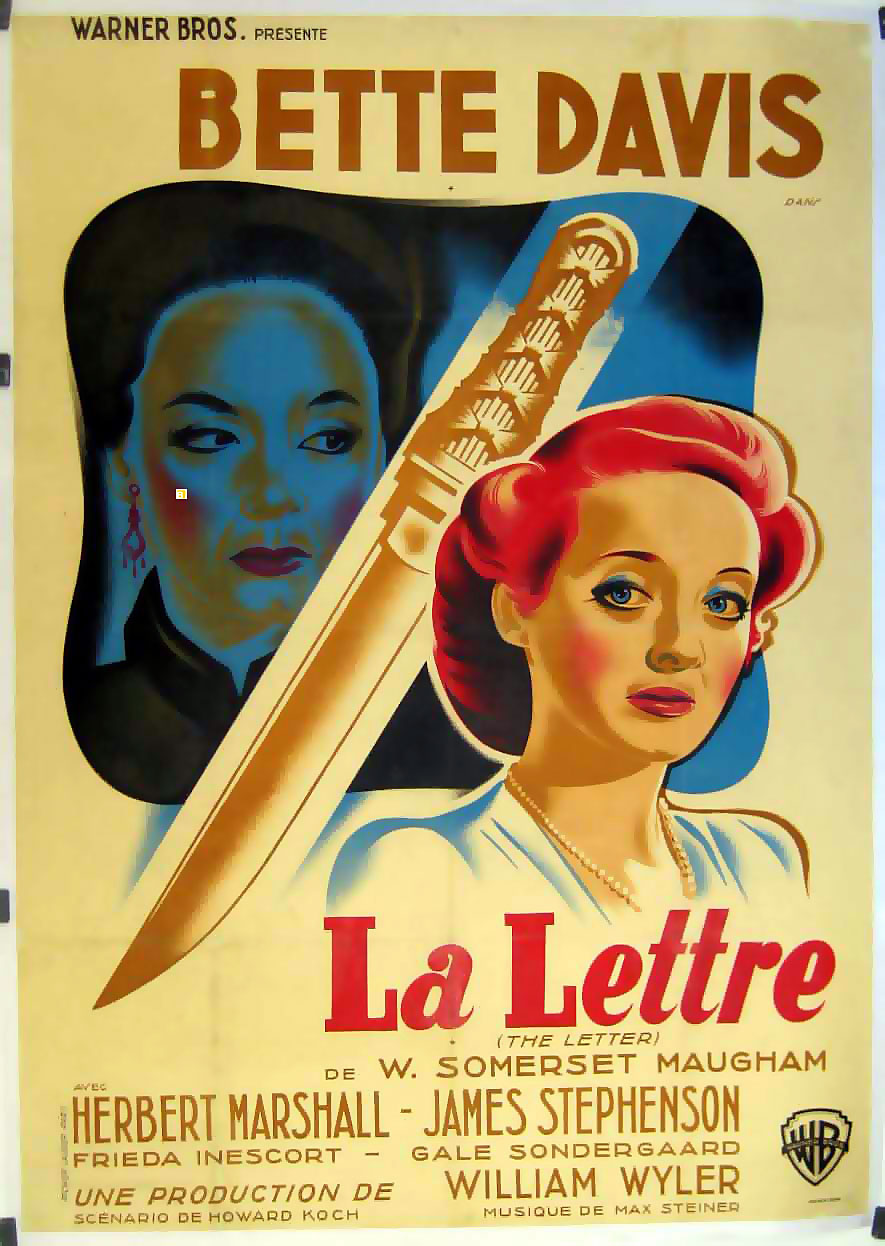
Herbert Marshall is empathetic, but with dry humor, as author Maugham. Marshall had quite an association with screen works of W. Somerset Maugham, appearing in Garbo’s The Painted Veil, with Bette Davis in The Letter, and George Sanders in The Moon and Sixpence.

Herbert Marshall is W. Somerset Maugham, the author of "The Razor's Edge."


The Razor’s Edge is an intelligent, adult adaptation, though tweaked somewhat to be studio movie-friendly.  Zanuck and those involved in the production put great effort into this film. Edmund Goulding, who directed literate fare such as Grand Hotel, does a great job balancing movie style without letting it take over the film’s story. Since the movie was filmed immediately after WWII, location shooting was out of the question. The production offers a convincing depiction of Paris and other locales, without being obvious—like plunking a landscape of the Eiffel Tower outside of Larry’s apartment window!

Anne Baxter is startling as Sophie, who can't overcome tragedy in "The Razor's Edge."

It’s interesting to compare Power in The Razor's Edge with The Sun Also Rises, two literary Darryl F. Zanuck super productions just over a decade apart. But the difference between Power then and later is a shock. It's really a shame that they didn't film Sun right after Razor.

Gene Tierney's Isabel later looks at Anne Baxter's Sophie as an adversary in 1946's
 "The Razor's Edge."

The comparison to The Sun Also Rises is similar in their lead characters. Both male leads have suffered in WWI, leaving them at odds with the tantalizing women they love.

Also, there’s great similarity in characters between The Razor’s Edge and The Great Gatsby: lone wolfs Larry and Jay; society belles Isabel and Daisy; tragic Sophie and Myrtle; Gray as a nicer Tom Buchanan; and Maugham as the outsider observer, like Nick Carraway. They're variations of certain character archetypes. And wouldn't Tyrone and Gene have made a marvelous Jay and Daisy, as well? Finally, Tierney’s Isabel has a bit of Scarlett O’ Hara in her makeup, willing to be tough as a means to an end. And Power’s Larry is a bit of Rhett and Ashley!

Larry’s transformation is very detailed in the book version of The Razor’s Edge, but the movie does a skillful job of skimming his spiritual change. Both the novel and the ’46 adaptation of The Razor’s Edge are very worthwhile, indeed.

Tyrone Power at his peak, as Larry Darrell, in 1946's "The Razor's Edge."

Tyrone Power in his personal favorite role as a carny con man in the cult classic, 1947’s Nightmare Alley. My take here:

https://ricksrealreel.blogspot.com/2022/01/tyrone-powers-personal-best-nightmare.html

Here’s my look at Gene Tierney in her signature role, as 1944’s Laura:

https://ricksrealreel.blogspot.com/2018/04/laura-1944.html

20th Century Fox does justice to W. Somerset Maugham's "The Razor's Edge."


Friday, April 21, 2017

Bette Davis: Double Bad in 'The Letter' and 'The Little Foxes'

“Nobody’s as Good as Bette When She’s Bad!”
***Spoiler alerts ahead***
That Warner Bros. advertising slogan for Bette Davis took on an extra meaning when she became older, crankier, and campier. I hadn’t watched The Letter and The Little Foxes, two from her heyday in ‘40 and ’41, since my teens. Re-watching recently, I was pleasantly surprised to see Bette’s tendency to overact kept in check by her favorite director, William Wyler.

Bette's bad medicine in 'The Little Foxes.'
Davis overplayed hot-headed, hard-hearted dynamic divas, like In This Our Life, Mr. Skeffington, and Beyond the Forest. Perhaps Davis downplayed the pyrotechnics in The Letter and The Little Foxes because Bette’s a cool customer as both “bitch” characters.

Leslie Crosbie in Letter and Regina Giddens in Foxes are two of her greatest roles. And both of Bette’s characters take extreme actions to control of their destiny in a man’s world: murder.
In The Letter, Bette takes on another M. Somerset Maugham anti-heroine, after her breakthrough in 1934’s Of Human Bondage. Leslie Crosbie runs hot and cold as the ex-pat plantation wife who plugs a man full of lead while leaving her house—not exactly the perfect hostess.

The setting is a Singapore rubber plantation. Leslie’s husband Robert blindly adores her and they are popular in their upper-middle class set. She claims self-defense, saying the man, a family friend, “tried to make love to me.”
Yes, but didn’t Leslie pump a full round of bullets into his carcass as he staggered off her front porch?
Howard, their family friend—and lawyer—agrees to take the case. Soon enough, an ambitious young Asian lawyer sidles up to Stephenson’s character and tells him there’s a letter—and since that’s the title of the movie, it must be pretty juicy!

Gale Sondergaard & Bette Davis have a memorable confrontation in 'The Letter.'
Leslie and the gentleman caller were lovers. The letter by Leslie wasn’t a casual invite, but a summons. The holder of the incriminating note is the playboy’s Asian wife. The letter comes with steep postage: $10,000. Behind the husband’s back, Howard the lawyer and Leslie the adulteress use the family savings to buy the note back. This easily paves the way for the “proper” British wife’s acquittal. Today, Leslie Crosby would be considered the perfect example of white privilege.

Wanting a fresh start elsewhere, Robert is devastated to learn just why he is financially wiped out. Leslie comes clean, but to a painful degree. After her painful confession, Leslie soon pays for her sins. Leslie Crosbie may have been acquitted, but she’s not off the hook.

Bette played it director William Wyler's way, but she wasn't happy about it!
Davis and Wyler, who had a volatile professional and personal relationship, fought over Leslie’s telling her husband that she still loved the man she killed. Wyler wanted Bette say it to movie spouse Marshall’s face; Davis felt the wife could never look him in the face and say such a thing. When they came to an impasse, Bette walked off the set. This was a preview for coming attractions on The Little Foxes set.

What prevents The Letter status as a true classic is the censorship-mandated, tacked on ending where Leslie is killed by the vengeful wife. Otherwise, William Wyler weaves this tale of murder, passion, sexual frustration, class, and white privilege with skillful ease. Tony Gaudio’s photography is truly stunning, especially during the film’s opening and closing night scenes. Gaudio actually makes the moon a mesmerizing character. Max Steiner, composer for many Davis dramas, offers a haunting and romantic score.

Bette with Victor Sen Yung and James Stephenson, going to retrieve 'The Letter.'
Herbert Marshall goes his first round with Davis as Bette’s put upon husband, Robert. Marshall is empathetic as he goes from sure to sorrowful, regarding his marriage. James Stephenson as Howard made his film debut and won a best supporting nomination, to boot. Stephenson plays the lawyer’s ethical entanglement well. The supporting standout is Gale Sondergaard, genuinely chilling as Mrs. Hammond, the widow of wife’s lover. When she forces Leslie to meet her in person to retrieve the letter, the tension is incredible, with barely a word or gesture wasted by either actress. It’s all in the eyes. Despite the forced ending, their final, fatal meeting is still eerie.

Bette giving the moon a baleful look, which haunts her through 'The Letter.'
As for Bette, she’s subtly brilliant. Maugham’s Leslie Crosbie is a tricky role: She’s both sympathetic and a bitch; she’s passionate and stone-cold. It amazes me that Davis could play this type of role in the ‘30s and ‘40s and still win audiences over. An old female friend of mine, Alice, a moviegoer from that era, once commented that there were three actresses that men couldn’t stand: Bette Davis, Joan Crawford, and Katharine Hepburn. I’ll amend that to straight men! All were strong-willed, smart, not conventionally beautiful, and the first two often played roles that bedeviled the male characters. Davis, as the cool English “lady” with fire underneath, required a finesse which Bette employs to terrific effect.

Bette as Regina in 'The Little Foxes,' photo by George Hurrell.
Davis and Wyler re-teamed for the last time with Lillian Hellman’s The Little Foxes. (Their first was Bette’s second Oscar winner Jezebel.) This time, their collaboration was so combative that they never worked together again, though they remained friends. Tallulah Bankhead originated the role of Regina Giddens on Broadway. Movie mogul Samuel Goldwyn bought the property for William Wyler to direct. Wyler requested Davis for Regina, who just turned 33, to play the 40-something mother of a 17-year-old girl.

The Little Foxes was Lillian Hellman’s indictment on American greed and capitalism, which ironically became a huge commercial success. Regina Giddens relies on her invalid husband Horace for finances to remain comfortable; Regina’s crooked brothers, Oscar and Benjamin Hubbard, have already amassed fortunes. Still, they all want more. A visiting investor offers to make them partners in a cotton mill. The brothers have their share and count on Regina to get her estranged husband to put up the third share. The mill, which promises to exploit the locals, gets a prompt no from her noble husband. Once again, he is played by long-suffering—literally, this time—Herbert Marshall. The brothers put up Oscar’s dimwit son to steal the funds from Horace’s bank deposit box. When Mr. Giddens finds out, he refuses to press charges, to thwart the deal. Naturally, Mrs. Giddens is livid.

Oh, did I mention Horace Giddens has a serious heart condition?

Bette as Regina, watching her husband crawl in the background, dying.
And Regina is serious as a heart attack that she will hold the cards in this deal. Regina and Horace have a showdown. She whips him for foiling her attempt at good fortune, and for good measure, tells Horace that their entire marriage a failure and she never loved him. Well, that has him reaching for the heart medicine, which he promptly knocks over. Whoopsy! Regina gets up to help, then hesitates. Opportunity knocks for the opportunistic southern belle. This famous onstage scene was made even more legendary on film by Citizen Kane’s cinematographer Gregg Toland’s renowned deep-focus photography. In the background, Herbert Marshall, acting out the throes of a heart attack, crawls across the room and up the staircase for help; in the foreground, Bette bolted to her chair, her wide eyes their widest, as she waits for the perfect moment to strike. The scene is still a showstopper: kudos to Wyler, Toland, Marshall, and Davis. Also, when I think of that grueling scene, I recall that poor Herbert Marshall wore a wooden leg, due to a war injury.

Patricia Collinge is great as poor Aunt Birdie, trampled by her greedy family.
Most of the Broadway cast was brought in to recreate their roles. They are all terrific, especially Patricia Collinge, as tragic Aunt Birdie. Miserably married to Regina’s brother, Oscar, Birdie gradually became an alcoholic. Birdie’s scene of recalling her life’s journey—belle of the ball, bartered bride, and finally, the bottle—is a stunning piece of acting by Collinge.

Bette’s performance was controversial. There’s a confusing history of quotes as to whether William Wyler wanted Bette to play Regina like Bankhead or that he thought Davis’ own interpretation was too unlikeable. Whatever the case, Wyler hated Davis’ portrayal. And Bette despised his direction of her. Tensions peaked where Bette walked off the set and production was shut down for several weeks. This is one of the key points in Bette Davis’s career when the “difficult” label was applied. Who was right and who was wrong?

Rare shot of Bette as Regina in color. Davis was made to look older in B&W.
It’s hard to say, since Davis and Wyler were equally hard-headed. For me, what matters in the end is what’s up onscreen. Bette powdered her skin, thinned her lips, and narrowed her eye makeup to look pinched, weary, and older. Which Wyler also hated. Only 33, Davis plays a scene where Regina dolls up for her husband’s return home, to butter him up. Regina catches an unexpected glimpse of herself in the mirror, at an unforgiving angle. The belle gets a reminder that she’s no longer the sweet young thing, but bitter and hard. Imagine another actress of that era willing to submit to such a harsh close-up. As with Leslie in The Letter, Bette’s Regina is bad, with no excuses as to how she got that way. Bette’s Regina is restrained, for such a show-stopping role; Davis is also a team player, this isn’t just a vehicle for her.

Bette with Frank Capra & William Wyler on 'The Letter' set.
The Letter and The Little Foxes are films that dealt with tough topics in an adult way, but still entertained. That’s why they still hold up today. Finally, despite their combustible chemistry, Bette Davis gives two of her best performances, playing bad to the bone, under the tough, strong direction of William Wyler.


Sunday, February 5, 2017

Did Bette & Joan's "Feud" Begin With 'Bondage?'


Bette Davis as monstrous Mildred in 1934's 'Of Human Bondage.'


Joan Crawford makes it "Rain" as sexy Sadie Thompson!


The feud between film icons Joan Crawford and Bette Davis has fascinated movie fans forever. The rivalry was a slow burn that ignited when they squared off for 1962’s Whatever Happened to Baby Jane?
Many assumed their rift began when Joan joined Warner Brothers in 1943, where Bette was queen bee. Joan idled for two years, and then won an Oscar for Mildred Pierce, as Davis’ star was peaking. More recent tales put the feud earlier, when Joan met future husband Franchot Tone, Bette’s co-star in 1935’s Dangerous. Davis admitted long ago that she had a mad crush on him, but some gossips say that Tone crushed back.

I think the life-long Crawford-Davis rivalry actually started in 1934. That’s when Bette rose to fame in W. Somerset Maugham’s Of Human Bondage, a year and a half after Joan stumbled critically and commercially in Maugham’s Rain.

Both Maugham heroines were shady ladies on the skids, and juicy roles. Joan and Bette had begged their studio bosses for loan out to outside studios to play their respective roles. At the time, Crawford was much criticized for her portrayal, whereas Davis made her breakthrough. I think this is the first time that the two ambitious stars became mutually aware of one another.

1932's 'Rain,' which starred Gloria Swanson in a silent movie just 4 years prior.

Rain was a short story turned stage play, legendary for Jeanne Eagels’ performance as prostitute Sadie Thompson. The tale had already been a hit 1928 silent film, Sadie Thompson, starring Oscar-nominated Gloria Swanson. In 1932, Joan Crawford requested a loan out from home studio MGM to United Artists to film a sound version, to prove that she was a serious actress—not just a glamour girl.

Leslie Howard, top-billed in 'Bondage.'

Of Human Bondage was filmed in 1934, after Bette Davis pestered studio boss Jack Warner to lend her to RKO Studios to play shrewish waitress-turned-hooker Mildred Rogers, to prove that she could be a serious actress—and a star!

Rain squared off good-hearted hooker Sadie Thompson against hard-hearted “reformer” Alfred Davidson. While trying to save Sadie’s soul, Davidson realizes he lusts for her, and rapes Thompson—and then kills himself. In Bondage, medical student Philip Carey falls hard for trampy waitress Mildred, who alternately toys with and torments him. Despite no hint from Mildred to become a repeat customer, Philip keeps coming back for abuse, hoping that she will see the light. As the masochistic story continues, Mildred goes from waitress to whore.

In regard to the two stories’ characters, gender sympathy is swapped: Rain’s salt-of-the-earth Sadie is more honest than the holier-than-thou reformer Davidson; Bondage’s Philip’s wide-eyed innocent is beaten down by Bette’s wide-eyed witch, Mildred.

The customer is always right is not on Mildred's menu in 'Of Human Bondage!'

Their studio heads let the actresses go to other, smaller studios to play the sordid characters. There’s no word on what MGM’s L.B. Mayer told Joan. My guess is that Mayer, who thought great films equaled glamorous stars suffering nobly, let Crawford have her head, in order to fall on her face, and thus learn her lesson. But no-nonsense Jack Warner got so sick of Bette’s haranguing to play Mildred that he finally relented, telling her, “Go ahead and hang yourself!”

Both Joan and Bette encountered unexpected hostility on the set. In Crawford’s case, Rain was filled with a cast of seasoned stage actors, who revered Eagels’ stage triumph, one telling Joan, “…when Jeanne died, Rain died with her!” This must have jolted Joan, who was used to being treated like royalty back at MGM. And Davis, a New Englander, was surrounded by stellar British actors in Bondage, who patronized her as a pretender.


Crawford took the trash talk on the 'Rain' set to heart & hid in her dressing room.

The turmoil had different outcomes. Joan retreated to her dressing room between takes, loudly playing popular music—just like Sadie does in the film! Of Human Bondage’s director, John Cromwell, warned star Leslie Howard and the rest of the British cast that while they were looking down at Davis, she was walking off with the film.

The movie divas were driven in delivering their performances. Crawford observed prostitutes in San Diego for their behavior and style of dress. Joan wanted to leave behind the glamour girl image she personified, wearing only two outfits: an off-the-rack dress and a black robe. Davis insisted on realism in clothes and makeup. For the waitress scenes, Bette wore little makeup and dressed modestly.

By the book: 'Of Human Bondage.'

Both films were released before the new Hollywood Production Code was strictly enforced. Lead by Joseph Breen, starting in July, 1934, the severe Production Code reigned for the next 30 odd years. The Code would never have let hooker Sadie Thompson walk off into the sunset at the end of Rain, with a dead man of God on the beach. Nor would it have let Bondage’s Mildred be depicted matter-of-factly as an unwed mother turned hooker.

The Maugham stories lucked out with their “Pre-Code” film adaptations, which followed the author’s original intent fairly close. But how are the ‘30s versions of Rain and Of Human Bondage remembered? Both movies fell into public domain in 1960 and ’62, respectively. Even in the age of restoration, nobody has bothered, surprising since both films are significant in the careers of two Hollywood greats. Both Crawford and Davis give larger-than-life portrayals in Rain and Of Human Bondage. The difference between the two is Bette’s performance is grounded in characterization and Joan’s bolstered by charisma.

Joan Crawford: Movie magazine favorite!
Though Joan Crawford won some strong roles as she progressed up the MGM leading lady ladder, she was more famous for film fashion. Coveting Sadie Thompson, played by silent superstar Gloria Swanson, one wonders if Crawford was emulating the career that she craved. Sadie is certainly the kind of lady that Joan could relate to: a woman from the school of hard knocks, with scorn heaped upon her by so-called “superiors.” Billie Cassin, before she became Joan Crawford, went from a laundry girl to chorus girl to starlet to top star, and not without some battle scars along the way. Rain should have made her a serious dramatic actress of the first rank. Instead, Rain became Joan’s first flop. For Joan, driven to ALWAYS succeed, this must have been devastating.

Joan isn’t awful as Sadie Thompson, but she gives an extremely uneven performance. Whether Crawford chose to ignore Lewis Milestone’s direction, or vice versa—Crawford claimed both at various times—what was a challenging role became a caricature. Joan’s dramatic entrance in Rain is as campy as her introduction in the battleaxe-thriller Strait Jacket over 30 years later. First, we see a bangle-laden arm clamp one side of the ship’s cabin doorway, then the other. Then a high-heeled foot poses on one side of the doorway, then the other foot at the opposite side—complete with fishnet stockings and an anklet. We get the slow close-up, Joan as Sadie, with a ciggie hanging out of her mouth. Crawford’s makeup as the tarty party girl is so over-the-top, that it looks like an inspiration for Bette’s Baby Jane Hudson.

Crawford, tarted up and then some as Sadie Thompson!

Once you get used to the black-rimmed eyes, super-arched brows, and lipstick that reminded me of “wax lip” candy from when I was a kid, Joan’s early scenes benefit from her electric vitality and earthiness. Some scenes are undercut by Joan’s body language—her acting out Sadie’s coarse manner is about as subtle as a sledgehammer. Yet, Crawford’s performing is always committed, and easily commands attention from her stagy supporting cast.

Joan’s fearlessness in going toe-to-toe with worthy co-stars comes in handy, since the fire-and-brimstone Mr. Davidson is played by the great Walter Huston. As the characters come closer to their showdown, this is where Crawford falters as Sadie, and it’s not entirely fair to blame her. Milestone moves the action and makes beautiful use of the location shooting, but once the story gets going, all the characters speechify. Rain is based on a Broadway play, and early talkies worshiped the theatre. So when Sadie and Davidson have their big scene, with the preacher determined to “save” Sadie’s soul, Huston seriously serves the ham. Crawford, who must convey a climatic change of acceptance, widens those enormous eyes, and stares her head off. Their pivotal moment is totally unconvincing.
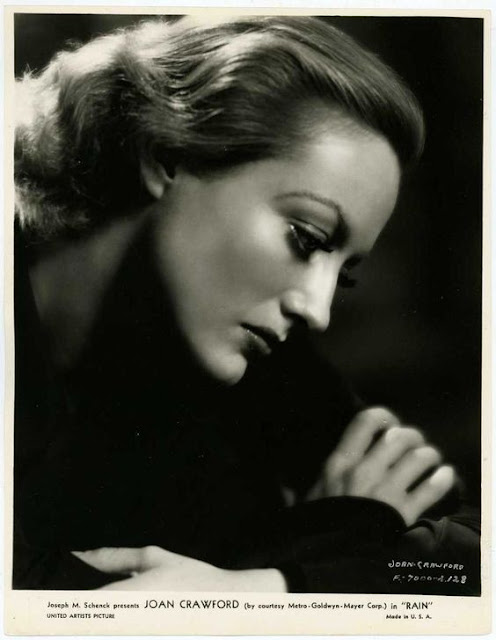
Joan as "saved" Sadie Thompson, looking like an MGM star!

After the breakthrough, Sadie’s change to “a shining daughter of God” is conveyed by her drastically toned down appearance. Thompson’s gaudy get-up is replaced by a black robe. Sadie’s tacky curls are gone, with Joan’s hair combed straight back. The cartoon makeup is now replaced by the stylized MGM makeup Joan Crawford wore in her ‘30s movies. Joan is back-lit beautifully, glowing like an angel. Crawford’s face, especially in profile, is a tribute to bone construction. And did the woman know how to take a close-up! 

And that’s exactly the problem with Rain’s last reels. Crawford is supposed to be a down-and-out hooker on a sweltering island, just put through the emotional ringer—not posing as if for MGM still photographer George Hurrell. Sadie voices her fears about staying reformed, and Joan’s grand lady manner creeps into her performance. This all feels like a letdown. Sadie’s subsequent rape by Davidson takes place off-camera, typical of the era. When he is found tangled in fishing nets the next morning, a suicide, everyone looks to Sadie for her reaction. Sadie is once more blasting hot jazz from her room, and makes her entrance the same ridiculous way she did at Rain’s beginning. Sadie is all tarted up again, but crumbles when she finds out about Davidson’s demise. Yet, there’s a happy ending for Sadie that wouldn’t have flown past the censors less than two years later.

Joan Crawford hadn't gotten her black belt in acting yet!

Any Crawford fan knows Joan never walked through a role. Joan definitely was an actress who responded well to strong direction. Like most actors, left to their own devices, In Rain, Crawford overcompensated in the obvious aspects of the role, while ultimately clinging to her image.

It’s been said that Bette as Mildred Rogers in Of Human Bondage is over-the-top by today’s acting standards. That can be said of all film acting from Hollywood’s golden area. Yes, the famous scenes of Bette Davis flaying into Leslie Howard’s Philip with vindictive glee are both demonic and deliciously hammy. But those are only two scenes. The first is the famous tirade when Philip turns down Mildred’s advances: “Me?! I disgust you?!...” The other is when she maliciously trashes Philip’s apartment—even burning his money!—before leaving him.

Otherwise, Davis is toned down in both look and demeanor, a sour personality who only comes to life when someone promises to take her out of a dull existence. John Cromwell was a strong actor’s director and he keeps Bette from going over the edge, no mean feat!

Bette Davis as Mildred at the bitter end 'Of Human Bondage.'
Audiences were shocked to see an actress depicted this way.

As Mildred goes down the path to hell, her hooker makeup is more scary than sexy, by Davis’ design. In the last scenes, Mildred is dying of consumption, and Davis insisted on looking ravaged—all unheard of in 1934 Hollywood. Also, Davis demanded on no bed scenes in full makeup and perfect hair and no improbably beautiful outfits for waitress Mildred. Davis plays Mildred like the “plain brown wren” she was once described as by a studio exec. Here, Davis’ Mildred is a pecking bird who longs to be a swan. Bette Davis didn’t care if audiences liked her as long as they could empathize with her. It is still a brave portrayal, during an era when glamour, charm, and likeability were all. Life magazine called Davis’ performance the greatest ever recorded on the screen by an actress. An overstatement now, of course—but it shows how daring Davis’ approach was in her performing and appearance onscreen at the time.

Bette as Mildred, ripping her man to shreds--and the scenery!

Davis’ Mildred is echoed in some of her later portrayals. Of Human Bondage made her a star in ’34 and by 1949, Davis’ last film on her Warner’s contract was Beyond the Forest. Interesting that Bette had to fight Warner to make Bondage but fought him—and lost—against playing Rosa Moline in Forest. Bette’s Rosa is another frustrated female who makes the man in her life (a doctor as well) miserable. There’s an identical scene where Rosa runs off to her lover, only to be rejected, and comes crawling back to the mild-mannered man she despises. Both suffer feverishly and fatally for their sins:  Mildred, sweaty and depleted with consumption; Rosa, sweltering from peritonitis, the after effects of a self-induced miscarriage. Hollywood’s wages of sin hadn’t changed much in those 15 years!

The "little brown wren," as Bette was dubbed, is very peckish toward her man.

Both films are surprisingly short—Rain runs just over 90 minutes and Of Human Bondage a mere 82 minutes. Rain got mostly poor reviews though it wasn’t the total financial flop that legend has it. Actually, Rain and Of Human Bondage made about the same at the box-office, but Bondage was much more modestly budgeted. Plus, Rain’s expectations were much higher: Swanson’s Sadie Thompson was a smash (it grossed twice as much as Rain) and Crawford was certainly positioning herself to take the mantle of Swanson as the next glamour AND dramatic star. Later, Joan herself bad-mouthed the movie, writing in her memoir, “Oh, who am I kidding? I just gave a lousy performance.”

'Rain' now enjoys revisionist praise in some quarters as an underrated film.

Joan freely acknowledged that the failure of Rain and Today We Live—where she plays a Brit!—made her wake up and find a moneymaker of a movie, ASAP. Luckily, 1933’s Dancing Lady restored Joan’s box-office luster. Yet the disappointment of Rain didn’t stop Joan from fighting for better roles, like The Women and A Woman’s Face at MGM, or Mildred Pierce and Possessed at Warner Brothers.

As for Davis, the little brown wren finally got to soar—though it was a bumpy flight. Amazingly, there was no Oscar nomination for Bette in Of Human Bondage. Warner, with no best actress nominated for any of his films, didn’t bother to sway WB voters to support their star on loan-out. A write-in campaign ensued, but Claudette Colbert won for It Happened One Night. Still, Jack Warner ordered a vehicle whipped up to cash in on Bette’s raves in Bondage. The result was Dangerous, for which she won her first Oscar, which even Bette said was a consolation prize. But for every good role, like The Petrified Forest and Bordertown, Bette had to endure three or four dogs like Satan Met a Lady. Davis created another first by suing Warner Brothers in 1936 to get out of her contract. Bette lost, but WB started giving her good films at last, in a gallery of movie roles for which Bette Davis is best remembered.

She's got Bette Davis eyes: 'Of Human Bondage' confirmed her stardom.

 Though Bette scoffed at Crawford playing working class girls in Adrian-designed outfits, Davis admitted in her memoirs that she envied the care Crawford’s career received at MGM. While Crawford likely didn’t take notice of the WB starlet cranking out low-budget flicks, I bet that Joan’s competitive radar pinged when that East Coast upstart triumphed where she failed.
And a life-long competition between two larger-than-life film stars was born.
Check out my blog for a combined nearly 30 posts on Bette Davis and Joan Crawford!

FYI: I put all the movie overflow on my public FB  movie page. 

Check it out & join!  https://www.facebook.com/groups/178488909366865/