Showing posts with label Eileen Heckart. Show all posts

Sunday, October 10, 2021

The Bad Seed 1956


Patty McCormack as Rhoda Penmark. The perfect angel or the bad seed?


***The best parts of The Bad Seed are its spoilers, so alerts ahead!***

Sorry, no can do! Spoilers are divulged! 

The high points of this totally ‘50s film are the chilling premise that evil is genetic and a trio of unforgettable performances by Patty McCormack as The Bad Seed, with Eileen Heckart and Henry Jones, as characters left in her wake.

Henry Jones gives a great performance as pervy Leroy in "The Bad Seed."

This classic story has been remade wretchedly for TV several times and “inspired” Macaulay Culkin’s The Good Son. Perhaps The Bad Seed was the product of post-war America, when our ideal was reflected in TV family sitcoms. The Bad Seed was the opposite image, as a decade later, when frothy movie marriages got a reality check with Who’s Afraid of Virginia Woolf?

Little Rhoda Penmark just lights up a room in "The Bad Seed!"

The Bad Seed is Rhoda Penmark, the outwardly perfect child who is really rotten to the core. Although Rhoda’s short past is marked by questionable incidents, her mother Christine must now see the light after a very public tragedy. At a school picnic, Rhoda’s classmate Claude Daigle “accidentally” drowns. But there is evidence that the shy boy struggled. And witnesses intervened with Rhoda and Claude, over a penmanship medal. As the truth comes out, the girl’s behavior becomes more overt.

The other shoe drops in "The Bad Seed."

The downside of The Bad Seed is that it’s filmed as a play, with the worst studio era movie conventions. You can thank Mervyn LeRoy for that, a most uninspired film maker in his later years. WB also ran into censorship issues, as Rhoda the sociopathic murderer survives at the end of the original story, while her martyr mother perishes. Not so in the film version, which leads to a lame finale.
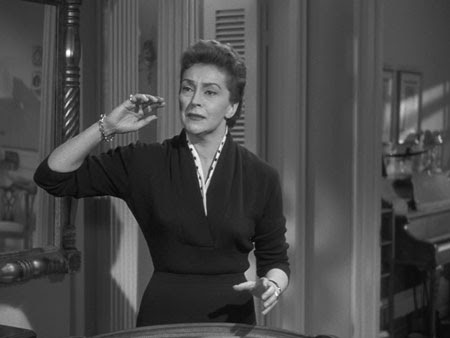
Nancy Kelly gestures more than a cop directing traffic as the mother of "The Bad Seed."

McCormack’s Rhoda is so transparently phony and monstrous that most of the other “sympathetic” adults around her come off as nincompoops when they fall for her act. The worst offender is Nancy Kelly, who plays the mother, Christine Penmark. Kelly’s hilariously overwrought performance, complete with gesticulating, raised eyebrows, and the most whispery, raspy voice since June Allyson. After the sincere blathering of the airhead upstairs neighbor, the dull daddy and grandfather, and the handwringing mother, I always find myself rooting for Rhoda!

There's lots of finger-pointing and hand-wringing in "The Bad Seed."

Not surprisingly, the most interesting performances are by those actors whose characters are not fooled by phony Rhoda. Eileen Heckart, as Hortense Daigle, the mother of the dead boy, goes way big. But Heckart is also genuinely touching in her moments when the mother’s grief is laid bare. Kelly, McCormack, and Heckart all got Oscar nominations for their performances. Henry Jones as the pervy Leroy, should have gotten a nomination too, for his full-bodied performance as the childish but cunning handyman. Jones’ scenes with McCormack’s Rhoda crackle with tension. And Joan Croydon as Miss Fern, the school teacher who has Rhoda’s number, scores.

Patty McCormick's rages as Rhoda "The Bad Seed" Penmark are still frightful!

As for Patty McCormack, while her performance betrays its stage origins, is still utterly creepy as Rhoda. The scenes where the saccharine mask is dropped and the perfect angel reveals her rage, McCormack is memorable.

A lucky lightning bolt takes care of pesky Rhoda Penmark in "The Bad Seed."

The Bad Seed’s ending is a campy letdown. There are two, actually. First is when Rhoda attempts to retrieve the stolen medal that her mother planted near the lake’s dock. Seeing Rhoda decked out in bright rain gear in the middle of a late night thunderstorm is a great visual. This instantly explodes into absurdity when Rhoda gets blasted by a thunderbolt of biblical proportions at the dock. The other is when the cast takes a “curtain call.” As if that’s not corny enough for such a heavy drama, Nancy Kelly shakes her finger at Patty McCormack and takes her over her knee for a mock spanking! As laughable as this is, it’s an indicator of what Hollywood thought ‘50s audiences could handle. Thankfully, we weren’t subjected to that with WB’s filmed Virginia Woolf a decade later, or their curtain call might have had George and Martha’s “son” taking a bow, too!

Whew! Thank goodness this was only a movie! The incredibly corny curtain call
from "The Bad Seed."

FYI: I put all the movie overflow on my public FB  movie page. 

Check it out & join!  https://www.facebook.com/groups/178488909366865/


Saturday, February 20, 2021

Edward Albert, Forever Young in “Butterflies Are Free” 1972

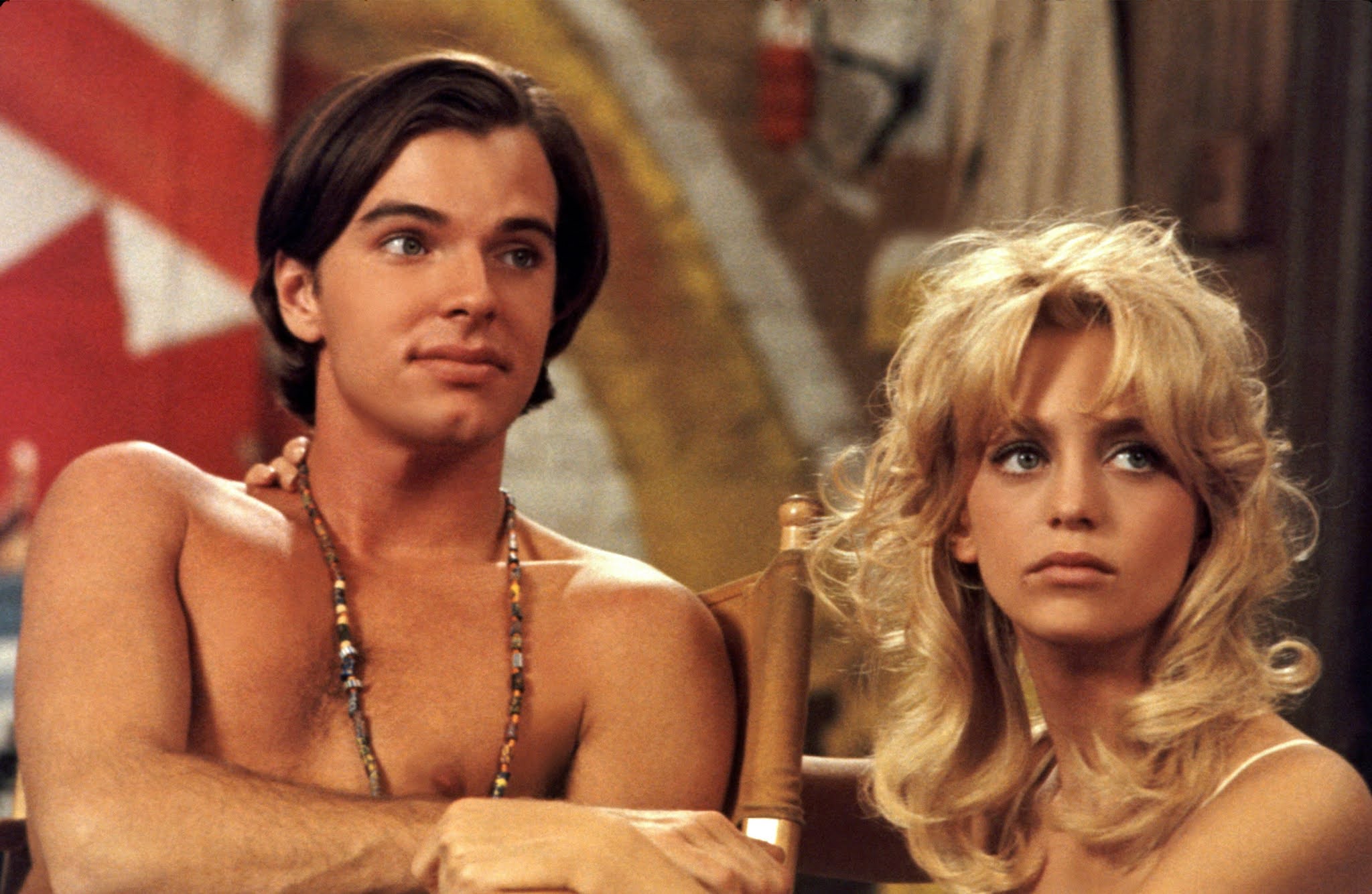
Edward Albert & Goldie Hawn get romantic in 1972's "Butterflies Are Free."


Edward Albert was just 20 when he starred in his first major film, Butterflies Are Free. Sadly, Albert only lived to be 55. Edward would be 70 as of 2/20/21. This post is written as a tribute to the appealing actor with a fascinating life.

Leonard Gershe’s stage smash Butterflies Are Free, which ran three years on Broadway, was snapped up as a movie for Goldie Hawn. Producer Mike Frankovich, Jr. had showcased Hawn in her Oscar-winning role from another stage hit, Cactus Flower.

That '70s movie poster! "Butterflies Are Free" was a Broadway smash and movie hit.

With Butterflies Are Free, there are essentially three characters: Jill Tanner (Goldie Hawn), Don (Edward Albert), and Mrs. Baker (Eileen Heckart.) Paul Michael Glaser appears in the last act, Starsky and Hutch just around the corner, as a douche director.

Butterflies Are Free is the story of Don, a young blind man who falls for the free spirit next door, and fights with his overprotective mother for his own space. Don was played onstage by Keir Dullea. The actor was 35 when Butterflies was filmed, too mature onscreen for a young guy who has just flown from the nest. Edward Albert was 20 when he was cast. Aside from some acting work as a child, this was Albert’s first screen role.

Keir Dullea & Blythe Danner originated Don & Jill in "Butterflies Are Free."

Hawn’s Jill is just 19 and an aspiring actress (Goldie was 26), who has already been married once, and is anti-commitment. Yet, Jill literally barges in on the life of neighbor Don Baker, a blind musician on his own. In less than two days, the two fall madly in love, nearly break up, and reconcile! Aside from that, their rapport and romance is charming, until overprotective Mom (Heckart) “drops by” from a suburb near the San Francisco-set film. Mrs. Baker finds the shabby chic apartment appalling and is on high alert when she finds Jill cavorting with her baby boy. Don has already experienced a bad romance with a similar type, who encouraged him to move to the city, only to dump him.

Free spirit Jill (Goldie Hawn) and blind Don (Edward Albert) get to know each other.

As Jill, Goldie Hawn is the hippie chick successor to Marilyn Monroe. Seemingly a dumb blonde, Hawn’s Jill is actually pretty smart, aside from some ditzy moments. Goldie’s role has similarities to Marilyn’s sexy neighbor next door in The Seven Year Itch. She’s realistic about men and relationships, and her own limitations. She’s child-like yet wise, with a distinctive star persona. Like MM, Hawn is effortless in navigating between comedy and drama, and Goldie’s most appealing here.

Goldie Hawn's appeal is effortless as aspiring actress Jill, in "Butterflies Are Free."

Eileen Heckart won a Best Supporting Actress Oscar as Mrs. Baker. She lost the Tony for the same role to Blythe Danner, who created the role of Jill Tanner onstage. Heckart is an old pro at playing vinegary but essentially likeable characters. Eileen and Goldie ping pong the smart lines as the two adversaries. But Heckart gets to show more, once Mrs. Baker sees that Don might get hurt again by another fluttery girlfriend. It’s in these moments that Heckart is most understated and affecting, as she starts to see the light, to set her son free.

A heart-tugging moment in "Butterflies Are Free," when Eileen Heckart's mother
lets go of her blind son, despite his distress at the moment. 

As for Edward Albert, he holds his own against these two comedic pros as the blind aspiring musician. Albert is appealing, intelligent, empathetic, and just happens to look a bit like young Montgomery Clift. Also, he sings quite pleasantly. Edward researched his role well, studying at the Braille Institute. After this film, Albert teamed with many of the Butterfly crew to film another Broadway hit, 40 Carats. Unfortunately, it flopped, and Albert went from promising young lead to journey man actor. If Albert was starting out in today’s show business, his diverse talents would have afforded Edward more of a shot at stardom.

At 20, Edward Albert played the independent blind man in "Butterflies Are Free."

Part of the problem was Albert started out as a likeable, handsome young actor at the height of the realistic filmmaking era, with stars like Hoffman, Pacino, and Hackman setting a very high standard, without relying on movie star looks. Younger actors who were more lightweight and handsome, like Edward Albert or say, Jan-Michael Vincent, William Katt, Christopher Reeve, or a younger Kurt Russell, didn’t get the top film roles. Jeff Bridges, whose background was similar to Albert’s, was able to leave the boyishness behind and move on to meaty roles.

Edward Albert as a boy, with parents Eddie Albert & Margo. Adopted daughter
 Maria is the only survivor of the immediate Albert family.

Edward Albert was the son of beloved character actor Eddie Albert and Mexican actress Margo. Eddie was most famous for Green Acres and Margo for Lost Horizon. Like the Bridges family, the Alberts were very politically and socially active. And like Lloyd Bridges, the Alberts were blacklisted for awhile during the ‘50s. Eddie later became an environmentalist. I mention this because Edward also became strongly involved in environmental and Native American causes, and spoke with pride about his parents standing up to the blacklist. Like his father, Edward had a prolific career as a character actor rather than leading man. Later came unfortunate times for the Alberts. First, Margo died at just 68 of a brain tumor, in 1985. Later, when Eddie was in his 80s, Albert was diagnosed with Alzheimer’s. Edward put his career on the backburner to care for his otherwise healthy father, who lived to be 99! Sadly, Edward found out that he had lung cancer a mere month before father Eddie died. Edward Albert died Sept. 22, 2006, 18 months after his father. A sister, Maria, was the only survivor of the small Albert family.

Edward Albert's first film role, "The Fool Killer." His co-star was Anthony Perkins,
who plays a possible ax murderer. Need I say more?

Edward Albert’s career was prolific, he was educated at Oxford, and was multi-lingual. He also came from a great lineage (Xavier Cugat was his great uncle, and his godfather was Laurence Olivier), he enjoyed one long, happy marriage, and became a father to a daughter.

Edward Albert & Eddie Albert, later in life.

Edward Albert lived a short life, but one that was well-lived. How lucky that movie watchers can watch him in his leading man debut, Butterflies Are Free.

Here’s Army Archerd’s obit for Edward in Variety: https://variety.com/2006/voices/columns/edward_albert_d-1200571358/

And here’s Edward’s actual film debut, in 1965’s “The Fool Killer.” Edward plays a runaway boy during the Civil War era, who encounters a number of odd characters, including Anthony Perkins!

https://ok.ru/video/2631968754356

FYI: I put all the movie overflow on my public FB  movie page. 

Check it out & join!  https://www.facebook.com/groups/178488909366865/ 

Edward Albert & Goldie Hawn, forever young on film, in "Butterflies Are Free."

Wednesday, July 8, 2020

‘No Way to Treat a Lady’ 1968


Lee Remick realizes that her Italian chef is a serial killer, "No Way to Treat a Lady."

Thrillers set in the Big Apple were big in 1968, like the somewhat forgotten sleeper, No Way to Treat a Lady. The Boston Strangler and The Detective were notable hits. The best of the bunch was Rosemary’s Baby.
Yet, compare the way No Way to Treat a Lady was filmed versus Rosemary's Baby, both made by Paramount Studios, in NYC. They are psychological suspense films, but Lady was filmed "realistically" versus Roman Polanski's mood-enhancing visual style in Rosemary’s Baby. Lady seems like a Universal TV movie in comparison. No Way to Treat a Lady was directed by competent but workmanlike Jack Smight and cinematographer, Jack Priestley. Both artists spent much of their career in TV and it shows. The same goes for screenwriter John Gay, as well.
It's in his kiss: the lipstick is the killer's trademark.

The strengths of No Way to Treat a Lady are the clever, engaging story by William Goldman and the appealing, well-cast actors. Goldman wrote some stories that are wonderfully entertaining: No Way to Treat a Lady, Magic, and Marathon Man are his best. More importantly, Goldman was considered one of the best screenwriters of his time. He was inspired to write No Way to Treat a Lady from the Boston Strangler headlines at the time. For awhile, it was thought that there might be two different killers, and Goldman wondered what would happen if the original killer became jealous sharing the headlines? In the film, this isn't at the core of the movie, but it offers a little levity. Several major points differ from book to film: the killer is much more prominent in the film; he also succeeds in killing the cop’s girlfriend; and the film is more about the killer and cop’s relationship. These changes are for the better, IMO. What is most amusing is that the cop and killer are both browbeaten mama's boys.
Lee Remick & George Segal have great chemistry as the free-spirited woman & the cop.

George Segal, as Morris Brummel, is winning as the cop who is driven crazy by his mama and the homicidal maniac, and finds his woes lightened when he’s smitten with Remick's free-spirited modern woman. Segal is a natural comic actor, but is also dramatically intense enough to be believable as a cop.
George Segal, as cop Mo Brummel, gets flack at work, home, & from a serial killer!

Lee Remick is smart, funny, not to mention lovely, as Kate Palmer. A quirky charmer here, Lee reminds me of the late Carole Lombard in mixing playfulness with sexiness. Remick had a solid career as a leading lady in film and TV. Especially considering that beautiful actresses were falling out of style for the few serious roles for females as the ‘60s went on. For instance, Lee would have made a great Hitchcock blonde. Yet, while Remick was a top leading lady, she never made that top tier as a female star who could carry a movie on her own. This was illustrated when Lee Remick won a Tony for her 1966 Broadway performance in Wait Until Dark. Yet, when it was made into a film the following year, Audrey Hepburn was chosen to play Susy Hendrix, the terrorized blind woman.
Lee Remick plays a latter day Hitchcock blonde, like Grace Kelly in 'Rear Window.'

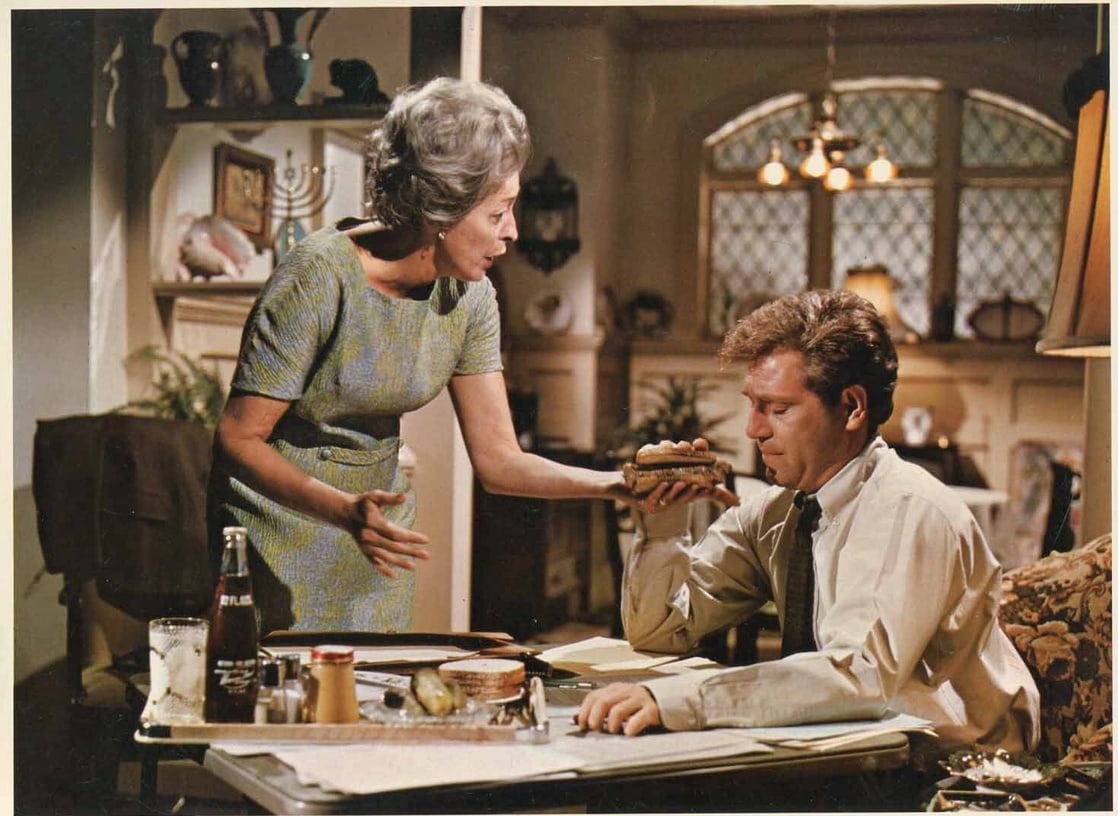
Eileen Heckart has a field day as George's Jewish mama, Mrs. Brummel. The character is a total stereotype, but Heckart makes the mama good-hearted and fun, beneath the endless kvetching! Eileen was the next generation Thelma Ritter.
Eileen Heckhart as the Jewish mama of Segal's cop Morris Brummel, multi-tasking.

Rod Steiger's serial killer offers an impersonation of W.C. Fields to George Segal's harried cop. Segal's reaction was like the critics later, when Steiger played Fields!

Rod Steiger has a field day as a would-be actor whose mother was the real talent in the family. His frustrated character, Christopher Gill, busts out every cliché in the book: the Irish priest; the gay hairdresser; the German plumber, etc. Steiger even offers an ear-splitting imitation of W.C. Fields—a film role he played later—and is so over the top that Segal’s Mo responds by wincing! Still, Jack Smight later wrote that while he had to remind Steiger to stop chewing the scenery, the method actor was totally committed to the role. Steiger gives it his all, and any Rod excess just benefits the character. Steiger as Christopher is funny, vain, scary, neurotic, sad, and just about everything in between. What’s especially interesting about Rod’s character is that he truly engages his victims that you hate that he’s going to kill them! Also, darkly funny, is when Gill follows his own press about the murders, like an actor reading his reviews.
Rod Steiger as killer Christopher Gill, keeping track on his press persona.

This film is filled with great character actors. Murray Hamilton seems to have been in every movie during this era, starting from ‘59’s Anatomy of a Murder through ‘75’s Jaws. Hamilton is Inspector Haines, Brummel’s no-nonsense boss. David Doyle, future Charlie’s Angels wrangler Bosley, is Lt. Dawson. The victims are very distinctive, real, and sympathetic: Sybil’s mom aka Martine Bartlett as Alma Mulloy; Ruth White as Mrs. Himmel; and Irene Dailey as Mrs. Fitts. The always quirky Barbra Baxley is the one who gets away, as the cat lady, whose sister is played by an unrecognizable Doris Roberts—until she speaks!—and scares Steiger off. Michael Dunn is hyper and amusing as the wannabe killer.
Steiger's killer as hissy hairdresser "Dorian," with fussy customer, droll Barbara Baxley.

Lady is a great time capsule of NYC in the late '60s. Speaking of which, the ‘60s is when wigs went mainstream and between virtually every female character and Rod Steiger’s master of disguise, it’s like Wigstock!
Though not a classic thriller, No Way to Treat a Lady treats its audience to a gripping story with strong performances from its stellar cast.

FYI: I put all the movie overflow on my public FB  movie page. 
Lee Remick's last supper? Steiger's killer zeroes in on the cop's girlfriend.