Showing posts with label Joan Collins. Show all posts

Saturday, March 14, 2026

Veteran Joan Collins & Newcomer Jon-Erik Hexum Make ‘Male Model’


Jon-Erik Hexum, blue steel in 1983's Making of a Male Model, co-starred Joan Collins.


Making of a Male Model was a 1983 ABC TV movie, with Joan Collins riding high at 50 from her new Dynasty stardom, as an ambitious model agency owner. Jon-Erik Hexum co-stars a country boy turned NYC super model, and he got a lot of buzz from this, at just 25. The TV film made the Nielson top ten ratings the week it aired and is still classic '80s ABC/Aaron Spelling television eye candy.

A slick made for TV soap opera which borrows a bit—ludicrously—from 1970's Midnight Cowboy. Hexum as Tyler Burnett struts around the streets of NYC in cowboy gear, relying on an older woman, becoming disillusioned by unsavory characters he encounters, except for one down and out new friend. And that's where the similarities end with that gritty classic and this glossy camp classic.

Cowboy Tyler Burnett on the mean streets of NYC, in 1983's Making of a Male Model.

Joan Collins' Kay Dillon likes what she sees in Jon-Erik Hexum's Tyler Burnett,
in 1983's Making of a Male Model.

Joan Collins' Kay Dillon takes a chance on Hexum's hunky hick, and puts him up with fading gay supermodel Chuck Lanyard. Played by Jeff Conaway with over the top awfulness, his Chuck’s cynical sarcasm is a ritzy Ratso Rizzo to Tyler's rube cowboy model. Sadly, Conaway himself went down the drugs and alcohol highway, dying at just 60. Jeff was a boyish and lanky star on Taxi and in Grease, but cast as a supermodel? With a beard that makes him look like Chuck Norris, Jr.?  And BTW, has there ever been a male supermodel named Chuck?!

Fading gay supermodel Chuck Lanyard, played by... Jeff Conaway?
Here, recovering from eye surgery, in 1983's Making of a Male Model.

ABC and Aaron Spelling's favorite perennial male starlet Ted McGinley plays the current model flavor of the month, Gary Angelo. Ted, with frosted blonde hair and tan, looks and acts like a catty Ken doll. In fact, most of the models surrounding Hexum's Tyler look more like soap stars!

'80s ABC male starlet Ted McGinley as a bland but catty model du jour
in 1983's Making of a Male Model.

The story of Making of a Male Model is as old as the Hollywood Hills, but with a male twist. Instead of the gals from Ziegfeld Girl or The Best of Everything or Valley of the Dolls, it's The Boys of the Big Apple soaring and suffering here. I guess that makes Joan Collins the dragon lady, a much less rough Joan Crawford or Susan Hayward, doling out the tough lessons. And in a twist, an affair with Kay means more to Tyler than to her. Tyler responds to Kay's noncommittal nature by going down the same path as chaotic Chuck. In an about face scene worthy of any latter day Joan Crawford bitch-fest, Collins' Kay tearfully tells her secretary in the finale that she let Tyler go for his own good. Sure, Joan!

Joan Collins indicates deep emotions when the career woman tells her secretary she let besotted hunk go for HIS sake! Making of a Male Model.

Before Tyler goes totally all in for booze and dope, he says goodbye to the yellow brick road of male modeling. He buys a carriage horse and rides down the streets of NYC like a rhinestone cowboy—all the way back to Nevada? 

At this point, Joan Collins was an old hand at making glossy trash watchable. Here, early in her reincarnation as Alexis, Joan is still subtle in looks and performance as the career-minded Kay Dillon. Collins is much more humane and warm, as well. Still, you'll think Kay's crazy for not wanting to commit to quarter of a century younger Tyler, who adores her.

Joan Collins stays in character as driven career woman Kay Dillon,
and still looks lovely, in 1983's Making of a Male Model. 

Only in one scene does Joan Collins let Alexis in, inexplicably showing up for her model's shoot, in lady exec drag! From 1983's Making of a Male Model.

I was only familiar with Jon-Erik Hexum as a handsome young actor who died young. I previously have never seen Hexum in anything. That's because he quickly became a star, and who became deceased even more quickly, like James Dean, with just five credits in two years.

Jon-Erik Hexum looking all rugged with baby oil "sweat,"
in 1983's Making of a Male Model.
 

Jon-Erik Hexum's new model after his makeover. 1983's Making of a Male Model.

Jon- Erik Hexum was probably the greatest male Hollywood beauty since Guy Madison. A true knockout, he also had a strong speaking voice and genuine presence. For a beginner, Hexum is fairly decent in Making of a Male Model.  Since Hollywood was still coming off its era of realistic film leading men, Erik probably would have ruled on television, like veteran Tom Selleck. Compare Hexum with co-star Ted McGinley (one year younger) in any scene and the difference in star quality is obvious. 

Jon-Erik Hexum's Tyler Burnett cleans up nice, just in time for Joan Collins'
 boss to dump him over lunch! 1983's Making of a Male Model. 

Kevin McCarthy is in slimy villain mode as a client who plays hardball. Familiar faces have bits as fashion photographers, who all hate models: Michael Anderson, Arte Johnson, and Robert Walker, Jr. Jeff Conway's model is gay and handled sympathetically, just before the AIDS crisis. Still, his drunken monologues are the most florid since Van Heflin's BFF to Robert Taylor’s Johnny Eager.

Rhinestone Cowboy meets Cougar Cleopatra! A typical artificial Aaron
 Spelling party scene. At least Sammy Jo doesn't turn up to tear up the
dance floor! From 1983's Making of a Male Model. 

A funny moment is when Joan refers to Jon-Erik's allure as that a cougar. Collins would become Exhibit A in giving new meaning to that word! Also an eye roll is a typically awful Aaron Spelling party sequence, which bears no resemblance to one in the real world. Jon-Erik is duded up as a Rhinestone Cowboy. And Joan Collins gets a chance to play dress-up as Cleopatra once again—Collins tells anyone who will listen that she almost appeared as the Egyptian queen in the 1963 epic. Again—sure, Joan!

Jon-Erik Hexum & Joan Collins make a hot May-December couple in 1983's
 Making of a Male Model. 

Making of a Male Model is really Jon- Erik Hexum's show, with Joan Collins as the special guest star. But they have a nice rapport and make a most attractive older woman/younger man couple. Sadly, a year later, Hexum would be dead a month before turning 27, from an on-set shooting accident. And as of this writing, Joan Collins will be 93 on May 23, 2026. Cheers to Ms. Collins, a true Hollywood survivor!

Joan Collins signature role!

My look at Dynasty, the show that made a star of Joan Collins: https://ricksrealreel.blogspot.com/2020/02/dynasty-catfights-cliffhangers-clothes.html


Jon-Erik Hexum's Tyler Burnett will give you "Fever!" 1983's Making of a Male Model. 


Thursday, September 28, 2023

Joan Collins is ‘The Girl in the Red Velvet Swing’ 1955


Joan Collins is Evelyn Nesbit in 1955's "The Girl in the Red Velvet Swing."


Based on one of the most shocking scandals from the early 20th century, The Girl in the Red Velvet Swing depicts the Stanford White/Evelyn Nesbit/Harry K. Thaw triangle, which eventually led to White's homicide by Thaw in 1906.

20th Century Fox made the film bio in 1955, starring Joan Collins as Evelyn, with Nesbit herself as a consultant. That made for great publicity, but The Girl in the Red Velvet Swing was filmed in the summer of '55, when Hollywood's censorship code was just beginning to crumble. That meant the unsavory private lives of this triangle’s principals had to be white-washed.

Evelyn Nesbit acted as consultant on 1955's "The Girl in the Red Velvet Swing."
Nesbit was then 70, with Joan Collins, just 22 when she played Evelyn.

What's left? The Girl in the Red Velvet Swing is a lavish, beautifully filmed Cinemascope soap opera that feels like a stage production. If the actors seem bland, that's mostly because they have one-dimensional characters to play. A book could be written just about the facts versus fiction of this film. The bare bones of the film do follow the triangular story; however, the key motivations, character flaws, and actual incidents along the way have been white-washed or changed wholesale.

The real Evelyn Nesbit as a popular teen-age model.

For Joan Collin's, this was her first starring role in an American film, under contract at 20th Century Fox. Just turned 22, Joan is femme fatale Evelyn Nesbit.  It's hard to believe that Fox first offered this to Marilyn Monroe, who turned it down. Monroe was 7 years older than Collins, yet asked to play a teen Lolita.

The first time architect Stanford White sees model Evelyn Nesbit.
Joan Collins' first starring role, as "The Girl in the Red Velvet Swing."

 Collins was certainly a dark beauty as Nesbit, but this may be the most white-washed character of all. Nesbit became a supermodel of the era, while still in her mid-teens. Her famed beauty led to a role in the hit musical, Florodora. Evelyn Nesbit liked older men and was probably encouraged by her mother, a struggling seamstress. At one point, she had to put Evelyn and her brother to work as young teens in a factory, laboring 12 hours a day, six days a week. And then a millionaire comes along and offers to put both your children in upscale schools and ply you with gifts and money... This is the opposite of how The Girl in the Red Velvet Swing portrays the story. When Evelyn breaks down at the private school after Stanford White steps back from their romance, it's depicted as a nervous breakdown. In actuality, she claimed it was appendicitis while others gossiped it was an abortion.

Joan Collins as model/show girl Evelyn Nesbit. Here, she's depicted as recovering
from a fictitious nervous breakdown, in 1955's "The Girl in the Red Velvet Swing."

At the murder trial, Nesbit is prevailed to testify in Harry Thaw's favor and trash White on the witness stand, after Evelyn falls for his mother's sob story about Harry's troubled childhood. It’s hard to believe that a young woman like Nesbit would give up her trump card to such a nest of vipers, with no guarantee of them helping her after the trial. In the film, they don't, of course.

"Dynasty" wasn't Joan Collins first time playing a femme fatale on a witness stand!
 Collins as Evelyn Nesbit, in 1955's "The Girl in the Red Velvet Swing."


Collins was groomed as Fox to be their answer to Ava Gardner and especially, Elizabeth Taylor. At this point, Joan was not seasoned enough as an actress to bring the animal vitality that Ava had or the empathy that Elizabeth brought to her roles. As The Girl in the Red Velvet Swing is a one-dimensional film, young Joan doesn't have a lot to work with and mainly postures prettily in mid-century film starlet style. Joan looks lovely and wears beautiful costumes and hairstyles, but the character of Evelyn Nesbit is a blank slate, not helped by the script or actress. Even at the finale, when Joan's Nesbit shoots a zinger at the Thaw family, it comes off very flat. Joan has some sweet moments as the girl with a very big crush on White, or her Scarlett O'Hara-like flirting with both men. Collins studied her American accent with fellow Fox star Jeffrey Hunter, but Joan's rather nasal voice attempting an American accent in the emotional scenes sounds odd.

Joan Collins' Evelyn Nesbit finds out that Ray Milland's Stanford White
won't be leaving his wife for her, in 1955's "The Girl in the Red Velvet Swing."

According to Ultimate Film Rankings, The Girl in the Red Velvet Swing made $65 million in today’s dollars, not a bulls-eye for a big budget movie promoting Collins in a starring role. Judging from Joan’s subsequent Fox movies, Zanuck seemed to have instantly given up on Collins, considering how intrigued he was by her in Land of the Pharaohs. Her biggest film at Fox was another soap opera, 1957’s Island in the Sun. This film made a fortune because it was based on a huge best-seller about interracial romance, wherein Joan was the second female lead to Joan Fontaine.

Ray Milland as Stanford White, about to be shot in public, by Harry K. Thaw,
in 1955's "The Girl in the Red Velvet Swing."

Stanford White, white-washed as he is, is made watchable by Ray Milland, who comes off best of the actors. Milland convincingly plays the superstar architect and is very distinguished, authoritative, and handsome at 50. There are just hints that White was a married womanizer who liked very young women, 48 when he met Nesbit. Evelyn was just 16 when she and White began their affair. In this era of Me Too, White would probably get branded a groomer and predator. During the trial, the defense made the claim that not only did White ply Nesbit with champagne, but drugged her when he took Evelyn’s virginity. Who can truly say? But in The Girl in the Red Velvet Swing, Milland's White several times makes a point to allow Nesbit just one glass of champagne. As for their affair, they kiss just twice! It doesn't mention that after their romance, White moves on to other young women.

The movie Stanford White makes sure Evelyn Nesbit has only ONE glass
of champagne! Ray Milland & Joan Collins in "The Girl in the Red Velvet Swing."

It was also alleged that White and other rich NYC men ran a sex club where they shared under-aged girls. Some things never change! In the film, when White finds that Nesbit's been hired to jump out of a giant pie at a stag party, he has her replaced, and sent home with the cash she would have made. That event happened, but over a decade prior, before Evelyn’s time. The actual girl was so ashamed by the later talk that she disappeared for a decade.

Harry K. Thaw turns out to be a horrible husband to Evelyn Nesbit. Farley Granger
& Joan Collins in 1955's "The Girl in the Red Velvet Swing."

Harry K. Thaw, the poor little rich boy, sort of the Nicky Hilton of his era, is played by Farley Granger. He's quite handsome as always and has the showiest role as the deranged playboy. Thaw's sadistic private life gets very toned down and Granger performs with his typical petulance. The role is one-dimensional, but Farley mostly plays him as a surface character, as well. Shaw was an infantile man child enabled by his mother. He used drugs, alcohol, and women. He was physically abusive and acted out publicly. Granger's usual hurt puppy dog eyes and pouting expression style of acting is irritating. But Granger has a few moments as when he decides to shoot White publicly or his final scene, when he gives Evelyn the brush off. Overall, his more grandiose scenes are serviceable but not inspired.

Farley Granger's Harry K. Thaw gets off the murder charge by reason of insanity,
 then gives Joan Collins' Evelyn Nesbit the brush-off. "The Girl in the Red Velvet Swing."

The supporting cast is solid, right down to the bit parts. Frances Fuller is empathetic and believable as White’s wife. One-time WB star Glenda Farrell is a scene-stealer as Evelyn’s pragmatic mother, as presented here. Cornelia Otis Skinner is a bit chilling as Mrs. Shaw, Harry’s two-faced mother. Reptilian Luther Adler is effectively creepy as Shaw’s defense lawyer.

Evelyn Nesbit's fame was confirmed when she became a "Gibson Girl" for the cover
of Collier's Magazine. From 1955's "The Girl in the Red Velvet Swing."

Richard Fleischer was just hitting his stride as a young director when he helmed The Girl in the Red Velvet Swing. He gradually fell into directing crowd pleaser movies, many successful, some dreadful. Here, Fleischer tries to imply some of the details of this scandal without directly addressing them. Also, he seems to make the red velvet swing in White’s pleasure dome hideaway a symbol for Stanford and Evelyn’s affair. Fleischer staged the climactic scene, of White’s public shooting by Thaw, quite skillfully.

A tense moment when Harry K. Thaw decides to shoot Stanford White.
Farley Granger in 1955's "The Girl in the Red Velvet Swing."

The Girl in the Red Velvet Swing is filled in with very watered down facts, and typical film fiction soap opera storytelling. The production is lavish, some say over-produced, but this was the Gilded Age, right? There are many books and docs on this ill-fated trio that tells the whole story. Having that knowledge will make this fill in the blanks production more watchable.

At the film's finale, there's nothing left for Joan Collins' Evelyn Nesbit to do
but cash in on her notoriety as "The Girl in the Red Velvet Swing."

This moral of this story is that bad behavior by people with wealth shows that there is nothing new under the sun. And people will never tire of reading or watching their scandalous stories.

My in-depth look at Dynasty, the TV show that made Joan Collins a genuine star:

https://ricksrealreel.blogspot.com/2020/02/dynasty-catfights-cliffhangers-clothes.html

My close-up look at what really made Dynasty, the female stars, led by Joan Collins as Alexis!

https://ricksrealreel.blogspot.com/2020/02/the-divas-of-dynasty-1981-89.html


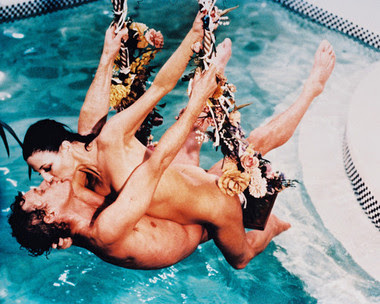
"The Girl in the Red Velvet Swing" wasn't Joan Collins last time as a saucy swinger!
 Nearly a quarter of a century later, Joan joins "The Stud" for a ride.

Monday, July 13, 2020

‘Island in the Sun’ 1957

Only Dorothy Dandridge & Harry Belafonte rise above the soapy script of 'Island in the Sun.'


Island in the Sun, by British author Alec Waugh, made a huge splash, selling 900,000 copies in 1956. The novel mixed politics, race, and S-E-X. Former 20th Century Fox head Darryl F. Zanuck, now the studio’s independent producer, envisioned Island as an international picture, with lush locations, torrid romance, and an unflinching look at interracial relations. Well, one out of three ain’t bad!
Darryl F. Zanuck's first independent production missed the mark depicting its subject matter.

The tensions between Island in the Sun’s characters stem from personal and power struggles over race in Santa Marta, a fictional Caribbean island. The Fleury family and their sugar plantation epitomize British power. David Boyeur is a black labor leader who wants to shake up the status quo and fight for the island people. Fleury scion Maxwell, an arrogant ne’er-do-well, decides to run against firebrand David for legislature. A news story reveals that the Fleurys have island blood mixed with their British blue blood. “I wanted to keep things as they were,” the Fleury father laments. This makes Maxwell even more insecure and his sister Jocelyn frets over her chances of marriage to the Governor’s son, Euan. Speaking of the Gov, his aide Denis Archer falls in love with black shop girl, Margot Seaton. Islander David is drawn to Brit aristocrat Mavis Norman. The consequences of all this, with added soap opera twists, causes the cast to drown in the ensuing suds.
'Island in the Sun' made a boatload of money in '57, but wasn't well-liked of by audiences or critics.

Zanuck thought that tough-minded director Robert Rossen was suitable to handle the racial/interracial themes. Either Zanuck or Fox copped out on that aspect. 20th Century Fox was especially good at the Hollywood shell game, promising scandalous controversy, but delivering mildly salacious soap opera: Peyton Place, The Best of Everything, and Valley of the Dolls are prime examples. The resulting glossy soap opera wasn’t really Rossen’s greatest genre. He made his mark with gritty films, writing A Walk in the Sun, and writing/directing Body and Soul, All the King’s Men, and finally, The Hustler.
Sold as a sexy movie, the couples of Island in the Sun rarely get up close and personal. David and Mavis barely touch each other, Margot and Denis only hug, and Jocelyn (whose racial background is questioned) and Euan first kiss just 30 minutes before Island is over! Despite the pussyfooting around, Island deserves credit for the finale, when David and Mavis break up, and he admits it’s easier for Margot to marry a white man, than for him to be with a white woman.
As close to interracial romance as 'Island in the Sun' got, with a fervent hug from Dorothy!

Still, Island in the Sun received great pre-publicity and became one of the year’s biggest hits. The sun-kissed soap also got the kiss-off by critics, which is why it’s not well-remembered these days. While the look at race and island life is surprisingly direct, interracial romance is handled very demurely, which made Island instantly dated. Still, movies like Island in the Sun took the first baby steps. There have been so few interracial film romances since, which still makes Island a significant footnote in Hollywood history.
Dorothy Dandridge should have been at the peak of a movie career, not dead at 42.

Island in the Sun possessed a great cast of veteran and then up-and-coming stars: James Mason, Joan Fontaine, John Williams, Diana Wynyard, Michael Rennie, Patricia Owen, Stephen Boyd, Joan Collins, John Justin, Harry Belafonte, and Dorothy Dandridge. What really let this solid cast down, aside from the watered-down story, is the soggy script and dialogue.
Dorothy Dandridge's spirit and beauty was a breath of fresh air in 'Island in the Sun.'

Two exceptions are Harry Belafonte and Dorothy Dandridge. Their characters are no better written than the rest, but both have charisma to burn, and Dandridge in particular rises above the stale storytelling.
Dorothy Dandridge’s sweetly beautiful face belies her strong-willed personality. As Margot, she’s a shop girl who wants to better herself—shades of ‘30s Joan Crawford! Then Dorothy falls in love with the governor’s aide, routinely acted by British John Justin. Dandridge has that young Susan Hayward energy, all smart, snappy, and sparkling. Dorothy gets a hug from her white lover, though she demurely dodges a standard screen kiss, per censor cop out. She flies off with him at the movie’s end, just like a decade later, with Sidney Poitier and white fiancée Katherine Houghton in Guess Who’s Coming to Dinner? They kiss, though shown in a tax rear view mirror!
Harry Belafonte has a strong screen presence as David Fleury, the man of the people.

Harry Belafonte, as David Boyeur, is a naturally commanding presence. That he gets to sing the lovely theme song and a rousing “work” ballad with island fishermen is a bonus. Harry is best as the stubborn island labor leader, who wants to help his people, and is blunt regarding class structures. Belafonte’s David meets Joan Fontaine’s Mavis, a wealthy socialite who is kind but self-admittedly useless. Whatever draws these two to one another is ambiguous, so their romance goes nowhere.
However, Belafonte’s David gets in some pointed racial commentary that still rings true today. His labor leader candidate tells a reporter at a party: “One of the most important fights is against tradition. This island is shackled by tradition.”
After heated exchanges between Boyeur and plantation heir Maxwell Fleury, he tells David that his field hand father was treated well by the Fleurys, even when he was sick. Boyeur retorts, “That was charity, Mr. Fleury. What we want is equality.”
Stephen Boyd & Joan Collins don't kiss until the movie 3/4 over! Not the most sultry 'Island.'

Whereas Harry and Dorothy rise above the script, Joan Collins and Stephen Boyd barely stay afloat. Both are in the prime of their beauty and play their parts smoothly. And that’s the problem; they’re performing like graduates of a Hollywood charm school. For once, Joan wasn’t trying to play an American; here, she’s an English ingénue. Collins was in the middle of her Fox tenure and it was roles like this that buried her. Joan was not able to rise above the lackluster script, like other genuine movie stars. Stars that are born film actors connect with the camera, and are at home in front of the lens. Great stars can usually rise above bad scripts, dialogue, and uninspired directors. Joan Collins never could.
As an actor, Stephen Boyd shows off his best assets. 

Stephen Boyd is perfectly pleasant—mostly visually—as the son of the island governor who wants to marry Joan, no matter what her heritage. While relaxed and easygoing, Boyd is a dramatic void on the screen. Stephen Boyd never became a lasting leading man, despite the buildup, because he lacked real depth or charisma. Compare Boyd to Sean Connery, a Scotsman to his Irishman from the same era, and the difference is obvious.
This is about as close to sizzling romance as Joan Fontaine & Harry Belafonte get in 'Island.'

As for Joan Fontaine, what to say? I never thought Fontaine had much range—lots of limpid eyes, the raised eyebrow, and her ubiquitous small smile or smirk. Fontaine could perform well, in an extremely small range, whether as a repressed heroine or smooth villainess. However, her patrician manner is utilized well here and Fontaine seems fond, if not wild about Harry. A still-telling scene is when Mavis and David buy local children sodas and a white mother makes her little girl give the soda back. Of the racism, Fontaine’s Mavis says, “The children don’t seem to know about that, do they?” David responds pointedly, “Not yet.”
The only overt sex scene in 'Island' is when James Mason's Maxwell commits husbandly rape.

As Maxwell Fleury, James Mason has a field day as the drunken son from a wealthy family, much like Robert Stack’s character in Written on the Wind: Self-loathing, ineffectual, and abusive. Maxwell is the personification of white privilege, especially when things don’t go his way. When he announces to his parents that he plans to run for office against David Fleury, they are rightly not impressed. Maxwell has a hissy fit, capped with, “I’d been better off if I had been born black!” This is rejoined by a slap from his mother and his father offering him a drink. Talk about a dysfunctional dynasty.
Mason’s Maxwell is a drag in other ways, too. His fatal assault and subsequent guilt trip hijacks Island in the Sun from its more topical issues. Michael Rennie’s Hilary Carson comes to an abrupt end. Rennie, a solid actor, barely has time to introduce his character, when Maxwell causes his demise.
Joan Collins & James Mason play rich kids in 'Island,' despite a quarter of a century age difference!

This was veteran British actress Diana Wynard’s last film, and is used mostly for her class, as the wealthy Fleury matriarch with a few secrets. John Williams is on duty again as an inspector, out to solve the murder of Hilary. Patricia Owen is sympathetic as Mason’s extremely put-upon wife, Sylvia.
The location cinematography— in Grenada, Barbados, and Trinidad—by Freddie Young, is superb. Young made his name in Great Britain, then in the U.S. at MGM, and finally, Freddie freelanced to great acclaim, especially as David Lean’s favorite cinematographer. As a travelogue, Island is lovely, and the few romantic scenes are artfully framed.
Island in the Sun deserves credit for stating the unfair economic, political, and social system in the Caribbean. The film gets applause for Belafonte and Dandridge getting to play strong characters, without stereotype or condescension. Island is worth watching on several levels, but the film sadly missed an opportunity to portray interracial romance with any real honesty or passion.
Things were apparently more lively off-camera than on, regarding 'Island in the Sun!'
FYI: I put all the movie overflow on my public FB  movie page.