Showing posts with label Robert Aldrich. Show all posts

Wednesday, October 11, 2023

“Hush… Hush, Sweet Charlotte” Still Chills 1964


Bette Davis & Olivia de Havilland go head to head in 1964's southern gothic
suspense film, "Hush... Hush, Sweet Charlotte."


Hush… Hush, Sweet Charlotte was a follow-up to the surprise 1962 smash, What Ever Happened to Baby Jane? While Baby Jane was aptly released that Halloween, Charlotte oddly opened during the 1964 Christmas season. Both fright films got mostly good reviews and made money, but Baby Jane was the one that stayed fixed in movie fans’ memories, with its comic horror look at Hollywood. Still, Charlotte succeeds as a straight-up southern gothic suspense film. While there are numerous similarities to Baby Jane, Charlotte also has some surprises.

"Hush... Hush, Sweet Charlotte" was the 4th and last film that Olivia de Havilland &
 Bette Davis co-starred together.

Aside from the twisty tale, the top drawer cast really puts Hush… Hush, Sweet Charlotte over. Bette Davis, as Charlotte Hollis, gets a raucous role to sink her teeth into. Davis’ son, Michael Merrill, said that she initially didn’t want to play another hag horror role and thought the script was too gruesome. Even after Baby Jane, work and money for 50-something female stars were scarce, so Bette accepted Charlotte.

Victor Buono's a big daddy indeed, as Sam Hollis, who wants to make sure daughter
 Bette Davis doesn't become a Jezebel! 1964's "Hush... Hush, Sweet Charlotte."

Hush… Hush, Sweet Charlotte starts with a prologue in 1927 at the Hollis family mansion. Patriarch Sam Hollis is raging at John Mayhew, a married man who’s having an affair with his young daughter, Charlotte. After some wrangling, John agrees to end it. At a ball in the Hollis mansion, Charlotte’s married lover meets her at the “summer” house. She doesn’t take the news well, despite John’s claims that he did love her. Moments later, someone comes back. John thinks its Charlotte and whoever the visitor is, they brought a cleaver that’s been used to open champagne cases. The ball comes to a halt when Charlotte reappears with blood on her white ball gown. Though she is never charged, everyone assumes that Charlotte butchered John Mayhew. Cut to present day 1964, with eccentric Charlotte fighting the authorities over moving out of the family manse, to make way for highway construction. When Charlotte’s Cousin Miriam comes to help, it’s an even bumpier ride.

Bruce Dern's characters suffered grisly flashback demises in both 1964's
"Marnie" & "Hush... Hush, Sweet Charlotte." 

Young Charlotte's reputation is forever stained by the suspicion of murder of
John Mayhew, in 1964's "Hush... Hush, Sweet Charlotte."

While Bette Davis doesn’t hold back portraying Charlotte’s pepper pot personality, she has subtle moments too, such as scenes with a curious reporter, played by Cecil Kellaway. The same is true of Agnes Moorehead as brash but devoted maid Velma. Moorehead is truly outrageous in some scenes, especially when she spars with Charlotte’s villains. Agnes has sly silent moments as well as sincere ones, like when Velma aims to look out for Charlotte’s welfare. The veteran character actress makes the most of her over the top role and got a well-deserved Best Supporting Actress Oscar nomination, and winning a supporting Golden Globe.

Agnes Moorehead has a field day as fiesty housekeeper Velma, in 1964's
"Hush... Hush, Sweet Charlotte."

As Cousin Miriam, Olivia de Havilland makes one smooth villain. As the poor relation taken in as a child by the Hollis family, Miriam returns at Charlotte’s behest. Olivia’s honeyed gentility and wide-eyed concern harkens back to her classic role as Melanie in Gone with the Wind. Except this time, her southern cousin IS too good to be true. One of Olivia’s few bad girl roles, she’s quite intriguing, and only goes over the top like her other female co-stars when Miriam shows her hand—sometimes literally!

Olivia de Havilland plays "sweet" Cousin Miriam in "Hush... Hush, Sweet Charlotte."

Barbara Stanwyck said that she was never asked to play Miriam, as sometimes written, but was requested to play Jewel Mayhew, John’s wife. Which Stanwyck turned down, as the part consisted of two scenes. In this cameo role, Mary Astor as Jewel is mesmerizing. Mary plays a dying woman in her final acting job, and plays the role simply and hauntingly. Mary’s encounter with Olivia is zingy, and her long scene with Kellaway is melancholy. Astor makes every moment count.

Mary Astor is superb in her cameo role as Jewel Mayhew, the wife of Charlotte's
slain lover. From 1964's Hush... Hush, Sweet Charlotte."

There are several encore actors from Baby Jane: Victor Buono plays Charlotte’s imposing Big Daddy, Sam Hollis; Wesley Addy—Blanche Hudson’s “nice Dr. Shelby”—is the sheriff who must deal with cranky Charlotte; and Dave Willock, Baby Jane’s beloved daddy, is the cab driver who brings Miriam back to the scene of the crime.

Joseph Cotten was the original Dr. Drew! He's Charlotte's doc and Miriam's ex-suitor
 in 1964's "Hush... Hush, Sweet Charlotte."

Joseph Cotten offers his smooth southern charm, played with laconic humor, as Drew Bayliss, Charlotte’s doctor and Miriam’s former beau. Cotton co-starred with Bette Davis 15 years earlier, in her WB swan song, Beyond the Forest. George Kennedy just tangled with Crawford in Strait-Jacket, and does the same as head demolition guy in Hollisport. Bruce Dern plays John Mayhew, Charlotte’s married beau, in the prologue. Later, he’d work again with Davis, as one her criminal sons, in a very special Gunsmoke episode. Cecil Kellaway’s gentle scene stealing offers contrast to some of the ladies and their scenery chewing. And look for John Megna (Dill from To Kill a Mockingbird) as the new kid who’s dared to go inside outcast Charlotte Hollis’ mansion. Lillian Randolph, the beloved Annie of It’s a Wonderful Life, is one of the packing ladies; squeaky-voiced Percy Felton is the funeral director; The Waltons Ellen Corby and Helen Kleeb are local gossips; and Frank Ferguson plays the local newspaper editor, while he was playing Eli Carson on TV’s Peyton Place.

Hush… Hush, Sweet Charlotte has the same upsides and downsides as Baby Jane. On the plus side, the cast is uniformly good, the story entertaining, and the production values strong. The debit side is mostly director Robert Aldrich’s weak points. While he’s a strong storyteller at his best, Aldrich’s tendency to overstatement causes Charlotte to run 2 and ¼ hours, and like Baby Jane, about 15 minutes too long. Both movies have entertaining but lengthy prologues and drag a bit in the last half. Both thrillers have some plot points that don’t bear scrutiny. Also, both movies have theme songs that get reprised one time too many!

Cecil Kellaway as a curious reporter & Bette Davis as Charlotte share some subtle moments in "Hush... Hush, Sweet Charlotte."

Among the other similarities between Charlotte and Baby Jane: Prologues that get a kicker in the films’ finales; two outspoken housekeepers; Bette as a disturbed daughter with daddy issues; Davis’ antagonists are charming phonies; dead bodies that must be disposed of; and Charlotte and Jane’s last scenes are of them being gawked at by onlookers.

Charlotte and Baby Jane were made in the early ‘60s, when there was the last vestige of film glamour versus plot sense. In Jane, Joan Crawford’s invalid Blanche still has lovely nail polish and lipstick despite having been a recluse for three decades. In Charlotte, after Bette Davis bravely threw down the glamour gauntlet as bizarre Baby Jane, is this time out the star that sneaks in a little glam for her aging Jezebel. Though Charlotte Hollis has seen only the maid and her doc for the last 35 plus years, she still sports makeup mortician Gene Hibbs’ war paint. And wears high heels, when not running around barefoot sporting a nightie and a shotgun! If only Bette had sported a more authentic no-makeup look like co-star Mary Astor. But then, maybe that’s why Bette was playing the title role and Astor had a two-scene cameo. Interestingly, Olivia de Havilland shows her Paris way of life in her own Dior wardrobe and chic bouffant, plus makeup that stays inside the lines of her facial features!

"I thought this Gene Hibbs makeup was supposed to make me look younger!"

Much has been made of Joan Crawford’s departure from Hush… Hush, Sweet Charlotte. I’ll only say that Joan could have played the silky villain with assurance and style. In fact, Crawford played a number of charismatic, insincere types for nearly 15 years before Charlotte. Who knows whether Joan left because she was genuinely sick or just sick of sparring with Bette Davis. Crawford claimed illness in another tense situation nearly two decades before, on Oscar night of 1946, with similar speculation. What’s unfortunate is that some Joan fans take out their ire on Olivia, who was a reluctant last minute replacement. Crawford probably would have played in a grander style, closer to Bette and Agnes’ performances. But Olivia’s casting against type, as a cool villain is its own fun.

Joan Crawford was to play Cousin Miriam but claimed illness and dropped out.

Was this the sparkly dress that Olivia's Miriam found slashed in the closet?

Trivia: Was the sparkly dress that Olivia’s Miriam finds slashed in her closet the one that Joan’s Miriam wore for the homecoming dinner scene? Also, I found it amusing that Bette, who liked to slap co-stars as much as Joan did, chickened out in the car scene where Miriam drops her mask. Though new Miriam Olivia was a long-time friend and co-star, Bette asked that her slaps be faked, and it shows! Finally, while a younger double is used for Charlotte, why on earth did they use Bette’s 60-ish cigarette voice, where she attempted to sound younger?

And typical of the mid-century moviemaking, the flashback scene of a ‘20s party looks like a ‘60s prom with a flapper theme. Also unfortunate is that the only blood on Charlotte’s dress is on her lap area! At least the other girls didn’t throw tampons at her, like Carrie!

The story/script by Henry Farrell and Lukas is most clever, despite some holes in logic. The music by DeVol is atmospheric, and Joseph Biroc’s wonderful cinematography is striking and truly adds to the mood. Also, I’ve visited one of the two Louisiana’s mansions featured in Charlotte. Miriam’s home is actually Oak Alley Plantation and it is stunning.

Mary Astor as Jewel, with a the reporter, played by Cecil Kellaway. Jewel's home is
 represented by the Oak Alley plantation. "Hush... Hush, Sweet Charlotte."

Here’s my take on the legendary Baby Jane! https://ricksrealreel.blogspot.com/2016/10/bette-and-joans-acting-duel-whatever.html

Here’s the one other time Olivia played evil, in The Dark Mirror! https://ricksrealreel.blogspot.com/2023/07/10-takeaways-olivia-de-havilland-dark.html 

Bette Davis & Olivia de Havilland aren't exactly kissin' cousins in 1964's
"Hush... Hush, Sweet Charlotte."


Wednesday, September 21, 2022

Crawford's Latter Day Best: ‘Autumn Leaves’ 1956


A young Cliff Robertson and mature Joan Crawford have a believable chemistry
in the May-September romance, "Autumn Leaves."


Autumn Leaves offered a rare sympathetic role for Joan Crawford in the 1950s, the autumn of the great star’s career. This was also Crawford’s first collaboration with director Robert Aldrich, usually known for his tough take in storytelling. In this adult soap opera, their team work is subtle and sympathetic.

Joan Crawford's Milly is a typist and you better believe she's the best!

Crawford plays Milly Wetherby, a work at home typist, who meets a younger man on a rare evening out. Burt Hanson, played by film newcomer Cliff Robertson, is a returning veteran. They strike up a friendship, which leads to romance. Initially resistant because of their age difference, Milly comes to realize that she really loves Burt. They marry and the honeymoon period is idyllic. Reality intrudes when Burt’s past catches up to him in the form of an ex-wife and estranged father. The young man’s stories don’t add up, and his family’s version doesn’t speak well for him. And their claim that he is unstable is indisputable, as Burt begins to fall apart. Still, there is more than meets the eye, as Milly is determined to not only help Burt, but get to the truth of the matter.

Crawford's Milly eventually realizes that she's ready to take a chance on love with
 Robertson's Burt Hanson in "Autumn Leaves."

Kudos goes to both director Aldrich and star Crawford.  They were known to go over the top and both the film’s direction and lead performance are surprisingly restrained and effective. Yes, there are moments when Robertson's troubled young man’s downfall is a bit voyeuristic. But Aldrich is empathetic to character Burt Hanson’s plight and makes him neither a weakling nor a bad guy. The director gives this "woman's picture" a noir-ish take, with camera work that heightens the tension. Best of all, Aldrich's look at the May-December romance between the typist and the tie salesman is treated seriously. 

Burt Hanson's mental illness is handled sensitively in "Autumn Leaves,"
without sentimentality or sensationalism.

As for Joan Crawford, she rarely got to play a sympathetic character so warmly in the '50s—an era of tough cookies, control freaks, or flat-out neurotic bitches: The Damned Don't Cry; Harriet Craig; This Woman is Dangerous; Torch Song; Johnny Guitar; Queen Bee; Female on the Beach; and The Best of Everything. 

Joan Crawford's Milly, having a night on the town, in "Autumn Leaves."

Joan's spinster typist Milly Wetherby is practical, confident, yet warm and caring; Crawford’s scenes depicting her loneliness certainly resonate. When Millie finally takes a chance on love, she gives her all, and you care for Crawford’s character. Along with Baby Jane, this is Joan's best latter day role and performance. Except for a few trademark Crawford poses in some of the big scenes, Joan is at her most genuine and straightforward here.

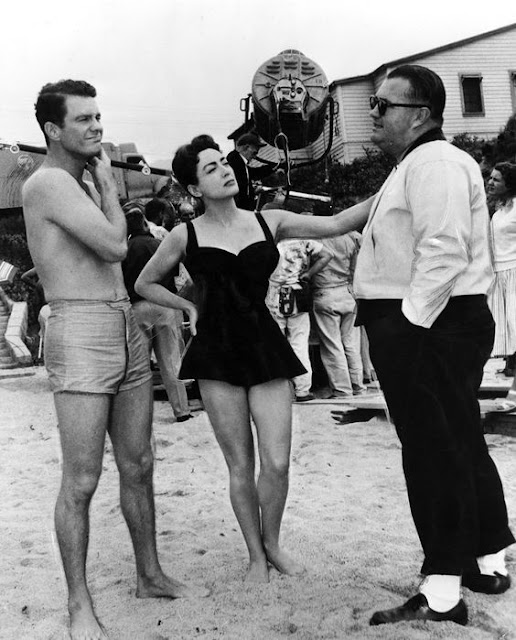
At nearly 50, Joan was in fine form in "Autumn Leaves," here with
co-star Cliff Robertson and director Robert Aldrich. 


The only criticism I have is that it's a shame someone couldn't get Joan to tone down her visual style in Autumn Leaves. At nearly 50, a swimsuit scene shows Joan in fine form and her huge eyes and bone structure were eternal. While the infamous Crawford shadows are ever-present, along with some heavy duty makeup contouring from the jaw line down, this was pretty typical of the era. But Joan's makeup of her eyes, eyebrows, and lips are truly startling, especially when she's in scenes with younger cast members, who are made up to look like merely attractive mortals. Joan’s severe cropped hair was unfortunate for most of her '50s.This called more attention to her age, along with some ill-advised extreme close-ups. 

Not sure who thought extreme close-ups like these of Joan Crawford were a good idea.

As Burt Hanson, this was Cliff Robertson's first leading man role. Robertson would play another mentally challenged man a dozen years later, as Charly, for which Cliff won an Oscar. Robertson uses his boyish charm to an almost Jimmy Stewart-like degree. He's very winning and it’s startling when he turns on a dime into a rage. When his character is hauled away, Burt has a male Blanche DuBois moment. 

Robertson's Burt depends on the kindness of strangers and Crawford's Milly
in "Autumn Leaves."

The 1956 film featured a great supporting cast, with Vera Miles looking every inch the Hitchcock blonde as the scheming ex-wife. This year was a break out for Miles as well as Cliff Robertson. Along with this showy role, Miles worked with John Ford in The Searchers and Alfred Hitchcock for the first time in The Wrong Man. Smoothly villainous Lorne Greene is memorable as Burt’s father, before he became saintly patriarch Ben Cartwright three years later. Ruth Donnelly is a scene stealer as outspoken but big-hearted Liz, Milly’s apartment complex manager. Also, future Baby Jane cast member Marjorie Bennett has a great bit as the waitress with an attitude.

A striking shot of Burt's loving family, as played by Lorne Greene and Vera Miles.

There's a number of lovely scenes in Autumn Leaves: the banter between landlady Liz and Joan's work-at-home typist; lonely Joan determined to have a nice night out solo; the first meeting of Burt and Milly at the restaurant; their courtship and the navigation of trust into love; the scenes where Milly battles Burt's selfish father and ex-wife that give Joan a chance to breathe some fire; the breakdown scenes, which are realistic; and the ending is hopeful, but not corny.

The two Mrs. Hansons: Joan Crawford as the current Mrs.; Vera Miles is the ex!

For a ‘50s film soap opera, Autumn Leaves feels authentic. It’s a Crawford fan favorite, and even those who aren’t one of Joan’s fans may be pleasantly surprised.

"Autumn Leaves" seems to be copying the love scene from another Columbia film,
 "From Here to Eternity." Legend has it that Joan Crawford turned the Deborah Kerr role down!

Also, here’s my look at Joan’s signature role, Mildred Pierce: https://ricksrealreel.blogspot.com/2020/03/how-joan-crawford-became-mildred-pierce.html

Milly gets her happy ending, though warned Burt might have changed once cured,
at the finale of "Autumn Leaves."


Monday, November 15, 2021

“The Legend of Lylah Clare” 1968

Kim Novak as Elsa Brinkmann, facing the press in "The Legend of Lylah Clare." 
The scene is afternoon, but the window's view always says sunset in Transylvania!


Robert Aldrich, one of the least subtle directors ever, made one of his most outlandish and personal films in 1968, The Legend of Lylah Clare. The 130 minute Tinseltown tale was taken from a 60 minute ‘63 TV drama. Aldrich loved showbiz gothic—imagine The Big Knife, Whatever Happened to Baby Jane?, and The Legend of Lylah Clare in a triple feature.

How many camp classics feature the star madly slashing away at a portrait?!

This type of hothouse Hollywood story was out of style by the late '60s, when gritty new movie realism had taken hold. What we have here is a Sunset Boulevard-esque show biz mystery: What Really Happened to Lylah Clare?

Those Kim as Elsa portrays '30s star "Lylah Clare," Novak's style says '60s, baby!

Kim Novak plays the legendary title character AND wannabe Elsa Brinkmann. Lylah’s agent, Bart Langner, who discovered the late star, comes across the dead ringer starlet. Thinking he’s struck lightning twice, Bart takes her to Lewis Zarken, Lylah’s late director—and husband, for a day! Skeptical, he runs roughshod over Elsa, though she turns out to be a diamond in the rough. Soon, the starlet is groomed to play Lylah in a big screen bio epic. Along the way, Elsa starts channeling Lylah that borders on obsession…or possession? To describe the byzantine plot any further would require many spoilers and a flow chart.

Tuesday Weld at 20 played Lylah as a fragile Monroe-type starlet.

While Tuesday Weld played TV’s Lylah as a Marilyn Monroe-esque type, Kim's movie Lylah is written as a Garbo/Dietrich-esque icon. Both Lylahs are controlled by a domineering director and claustrophobic Hollywood mindset. The TV version focuses on what Hollywood does to fragile personalities, having been filmed a year after Marilyn Monroe's sudden and shocking death. The expanded movie version gives director Aldrich ample opportunity to take his pot shots at Hollywood, both old and new. Some criticisms are still relevant today, like moviemaking as a mainly tie-in venture, the public's acceptance of anything that's dished up to them as truth, etc. And old Hollywood gets skewered with their crass moguls, bitchy gossip columnists, and movie legends with lurid off-screen lives. 

Kim Novak at 35 played Lylah ala Dietrich/Garbo, here portraying "Anna Christie."

With the exception of Kim Novak, the cast cannot be faulted for the mind-bending awfulness of The Legend of Lylah Clare. It's the absurd, literal screenplay. Robert Thom wrote the original teleplay, but some Aldrich associates with slim resumes wrote the film screenplay, along with Bob’s heavy hand, no doubt.

Elsa/Lylah gives the hunky Italian gardener the Hollywood handshake 
in "The Legend of Lylah Clare, as the Svengali director looks on.

The supporting cast plays types, often stereotypes, but they get the job done. Peter Finch has great fun as the egotistical director, based on Svengali-types of Hollywood past like Josef von Sternberg, Mauritz Stiller, and Erich von Stroheim. Peter's at his most rugged, silver fox best, and he's quite convincing in this cartoonish role. Notice how Peter Finch in flashback as the evil genius sports the same goatee as Kenneth Branagh in his flashbacks from Dead Again. Finch has the film’s most absurd lines and relishes every one of them! Yet, in the few moments of melancholy, Finch is genuinely touching.

In one of the many absurd flashbacks, Peter Finch as the mad director sports a goatee.

...which reminded me of Kenneth Branagh
in HIS maestro flashbacks from "Dead Again!"
 

Everyone assumed that Coral Browne as Molly Luther was playing a mix of Louella Parsons, with her grumpy cat face, and Hedda Hopper, all queen bee snappishness. Perhaps, but it's also a takeoff on lesser-known columnist Radie Harris, who had a wooden leg due to a childhood riding accident, and was usually in a wheelchair. Ironically, Browne was sued by Harris years prior, when she publicly asked Radie how it felt to have showbiz at her FOOT. Browne lost, but got her revenge later!

Coral Browne does a take-off on imperious columnist Radie Harris in "Lylah Clare."

Rossella Falk is quite convincing as ... Rossella! The drug addict lesbian loves Lylah, but seems to have a love/hate feeling toward Zorken, is an interesting character. Why does she stick around and put up with the director’s abuse—the drugs, their secrets? Falk makes this all very believable and empathetic.

Rossella Falk plays imaginatively named Rossella in "The Legend of Lylah Clare."

Ernest Borgnine has a ball hamming it up as the forever shouting movie mogul, Barney Sheean. His exact opposite, mild-mannered Michael Murphy, plays the son, who wants to make films! Aldrich fave George Kennedy has a cameo as Lylah's co-star in a movie within a movie of Anna Christie. 

Ernest Borgnine as the loud studio head, bargaining with Peter Finch's director,
with demurely dressed Kim Novak looking on.

Of the huge cast, the one big problem is Kim Novak. As mousy Elsa Brinkmann, Kim is vulnerable and awkward in the Vertigo mold. Kim's face and figure found her aging far more beautifully than such screen beauties as Rita, Ava, and Liz. However, Kim was 35 and a bit long in the tooth to be playing an aspiring actress. Sharon Tate, a decade younger, might have been a better choice. But that's the least of Kim's problems as Lylah Clare.

I think Kim Novak is actually prettier as "plain" Elsa Brinkmann
than as bleached blonde Lylah Clare.

Once Kim gives up Elsa's dowdy clothes and long brownish wig, Novak gets the Hollywood makeover and is transformed into the late, great Lylah Clare. Kim Novak also seems to have her own version of Wigstock going on in Lylah Clare. Kim looks fab in the Renié wardrobe and sports a variety of puffy platinum wigs and falls, accented with Novak's trademark black eyeliner and frosted lipstick. Oh, wait, isn't Kim supposed to be playing an old-time Hollywood star? Novak's about as convincing a '30s star as Carroll Baker was as Harlow. Authenticity apparently wasn’t “in” during the '60s.

Kim as Elsa starring in a Lylah Clare bio pic, got all that? With Peter Finch.

Kim Novak's 60s's style reminded me of another star
who loved wigs, black eyeliner, and frosted lipstick!

Though Kim looks more like Dusty Springfield than Hollywood golden era, Novak handles the gorgeous part, but doesn't have the flair to play the flamboyant film diva. As Lylah seems to possess Elsa, Kim throws her head back to laugh so far and wide, that you can see all of her fillings. And out from her mouth spouts a baritone German accent that sounds more like Mercedes McCambridge in The Exorcist than Hildegard Knef mimicking Marlene Dietrich. The dubbing comes off especially bad because it seems broadcast in Stereophonic sound compared to Kim’s whisper! The excruciating dialogue makes the accent sound even more absurd: "Keep your FEEL-THEE hands off me!" And her bwah-hah-hah laugh makes me think of Rocky and Bullwinkle's Natasha Badenov! Finally, in the flashbacks, the voices are slowed down, making the dubbed baritone sound especially bizarre. It’s all insane, and instantly undercuts Novak, who looks helpless as the late volatile screen siren.

Photographer Richard Avedon took a series of pictures of Kim Novak as Lylah Clare,
which are more subtle than anything in the film!

Elizabeth Taylor and Bette Davis dished up over the top self-parodies in Boom! and The Anniversary in ’68. Lana Turner and Jennifer Jones were oblivious in their late '60s camp misadventures, The Big Cube and Angel, Angel, Down We Go. But Kim seems painfully aware that she's out of her depth in Lylah Clare. She doesn't just cruise along in like Lana and Jen, or ride the wheels off like Liz and Bette. Novak looks like she wants to leap out of her vehicle!

The finale of "Lylah Clare" is a circus scene. Why? Don't ask! And don't look down!

The last act of Lylah Clare takes the cinema cake. The circus climax that “explains” Lylah’s mysterious death is beyond absurd. The film within a film finale at the premiere is a major eye roll. And the gun-wielding Rossella watching a deranged dog food commercial in the last scene is beyond “what the hell?!”

Kim Novak as Lylah Clare in her swan song... dive. Lylah dies with her tiara intact!

Gossip girl Molly Luther asks Zorken, “Aren't you borrowing from Sunset Boulevard?” Yes, and Vertigo, and Baby Jane, too. And as usual, Aldrich’s film is at least 15 minutes too long.

Rossella and director Louis' reaction to Lylah's bio pic! Bingo to the "BS" logo!

That insane soundtrack by DeVol, especially the theme, is like being put on hold by ‘60s showbiz hell. The music seems more suitable for a sitcom or romantic comedy, not a Hollywood horror story.

I loved all the paintings of Kim as Lylah Clare, which makes me wonder if artist Novak got to keep any mementos. Jaroslav Gebr is the same artist who did the paintings for the Night Gallery pilot, including the famous Joan Crawford painting, and the nostalgic title cards for The Sting.

Artist Jaroslav Gebr with his collection of Kim as Lylah Clare paintings.

Director Robert Aldrich deserves credit for owning up to this debacle and for his mishandling of Kim Novak. Classic film fans will probably find The Legend of Lylah Clare fascinating to watch. More casual movie fans will probably reach for the remote!

Kim at the "Lylah" premiere, channeling more Lylah than Elsa!

FYI: I put all the movie overflow on my public FB  movie page. 

Check it out & join!  https://www.facebook.com/groups/178488909366865/

Like many movie paintings, I wonder who owns Kim's "Lylah Clare" portrait now?