 |
| Joan Crawford wears a waitress uniform once again for 'Flamingo Road!' |
FYI: I put all the movie overflow on my public FB movie
page.
Check it out & join! https://www.facebook.com/groups/178488909366865/
Some
say that studio head Jack Warner re-teamed Joan Crawford with Michael Curtiz,
who guided her Mildred Pierce
comeback, in 1949’s Flamingo Road because
the star was slipping. Critics point to the box office returns of Crawford’s
post-Mildred pictures as proof.
I
don’t think that’s a fair comparison. While those films did about half the box
office business of 1945’s Mildred Pierce,
Crawford’s Oscar winning role as a waitress turned tycoon was a once-in-a-lifetime blockbuster, her all-time highest-grossing movie. Joan’s first three post-Mildred movies all made it over the 100
million mark, in today’s dollars. And they were not typical Crawford films: in Humoresque, Joan was an alcoholic
socialite; in Possessed, Crawford
played crazy; and in Daisy Kenyon,
she was a career girl at a crossroads.
 |
| This WB poster pushes the 'Mildred Pierce' connection and the star's still shapely figure. |
Warner
may have wanted to shore up Crawford’s continued popularity with a more commercial
picture, which Flamingo Road certainly
was. In fact, this was her last bonafide hit film for Warner Brothers. The noir
southern soap opera was the beginning of a series of Crawford shady lady roles,
and what followed was a case of diminishing returns. Next year’s stylish
Crawford mashup, The Damned Don’t Cry,
marked a huge drop off in Joan’s drawing power, and with a few exceptions, stayed
that way from 1950 on.
 |
| Joan was born in a wagon of a traveling show! Yes, Crawford still has IT-look above her head. |
Flamingo Road
is often described as campy Crawford cinema. Imagine my surprise to find that
it was not—except for the hooty
opening sequence, with Joan as a hoochie mama dancer in a traveling carnival
show—complete with a veil. The scene hilariously shows Joan performing for a gaggle
of gaga adolescent boys. Joan, who was officially 41—I’m of the school who
think that Crawford was actually a few years older—either way, was too mature
for this. When Joan’s Lane Bellamy falls for Zachary Scott’s deputy, her love
rival is played by Virginia Huston, who was 24 here!
 |
| Joan with some of her favorite WB leading men: L, David Brian, and R, Zachary Scott. |
This
film came out the same year that Bette Davis was trying to convince audiences she
was a small town sex bomb in Beyond the
Forest. Davis commented that WB should have had cast studio star Virginia
Mayo in her role. The same thought crossed my mind when I first saw Joan here
as Lane Bellamy—Mayo would have been a no-brainer. Whatever—let’s just say that
Joan was MUCH better preserved in Flamingo
Road than Bette was in Beyond the
Forest.
 |
| Joan as Lane Bellamy, carny girl turned waitress, and on her way up! |
Once
that suspension of disbelief is dispensed with, Flamingo Road is a highly watchable melodrama that has a strong story,
cast, production, and direction. Under Warners’ top director Michael Curtiz, Joan
gives an intense, yet restrained performance as the ex-carny girl who wants to
put down roots. Lane’s weak-willed beau Field Carlisle is under the thumb of
crooked sheriff, Titus Semple, played by Sydney Greenstreet. The sheriff has
political plans for the deputy. So, Zachary Scott’s weak charmer (did he ever
play anything else?) marries the rich girl from Flamingo Road and immediately
hits the bottle. Meanwhile, Titus does everything he can to run Lane out of
town. Crawford’s character must really like the real estate in Boldon, because
she will not leave. After release from a jail stint, railroaded by Titus, Lane
goes to work at Lute Mae’s a “roadhouse.” Lute is played by the great Gladys George,
the best wisecracking scene stealer since Thelma Ritter. Note all George’s
world-weary talk of getting “old,” while Joan is constantly referred to as a “girl,”
and they’re nearly the same age.
 |
| Joan Crawford gets great lighting and lines in 'Flamingo Road': "I'm not a carny girl anymore!" |
At
Lute Mae’s, Lane meets Dan Reynolds, played by David Brian, who was also Bette
Davis’ tough businessman lover in Beyond
the Forest. This was the first of Brian’s several pairings with Crawford,
who “discovered” him. As always, Crawford has men fighting over her. The thing
is, the two leading men are only mildly appealing, so the real interest comes
when Crawford and Greenstreet square off. As Sheriff Semple, Sydney Greenstreet
is a worthy adversary for Joan, a forerunner to Orson Welles sweaty slob of a sheriff
in Touch of Evil.
 |
| Sydney Greenstreet's crooked sheriff & Joan's Lane tussle at 'Flamingo Road's' climax! |
The
indomitable Lane is at first unnerved by sweaty, sinister Titus, but quickly
asserts herself—after all, she is played by Joan Crawford! Flamingo Road’s most famous line comes after Titus Semple says he
never forgets anything. Joan’s Lane Bellamy replies: “You know, Sheriff, we had
an elephant in our carnival with a memory like that. He went after a keeper
that he'd held a grudge against for almost 15 years—had to be shot. You just
wouldn't believe how much trouble it is to dispose of a dead elephant.”
 |
| Gladys George is great as Lute Mae, wondering if new hire Lane will be worth the trouble. |
Coming
from a campy ‘50s Crawford vehicle, Joan would have dropped this line like a
piano from a twenty story building. Here, the star’s delivery is snapped, but
simply said. Director Curtiz was able to keep Crawford as understated here as
he did in Mildred Pierce. Oh, occasionally
the MGM “English” creeps in, especially once Lane becomes a “lady,” but here it
works. I always thought that Joan more fun as a working class girl, which is
where she came from in real life. At the Flamingo’s
early scenes, Joan sports dishwater blonde hair and curls. Her clothes are
tight and manner plain-spoken. Crawford’s demeanor as Lane is no-nonsense but
game, with her vulnerability just below the surface. Crawford is actually most
appealing when her characters are on their way up, as in Mildred Pierce, as opposed to later scenes, when she’s suffering nobly in
mink.
 |
| For Joan Crawford, guns and minks go together like Pepsi and vodka! |
While
Flamingo Road is pure melodrama, from
Written on the Wind author Robert
Wilder, there’s a real story to hold audience interest. Michael Curtiz elevates
the book’s atmospheric world of a southern town and its class system. Curtiz
and cinematographer Ted McCord bring great visual style to the storytelling and
the scenes at Lute Mae’s roadhouse especially pop. McCord’s deep focus
photography is reminiscent of Gregg Toland (Citizen
Kane, The Little Foxes).
 |
| Once JC's a stylish "lady," she wears some swanky duds by Travilla. |
Caricature
for Crawford was just around the corner in the ‘50s. But here, in Flamingo Road, Joan goes from cheap to
chic, and is framed throughout in soft lighting and deep shadows. Travilla, who
famously dressed Marilyn Monroe over at 20 Century Fox, and later infamously
overdressed those Valley of the Dolls,
creates Crawford some sexy frocks as the waitress and sleek outfits as the
wealthy wife. Whatever age Joan was, she is in super-fine form here, and wears
it all with her usual aplomb.
Warner
Brothers made many film noir soap operas with their female stars in the last
half of the ‘40s, but most were dark and dreary. Joan Crawford moved mountains
to elevate hers, while holding her ground for better roles. In my research, I
was amazed at how many Warner Brothers’ female stars were suspended for turning
down bad movies, and some even sued: Bette Davis, Olivia de Havilland, Ann
Sheridan, Ida Lupino, and even sweet Joan Leslie!
After
leaving long-time studio MGM, Joan Crawford was off-screen for two years after
signing with WB, waiting for a proper comeback vehicle. While none of Joan’s WB
films topped Mildred Pierce, Flamingo Road is a finely crafted, fun film that crosses several genres, and
provides Crawford with a worthy vehicle.
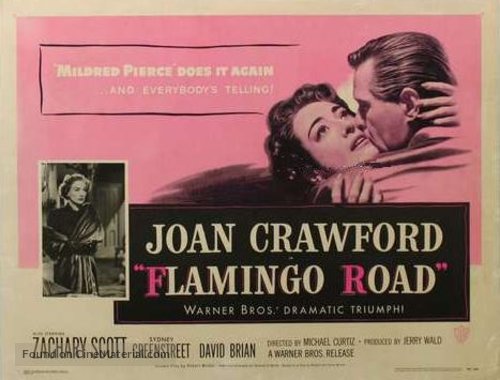 |
| Just a reminder, 'Flamingo Road' is by the same folks who brought you 'Mildred Pierce!' |


