Showing posts with label Lee Remick. Show all posts

Wednesday, July 21, 2021

‘Experiment in Terror’ 1962


Lee Remick is terrorized and toyed with in 1962's "Experiment in Terror."


In the wake of 1960’s Psycho, a number of modern thrillers were now distinctly on the dark side. One of the most stylish and disturbing Hitchcock prototypes was 1962’s Experiment in Terror, Blake Edwards’ rare film foray into suspense.

The premise of Experiment in Terror is simple: psycho villain Garland “Red” Lynch coerces teller Kelly Sherwood to steal a bundle from her bank employer. If not, Lynch threatens to kill Kelly and her teen sister. It all sounds simple, but there are some sick twists along the way. The film’s story was written by husband and wife team, The Gordons. Another talent that gets interesting billing is Ross Martin, as the villain, who only gets his name at the end credits.

Ross Martin's villain  'Red' is slowly revealed as "Experiment in Terror" progresses.

This was Blake Edwards and Lee Remick’s first collaboration, just before their classic, The Days of Wine and Roses. After grueling roles as the targeted heroine in Experiment in Terror and alcoholic wife in The Days of Wine and Roses, Edwards should’ve invited Remick to star in one of his many comedies!

Ross Martin's maniac ain't playin' as he catches Lee Remick's Kelly calling the FBI.

Like Hitchcock’s suspense films, Experiment in Terror is leisurely paced, by today’s attention span-challenged standards. Edwards’ films are often long, but the night driving opening scene in San Fran, with Henry Mancini’s languid score, sets the eerie mood. At just over two hours, Experiment could’ve been closer to the standard 1 hour and 45 min. mark, yet keeps the viewer intrigued.

"Experiment in Terror" has an dreamy opening score by Henry Mancini.

Philip H. Lathrop’s cinematography is atmospheric, with deep shadows and strategic light for the evening scenes, in sharp contrast to the blinding daytime scenes in sunny CA. Experiment in Terror’s great camera angles and point of view are striking and contribute much of the suspense. Lathrop was a frequent Blake Edwards collaborator and also photographed another mid-century suspense classic, Orson Welles’ Touch of Evil.

"Witness for the Prosecution" lighting? Lee Remick as Kelly, "Experiment in Terror."

One thing I admire about Blake Edwards’ work is that his approach to dramatic material was adult and forward-thinking, especially for the era. For instance, though the targeted heroine and the FBI agent become close while trying to capture the villain, they don’t fall in love. Also admirable is that the heroine Kelly Sherwood is not a cowering victim, though rightfully terrified of the creepy bad guy. Kelly is a bright, independent, stand-up person who’s not afraid to hold her own against the domineering villain. This is emphasized with Lee Remick’s performance. Remick had that gentle side, with those huge, child-like baby blues that made her perfect for projecting fear, in such movies as this, The Running Man, No Way to Treat a Lady, and The Omen. She also originated and won a Tony for the Broadway version of Wait Until Dark. Remick’s sass, warmth, strength, and intelligence are put to good effect in this thriller.

Lee Remick as Kelly, would-be bank robber, brings to mind Hitchcock's "Marnie."

During the scenes where Kelly goes along with the bank heist at the villain’s behest, I kept thinking what a marvelous Marnie Lee Remick would have made, instead of non-actress Tippi Hedren. Lee was also six years younger than Tippi, and more age appropriate to emotionally stunted Marnie. I’ve wondered why Hitch didn’t use Lee in the first half of the ‘60s, when he was often looking for his next Hitchcock blonde.

Lee Remick's heroine hides in the bathroom, just like Tippi Hedren's "Marnie."

Glenn Ford, not one of my favorite actors, is low-key but straightforward as FBI agent John Ripley. One thing I like about Ford is that he was comfortable enough not to act the macho showboat, like Kirk Douglas or Burt Lancaster, or the younger anti-heroes of the ‘60s. Ford comes across like an intelligent, decent guy and his character doesn’t have all the answers.

Glenn Ford is solid as the FBI man, but what's up with his greasy comb-forward?!

Ross Martin as psychotic villain Garland “Red” Lynch is terrifying and terrific. His character’s penchant for disguise is a precursor to Martin’s later role as Artemis Gordon on The Wild, Wild West. I, along with others on the Internet, have found that his disguise in the finale must have inspired the Unabomber! Martin is utterly creepy, pathetic, sadistically funny, and compelling. Any other year, Ross Martin would have been a best supporting actor nominee shoo-in. But 1962 was a strong performance movie year, and Victor Buono got the suspense movie nod, as Edward in Whatever Happened to Baby Jane? Given the Buono played the same type for his entire career, Ross’ virtuoso turn as ‘Red’ was more deserving, in retrospect. Martin was an early Blake Edwards favorite during his previous TV tenure, who gave Ross his first substantial film role as the asthmatic killer in Experiment in Terror. Soon after, Edwards cast him another scene-stealing role, in The Great Race.

Ross Martin, as 'Red' Lynch, lurks among the mannequins in "Experiment in Terror."

Anita Loo, as Susie Soong, is intriguing as the Asian girlfriend of Ross Martin’s “Red.” Her character is ambiguous as to how close they are and how much she knows about his other life. How adult of Edwards to show that the villain has a human side, in this case, helping the woman’s son with medical issues. Also realistic is Soong’s denial and defiant attitude about helping the Feds, only looking from her own personal point of view. Loo plays the enigmatic character in an understated way that is both empathetic and yet rather chilling.

Anita Loo is the killer's mystery woman, with Glenn Ford, in "Experiment in Terror."

Stefanie Powers is nearly unrecognizable as a baby-faced teen, as Toby Sherwood, Kelly’s kid sister. She is sincere and holds her own during some of the later terrifying scenes involving her. Ned Glass is a scene stealer as always, as “Popcorn,” the genial, movie-loving informant. Patricia Huston is Nancy Ashton, a target of the villain’s wrath. Her character is touchingly stoic, as she reaches out for help, but too late. Amusing that the villain’s last name is Lynch and that the heroine lived near Twin Peaks in San Francisco—no coffee loving cops, however. And I love the stars oh so ‘60s names of the sisters, Kelly and Toby Sherwood!

Stefanie Powers is nearly unrecognizable as the kid sister, in "Experiment in Terror."

Experiment in Terror used to be on TV a lot when I was a kid, but I hadn’t watched it as an adult, until just recently. Experiment is an early modern thriller that still chills.

Here’s the movie that made Lee Remick a star, my look at Anatomy of a Murder, filmed entirely in Upper MI, my home! https://ricksrealreel.blogspot.com/2016/08/anatomy-of-murder-film-fiction-draws.html

FYI: I put all the movie overflow on my public FB  movie page. 

Check it out & join!  

https://www.facebook.com/groups/178488909366865/

Does Ross Martin's psycho in "Experiment in Terror" remind you of anyone?


Friday, April 30, 2021

Laurence Harvey Runs Amok as ‘The Running Man’ 1963

Do blondes have more fun? Laurence Harvey & Lee Remick in 'The Running Man.'


The 1963 romantic suspense film The Running Man is rather reminiscent of Patricia Highsmith’s The Talented Mr. Ripley. The suspense comes from a charismatic but amoral schemer who unravels as his grand plans go awry. The romance is the woman drawn to both the cad and the good guy. Laurence Harvey is the title character, con man Rex Black, with Lee Remick as his wife Stella, and Alan Bates as the enigmatic insurance man. Rex is a charming ne’er-do-well who feels cheated out of an insurance settlement after surviving a private plane crash. With the help of Stella, he fakes a glider plane crash the next year, and the “widow” collects on the insurance. Who would suspect, right? Logic isn't the strong suit of this movie, but then, neither is it in even the best Hitchcock films!

'The Running Man' stars Alan Bates, Laurence Harvey, & Lee Remick.

After the dust settles, Rex visits Stella, where they plan their future elsewhere. Then, an insurance man just happens to stop by, to tie up some loose ends. Talk about coincidences—this movie is loaded with them. Rex and Stella later reunite in Spain, where he has disguised himself and has taken another person's identity—and his passport. Guess who just happens to show up shortly after? That's right, the insurance man…again! However, all is not as it seems.

Alan Bates as the insurance man who shows up more unexpectedly than 'Columbo!'

From there on, The Running Man is more cat and mouse than a Tom and Jerry cartoon. This type of sexy suspense thriller was a trend in mid-century movies, inspired greatly by Alfred Hitchcock. The Running Man is no classic, but it's an intermittently entertaining suspense film, which becomes more of a character study, as the main characters’ personalities become clear. In the early scenes, Laurence Harvey shows the charming "Larry" Harvey that made him the life of the party off-screen. Harvey’s Rex feels like his insurance scam is his rightful payday and has big plans for himself and his wife. Stella is the dutiful wife, who would be dull if she wasn't played by lovely, warm Lee Remick. Stella reunites with the reinvented Rex in Spain, complete with another identity, bleached blonde hair and matching mustache, and worst of all, a flamboyant Australian accent that comes and goes. Simply put, Larry's scheming character is The Talented Mr. Ripley's Dickie Greenleaf and Tom Ripley combined: the entitled prince and the scheming poser.

Laurence Harvey is a brunette charmer as Rex Black, here with Lee Remick.

Stella is initially a bit shocked. But once the insurance man shows up, Rex loses his confidence and his cool. Soon, Rex acts like every other character Laurence Harvey ever played: snide, sneering, sullen, sour, etc. And did I mention that the insurance man is played by Alan Bates, at the height of his youth and good looks? Not only that, but Alan Bates has more onscreen warmth and presence in his little finger than Harvey has in his entire scrawny body. Once Bates' character, Stephen Maddox, is smitten with Stella, you wish that Harvey’s Rex would take another plane ride. Rex's boorish behavior escalates when he realizes that Bates attracted to Stella, and that she in turn is drawn to him. Perhaps that’s because her husband’s behavior makes it quite easy?

Here's Alan Bates & Lee Remick looking gorgeous as the insurance man & the widow.

And here's Laurence Harvey as Rex in his new disguise, blonde & sunburned!

Laurence Harvey, Alan Bates, & Lee Remick in 'The Running Man.'

As the movie saunters along, like a summer afternoon, Remick and Bates become more sun-kissed and golden. Larry, however, looks like a bleached blonde red lobster. Even worse is when Larry sports a Speedo for an extended scene and looks utterly emaciated. Alan Bates is such a warm, subtle, masculine film presence here that you wish Alan and Lee had appeared in a romantic film together, without Laurence Harvey hogging the scenes with his hammy performance. Lee Remick was one of a legion of actors who disliked working with Harvey, but she's empathetic as always as the loving but bewildered wife.

Ah, there's the Laurence Harvey we all know and love!

After a too-long second-act, there's a twist ending that proves the third time is NOT the charm for Harvey's charmless Rex. The Spain location filming by Robert Krasker is stunning. Director Carol Reed, famed for many films, including The Third Man, was still reeling from tangling with Marlon Brando before he got fired from Mutiny on the Bounty, and then had to deal with difficult Laurence Harvey. Also, Reed’s health was failing, though he’d go on to win an Oscar for Oliver! The script is by John Mortimer, from a well-received novel by Shelley Smith. The star trio is backed by a dependable supporting cast.

Alan Bates is a sight for sore eyes as Stephen Maddox, after watching scrawny sourpuss Laurence Harvey as Rex Black in 'The Running Man.'

The Running Man often gets run down by critics and movie fans, but the clever story, lovely locations, and Remick and Bates made for a moderately entertaining suspense movie.

Lee Remick made many suspense thrillers, but none for Alfred Hitchcock.
Remick would have made a wonderful Hitchcock blonde!

For my take on Laurence Harvey’s best performance, here’s my post on The Manchurian Candidate:

https://ricksrealreel.blogspot.com/2017/10/the-manchurian-candidate-1962.html

And here’s my look at the breakthrough movie for Lee Remick, Anatomy of a Murder:

https://ricksrealreel.blogspot.com/2016/08/anatomy-of-murder-film-fiction-draws.html


FYI: I put all the movie overflow on my public FB  movie page. Check it out & join!  https://www.facebook.com/groups/178488909366865/


One more shot of lovely screen stars Lee Remick & Alan Bates in 'The Running Man.'


Wednesday, July 8, 2020

‘No Way to Treat a Lady’ 1968


Lee Remick realizes that her Italian chef is a serial killer, "No Way to Treat a Lady."

Thrillers set in the Big Apple were big in 1968, like the somewhat forgotten sleeper, No Way to Treat a Lady. The Boston Strangler and The Detective were notable hits. The best of the bunch was Rosemary’s Baby.
Yet, compare the way No Way to Treat a Lady was filmed versus Rosemary's Baby, both made by Paramount Studios, in NYC. They are psychological suspense films, but Lady was filmed "realistically" versus Roman Polanski's mood-enhancing visual style in Rosemary’s Baby. Lady seems like a Universal TV movie in comparison. No Way to Treat a Lady was directed by competent but workmanlike Jack Smight and cinematographer, Jack Priestley. Both artists spent much of their career in TV and it shows. The same goes for screenwriter John Gay, as well.
It's in his kiss: the lipstick is the killer's trademark.

The strengths of No Way to Treat a Lady are the clever, engaging story by William Goldman and the appealing, well-cast actors. Goldman wrote some stories that are wonderfully entertaining: No Way to Treat a Lady, Magic, and Marathon Man are his best. More importantly, Goldman was considered one of the best screenwriters of his time. He was inspired to write No Way to Treat a Lady from the Boston Strangler headlines at the time. For awhile, it was thought that there might be two different killers, and Goldman wondered what would happen if the original killer became jealous sharing the headlines? In the film, this isn't at the core of the movie, but it offers a little levity. Several major points differ from book to film: the killer is much more prominent in the film; he also succeeds in killing the cop’s girlfriend; and the film is more about the killer and cop’s relationship. These changes are for the better, IMO. What is most amusing is that the cop and killer are both browbeaten mama's boys.
Lee Remick & George Segal have great chemistry as the free-spirited woman & the cop.

George Segal, as Morris Brummel, is winning as the cop who is driven crazy by his mama and the homicidal maniac, and finds his woes lightened when he’s smitten with Remick's free-spirited modern woman. Segal is a natural comic actor, but is also dramatically intense enough to be believable as a cop.
George Segal, as cop Mo Brummel, gets flack at work, home, & from a serial killer!

Lee Remick is smart, funny, not to mention lovely, as Kate Palmer. A quirky charmer here, Lee reminds me of the late Carole Lombard in mixing playfulness with sexiness. Remick had a solid career as a leading lady in film and TV. Especially considering that beautiful actresses were falling out of style for the few serious roles for females as the ‘60s went on. For instance, Lee would have made a great Hitchcock blonde. Yet, while Remick was a top leading lady, she never made that top tier as a female star who could carry a movie on her own. This was illustrated when Lee Remick won a Tony for her 1966 Broadway performance in Wait Until Dark. Yet, when it was made into a film the following year, Audrey Hepburn was chosen to play Susy Hendrix, the terrorized blind woman.
Lee Remick plays a latter day Hitchcock blonde, like Grace Kelly in 'Rear Window.'

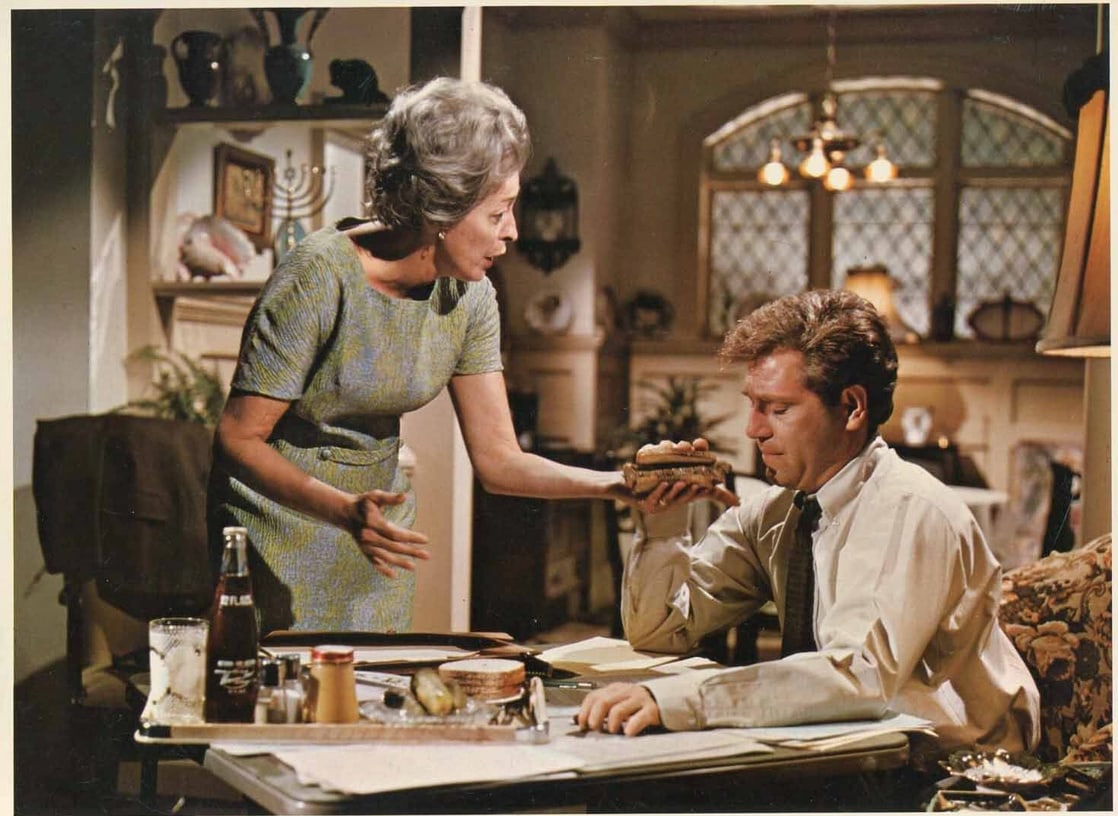
Eileen Heckart has a field day as George's Jewish mama, Mrs. Brummel. The character is a total stereotype, but Heckart makes the mama good-hearted and fun, beneath the endless kvetching! Eileen was the next generation Thelma Ritter.
Eileen Heckhart as the Jewish mama of Segal's cop Morris Brummel, multi-tasking.

Rod Steiger's serial killer offers an impersonation of W.C. Fields to George Segal's harried cop. Segal's reaction was like the critics later, when Steiger played Fields!

Rod Steiger has a field day as a would-be actor whose mother was the real talent in the family. His frustrated character, Christopher Gill, busts out every cliché in the book: the Irish priest; the gay hairdresser; the German plumber, etc. Steiger even offers an ear-splitting imitation of W.C. Fields—a film role he played later—and is so over the top that Segal’s Mo responds by wincing! Still, Jack Smight later wrote that while he had to remind Steiger to stop chewing the scenery, the method actor was totally committed to the role. Steiger gives it his all, and any Rod excess just benefits the character. Steiger as Christopher is funny, vain, scary, neurotic, sad, and just about everything in between. What’s especially interesting about Rod’s character is that he truly engages his victims that you hate that he’s going to kill them! Also, darkly funny, is when Gill follows his own press about the murders, like an actor reading his reviews.
Rod Steiger as killer Christopher Gill, keeping track on his press persona.

This film is filled with great character actors. Murray Hamilton seems to have been in every movie during this era, starting from ‘59’s Anatomy of a Murder through ‘75’s Jaws. Hamilton is Inspector Haines, Brummel’s no-nonsense boss. David Doyle, future Charlie’s Angels wrangler Bosley, is Lt. Dawson. The victims are very distinctive, real, and sympathetic: Sybil’s mom aka Martine Bartlett as Alma Mulloy; Ruth White as Mrs. Himmel; and Irene Dailey as Mrs. Fitts. The always quirky Barbra Baxley is the one who gets away, as the cat lady, whose sister is played by an unrecognizable Doris Roberts—until she speaks!—and scares Steiger off. Michael Dunn is hyper and amusing as the wannabe killer.
Steiger's killer as hissy hairdresser "Dorian," with fussy customer, droll Barbara Baxley.

Lady is a great time capsule of NYC in the late '60s. Speaking of which, the ‘60s is when wigs went mainstream and between virtually every female character and Rod Steiger’s master of disguise, it’s like Wigstock!
Though not a classic thriller, No Way to Treat a Lady treats its audience to a gripping story with strong performances from its stellar cast.

FYI: I put all the movie overflow on my public FB  movie page. 
Lee Remick's last supper? Steiger's killer zeroes in on the cop's girlfriend.


Monday, August 7, 2017

'The Long, Hot Summer' 1958

Paul Newman is hot, Joanne Woodward is the heart of this 'Summer.'

FYI: I put all the movie overflow on my public FB  movie page. 

I love sexy Southern melodramas, so it’s amazing that I somehow missed 1958’s The Long, Hot Summer. Based on several William Faulkner stories, the film features an all-star cast: Paul Newman, Joanne Woodward, Orson Welles, Angela Lansbury, Lee Remick, and Tony Franciosa. I guess when I wanted to watch Paul Newman sneer and swelter Southern-style, I put Cat on a Hot Tin Roof on instead.
Paul Newman provides the sizzle as barn burner Ben Quick.

Legendary wheeler dealer Jerry Wald was always ahead of the curve in Hollywood. When everyone thought Joan Crawford was washed up, Wald actually hyped that she was making a comeback with Mildred Pierce. Wald repeated the same feat with Lana Turner a dozen years later, with Peyton Place—see Lana as a mother for the first time! Wald saw that MGM snapped up screen rights for Tennessee Williams’ Pulitzer-prize winning Cat on a Hot Tin Roof for a record sum. So, the wily Wald bought several stories by Faulkner, played up similarities to Cat, and called it The Long, Hot Summer.

Like Cat on a Hot Tin Roof, there’s a crude, fearsome Big Daddy type, Will Varner (Welles.) Ditto Cat’s Brick, there’s a man-child son, Jody (Franciosa.) Jody’s wife is a sexy Maggie the Cat type, Eula (Remick.) Will is a widower, so he doesn’t have a Big Mama to mistreat, but he does have goodhearted town whore to selectively ignore, Minnie Littlejohn (Lansbury.)

Paul and Joanne made beautiful music together--on camera and off!
A minor character in the Faulkner pieces is Ben Quick, elevated to every insolent stud that Paul Newman played. And Joanne Woodward is Clara Varner, Will’s daughter, considered an old maid at 23. Yes, there will be chemistry between the two!
Like Big Daddy Pollitt in Cat, Will Varner comes home from the hospital, but arrives one better—by ambulance, sirens blaring. Unlike Cat’s patriarch, Will Varner gets a clean bill of health. As with Big Daddy, Will wants to pick the perfect offspring to run the family business, and a favored child to produce some grandchildren.

This is where comparisons to Cat on a Hot Tin Roof and The Long, Hot Summer end.  And there are two big reasons why Summer doesn’t sizzle like Cat.
First, The Long, Hot Summer’s story is a warmed-over mishmash that doesn’t go anywhere. Cat’s plot structure isn’t perfect, either.  Yet, Williams’ themes of family, love, mortality, greed, and sexuality are woven well in the Pollitt family’s fighting over their fortune. In The Long, Hot Summer, Jody keeps disappointing daddy Will with his juvenile behavior, Clara refuses to marry just to produce an heir, and Minnie wants Will to marry her. That’s it. There are no overriding themes as with Cat, to elevate Summer above a southern soap opera. Summer’s ending is so ridiculous and rushed, that I hooted in disbelief at the climactic scene which brings about Will and Jody’s reconciliation. And the finale, with all three couples laughing merrily, felt like a southern sitcom.

Welles may be big, but he's no Big Daddy!
Orson and Paul, only a decade a part in age.
The second strike that really sinks The Long, Hot Summer is Orson Welles as Will Varner. Burl Ives created an indelible portrait as Big Daddy in Cat on a Hot Tin Roof, first on Broadway, then in the 1958 film version. Welles feared being upstaged by the young Actors Studio cast members—so he decided to upstage them. Welles wears such heavy tan makeup that his co-star Angela Lansbury compared it to Orson’s famed Othello. Welles wore a false nose, at times obvious onscreen, plus an unruly, grey wig. With his Halloween film costume and already pumpkin-like physique, I was shocked that Welles was only 42 when making of The Long, Hot Summer. Consider this when watching Summer: Orson Welles was only ten years older than Paul Newman!

Orson Welles certainly set himself apart from the rest of the cast--in every way! With Franciosa, Remick, & Woodward.
Mocking Method actors and their alleged “mumbling,” Welles mush-mouthed southern delivery sounds like he’s recovering from a stroke. The great Orson Welles gives such a gawdawful performance that he pretty much stinks up this Summer. Will Varner is a character who all the others’ fates depend upon—and Welles plays him as such a cartoon villain. Who cares if he approves of them?

Joanne Woodward and Lee Remick as Southern sister-in-laws.
On the plus side, the young cast is capable. After a few years of getting called a second-rate Brando, Newman gives audiences their first taste of the cool hand Paul persona. Joanne Woodward, often cast as the old maid, is spirited and smart, the hallmark of her screen work. This was Paul and Joanne’s first collaboration together, and with director Martin Ritt, as well. Lee Remick, a year before her breakthrough in Anatomy of a Murder, is mostly decorative—but has moments that show she should have played Maggie the Cat sometime in her career. Tony Franciosa is intense in the thankless son role. Angela Lansbury is fun as good-time girl Minnie, who for some reason loves Will Varner. Richard Anderson, later famous for The Six Million Dollar Man and The Bionic Woman, plays Alan, Clara’s suitor—until Newman’s own Ben Quick comes along. Alan is referred to as a “sissy” and “mama’s boy,” and much is made of the fact that he has dated Clara for six years without proposing—what do you suppose that means?!
Richard Anderson: the suitor who's "courted" Woodward for six years. Hmm!


Jerry Wald got the jump on Cat on a Hot Tin Roof by about six months, The Long, Hot Summer only did modestly well at the box office. The main reason I’d recommend The Long, Hot Summer is for the scenery: both the Louisiana locations, (subbing for Mississippi,) and the up-and-coming cast, especially Paul Newman, in their youthful prime.
Paul Newman, when he was cool and fresh as a slice of watermelon!

Friday, January 20, 2017

'A Face in the Crowd' Looks at Real Issue of Media Mania: Us

'A Face in the Crowd' came out in '57, with Andy Griffith
as southern singing idol Lonesome Rhodes, a nod to Elvis!

Media pundits have had a field day over Lonesome Rhodes, from 1957’s A Face in the Crowd, claiming the charismatic creep “predicted” the rise of Donald Trump. Even religious right columnist Cal Thomas tagged Trump as Rhodes, the rags-to-riches character of Elia Kazan’s prophetic film. Yet one columnist scoffed that a more apt comparison would be of Trump to Orson Welles’ Citizen Kane—and meant it as a compliment!

 Welles’ 1941 epic, Citizen Kane, is about a rich blowhard who pushes his luck with the public, and sends his empire tumbling. Like Rhodes, Kane pays the price for hubris. Kazan’s A Face in the Crowd and Welles’ Citizen Kane were tough movies that questioned the triangular love-hate relationship between the media, public figures, and their audience.

Andy Griffith, loathsome as Lonesome Rhodes: boob on the tube, audiences eat it up!
A Face in the Crowd was made in 1957, when film censorship and ‘50s conformity was past its zenith, but still in power. Still, the film is gritty, unglamorous, realistic, and packs a punch. Director Elia Kazan employs a sharp visual look but discards the glossy movie style of the era: A Face in the Crowd’s characters look sweaty, rumpled, harried, and human. Andy Griffith is eerily good, both loathsome and riveting as Lonesome, the country crooner turned super-celebrity. Patricia Neal does world weary perfectly, yet is also vulnerable as Marcia, the reporter who falls for Rhodes’ slick charm. Walter Matthau shows his dramatic side as a cynical reporter who carries the torch for Neal. And Lee Remick, in her film debut, is luminous and funny as Rhodes’ majorette bride.

Lee Remick, a majorette who thinks Lonesome is a dream, & finds out he's a nightmare.
The only letdown perhaps is when Lonesome loses his TV throne/bully pulpit after a hot mike exposes the real Rhodes on network television. Censorship of the day demanded characters pay for their sins. Today, we see inflammatory remarks, boorish behavior, and scandal rewarded with TV shows, book deals, and yes, public office.

Both A Face in the Crowd and Citizen Kane got rave reviews but were box office flops. Movies in Hollywood’s golden era were typically escapist fare and audiences didn’t flock to see grim dramas. Post-Watergate cynicism made Sidney Lumet’s Network possible as a black comedy hit, with its dire message about power, politics, and television. Network, which came out nearly two decades after A Face in the Crowd, takes washed-up TV anchor Howard Beale from a nervous breakdown on the air to a megalomaniacal media messiah.

Even worldly-wise reporters Walter Matthau & Patricia Neal can't look away!
 A Face in the Crowd is an in-depth look at the impact that television has on the masses—both positive and negative. Lightening bolts like Elvis and The Beatles made their mark on pop culture when they appeared on American television. So did political phenom Joseph McCarthy, when he found himself on the other side of an investigative committee, and went down in flames on live TV. Yet, fellow Republican Richard Nixon managed to warm the public’s heart once, when he gave his infamous “Checkers” speech in the 1952. The public later cooled toward Nixon in the early ‘60s, with his shifty, sweaty looks next to all-American John Kennedy, during their presidential debates. His infamous losing comment didn’t help his image: “You won’t have Dick Nixon to kick around.” In the ‘70s, President Nixon sealed his Tricky Dick persona with the “I am not a crook” speech…which was later followed by his resignation speech!

Citizen Kane, A Face in the Crowd, and Network took a hard look at how far the media would go to manipulate the masses. Now you can add the internet to the mix. In their time, these films were a therapeutic slap in the face to audiences, to wake up from their complacency and naiveté.

Applause whets the appetite of celebrity consumers.
Here’s the difference in today’s world: We live in an age where just about any small-town person is media-wise. The change started with cable TV and later, the Internet, providing a world-wide platform for anyone with something to sell—a product, a personality, or a point of view. We have been the consumers, sitting in front of massive TV screens and computers, laptops, tablets, and cell phones. There’s been an escalating Tower of Babel built by “personalities,” pundits, and politicians. They are all vying for our favor, with louder voices, bigger promises, and no regard for the truth.

The problem is many of us want to believe the lies, despite the mass of information at our fingertips. Now, people have always preferred comforting lies to painful truths—that’s human nature. But now, we rationalize bad behavior, wallow in conspiracy theories, and defend to the death negative news that fits our world view—no matter what. Before, it was a matter of exposing lies to an unsuspecting public—Watergate, for example. Now, it seems hardly anyone cares. On a recent This American Life broadcast, Ira Glass addressed this trend in “Lies Become the Truth.” After recounting some recent political dust-ups where mud was flung, Glass noted, “It’s easier than ever to check if the fact is true, but the facts matters less than ever…”

The real "face" of celebrity isn't always pretty.
Is it because we want to cling to old beliefs, even though, deep down we know they don’t work anymore? Is it because it takes too much time to sift through the vast amounts of information out there, in our limited attention span era? Is it because we prefer to feed on a newsfeed that’s exclusively scandal over substance? Or is it all of the above?

The tune of a Lonesome Rhodes, Citizen Kane, and Howard Beale never really changes, nor do those of real-life demagogues like Huey Long, Joseph McCarthy, Richard Nixon, Donald Trump, or any of the loudmouths on MSNBC, CNN, or FOX News.
Only the face in the crowd changes, but the song remains the same. It is us who have changed. Too many people are willing to overlook the deep flaws of their idols, as long as they can continue to believe the false message. 

What politicians still count on today...

FYI: I put all the movie overflow on my public FB  movie page. 

Check it out & join!  https://www.facebook.com/groups/178488909366865/