Showing posts with label Stanley Donen. Show all posts

Monday, April 6, 2026

'Lucky Lady' & Other Cine-bombs of My '70s Youth


The most memorable thing about 1975's 'Lucky Lady'
starring Gene Hackman, Liza Minnelli, & Burt Reynolds
may be this beautiful Richard Amsel poster.


I discovered classic films during the early '70s, on TV afternoon movies. This coincided when Hollywood struck gold with modern cinematic gems that harkened to its studio era heyday: The Way We Were; The Sting; Chinatown; and That's Entertainment, to name the most notable.

Alas, there were an equal amount of much-hyped films that my '70s teen self couldn't wait to see, but which never made it to my local theater in Upper Michigan. And for good reason—most were flops!

One of the few film duds that did come to my hometown Manistique was 1974's The Great Gatsby. The 3rd version of F. Scott Fitzgerald's novel actually made money, but was a disappointment because of the enormous money spent making and promoting the lifeless movie. I was turned off because I already loved the book and couldn't imagine why anyone would pine after Mia Farrow for a decade. As for remote Robert Redford, he was not great as Gatsby. The supporting cast came off best in this fashion spread of a movie, which I never saw again.

My entertainment guru of the '70s was Rona Barrett, who really beat the
 drums for 1974's "The Great Gatsby." Note the Lucy headline at lower left!

I was also excited to see Lucille Ball as Mame in ’74. I watched all three of Lucy's series, which CBS was running: I Love Lucy and The Lucy Show in daytime reruns and Here's Lucy in prime time. The latest series should have been a warning. Canned comedy ensued whenever Lucy Carter met a celebrity and irritated them with her star struck antics or looked for an excuse to sing. On I Love Lucy, Ball's singing always caused intentional laughter. 

'Lucille Ball as Mame' was the hype mantra for this 1974 mammoth musical.

There were all kinds of promo for Mame. The gay geek that I was, I kept looking at the big spreads Rona Barrett's mags, marveling at how young Lucy looked. And there was the new fave, TV's Maude, Bea Arthur in a black Joan Crawford wig and ankle straps. I was awestruck —and so naive.

Love this headline for Rona Barrett's 1974 story on "Mame."
The short answer is NO!

Then the bad reviews for Mame came out… then there were stories about the reviews! I read one news story of Lucy at an event, dabbing tears away, distraught over the backlash. The news photo showed that she did not look young, despite Ball all dolled up like Mame. The film never shook the blues in my hometown! 

I saw Mame a couple times later on TV. My thought was that if the songs with Lucy's raspy singing were cut, Mame would have been much better. Only, then you would have Auntie Mame again. So why not just watch the 1958 Rosalind Russell as Mame Dennis?

Lucille Ball was a favorite veteran star for Rona Barrett magazines. 

Next, I was fascinated that my favorite star, Elizabeth Taylor, was heading an all-star musical remake of The Blue Bird, filmed in Russia. Directed by George Cukor, it was hyped as the ‘70s answer to The Wizard of Oz. I read gossip items on the troubled filming, but when I saw that Rona Barrett was promoting a big spread for the epic in her next issue, I was hopeful. Then the issue came out, and no sneak preview of Easter 1976’s The Blue Bird! I've only seen clips of the elusive epic on You Tube since and that was plenty. The Blue Bird looks like a chintzy costume party.

I was agog when I bought this People magazine with Elizabeth Taylor in
 costume in "The Blue Bird." I think I still have the Milton Greene cover shot.

A lovely poster for 1976's "The Blue Bird," a gawd-awful movie.

By 1976, I was becoming a jaded teen when it came to modern Hollywood cashing in on old-time Tinseltown. I loved the biography book, Gable and Lombard, which made me a new fan of Carole Lombard. When they cast Marcus Welby's James Brolin as Clark and newcomer Jill Clayburgh as Carole, I was appalled. When clips were previewed on TV talk shows, I knew once again that the onscreen Gable and Lombard was never coming to Upper Michigan. I finally watched Gable and Lombard during 2020's Covid lockdown, and found the film bio inaccurate at best, smutty and juvenile at worst.

I was hoping that 1976's "Gable and Lombard" wouldn't be as terrible
as it looked... sadly, it was!

And there was so much bad press about Barbra Streisand's ’76 remake of A Star is Born that I vowed not to go see it. In the '70s, people would flock to see Streisand sing from a phone book, so Star was a big hit. My female classmates loved it and when I sang the praises of Judy Garland's version over Babs', their sullen stares said, “Shut up, nerd!” I didn't see Streisand's Star until 2017, over 40 years later. It was indeed still awful, after all these years!

By the time 1976's "A Star is Born" came out, I never wanted to hear about this
 ego 
trip again. I finally watched Babs' version in 2017!

This brings me to 1975's Lucky Lady, which inspired all these movie memories. This was another event movie that I was all excited about back then: Cool Burt Reynolds! Judy Garland's daughter, Liza Minnelli! Gene Hackman, that guy from The Poseidon Adventure! And dreamboat Robby Benson, who sealed the deal! They were starring in a comedy caper like The Sting, which I loved. Once again, I pored over my bible, Rona Barrett’s magazines, trying to figure out what Lucky Lady was all about. Turns out, not much! The Christmas blockbuster was looked upon as a cinematic lump of coal and bad word of mouth trumped three superstars at the height of their appeal. This too didn't come to pass at my hometown's theater.

Just watched 1975's "Lucky Lady" for the 1st time in 2026! Better late than never?


I just saw a great copy of Lucky Lady for the first time on YouTube, in March 2026, over 50 years later. The disjointed story and style of Lucky Lady reflects its troubled filming. The plot of Lucky Lady was inspired by rum running stories on the western coast and classic buddy movies where the men fight over the sassy leading lady. What appeared onscreen was pretty thin, and no one knew how to end the movie. No one liked the original finale, where the men were killed, ala Butch Cassidy and the Sundance Kid. One version that was quickly discarded had the trio reunited in their senior years and looking decomposed, not aged. 

The "old age" ending for 1975's "Lucky Lady" was quickly scrapped,
for good reason. The stars look mummified!

Stanley Donen, a classic era director fave of mine, was past his prime and out of his depth. As the romantic triangle, Gene Hackman fares well enough, displaying an early comic touch. Liza Minnelli, the leading lady, just wrote in her memoirs that Gene was extremely rude to her throughout filming. Hackman could be a curmudgeon, I think because he was rarely cast as a romantic leading man. Or perhaps it was because Gene was appalled by Liza's obnoxious performance as Claire. If you looked up "over the top," in the dictionary, I'm sure Liza's picture is on that page. And Liza goes beyond the pale in Lucky Lady. Minnelli is all over the place—character, comically, and she caterwauls her dialogue and two songs, both Kander and Ebb on autopilot. My guess is director Donen turned Liza loose, hoping the results would be triple threat Judy all over again. She looks like a deranged Clara Bow and whines and wheezes in her harried moments like Shelley Winters! Burt Reynolds is the surprise here. As the handsome but dim rum runner, Burt doesn't fall on his mock macho shtick and is quite endearing. Reynolds was a natural comic actor and could be a strong dramatic one, too. A shame Burt didn't prioritize those qualities over stardom.

Liza Minnelli, Gene Hackman, & Burt Reynolds take over the "Tonight Show"
 to promote 1975's "Lucky Lady." Everyone seems jovial here.

Gene Hackman, Liza Minnelli,  & Burt Reynolds may be wondering how
they got stuck in 1975's "Lucky Lady" he
re.

It must be said while Gene, Liza, and Burt were at the top of their ‘70s stardom, independent modern day stars weren't any better at choosing scripts than the old studio star system. All three made some real clinkers during this time: Gene in Zandy's Bride and Bite the Bullet; Liza in A Matter of Time and New York, New York; Burt in W.W. and the Dixie Dance Kings, At Long Last Love, and Nickelodeon. None of which I have seen, nor plan to, ever!

Of the superstar menage a trois with Burt, Liza, & Gene? I'd take only one!
 1975's "Lucky Lady."

As for Lucky Lady, what began with anticipation became a boondoggle, with a final film that satisfied no one. Visually, it's lovely despite the excessive soft focus, filmed along the water in Mexico. Some beautiful architecture serves as backdrops. Despite the incoherent story and unfunny dialogue, Gene, Burt, and Robby Benson, do decent work. But you have to be a hardcore Liza fan to enjoy her performance—she's one unlucky lady here. 

A sweet snapshot of the "Lucky Lady" cast: Robby Benson, Burt Reynolds,
 Liza Minnelli, & Gene Hackman.

Up next for Minnelli was New York, New York, which was another troubled production that flopped on first release. A few years later, a director's cut was released, to better effect. While Liza won praise for New York, New York, it's almost an anti-musical, not a tribute. To revamp a quip that Bette Midler made about another '70s song-laden movie disaster, "I never miss a Martin Scorsese musical.”

Well actually, I did. I don’t even recall if New York, New York came to Manistique—a Minnelli miss to be remedied at a later date!

Another big movie everyone was excited about... until it was released!
Rona Barrett gives the big build-up for 1977's "New York, New York."

My deep dish on Barbra Streisand's diva version of A Star is Born: 

https://ricksrealreel.blogspot.com/2017/08/barbra-streisands-star-is-born-still.html


Sunday, January 12, 2025

Cary & Audrey Bring Charisma to “Charade” 1963


Cary Grant & Audrey Hepburn charm in 1963's suspense-comedy "Charade."


 The Stanley Donen comedy-suspense film Charade was filmed late ‘62/ early ‘63, and released for 1963's Christmas holidays. At age 65, my first time watching Charade was during 2024’s Christmas holidays, and I’ve been watching classic movies since I was in my early teens!

My impression had always been that Charade was a bland version of Alfred Hitchcock, so I'd just watch North by Northwest for the millionth time. This is especially inexplicable even to me, because I enjoy Cary Grant and Audrey Hepburn a great deal. I’m so glad I corrected my Charade situation.

Once again, Cary Grant is the charming stranger, in 1963's "Charade."
Should Audrey Hepburn's heroine trust him?

Charade really is like Hitchcock’s more mainstream works because there are none of the emotional undercurrents that often suffuse Hitch's more serious work. I’d compare the mix of suspense, romance, and comedy along the lines of Hitchcock’s To Catch a Thief and North by Northwest. Likewise, Charade is smart entertainment. Much of this is due to director Stanley Donen, one of the best for grown-up entertainment. Donen’s humor and intelligence made him versatile in musicals, comedy, and drama. In Charade, Donen brings all the ingredients of this cinematic confection together beautifully. Peter Stone got his first screenwriter credit at 33 from his own story, and it’s quite smart, leading to an association with director Donen. Also, Stone had a solid career in film, on television and stage, winning an Oscar, Emmy, and two Tony awards.

Here's a Hitchcock-esque shot from Stanley Donen's 1963's "Charade." Definitely in
 the Hitch style, Donen does a fine job mixing suspense, comedy, and romance.

I knew right from the start I should have watched Charade eons ago. The opening titles are by Maurice Binder, famed for his 16 opening titles for the James Bond film series, starting with the first, Doctor No. The colorful graphics would make Hitch fave Saul Bass green with envy. The insinuating score is by Henry Mancini, a subtle contrast to Bernard Herrmann’s booming scores for Hitch. 18-time Oscar nominee Charles Lang supplies the glamorous cinematography of the stars and locales.

I love this romantic shot of Cary Grant & Audrey Hepburn in 1963's "Charade."

Charade’s opening scene shows a dead body dispatched from a moving train. That would be Charles Lampert, estranged husband of Audrey Hepburn’s “Reggie.” When we first meet her at a ski resort, she doesn't know yet. What Reggie does know is that her marriage is over. She meets cute with mystery man Cary Grant, who introduces himself as Peter Joshua. Not so cute is when Reggie returns home and finds it emptied of all belongings. Then Cary shows up again, very much the Hitchcock mystery man, who finds her a modest hotel. And there are three men also in residence, who feel she has money from her hubby that is due to them. And they aren't nice about it: Ned Glass is Gideon; James Coburn is Tex; and George Kennedy plays Scobie. They are former WWII soldiers, who want their share of money from absconded war time gold that Charles cheated from them. A fourth man, Carson Dyle, was wounded and left for dead at the time. Soon after, Walter Matthau is introduced as a CIA administrator, who also wants the money, as it belonged to the US OSS.

James Coburn, as bad guy Tex, who just has a revelation, in 1963's "Charade."
Walter Matthau with the CIA? In "Charade," most of the characters don't even know
 what the agency stands for. Such innocent times!

Reggie doesn't have the money, but the thugs don't believe her. Cary's character’s identity changes practically scene by scene, and Audrey’s widow doesn't know whether to believe him or not. There are a number of alternately thrilling scenes and amusing moments, which leads to a genuinely suspenseful climax. The real villain is no surprise, but that's not Charade is really about—it’s the ride, not the destination.

Audrey Hepburn's widow gets an eyeful about her husband's past,
in 1963's "Charade."

Audrey Hepburn is most endearing as the beleaguered heroine. Audrey is amusing in her exaggerated reactions to the extreme situations, warm in her attraction to Grant’s mysterious stranger, and natural in her dramatic moments. It takes subtle skills to go from the various moods this type of movie offers. Hepburn also embodies flawless early ‘60s style here: stylized hair and makeup, plus simply chic clothes by Hubert de Givenchy. The look is ultimately timeless and Audrey puts the glamour girls of today in the shade. A running gag in Charade is when famously thin Audrey’s heroine is anxious, she starts eating! Hepburn would reunite with director Donen in one of their best films, 1967’s Two for the Road.

Audrey Hepburn's look is timeless in 1963's "Charade."

There are moments that foreshadow Hepburn’s 1967’s Wait Until Dark. Like when the thugs torment her, especially James Coburn’s Tex, as he accosts her with lit matches in a phone booth. Or characters who misrepresent themselves to Audrey’s trusting character. Reggie drolly wonders if her husband’s tooth powder is actually heroin, a substance that was a strong plot point in Dark.

Audrey Hepburn gets a rehearsal for the torment to come, in 1967's "Wait Until Dark."
Here, James Coburn is the villain terrorizing Hepburn, in 1963's "Charade."

There’s been criticism of Cary Grant as too old for the role opposite Audrey. Well, 60 at Charade's release, he was. But he was also perhaps the best preserved male star of his era. Grant's tan, lean, and stylish. Look at the three big male stars that have just passed 60 in recent years: Depp, Cruise, and Pitt. Cary Grant is in better form than any of them, in my opinion. I think that Cary Grant has great chemistry with Audrey Hepburn in Charade. Cary had more in common with Audrey than he did with Doris Day in the previous year’s That Touch of Mink. Grant’s role in Charade is as perfectly tailored to his persona as his suits. Grant is most cool and charming. But the role also gives him some humorous moments to off-set Cary’s aloofness.

To me, Cary Grant looks like a million at 60, when 1963's "Charade" was released.

It's interesting that James Coburn, Arthur Kennedy, and Walter Matthau play supporting roles here. They are all quite good, no doubt. And soon movie stars like Grant and Hepburn would be obsolete; Cary and Audrey would soon retire. And realistic actors like the first three would become big stars—for a while. Of the trio, Walter would retain his star status. Coburn would later play villains, and Kennedy character roles, after the “realistic” trend of late ‘60s and early ‘70s played out.

George Kennedy & Cary Grant: '60s realism meets 60-year-old classic leading man.
1963's "Charade."

Charade is like a snapshot of an era, when “Camelot” at its peak, with some shots of stars Grant and Hepburn giving off a Jack and Jackie Kennedy vibe. Actually, the film icons made their style imprint first. Anyway, after 1963, life and movies became increasingly realistic and less romantic than the charming Charade.

Cary Grant & Audrey Hepburn give off a JFK & Jackie vibe here, stylish & classy,
in 1963's romantic suspense comedy, "Charade."

Here’s Cary Grant, in one of his and Hitchcock’s best, my take on 1959’s North by Northwest: https://ricksrealreel.blogspot.com/2020/08/north-by-northwest-1959.html

And here’s one of Audrey Hepburn’s latter day best, my look at 1967’s Wait Until Dark: https://ricksrealreel.blogspot.com/2022/10/wait-until-dark-slick-thrills-stellar.html


Thursday, March 31, 2022

Singin’ in the Rain 1952

"Singin' in the Rain." Hollywood's greatest musical?


I've been watching classic movies since I was about12, over 50 years now. But I never saw Singin' in the Rain until my mid-40s. I thought the MGM classic was just another cute and corny musical. Mom had told me to watch, who said it was clever and funny—and she was right!

When you look at the passé musicals that other studios were putting out in the early ‘50s, Metro’s Singin’ in the Rain is far more imaginative, funny, smart, vivid, and exuberant, by far.

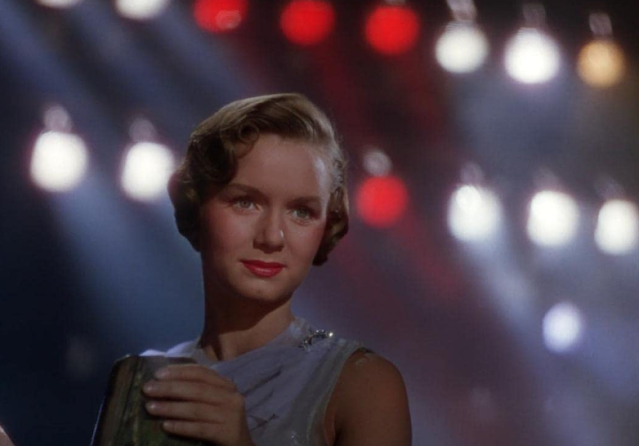
Debbie Reynolds became a star upon her 20th birthday with "Singin' in the Rain."


With Debbie Reynolds, a star was born in Singin’ in the Rain. Considering that she was then not a singer or dancer per se, Reynolds worked very hard to get up to speed. Co-director Stanley Donen had her two solos dubbed because Debbie sounded too Midwestern—typical MGM, home of the “mid-Atlantic” accent. You can find one of her solos on YouTube with her own vocals and she sounds just fine. While Reynolds wasn't a born dancer like those dervishes Gene Kelly and Donald O' Connor, Debbie keeps up with them in their group numbers. 

Debbie Reynolds shines as Kathy Selden in 1952's "Singin' in the Rain."

Debbie Reynolds was just 19 when Singin’ in the Rain filmed and the release was just days before her 20th birthday. Debbie was obviously working with superior talent and material in Rain. In lesser vehicles, Reynolds could come off as saccharine, like Doris Day; here Debbie is genuinely sweet and girlish. As Kathy Selden, her energy and natural clown personality are well-utilized. This film officially made her America's sweetheart, which came in handy during the downtimes of her career. I prefer Reynolds in her early stardom, when she was a honey blonde sweetie rather than the later bleached blonde dead set on wowing her audience. Debbie’s the girl next door and quite endearing. I won't dwell on co-director Gene Kelly's taskmaster reputation. If Gene had treated prior co-star and neophyte dancer Frank Sinatra the way he treated Debbie, Frankie probably would have knocked his teeth out. But Debbie was from a tough working class Texas family, and she survived.

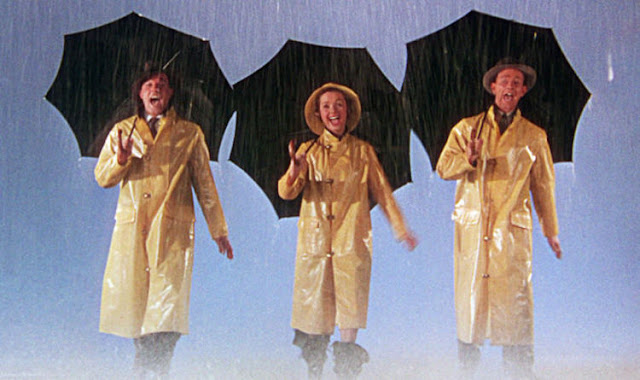
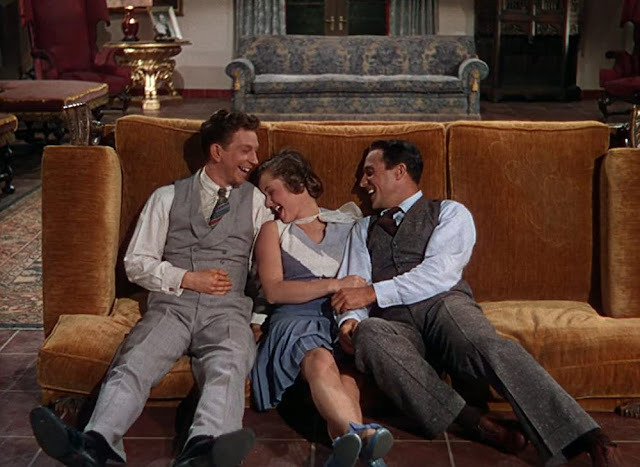
Donald O' Connor, Debbie Reynolds, & Gene Kelly are triple threats in "Singin' in the Rain."

Debbie, Donald O' Connor, and Gene Kelly were a trio who were triple threats at singing, dancing, and comedy. “Good Morning” is still an instant high, with its upbeat lyrics and joyful dancing. Kelly worked hard with them on the musical numbers and Stanley Donen's sophisticated touch shined on the rest.

Donald O' Connor's famed acrobatic number, "Make 'Em Laugh," from "Singin' in the Rain."

Everyone's on their game here. As Cosmo Brown, Donald O' Connor's impish and energetic, and his dancing is just as brilliant as Gene's. Donald was also a great clown, showcased in “Make 'Em Laugh,” though the song is a total rip off of Cole Porter’s “Be a Clown.” When Donald and Gene sing and dance to the imaginative “Moses Supposes,” the song is a tongue-twisting delight and their dancing is like watching an Olympic event. Gene as matinee idol Don Lockwood is pretty dang perfect. Kelly is at his most handsome and charismatic, and his dancing is superb. There's a great versatility in his showcased numbers, capped by his rain dance of the title tune. And I'm supposing that Stanley Donen, one of Hollywood's smartest directors, helped reign in the three stars tendency to mug. While they all get to clown, there's very little ham here.

Aside from his many talents, Gene Kelly is well-cast as a matinee idol in "Singin' in the Rain."

Singin' in the Rain has that favorite movie myth attached that it wasn't a huge hit upon release, just a modest hit. Those who tell it usually compare Rain to Kelly's previous An American in Paris. Well, if you're talking about Oscars, yes. Paris got 8 Oscar noms and won 6; Rain got 2 noms, and won 0, which I find ridiculous. The only ones nominated were Jean Hagen for Best Supporting Actress and Lennie Hayton for Best Musical Score. Again, proof that Oscars are not a part of what ultimately makes movies memorable. As for the box office, both films cost about the same to produce and Paris made slightly more money. But which film is better remembered today? For my money, it's Singin’ in the Rain.

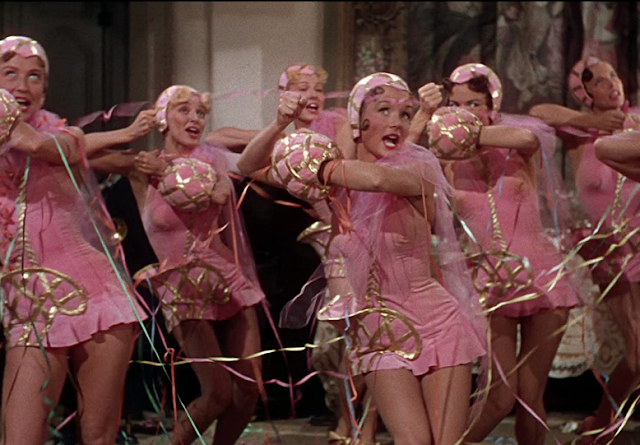
Cyd Charisse makes a guest appearance for "Singin' in the Rain's" "Broadway Melody."

One quibble: though the 13 minute “Broadway Melody” is presented as a "pitch" to the studio head in the movie, it feels very tacked-on. Superbly done in every respect, it also has zero to do with Singin' in the Rain or especially, the movie within a movie, The Dancing Caballero. It’s certainly superior to a similar showstopper, Judy Garland’s “Born in a Trunk” from ‘54’s A Star is Born. And Judy’s saga is twice as long! While I’ve read some smart comments in defense of “Broadway Melody,” it just feels like a Kelly showstopper, “All About Gene.”

Gene Kelly was never shy about seeking audiences' adulation.

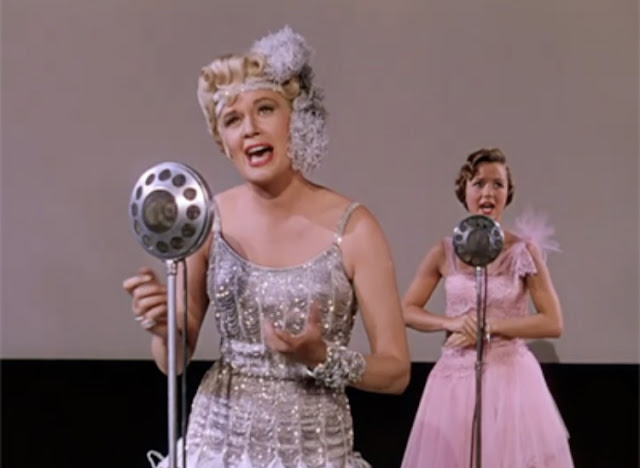
I'm also puzzled as to why Jean Hagen's hilarious Lina Lamont lost to Gloria Grahame that year. Was it because Hagen's shrill star sounded too much like Judy Holliday in Born Yesterday, for which Hagen was her understudy on Broadway? To me, Jean’s shtick is much easier to enjoy in small doses than Judy's shrieking at bellowing Broderick Crawford throughout the movie version of Born Yesterday. As for Grahame, she was the “It” bad girl of the early '50s, but her role as a flirty southern wife in MGM’s The Bad and the Beautiful was a mere nine minutes... and she even dies off-camera!

Jean Hagen, right, gives a hilarious performance as silent star Lina Lamont.
With an equally funny Kathleen Freeman, as Lina's poor diction coach!

With a couple of exceptions, the songs are all from MGM’s early decades, tied to the story of Hollywood's silent era ending and sound beginning. The satire is snappy, with some real life nods to casualties of the silent era. Funny bits abound, with a great cast down to the smallest parts, like hilarious Kathleen Freeman as Lina’s voice coach. Cyd Charisse is spectacular in the “Broadway Melody” number. Watch fast for Rita Moreno as starlet Zelda Zanders.

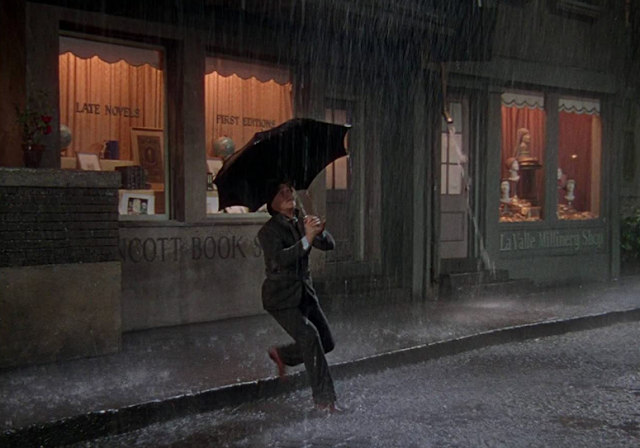
Perhaps the most famous song and dance number in movie history?
Gene Kelly is "Singin' in the Rain!"

Singin’ in the Rain is such a treat, with memorable song and dance numbers, gorgeous sets and costumes, great humor and performances. It all adds up to be MGM’s greatest musical. 

Here’s my tribute to Debbie Reynolds, when she passed away, on her life and very readable memoirs: https://ricksrealreel.blogspot.com/2017/01/debbie-reynolds-double-dose-of-memoirs.html

Debbie Reynolds was no longer in the movie background after "Singin' in the Rain!"

FYI: I put all the movie overflow on my public FB  movie page. 

Check it out & join!  https://www.facebook.com/groups/178488909366865/