Showing posts with label Norman Jewison. Show all posts

Sunday, April 21, 2024

Charismatic Steve McQueen is ‘The Cincinnati Kid’ 1965


Steve McQueen tries to keep his cool as "The Cincinnati Kid."


There were many talented hands involved with the poker playing epic, 1965’s The Cincinnati Kid. However, Steve McQueen is the winner, in the title role. McQueen isn’t just cool, but also effortlessly natural and emotionally understated as the man who has something to prove.

Like Paul Newman, Steve McQueen knew the power of his piercing blue eyes.

A common criticism of The Cincinnati Kid is that Paul Newman’s The Hustler from 1961 is a much more powerful story. That should go without saying. To me, the similarities between the two films are superficial:  both title characters struggle to make a name in their game; both are going up against a veteran champ in their respective sport. Otherwise, the movies are apples and oranges: Newman’s film is a stark, realistic black and white drama; McQueen’s movie is a stylish, colorful crowd-pleaser. The Hustler is a classic; The Cincinnati Kid is great entertainment and holds up well 50 years later.

A smile from the usually laconic Steve McQueen, as "The Cincinnati Kid."

I’ve only seen a few of Steve McQueen’s films because many of them are genre flicks. However, from what I’ve seen, I’m always knocked out by McQueen’s naturalistic performances. As The Cincinnati Kid, Steve’s card player is tough, but only when he has to be. Though he has ethereal Tuesday Weld and erotic Ann-Margret in his thrall, McQueen’s bad boy truly only wants Weld. When he strays once with A-M, he sees that it’s a mistake. In the typical male star vehicle, it’s a given that the hero can beat up any man and bed every female in sight. Steve McQueen differed from his greatest competitor, Paul Newman. Growing up, I always thought of them as the same type. While McQueen’s beat-up good looks and blue eyes are irresistible, Steve was no male beauty like Paul. I like Steve’s style during the ‘60s, much more than Newman’s cocky anti-hero. McQueen reminds me of an updated version of Bogart and Garfield. The final scene where the Kid admits that he’s done, tonelessly matter of fact, is just one of many understated moments by Steve McQueen in The Cincinnati Kid.

The scene when Steve McQueen's "Cincinnati Kid" quietly admits defeat is powerful.

Edward G. Robinson’s performance as veteran gambler Lancey Howard is one of his best—and one of Eddie’s most restrained. Nicknamed “The Man,” Howard knows that “The Kid” is coming down the pike. When Howard rolls into New Orleans, he’s like visiting royalty. I love watching Robinson as Lancey, like a Cheshire cat, taking everything in with great stillness. His poker face is quite entertaining, contrasted with those half-asleep eyes that miss nothing. After a game with a sore loser of a rich man, a game is set up that includes The Man and The Kid. During that third act poker game, Robinson gets to genially spar with former WB co-star Joan Blondell, and his interaction with younger star McQueen is understated and riveting. Eddie was quoted that he admired McQueen, that he was a throwback to the WB stars like himself, Bogie, Cagney, and Garfield. Robinson was totally right.

"I'm still the top stud poker player, see?" Edward G. Robinson as Lancey Howard
aka The Man in 1965's "The Cincinnati Kid."

What a shame that Edward G. Robinson didn't get an Oscar nod for his subtle, dryly humorous performance. This and his final turn as Sol in 1973’s Soylent Green were most worthy for Best Supporting Actor Oscar nomination consideration. The fact that Eddie got zero Oscar nominations in his film career is one of the Academy’s blindest blunders.

One-time WB stars Edward G. Robinson & Joan Blondell reunited as a card shark
& card dealer in 1965's "The Cincinnati Kid."

Aside from Steve McQueen, Ann-Margret, and Tuesday Weld, with their modern style, there's a lot of period detail for a ‘60s movie that wasn't a costume picture. McQueen has his designer hair cut, but his clothes are timeless, except for that cool rain jacket in the opening scenes. And Weld’s hair is very ‘60s hippie chick, but she’s otherwise in character. Then there’s Ann-Margret as Shooter’s young wife, Melba. I like A-M overall as an actress and she seems like a class act as a person. But her shallow kitten with a whip gets old really fast. Compared to the natural performances and physical appearance of the rest of the cast, Annie’s tidal wave of dyed red hair, awning-sized false lashes, and her purring/hissing cat in heat act stands out in the wrong way. Totally ‘60s in a ‘30s set movie, Ann-Margret’s performance is ironically the one thing that is dated in an otherwise authentically atmospheric film.

Ann-Margret as Melba the Cat? As Karl Malden's faithless wife, Melba even cheats
at jigsaw puzzles! From 1965's "The Cincinnati Kid."

Tuesday Weld’s Christian, a country girl in New Orleans, is her quirky, child-like self. But as the good girl to Ann-Margret’s vamp, Weld has a more genuine rapport with McQueen’s character. The Kid’s bathtub scene, when Christian explains a foreign movie that she’s just seen is one example of their charming interplay.

Tuesday Weld & Steve McQueen have a sweet rapport in 1965's "The Cincinnati Kid."

The cast of The Cincinnati Kid is simply incredible. Karl Malden is a flawed good guy, Shooter, coerced into cutting the cards in the Kid’s favor, because of debts incurred by his trampy wife, Melba. Malden’s empathetic, as always. Rip Torn, of the John Cassavetes/Ben Gazzara department of creeps, is the poor sport money man who wants the Kid to take down reigning ancey. Joan Blondell has her likeable broad routine down pat by now as card dealer Lady Fingers. All the actors get their moment to shine: Jack Weston as grouchy Pig; plus Jeff Corey, Dub Taylor, Cab Calloway, Karl Swenson, Milton Selzer, and Burt Mustin. Uncredited but remarkable is Ken Grant as the little shoeshine boy who always wants to challenge the Cincinnati Kid in a penny pitch.
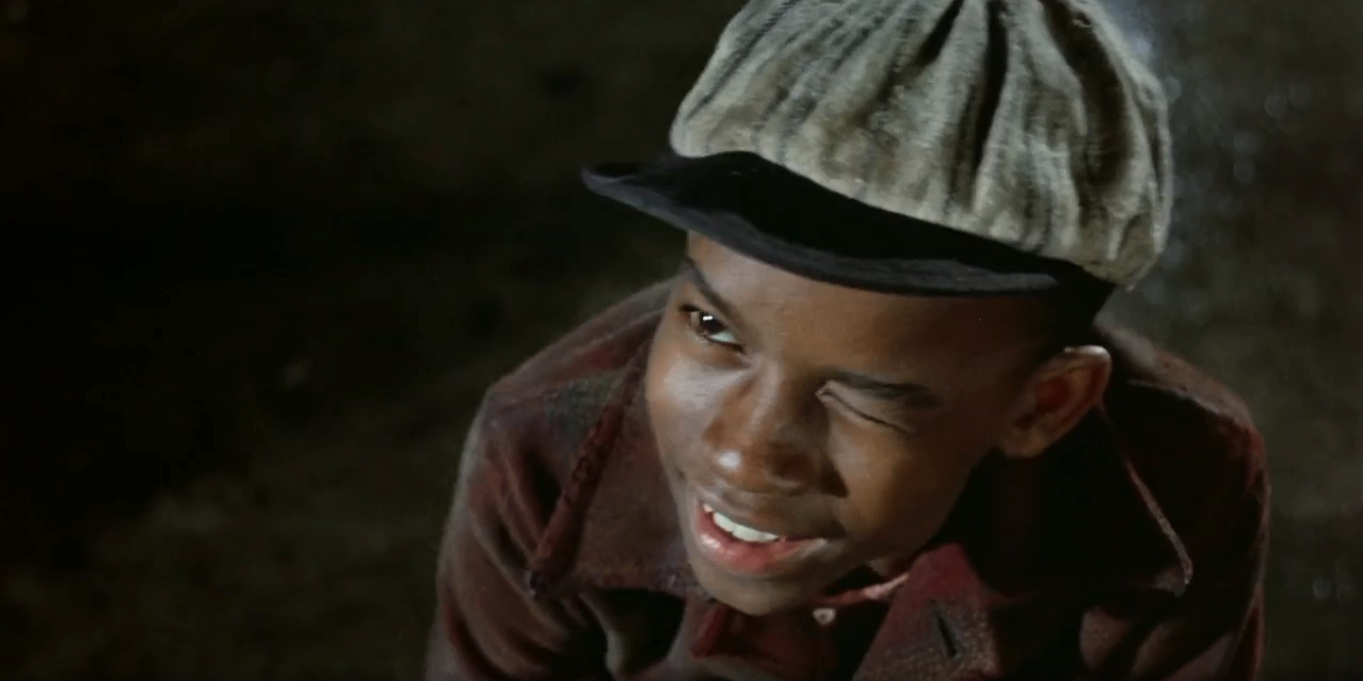
Ken Grant is winning as the shoe shine boy who dogs "The Cincinnati Kid."

The shoe shine boy who idolizes and challenges "The Cincinnati Kid," 1965.

The movie’s tight yet intriguing visual style is courtesy of director Norman Jewison, editor (future director) Hal Ashby, and versatile cinematographer Philip H. Lathrop (Touch of Evil and Point Blank). Jewison was an actor’s director who was also a great storyteller and it shows here. The story, though it revolves around cards, is really about what the stakes are for these characters in the game. You notice every character, even if they are only reacting to the major players, a hallmark of a Jewison movie.

Director Norman Jewison at right, listening to his star, Steve McQueen, on the set of
 "The Cincinnati Kid." Tuesday Weld is in the middle of the talk.

The Cincinnati Kid was from a novel by Richard Jessup, a writer with a tough upbringing, similar to star Steve McQueen. Sadly, both men died young, two years apart, from cancer. The crisp and humorous script is by old pro Ring Lardner, Jr., first time off the black list, and newcomer Terry Southern, who came into his own in the ‘60s. Lalo Schifrin provides the score, with Ray Charles singing the theme song.

An amused beef from me: Why didn't Jewison reshoot the scene where McQueen throws Malden up against the door, after the Kid finds out Shooter is favoring him with the cards? When Steve slams Karl, the entire wall wobbles!

Rip Torn, so good at playing villains, is rich SOB Slade in "The Cincinnati Kid."

Some movie critics and film fans have complained about card games as a subject matter and the impossible odds of The Kid and The Man’s last hands. Personally, I find card games incredibly boring. The game scenes here were filmed with great skill and I was much more interested in the players’ motivations than their card hands.

The Cincinnati Kid is a crowd-pleaser, you’re either all in, or you’re out.

Here’s my look at director Norman Jewison’s 1967 ensemble masterpiece, In the Heat of the Night: 

http://https://ricksrealreel.blogspot.com/2020/06/in-heat-of-night-1967.html


"The Cincinnati Kid" is on its game as great entertainment.

Friday, June 30, 2023

A Warm Cold War Comedy: ‘The Russians Are Coming!’

A bittersweet moment with Alan Arkin, Eva Marie Saint, & Carl Reiner near the finale of 1966's "The Russians Are Coming! The Russians Are Coming!"


The Russians Are Coming! The Russians Are Coming! was released in 1966, at the height of the cold war. The Norman Jewison directed comedy, about chaos caused by a Russian sub that runs aground near a small New England town, was notable for its even-handed treatment of both Russian and American characters. At the time, it was a huge commercial hit and received four Oscar nominations.

I find it odd that there's some derision directed at The Russians Are Coming! The Russians Are Coming! because it was so successful in its time. And yet classic movie fans fall all over the marathon farce It’s a Mad, Mad, Mad, Mad World. Russians may seem quaint by modern movies’ in your face style, but the humor is still most apt and the cast is mostly terrific. Also, the humor of Russians is more character-driven than Mad World. I've always been allergic to the heavy-handed slapstick of Mad, and I think Jewison is a far more skilled and subtle director than Stanley Kramer, whose style was pedantic.

Cantankerous Carl Reiner warms up to adorable Eva Marie Saint in 1966's
"The Russians Are Coming! The Russians Are Coming!"

And while The Russians Are Coming! The Russians Are Coming! indeed feels like an elevated and elongated sitcom, satirizing American hysteria is still pertinent today. Also, I'm really surprised that Carl Reiner didn't have a hand in writing this, because his and Saint’s characters remind me a bit of Reiner’s creations, Rob and Laura Petrie from The Dick Van Dyke Show.

Hilarious physical comedy in "The Russians Are Coming! The Russians Are Coming!"

I love Carl Reiner and his natural comic abilities save his performance as playwright Walt Whittaker, such as his tied up scene with the local telephone operator, played by Tessie O’Shea. But his comic sour puss persona wears thin fast as a lead, that's why he was so much better as the side character Alan Brady on The Dick Van Dyke Show. Watch Reiner as Rob Petrie in the pilot that was later re-tooled for Dick Van Dyke to much greater effect and you’ll see the difference.

Eva Marie Saint's level-headed wife tries to explain all the chaos in 1966's
"The Russians Are Coming! The Russians Are Coming!"

Eva Marie Saint is a fine straight woman and quite appealing as Ellie Whittaker. Saint looks lovely here in her early 40’s, she’s both subtly sexy and the patient wife to bombastic Reiner’s husband. I always liked Saint’s simple style, which didn’t date her to later audiences. In this film, Eva Marie looks timeless.

Alan Arkin's Russian asks Carl Reiner's writer to please not try to kill him again!
"The Russians Are Coming! The Russians Are Coming!"

Alan Arkin is charismatic and funny as the Russian Lt. Rozanov. Arkin's grand-parents were Russian Jews and he spoke Russian fluently. Here, he gets to fracture English to comic effect. This was the actor’s first major role and he got raves and an Oscar nomination. Arkin is hilarious but has authority, believability, and warmth. With those dark expressive eyes and sly smile, Alan could have played more romantic leads in a later era.

John Phillip Law is the shy Russian officer in 1966's "The Russians Are Coming!
The Russians Are Coming!"

John Phillip Law, often considered wooden, is sweet here and those blue-grey eyes are riveting. As Alexei, the 6 ft. 5 Law is a gentle giant. Remembering him from this and a few international movies, I assumed Law was European, probably German, like Horst Bucholz. I was surprised to find that he was born in California and grew up around the movie business! He’s quite endearing here and I had also forgotten that he passed away in 2008, at just age 70, of pancreatic cancer.

Brian Keith as the exasperated sheriff, with Dick Schaal & Jonathan Winters
in 1966's "The Russians Are Coming! The Russians Are Coming!"
Keith's bangs are really his mussed up comb-over!

What a great cast of character actors in The Russians are Coming! The Russians are Coming! Some you will just recognize by their familiar faces, others are well-known names like Theodore Bikel, Paul Ford, Jonathan Winters, and Brian Keith. They are all totally believable as small town archetypes. Aside from Reiner's occasionally grating performance, the other dud is Sheldon Collins as son Pete, who is directed to be the big mouth "cute" kid. Highly annoying!

Sheldon Collins as the highly irritating son of the Whittakers in 1966's
"The Russians Are Coming! The Russians Are Coming!"

Joseph Biroc’s cinematography is beautiful and stylish; Johnny Mandel's warm, funny score is a big plus. The visuals are very strong, making great use of the locations, blending them in with the story, though the New England coastal community was actually shot along the Pacific coast. A few of such scenes: Ben Blue as he chases a horse around an open field in attempt to make like Paul Revere; Carl Reiner as he wobbly rides a small bike down a rural road; and the overhead shots of the small American boats acting as a flotilla for the Russian sub.

America's favorite past-time, mass hysteria, in 1966's "The Russians Are Coming!
The Russians Are Coming!"

The Russians Are Coming! The Russians Are Coming! is slightly overlong at two hours and five minutes, but it’s not elephantine like the three and a half hour Mad World. The finale is a bit forced, with future Family Affair star Johnny Whitaker dangling from a church steeple, which brings the Americans and Russians together to his rescue. But Russians is a comedy, not a hard-hitting social drama, and the ending with the locals escorting the Russian sub to safety is an appropriately feel-good moment that’s not totally out of place. Enjoy this stylish, sometimes silly, comedy with its stellar cast and good-hearted satire.

The locals give the Russians and their sub a send-off in 1966's
"The Russians Are Coming! The Russians Are Coming!"

Here’s my tribute to Eva Marie Saint, a most intriguing Hitchcock blonde: https://ricksrealreel.blogspot.com/2019/07/eva-marie-saint-secret-weapon-of-north.html

Theodore Bikel's Russian ship commander offers a wave goodbye in 1966's 
"The Russians Are Coming! The Russians Are Coming!"


Wednesday, May 19, 2021

Cher Shines in Modern Classic: ‘Moonstruck’ 1987


Cher and Nicolas Cage clean up nice for a night at the opera in "Moonstruck."


The fact that nobody involved—except director Norman Jewison—expected much from 1987’s Moonstruck may surprise today’s movie fans. At best, MGM hoped for the comedy to find an art house audience. The then-quirky romance, screenplay by playwright John Patrick Shanley, started to get good word of mouth. Moonstruck then went from sleeper hit to a smash award-winning movie.

"Moonstruck" was an important movie for the careers of Cher, Nicolas Cage, & Olympia Dukakis.

A testament to the charms of Moonstruck is that it’s remained a favorite over the decades, plus even greater popularity as a COVID era comfort film. I think that Moonstruck is a modern romantic comedy classic, a throwback to the smart comedies of the ‘30s and ‘40s.

Cher is a modern day Cinderella as a widow who goes to the opera in "Moonstruck."


Moonstruck is a current day Cinderella story. Loretta Castorini, widowed early in life, reluctantly agrees to marry Johnny Cammareri, long-time bachelor and mama’s boy. While he attends to his “dying” mother in Sicily, Loretta agrees to meet with his estranged younger brother, and invite him to the wedding. Brother Ronny is the total opposite of Johnny, a hot head who’s never gotten over losing his hand while working at the family bakery—and for some reason blames his brother. Despite the widow’s cautious nature, she is stirred by his passion and winds up in the baker’s bed. Meanwhile, Loretta’s father, Cosmo, is having a late mid-life crisis romance, and her mother Rose senses something’s up. Other characters are either happily in love, looking for love, or resolutely lonely. The romantic dilemmas all come to a head, revealed under a magical full moon.

The wolf without a paw meets the bride with bad luck! Big scene from "Moonstruck." 

Some were shocked that a comedy starring Cher won her an Oscar. Well, 40 years before, even more folks were shocked when another veteran glamour girl, Loretta Young, won an Oscar for a comedy, The Farmer’s Daughter. She also sported an accent! Like Loretta, Cher won from a handful of dramatic nominees. This was a great comeback for Cher, who was 41 when Moonstruck was released; the film is still strongly associated with the superstar, who turns 75 on May 20.

Disclaimer: I’ve been a Cher fan most of my life. Second disclaimer: I think the Oscars are meaningless. What ultimately matters is how well a film is remembered in future years. And those seldom match up with Oscar nominees or winners of any given year. But for those that think the Oscars matter, Cher’s win for Moonstruck was a career Oscar, after an uphill battle to get in films. Of course, Glenn Close is a superior actress to Cher. But Oscar has stiffed Close eight times now, so naysayers should place the blame where it belongs, on the Academy of Motion Picture Sciences, not Cher.

Cher with her Oscar for "Moonstruck" in 1988.

John Patrick Shanley deservedly won Best Original Screenplay for Moonstruck. The story is so perfectly told that I'm surprised it hasn't been done as a Broadway play or musical. In this age of re-invention and re-boots, I’m sure that day will come. This fairy tale for adults has wonderful bits of business, unabashed romanticism, smart dialogue, and an atmospheric valentine to New York City. The charm is in the quirky details and dramatically heightened characters.

Norman Jewison, who will be 95 in July, has had a long, diverse career, but his films have always focused on character, often with humor: The Cincinnati Kid; The Russians Are Coming, the Russians Are Coming; In The Heat of the Night, The Thomas Crown Affair; Fiddler on the Roof; And Justice for All; and Moonstruck. Jewison is the only director to have guided singing divas Judy Garland, Doris Day, and Cher in their mid-life careers! A great actor’s director, Jewison’s movies are typically smart, well-told, and character driven. It’s a shame that Jewison didn’t win for Best Director, as Moonstruck was his baby, and one of his last big hits. Instead, Bernardo Bertolucci won for The Last Emperor.

The ensemble cast is memorable, from the leads down to the smallest parts.

Nicolas Cage as Johnny, the baker who lost a hand and then his bride-to-be.

Nicolas Cage is bizarrely brilliant as Ronny Cammareri, and has Cher to thank for getting the role. Nobody wanted Cage, even after a screen test, or perhaps especially so. However, Cher thought Cage’s take on the bruised romantic baker was fascinating. Nicolas Cage, then not keen on making mainstream movies, thus became a top leading man with Moonstruck. He reminds me of a comic Stanley Kowalski, with some of his monologues near-operatic. As Ronny, Cage’s bellowing rant about his baker not having a hand or bride is hilariously riveting. And the opera loving baker’s impassioned speech on love’s imperfection is a classic moment, comedic but wise. Cage is at the beginning of his youth and offbeat good looks, and gives the role everything he’s got.

Nicolas Cage became a leading man with his off-kilter looks & delivery in "Moonstruck."

Danny Aeillo plays the thankless part of mama’s boy Johnny Cammareri beautifully. Like most of Moonstruck’s characters, he has to decide whether to make a romantic leap or not. Johnny’s got a heart of gold but is a gutless wonder, yet Aeillo makes him funny and empathetic.

Olympia Dukakis & John Mahoney in one of the loveliest scenes from "Moonstruck."

Olympia Dukakis, who got her big movie break in Moonstruck, was perfect casting as Cher’s film mother, Rose Castorini. Aside from their resemblance, Olympia’s no-nonsense demeanor was perfectly in sync with Cher. Dukakis gets big laughs with her deadpan lines, but also wins over viewers as the longsuffering wife of a cheating hubby. Dukakis’ dinner scene with John Mahoney’s man-child professor is flirtatious and bittersweet, and shows both Rose’s softer side and strong character, as she tells Professor Perry, “I know who I am.”

Olympia Dukakis with her Oscar for "Moonstruck."

Vincent Gardenia, as Cosmo Castorini, has one of his best roles as the straying husband. Vincent was a wonderful actor, who was at home in comedy or drama. Here, Gardenia conveys both. He’s utterly believable as the Italian alpha male, a tough businessman who thinks he’s calling all the shots. But every scene Cosmo’s in with wife Rose, you absolutely know he doesn’t have the last word.

Vincent Gardenia and Anita Gillette as Cosmo Castorini & Mona, in "Moonstruck."

John Mahoney, who soon became a favorite TV face, as the dad of Frasier, is charming and wistful in his extended scene as the tomcat college professor mama Rose meets while dining out solo.

Louis Guss is loveable as Rose’s brother Raymond, happily married to Rita. Guss goes big but in a good way as the romantic who lets the whole word know it.  Julie Bovasso, as Rita, so delightful here, was also the dialogue coach for the other actors’ accents. I can hear her in my head her telling Cher’s Loretta, “You were so weird last night!” Or in the finale, as the family member who answers the door, Rita announces in a sing-song voice, “It’s Johnny Cammareri.”

Julie Bovasso & Louis Guss as Rita & Raymond, with Olympia Dukakis.
Everyone's waiting for the arrival of Johnny Cammareri in "Moonstruck."

Feodor Chaliapin, Jr. shines as the paternal grandfather with all the dogs, looks on in bewilderment at the goings on in his family during the full moon.

Anita Gillete, one-time sitcom fave, is great fun as Mona, the “cheap bit of goods” Cosmo is having an affair with. She doesn’t have the biggest part, but she makes her screen time count and is warm and funny as the overripe tart.

All of the characters, right down to the bits are comic gems, like Chrissy from the Cammareri bakery, so snarky to Loretta and sweet on Ronny. Or the crone at the airport, who tells Loretta that she hopes the plane her sister is on crashes, over a man. Everyone gets their moment to shine.

The trouble begins when Loretta accepts Johnny's marriage proposal.
Danny Aeillo & Cher in "Moonstruck."

Finally, there is Cher, who is perfectly cast as Loretta Castorini. It’s hard to believe that Sally Field was actually first choice for the role. I like Sally, I really like her, but I can’t even imagine Field as the hard-bitten Italian widow. I once had a bookstore boss who liked Cher in movies because she didn’t try to “play nice” to win over audiences. That’s Cher’s persona perfectly defined, which has made people love or loathe her for six decades now. She deftly plays the lovelorn Loretta, the brittle bookkeeper who is a romantic at heart. For those who thought Cher wasted her time on TV in the ‘70s, that’s where Cher honed her natural comic timing. And the diva’s delivery is pretty perfect here, barking out some of the movie’s snappiest lines, including the classic, “Snap out of it!”

Cher, who’s made no pretense of being a natural beauty, plays the Cinderella aspect of her role perfectly. I recall the audience I watched Moonstruck with ooh over Cher’s makeover for Loretta’s night at the opera. A Catholic pal told me at the time that she thought it hilarious that Loretta runs smack into some nuns after leaving the beauty parlor—and on her way to sin some more!

Loretta's luck finally turns, with a a love match proposal, in "Moonstruck."

My late, great movie pal, Alice once told me she liked the way Cher looked before her makeover, and I could see her point. It was a rare look at Cher, minus most of the drag, and her soulful big eyes and cheekbones are photographed beautifully. Cher works well with an ensemble, as most of her big movies were, and is effortlessly believable as a daughter in this big Italian family. And as Cher’s stone cold Loretta warms up, Cher’s charm and charisma is lovely to watch. To me, Loretta’s a great character for any actress to play, and Cher more than does her justice.

Nicolas Cage & Cher are "Moonstruck" lovers.

I saw Moonstruck at an art theater in Suttons Bay, MI during the winter of ’88. There were titters of laughter mixed with guffaws of disbelief at this unconventional romantic comedy, as the movie kept the audience off-balance. I also remember during the closing credits, there were many happy, smiling faces as people slowly left the movie. More than a few folks were humming or singing along to the Dean Martin standard, That’s Amore. And there were more than a few pleasantly surprised comments on how good Cher was in Moonstruck. Cher’s been surprising audiences for almost 60 years now.

FYI: I put all the movie overflow on my public FB  movie page. 

Check it out & join!  https://www.facebook.com/groups/178488909366865/


All in the family: The cast of 1987's "Moonstruck."


Thursday, June 11, 2020

‘In the Heat of the Night’ 1967


Big city detective Virgil Tibbs VS. racist small town Sparta, Mississippi. Note the telling sign.

When In the Heat of the Night was released Aug. 2, 1967, racial strife was rife across the U.S. That summer, my family was living in Milwaukee, WI, where citizens were under curfew, enforced by The National Guard. This prompted my small town, white parents to move us back to Upper MI. I was only 7 and had no idea until my mother mentioned it recently, in reference to current racial tensions. Watching In the Heat of the Night in 2020 makes me realize how the film still resonates, and that moving or looking away is no longer an option.
On April 10, 1968, In the Heat of the Night won five Oscars. With tragic irony, the Academy Awards were postponed two nights, in honor of the funeral for the assassinated Martin Luther King. Heat won the Best Picture Oscar for 1967. Veteran actor Rod Steiger won for Best Actor against tough competition, for his nuanced portrayal as Police Chief Gillespie. Future director Hal Ashby got the nod for best film editing, as did Stirling Silliphant for best adapted screenplay, and Heat also scored for Best Sound. Amazingly, Sidney Poitier received no Oscar nomination for 1967, despite or because of the fact it was his biggest year in film: In the Heat of the Night; To Sir, With Love; and Guess Who’s Coming To Dinner?
Rod Steiger as Police Chief Bill Gillespie. Known for his "big" performances, Steiger shines in his small moments.
Here, the small town cop reacts to Tibbs engaging the suspect.

Heat gets the rap in some quarters for winning Best Picture Oscar over the innovative and iconic The Graduate and Bonnie and Clyde. Certainly, those two films broke ground and spoke to its then-younger generation. Heat was also more of a genre picture than the other two, but it too pushed the envelope, in its depiction of racial tensions. Over 50 years later, in terms of storytelling, I’d say that In the Heat of the Night holds its own just fine, and it isn’t dated at all. In fact, one recent review I’ve read aptly described Heat as ‘once timely, now timeless.’
Chief Gillespie & Virgil Tibbs try to make lemonade from lemons with their uneasy alliance.

Except for a few well-chosen tweaks, In the Heat of the Night is a faithful version of the John Ball novel. The Oscar-winning screenplay by veteran Stirling Silliphant is taut and tough. The story of a murder in a small southern town, with a white police chief grudgingly asking the help of a black Philadelphia detective who’s passing through, is precisely told. There’s hardly a wasted moment in Heat. And as the local racial tensions mount over the visiting black cop going through their dirty laundry, screenwriter Silliphant’s dialogue doesn’t pull any punches. 
Warren Oates offers wonderful comic relief as Sam Wood, the Barney Fife of Sparta.

While Heat’s mystery is intriguing and the racial element most direct, what makes this movie especially watchable is its character study of small town life—southern gothic, really. The small town folks, when it faces a controversial crime, reminded me a bit of Anatomy of a Murder. As someone who grew up in one, these characters are quirky, flawed, but totally real. Director Norman Jewison caught the disparity of small town life beautifully. He juxtaposes the black and white, the rich and poor, rural with “progress,” good ole boys and bad girls, and all the folks in between, uneasily living together.
Anthony James as Ralph, the diner employee who may be Sparta's quirkiest resident!
James, memorable as the creepy chauffeur in 'Burnt Offerings,' passed away in May, 2020.

The strong characters are reinforced by a stellar ensemble cast, one of In the Heat of the Night’s many strengths. Poitier makes a terrific leading man and Steiger is a dynamic star character actor. Sidney was 40 at the time and didn’t look it, but I was shocked that Rod was only 42 as the aging, small town cop! Carroll O’ Connor was 64 when he reprised the role on television in 1988. Rod Steiger chews gum like Bugs Bunny munches carrots throughout this film, and gives me TMJ just watching him!
Steiger's Chief Gillespie may not be a crime solving genius, but he's got Virgil's number.

I am not a fan of Rod Steiger. I think he's talented, but for me, he’s the male version of Shelley Winters—a gifted actor who was too often an outrageous ham. That said, I think Steiger strongly deserved his Oscar. Except for a few scenes where he goes loud and does his motor mouth bit, I was so engrossed in the police chief's character that I at times forgot I was watching Rod Steiger. Gillespie, while a slightly scary and tough character, is ultimately decent, and most affectingly, a sad and lonely one. Steiger has some incredible moments here, sometimes with just a sad look in his eyes, or with uncomfortable body language.
Poitier's Tibbs' trip back home to Philly is interrupted during a fateful stopover in Sparta.

Sidney Poitier as Virgil Tibbs is often the observer, watching and wondering how to deal with all these racist locals. Richard Burton once wrote that Elizabeth Taylor and Marlon Brando both had the gift for stillness, making each physical movement count, and act as much with their eyes as through their dialogue. That describes Sidney perfectly here. He has some great moments of power, like when he's frisked, or consoles the widow, and when he shares a cell with the suspect.
These superb actors plus the ensemble cast are a major strength for 'In the Heat of the Night.'

The tension between Poitier's Tibbs and literally the rest of the cast is incredible. With the exception of Mrs. Colbert, the victim's wife, Virgil meets hostility and downright hatred at every turn. Tibbs is a black man who—in the eyes of the locals—has stepped above his subservient station, and is therefore a threat. The only difference between then and now, it was the norm back then. Poitier plays it cool for most of the movie, with the sense that his character has seen this all before. From the get go, the cop picks him up at the bus station as an instant suspect for the murder. Virgil continues to be quiet, though not obedient, until he hits his breaking point. It’s then Poitier pointedly proclaims his famous line: “They call me Mr. Tibbs!”
Larry Gates recalls his cultured professor in another small town melodrama, Some Came Running. Only here, as town big shot Endicott, his charm is only skin deep. Gates’ lone, long scene contains the classic slap-off between his white bigot and the black cop.
Larry Gates as Endicott, the town big shot bigot. Doesn't he look like Dick Cheney?

Scott Wilson made his film debut, as a suspect Harvey Oberst, followed up with the same year’s In Cold Blood, in which he was promoted to star and killer. As troubled Harvey, Wilson uses those child-like blue eyes to great effect. Warren Oates as Sam, the Barney Fife wannabe tough cop, is very funny and likeable, despite the fact he's not the sharpest tool in the shed. He also gradually respects Tibbs' detective skills.
Scott Wilson as Harvey, a wrong suspect. In '67, Wilson starred as a real killer 'In Cold Blood.'

Lee Grant was back on the big screen in ‘67, after being blacklisted for more than a decade. She’s fascinating to watch as Mrs. Colbert, the widow of the Yankee who was going to start a factory to compete with local big wig Endicott—and hire “colored people!” Grant is pent up intensity personified, and with that distinctive husky voice to boot, though I found some her hand gestures a bit too Actors Studio. The recently deceased (5/26/2020) Anthony James is funny and spooky as Ralph, the diner dude, gleefully hiding pie from Oates’ cop. Quentin Dean is feral as Delores, the tough, small town tart. Fine familiar faces William Schallert and Beah Richards have their moments, too. The entire cast builds a most believable world here.
Lee Grant, back on the big screen, here as the victim's widow & as Sharon Tate's sister-in-law in 'Valley of the Dolls.'

Sparta, Illinois substitutes for Sparta, Mississippi as a backdrop for In the Heat of the Night. Why? Star Sidney Poitier did not feel safe travelling to the second Sparta, circa 1966. The week-long stint to film cotton fields was done in Tennessee, and Poitier slept with a pistol. However, director Jewison makes evocative use of his locales to depict hard scrabble small town life.
'Heat' catches the feel of small town life, thanks to Haskell Wexler's cinematography.

Haskell Wexler and Norman Jewison’s collective vision is great. Like Jewison’s first breakout dramatic hit The Cincinnati Kid, In the Heat of the Night melds the visual, soundtrack, dialogue, and performances in a pleasing rhythm. Jewison started out directing musical and musical comedy productions, including the legendary Judy Garland variety series. Cinematographer Haskell Wexler, who just had the job of making 33-year-old Elizabeth Taylor look 20 years older in Who’s Afraid of Virginia Woolf ?, now rose to the rare task of giving a black man the star treatment, which Poitier credited with enhancing his leading man status.
The look on Poitier's face as Tibbs, reacting to his fellow blacks picking cotton, is haunting.

In the Heat of the Night is filled with memorable shots: Sam’s bloody hand in front of the cop’s headlights; a close up of Tibbs, framed by his arms against the wall, as he is frisked; and Virgil’s staring at the chief, the car window a backdrop to cotton pickers as they drive by, as Gillespie jibes that this life is not for Tibbs. Perhaps the most classic shot is Philly detective Virgil Tibbs and southern cop Gillespie sitting on a bus stop bench together, a spin on the classic Nichols and May expression "proximity, but no relating."
Note the body language of Tibbs and Gillespie, as they reluctantly agree to team up.

And the cherry on this cinematic sundae is the jazzy soundtrack is by Quincy Jones, with Ray Charles singing the title song.
A few film writers have criticized that the eventual admiration between Tibbs and Gillespie was too pat—in the real world, perhaps. However, the screenwriter and director do a great job of giving subtle gradation to the breakdown in their defenses and growing respect for each other.
Ultimately, In the Heat of the Night still cooks on all burners. For anyone who thinks Heat is out of date, compare it to the same year’s instantly obsolete racial comedy, Guess Who’s Coming to Dinner? Given what’s going on in this country as of 2020, I’d say In the Heat of the Night is a hotter film subject than ever.
'In the Heat of the Night's' final scene, Tibbs and Gillespie have come to respect one another.
FYI: I put all the movie overflow on my public FB  movie page.