Showing posts with label Carroll Baker. Show all posts

Thursday, March 28, 2019

‘Sylvia’ Surely a Guilty Pleasure, but No ‘Laura’ 1965

Carroll Baker's 'Sylvia,' a puzzle who sure has a lot of pieces to her past!


Sylvia is a mystery woman, whose story is told in flashback, by the people in her life—all who find her unforgettable. Is Sylvia everything she seems on the surface? A detective is called in to investigate, by her fiancĂ©e. Then the gumshoe goes gaga for Sylvia.
If 1965’s Sylvia seems familiar, that’s because it borrows heavily from the famous 1944 film noir, Laura. If you threw a bit of BUtterfield 8 in the cinematic blender with Laura, the resulting concoction would be Sylvia. Howard Fast, who wrote the 1960 novel under the name E.V. Cunningham, seems also influenced by Elizabeth Taylor’s Gloria in John O’Hara’s BUtterfield 8. Fast’s Sylvia is a raven haired and lavender-eyed good/bad girl with a sordid past.
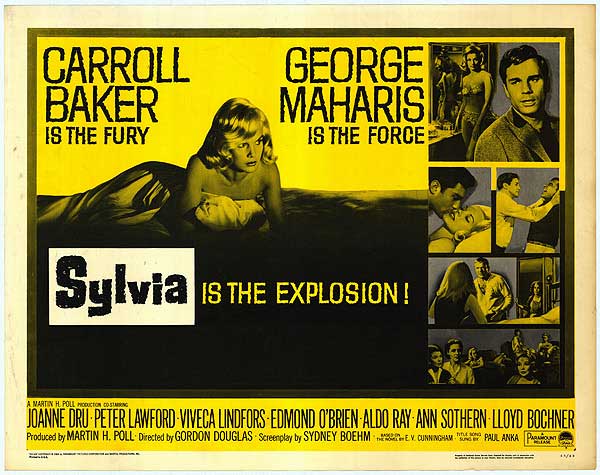
'Sylvia's' poster sums up the stars' shortcomings: Baker is more flat than fury, and Maharis is hardly forceful.

Over the opening credits, jigsaw puzzle pieces of Sylvia’s face are juxtaposed with the richly romantic title ballad by David Raksin, who composed the standard, ‘Laura.’ The problem is that Sylvia came 20 years after Laura, and despite some “daring” ‘60s plot points, it feels dated compared to timeless Laura.
The hokey but highly watchable Sylvia begins when private eye Alan “Mac” Macklin (pretty George Maharis) is summoned in secret to the estate of millionaire Frederic Summers (puffy Peter Lawford). The sinister Summers rolls out his request Mission Impossible-style, complete with home movies, photos, and documents. He wants a major background check on his bride-to-be, Sylvia West (platinum pretty Carroll Baker). The groom has found out that West, a poet and heirloom rose gardener, was not an orphan raised by wealthy relatives in England. Since the 1965 prospective groom can’t just Google or stalk Sylvia on social media, he needs Mac to track down her back story.
Maharis' private eye accepts a mission from Peter Lawford's millionaire, here in his cardigan sweater period.

Mac accepts this mission, and with the help of a handwriting expert and a pompous poet, the detective discovers that Sylvia was not from England, but plain old Pittsburgh. Mac follows leads, from person to person, in the tragic trajectory of Sylvia’s sordid life—starting with Sylvia West once was Sylvia Karoki, from an immigrant slum family. What makes the series of vignettes so watchable is the stellar veteran cast, ranging from over the top to touching, all giving their best shot in their limited screen time.
Viveca Lindfors gives the best performance in 'Sylvia,' subtle as the librarian who first knew the title character.

First up, is Viveca Lindfors as Irma, the possibly lesbian librarian who takes a shine to Sylvia. Lindfors gives the film’s best performance, heart touching without hamming. Irma rhapsodizes over Sylvia’s love for learning and beauty. In the first of endless flashbacks, Lindfors gives a lovely introduction of her first meeting then early-teen Sylvia at the library. Lindfors lilting recollection of Sylvia saying, “I want a book, I want a book…” is soon deflated by Carroll Baker’s flat reading of “I wanna book.” We are treated to 34-year-old Baker in a pinafore and a long Goldilocks wig, photographed in soft, golden light that pinafore-loving Jennifer Jones or Ginger Rogers would pine for. In her scenes as an early teen, Baker is mostly posed kneeling or lying down. Later, we see her at Irma’s apartment, inquiring about a bouquet in a deadpan voice, “Are these real?” This sums up the biggest problem with Sylvia, and that is Carroll Baker. There’s nothing enigmatic, empathetic, endearing, etc. about Baker. Carroll’s Sylvia comes off as charmless for most of the movie.
Carroll Baker as early teen 'Sylvia.' Uh huh.
The first rape scene in 'Sylvia.'


In Gordon Douglas’ solid but by-the-numbers direction, he actually has Lindfors’ Irma ask, “Would you like me to show you where the story began?”
After watching some nice LA and Pittsburgh location shooting, we are then shown a patently phony soundstage slum where you half expect the Dead End Kids to drop by. This leads to a flashback where Sylvia’s drunken stepfather (Aldo Ray) catches her with lipstick that Irma gave her. Accusing her of taking gifts from men, to Sylvia’s vehement denials, he responds by violently attacking and raping her.
My advice to any young girl is to stay away from a guy who drives a vehicle painted "Peter the Healer!"

Young Sylvia walks out of her tenement apartment into the night, changed forever. As she clings to a post, what does she see? Salvation is literally just across the street, complete with huge painted messages on their windows, run by—seriously—Peter the Healer! Pervy Peter promptly gloms on to Sylvia and takes off with her in his Peter Mobile, also painted with holy warnings, like “Sin No More.” Of course, in this sleazy melodrama, it’s more like, sin some more!
A holy man 'Sylvia' can truly trust! Don't worry, Baker's hair becomes increasingly bigger as she claws her way up!

Mac finds out from Pittsburgh police that the pair ended up down in Mexico, with Peter pimping Sylvia out in her new trade. So, Mac heads south of the border, where he comes upon a holy man who actually helped Sylvia. For some insane reason, the hooker feels obligated to the now-deceased Peter and wants to give him a proper funeral. The priest, like everyone else who comes into contact with Sylvia, is taken by her humanity, love of learning and beauty, and vulnerability. That she’s one hot mama is only noted by the bad characters. Once Peter is put underground, Sylvia moves on. One form of her evolution is constantly evolving hair styles, which telegraphs her lot in life: a shaggy waif, a lank-haired tart, a sleek slutty do, to full-glam hooker hair, to the classy coif of a poetess.  Her last name changes almost as much: Sylvia Karoki becomes Kay, Carlyle, and West.
What would you rather do, read poetry naked in bed, or make sweet love with Edmund O'Brien? 

Sylvia bids adios to Mexico, when her classy chassis catches a ride to New York with a middle-aged travelling salesman. And who better to play him than sweaty Edmund O’Brien? As Mac finds out, salesman Oscar Stewart was crazy about Sylvia. “I’m talking about marriage!” he tells Mac. He remembers every detail of their time together. He must be a masochist, because the flashbacks show him begging for crumbs of affection, with Sylvia dishing out curt rejections. You’re supposed to believe that the tough tart travels across the country with a man, for her “company” as her ticket to ride, and she won’t even give him a kiss? When he declares his adoration of her, Sylvia snaps her response, “Aww, shut up.” She’d rather read poetry, while lounging around nearly naked. Their baleful banter reminds me of tired waitress getting an unwanted customer at the end of her shift.
No, this isn't an episode of 'Bewitched.' Ann Sothern is good hearted tart Gracie, with Baker's 'Sylvia.'

From there, Sylvia’s saga is recalled by characters in the sex trade. Most memorable is Ann Sothern’s Gracie, a long-time employee at a “honky tonk arcade.” Good time girl Gracie adored Sylvia, now going straight. They end up roommates, where we are treated to Sylvia studying French, flowers, and the finer things in life. Gracie tries to help by hooking her up with old men with money. Sothern’s big scene comes when she milks Maharis’ Mac for a night of pricey drinks and dinner in exchange for the dish on Sylvia. Sothern is all dolled up in flouncy finery, falls, and false eyelashes. Not only does Sothern’s Gracie devour martinis and caviar, but the scenery as well. Sothern is over-the-top, but deliberately and delightfully so. It is great watching an old pro like Sothern put over this sentimental slop with gusto.
Even in 'Sylvia's' publicity stills, Ann Sothern is over the top!

Then it’s on to “Big Shirley,” a former hooker turned stripper who toiled with Sylvia while hooking at “Mother’s.” Big Shirley is delightfully played by Nancy Kovack, sporting most of her curvy figure and ALL of her comedic timing. Kovack has but one scene, but definitely makes the most of the stripper who’s too tall, wears glasses, and lousy with names. But memories of Sylvia jog her memory enough to send Mac on to the next acquaintance. 
Nancy Kovack as 'Big Shirley' displays more charisma and sex appeal in her one scene from 'Sylvia' than Carroll Baker does in the whole movie!

Then there’s Jane Bronson Phillips, another former hooker who “married a piggy bank,” as Big Shirley coins it. She is played by a no-nonsense Joanne Dru. After they are busted at Mother’s, Jane and Sylvia try to go straight, but their pasts keep popping up. BTW, “Mother” is played by the wonderful character actress Connie Gilchrist. Apparently her part was cut, because not only does she just have once scene, it’s in a long shot! But you’ll recognize that voice instantly, as the madam who’s in no mood for Sylvia’s snooty disposition. After getting fired from their latest legit jobs, Bronson becomes forever indebted to Sylvia when she is hit by a truck—again, don’t ask! Apparently, Sylvia and Jane bonded in jail, and she goes back to hooking, to pay off Jane’s huge hospital bills—what a gal. Again, Dru is another old pro who puts this schmaltz over.
Maharis' Mac with Joanne Dru as the hooker who made good.

This leads us to the final flashbacks. “The Colonial” is a swank bistro run by drag queen/pimp Lola Diamond, who’s dolled up like a latter day Debbie Reynolds. Diamond offers more tasty dishes than what’s on the menu. In her interview, Lola is impressed with Sylvia’s knowledge of what order to use fine dining silverware. Luckily, Diamond is no Professor Higgins, since when he asks Sylvia where she hails from, Baker answers in her most bored, nasal tone, “I was born in El PAAAH-so, by the BORRR-der.”
Heaven help the mister who comes between Sylvia and Lola Diamond!

Sylvia shows up for work to meet her first big spender, salesman Pudgey Smith, who makes Edmund O’Brien look like Clark Gable. Sylvia’s dressed to kill, with a hair flip that talk show gabber Virginia Graham would have killed for. Sylvia and Lola greet Pudgey, looking like a mother-daughter act!
Soon, Sylvia is paying down that hospital bill, when she meets her final client, classy Bruce Stamford III. He is played by Lloyd Bochner, unctuous as always, sporting his standard slick hair and ascot. Bruce shows bookworm Sylvia a tome with lots of pictures of what he’d like them to try. When she refuses, Sylvia is raped once again. This time, Sylvia turns the tables to her advantage, and is given a bundle of hush money. Jane’s “piggybank” parlays this into a nest egg for Sylvia, allowing her to finally give up hooking and pursue her dream of poetry and culture. Talk about graduating from the school of hard knocks.
Was Lloyd Bochner born with an ascot? Forever Cecil Colby to me, here he's sicko rich guy Bruce Stamford III. 

When Mac gathers all this convoluted info and heads back to California, he is torn: report the facts or say there’s no story? Despite her past, Mac’s enthralled with Sylvia, without ever having met her.
When they finally meet—at his favorite bookstore—Mac’s truly smitten—and so is Sylvia. The ending is really anti-climatic, but also remarkable, as Sylvia finally gets her happy ending, but isn’t require to suffer for her past sins, as was usually the case in old movies.
"Is this movie over yet?" Once 'Sylvia' and Mac meet and fall instantly in love, there's nowhere for the story to go.

As Mac, George Maharis is handsome, perfectly competent, and possessed a brash charm. But like many actors who left a hit TV series to become a big movie star, for every Clint Eastwood and Steve McQueen, there were far more Richard Chamberlains and  David Janssens. All solid actors, but without the luck, right vehicles, or “it” factor that separated the popular stars from bonafide superstars.
Carroll Baker's 'Sylvia' and her hair at the height of her call girl career!

As Sylvia, Carroll Baker was in her mid-30s, but still cheerleader pretty and sporting a trim figure, and looks terrific in her tight frocks. The movie, in typical Hollywood style, makes a point to give Sylvia’s age as nearly a decade younger than Baker’s actual age. Though Carroll’s supposed to come off as standoffish, there’s no underlying vulnerability that is the true Sylvia. There are moments, but Baker doesn’t make much of them. During her Hollywood heyday, Baker could be effective, but was undercut by her curt, petulant manner and a voice that was more than a bit like Alice Kramden of The Honeymooners. Baker is better in the later, less dramatic moments with Maharis, when Sylvia is a successful poet.
"Sylvia" is the rare mid-century movie prostitute who gets a happy ending. No suicides or car crashes for her!

Carroll Baker’s tenure as a Hollywood star lasted less than a decade. After she broke through with Giant and especially the once scandalous Baby Doll, Baker was the sexy star who studied at the Actors Studio. What followed was more misses than hits. Baker left WB after constantly fighting for better roles. In 1964, Baker signed with producer Joseph E. Levine at Paramount. Levine decided to give Carroll the big build up as a sex symbol, to replace the recently deceased Marilyn Monroe. Since half of Hollywood was trying to do just that, this should have been a red flag. What made it all curious was Carroll Baker had already been kicking around Hollywood for nearly a decade, and now approaching her mid-30s, Levine was going to make her a sex bomb? In Hollywood, young starlets are given the sex symbol buildup, and once established, aim for respectability with serious roles. Baker was going backward! Carroll was getting the sex bomb reboot when most of her contemporaries were starting to downsize or depart showbiz. Where was all of this supposed to lead? And Carroll Baker just didn’t have the resume of an Audrey Hepburn, Elizabeth Taylor, or Shirley MacLaine as a bargaining chip.
With 1964’s The Carpetbaggers, Baker was her last big hit that also got wretched reviews. And 1965 was her last year in Hollywood, with four dud movies: Harlow, Sylvia, Mister Moses, and The Greatest Story Ever Told. Baker bailed from Hollywood, fighting Levine in a lawsuit to exit her contract. Carroll Baker then worked steadily in Europe and later came back to Hollywood as a respected character actress.
The preposterous plot of Sylvia can either enthrall or gall you, but the stellar supporting cast more than makes up for the shortcomings of the movie’s two stars. Sylvia is Hollywood hokum at its worst, but a guilty pleasure of the highest order.
As of 3/28/19, there is a great copy of Sylvia here: https://ok.ru/video/572813019792


The pieces may not fit, logic-wise, in 'Sylvia,' but it's still fun to watch George Maharis put them together.


Wednesday, April 11, 2018

The Carpetbaggers 1964

This is about as close to swingin' as 'The Carpetbaggers' gets!

Harold Robbins’ The Carpetbaggers was a “bad” book that was made into “dirty” movie. Like Jacqueline Susann’s Valley of the Dolls’ and its movie version, I always wondered as a kid how much of the “good parts” got cut when they were shown on TV.
Today, I can say there aren’t any truly “good parts” to either movie! The Carpetbaggers is all 1964 T & A tease, there’s no bad language, and the one “nude” scene filmed with Carroll Baker never made to the screen.
One of the few times George Peppard cracks a smile as ruthless tycoon Jonas Cord.
The Carpetbaggers is just a soft core cartoon of the life of Howard Hughes, the rich kid who ran with the ball—making airplanes, movies, and business deals. Hughes was famous for the women in his life, though what actually went on behind doors has been questioned over the last few decades. In real life, even the young Hughes was shy and eccentric, which made women want to mother him. However, in The Carpetbaggers, Jonas Cord is a cool, cruel stud who is catnip to the ladies and a ballsy business man and innovator. He works hard, plays hard, and drinks hard. In short, Jonas Cord is a cartoon daydream of what every man dreamed to live like back in the early 1960s. Except that this movie takes place during the ‘20s & ‘30s.
The Carpetbaggers’ plot and dialogue are cartoonish. The women always seem to be in negligees or nude under furs, the men are hard-drinking and dirty-dealing, and it all feels more like Hugh Hefner than Howard Hughes. John Michael Hayes, who started off screenwriting for Hitchcock, later became the go-to guy to “clean up” all those “dirty” books like BUtterfield 8 and that other Robbins epic, Where Love Has Gone.
Nevada Smith and Rina Marlowe goin' Hollywood in 'The Carpetbaggers.'
The Carpetbaggers abounds with amusing moments, such as the pompous opening narration that sounds more suited to a biblical epic, which aptly describes Jonas Cord, Jr. as “fabulous and fictional!”
Or the early scene that establishes Jonas’ source of pain, where he enters the room of his long-lost twin brother, who apparently went insane. His father had the other brother banished to an institution. When Jonas opens the long-sealed off room, a cloud of dust emanates that resembles a small atomic bomb going off.
To give you an idea how phony this movie is, there’s the scene where Jonas Cord reacts to the death of stepmother/sex bomb Rina Marlowe by going on a bender. He wakes up in a whorehouse a week later, worse for wear. Peppard hilariously sports shiny grey greasepaint that’s supposed to be unshaven stubble—he looks like a weary clown.
George Peppard, as Jonas, with then real-life wife Elizabeth Ashley, as long-suffering Mrs. Cord.
 Adding to the artificiality of all this is that except for the opening aerial scene, the entire movie seems to have been filmed on Paramount’s sets or back lot, and looks it.
Edith Head's hybrid creations—the costumes have just barely enough period detail to depict the ‘20s and ‘30s era, but veer toward ‘60s style—add to the unreality. This isn’t Head’s fault: Edith once spoke about getting berated by producer Hal Wallis, for trying to sneak period details into her costumes for 1965’s The Sons of Katie Elder. Authenticity was not the order of the day for ‘60s period movies.
The one true highlight of The Carpetbaggers is the swaggering Elmer Bernstein score, especially over the opening credits. Bernstein rocks, as always.
George Peppard gives a committed if one-dimensional performance as Jonas Cord, Jr. The blonde actor with the piercing blue eyes was a bit like Paul Newman, but without his sculpted face and abs, much less his empathic qualities. While Peppard played similar cynical roles as Paul, George’s sneering cads were closer to Laurence Harvey than Paul Newman. Peppard, a heavy drinker, already looks soft here. And the scenes of 35-year-old George as a college-age daredevil are a bit much.
'The Carpetbaggers' was Alan Ladd's last film, who died at 50, a decade after his greatest role as 'Shane.'
Alan Ladd, in his last performance as Nevada Smith, is a bit like watching Clark Gable in The Misfits, a welcome yet sad sight. Like other older icons playing guest starring roles in the ‘60s, Ladd is the most interesting and authentic thing about The Carpetbaggers. Laconic and weary, Ladd is the observer of the action, and is fascinating to watch. After the climactic brawl between Jonas and his mentor, Cord asks Nevada what he can do to make amends. Before walking out, Ladd, in a nod to Gable’s Rhett Butler, replies, “Junior, I haven’t the faintest idea.”  Sadly, Alan Ladd died shortly after making the film, from a mix of alcohol and sleeping pills.
Carroll Baker as Rina isn't guessing Ladd's Nevada Smith's weight, but his age! And guesses wrong.
However, the love scene that brings Nevada Smith and Rina Marlowe together—Alan Ladd and Carroll Baker—is cringe-worthy. When Rina asks how old Nevada is, Smith says 43. Ladd was only 50, but after years of cigarettes, booze, and pills, he frankly looks closer to 60. Even more eye-rolling is when Baker replies that he looks 30, as Ladd tries to button up his shirt, her pawing his chest, with a clear side view of his jowls.
Capping this ludicrous scene is when Nevada asks Rina how old she is. Baker purrs that she’s 20—and Ladd replies that she looks 30! Baker had been kicking around Hollywood nearly a decade when it was decided to give her a Marilyn Monroe-type sex symbol build up at age 33.
After a decade as a "serious" method actor, Carroll Baker got the sex symbol build up at 33.
This came courtesy of Carroll’s studio, Paramount, and producer Joseph E. Levine. Other actresses claimed they were offered the role of Rina Marlowe aka Jean Harlow, including Joan Collins and Angie Dickinson. No knock on Baker, but after starting off in Hollywood as an imported Actors Studio “serious” actress—a decade later she was getting groomed as a sex goddess? This seems a bit ass backward—which is how it came to pass, as Baker bumbled through later sexy roles Sylvia and most notoriously, Harlow. I recall acerbic critic Judith Crist saying that The Carpetbaggers’ Carroll Baker had “all the sex appeal of a whole wheat muffin.”
Carroll was no cat on a hot tin roof: "Junior! Junior! Junior!"
In this type of role, Carroll Baker’s style always came across like Elizabeth Taylor-Lite. After a failed attempt at seducing Jonas Cord, Jr., following the death of his father, Baker shrieks after him, “Junior! Junior! Junior!” Carroll sounds puny and petulant, lacking the verve in which Taylor put over the equally junky BUtterfield 8.
40-year-old Martha Hyer's Jennie Denton as the young successor to Baker's late Rina Marlowe.
The studio star system was pretty much over at this point and Hollywood had many sexy young starlets all dolled up and nowhere to go. So, why was 40-ish Martha Hyer cast as a Jane Russell kind of starlet with a Joan Crawford kind of past? Russell was tapped by Hughes at 19 as his next sex symbol. Hyer benefited as the fiancĂ©e, later wife, of super producer Hal Wallis, whose films were released through Paramount. One of the most synthetic of Hollywood's ‘50s blondes, Hyer was neither sexy enough to suggest Monroe, nor classy enough to suggest Grace Kelly. Except for Martha's plusher curves, Baker and Hyer are interchangeable, bleached blonde ‘60s Playboy bunnies, playing dress up as ‘30s starlets. Baker became more interesting later, as a character actress; Hyer didn't, and eventually retired.
Elizabeth Ashley has always grated on my nerves, especially as she grew older and hammier, in the Kathleen Turner self-aggrandizing mode. But here, Ashley is young and gamely appealing, and about the only person resembling a human being among the younger cast.
Robert Cummings oozes more camp than sleaze as the agent negotiating with Martha Hyer.
Robert Cummings is laughable as sleazy, wolfish agent Daniel Pierce. I don’t know what Bob’s deal was off-camera, but on-camera, he comes across as such a flamer that the only pants that he would be believable trying to get into are Jonas Cord’s!
There’s a great supporting cast, but they’re stuck in stock roles: Lew Ayres as the long-suffering family lawyer; ‘40s femme fatale Audrey Totter has one scene as the hooker with a heart of gold; Leif Ericson appears in the opening, as the overbearing Jonas Cord, Sr.; and Martin Balsam as the crass studio head.
The colorful cast of The Carpetbaggers.
Like Valley of the Dolls, The Carpetbaggers got terrible reviews but made a fortune, from the public flocking to see if the film version was as dirty as the book. Today, The Carpetbaggers is just a mildly entertaining cartoon of a movie that milks every clichĂ© about Hollywood. Enjoy!

FYI: I put all the movie overflow on my public FB  movie page. 

Sunday, November 27, 2016

Giant: 1956's Timely and Timeless Epic

'Giant' with '50s icons Jimmy Dean, Liz, and Rock. Please don't remake this, Hollywood!

Giant is often described as sprawling. Released Thanksgiving weekend in 1956, the Texas-sized saga certainly has one foot in Hollywood’s golden era and the other in modern film-making. Yet, it’s due to director George Stevens’ stellar storytelling that Giant is both entertaining and intelligent. The more traditional movie epic moments cause some critics to dismiss the film entirely, missing the sharp social message in the tale of the super rich Texans.
Bick and Leslie, either bickering or loving up to each other!

The Edna Ferber behemoth bestseller was snapped up by Warner Brothers, intended as the Texas answer to Gone with the Wind. The book had it all: A hard-headed hero, a charismatic bad boy, and a feisty female that they both love, set against three decades of changing times and fortunes in colorful Texas cattle and oil country. Director George Stevens cast Rock Hudson in his best role, James Dean in his last, and Elizabeth Taylor in the film that made her a superstar. Stevens cannily mixed the crowd-pleasing aspects of Giant with an honest look at the downside of the American Dream: poverty, politics, racism, sexism, materialism, and greed.
This famous still from 'Giant' was not even in the movie.

Some critics at the time, even now, sometimes focus on Giant’s epic aspects, citing it as a super soap opera. Giant came out in an era when epics about strong, self-made men and their imported brides were all the rage.
I also happened to catch 1954’s The Naked Jungle as well as Giant over Thanksgiving. This cinematic turkey starred comatose Charlton Heston and posturing Eleanor Parker as at-odds newlyweds who finally bond over fighting soldier ants that invade their Brazilian chocolate plantation. That’s it, that’s the whole story! Also in ’54 was Elephant Walk starring Elizabeth Taylor, in a dry run for Giant. Taylor played a British bride swept off her feet by moody Ceylon tea plantation owner Peter Finch. The couple also has a rocky honeymoon, but team up while fighting off rampaging elephants, headed right through their plantation. These films are typical of their era, empty escapism with none of Giant’s three-dimensional characters and dramatic realism.
Giant aims for the greater picture. After a whirlwind romance with over-aged bachelor Bick Benedict, Leslie Lynnton is whisked off to Texas as his bride. No angry elephants or relentless ants here.  However, Leslie encounters a hard-ass sister-in-law, rowdy ranchers, prejudice toward Mexicans, greed, and macho men who resent strong-minded women.

George Stevens was at the peak of his cinematic skills with Giant. Intimate moments mix with scenes of grandeur. The opening Virginia fox hunt racing with a locomotive mingles with Liz’ belle alternately flirting and tangling with visiting Texan Rock over breakfast: “We really stole Texas, didn’t we? I mean, away from Mexico.”
Liz as Leslie: Both star and character were outspoken!

Upon returning to their Texas ranch, Reata, Bick and Leslie’s differences are obvious. As the bride gushes over the bouquet his Mexican workers gave her, the rancher’s racism comes out.
Bick: “Leslie, don’t behave like that… Here we don’t make a fuss over those kind of people. You’re a Texan now.”
Leslie: “Is that a state of mind? I’m still myself.”
Not only is the frank exchange still startling for a ‘50s movie, but so is a wife who doesn’t simper over her manly husband like a June Allyson.
Leslie about to give Bick and his buddies a piece of her mind!

The set-piece of Giant’s first half is when liberal-minded Leslie squares off with Bick after electing to join the men folk talking politics, instead of the wives’ sewing circle. When told that she’d be bored by their “men stuff,” Taylor is in fine fiery form: “Men stuff! Lord have mercy! What is so masculine about a conversation that a woman can’t enter into it?”
Later the debate is taken upstairs, with a funny shot of the guest rooms’ lights popping on as Leslie and Bick continue their fight. The next morning, after the bickering Benedicts have kissed and made up, their banter heats up again when Bick pronounces that their Reata ranch will be run his way, and by his future son, as well.
Bick: “Everything that has a Reata brand on it is run by me!”
Leslie: “Does that include me?!”
This is Stevens neat way of letting Leslie tell her husband a baby is actually on the way, but also letting us know that their differences will not be easily solved. As Leslie consolingly cradles Bick’s head, the scene ends with a closeup of her saying that their son will be “a boy very much like his father. In many ways. But not all.”
Dennis Hopper as Liz and Rock's son in 'Giant'...what a family!


Giant was one of those ensemble epics that were a spring board for promising stars Taylor, Hudson, and Dean and newcomers Carroll Baker, Dennis Hopper, Sal Mineo, Rod Taylor, and Earl Holliman, yet also benefited from great character actors such as Chill Wills, Mercedes McCambridge, and Jane Withers. Wills is especially good as Benedict family confidante Uncle Bawley.

The aging makeup seems basic today, but it was a departure from depicting age with merely a silver streak running through the stars’ hair or trying to make a “mature” star look young. Of the three leads, Hudson is the most convincing as middle-aged. Rock was beefy and laid-back even then, plus wardrobe padded his middle and outfitted him a weighted belt. Rock’s steady persona and resonant voice were well-suited for the old-school Bick. Often mocked as the typical studio-created movie star and obsolete as an Edsel by the time ‘60s movie realism took hold, it’s important to remember that there’s always been a crowdpleaser cinema star. Today’s version of Rock Hudson is now the equally memorably-named Channing Tatum.
Leslie is a tough Texan with attitude, with Bick looking on.

At 23, Taylor’s make-up as middle-aged Leslie is the most noticeable, but Stevens tapped into Taylor’s strong maternal quality and simmers down her younger, outspoken self. Though Taylor later received accolades for more theatrical roles, Elizabeth is actually at her best when she is under-stated. There are many scenes that show film skills Taylor began learning as a child star: the subdued confrontation with her overbearing sister-in-law; the son’s birthday party where Leslie watches with increased exasperation at Bick’s insistence that their boy ride his new pony; and especially when parents’ Bick and Leslie are at cross purposes while discussing their children’s futures. Notice in this scene, Stevens filmed the scene with the couple in twin beds, Hudson’s newspaper blocking out Taylor. Stevens made Taylor rely on her voice in her performance, an attribute Liz was often criticized for.
James Dean as Jett Rink: His well comes in at last!

James Dean starred in only three movies, yet his name conjures up many myths, might seem overrated. Watching Giant again, Jimmy practically jumps out from the screen as stubborn, sexy, and ultimately sad, as Jett Rink. Often observing from the sidelines, Dean steals nearly every scene he’s in.
Mooning over his former boss’ wealth and wife, Leslie stops by Rink’s ramshackle ranch for tea. Jett also pours out his dreams for riches.
Leslie: “Money isn’t all, you know.”
Jett: “Not when you’ve got it.”
Leslie is dismayed to find underdog Jett not all that different than her husband.
Jett: “I'm just as much a Texan as Bick Benedict is. I'm no wetback.”
Leslie: “You're very like Jordan in that respect. Attitude, everything.”
When Rink strikes it rich, Jett becomes top dog at last. The latter scenes require Dean to play Rink as a dissolute drunk, which some criticized as a caricature. Considering the flamboyant character, Dean does just fine. And it was while finishing up work on Giant back in Hollywood that James Dean died in show biz’ most famous car crash.
James Dean, in front of Reata, the Benedict ranch. This was actually a three-sided facade.

Giant was Warner’s biggest hit until Christopher Reeve’s Superman. The film received 10 Oscar nominations, including best actor for both Hudson and Dean. Giant confirmed Hudson’s leading man status; Dean’s nomination was posthumous. In fact, Rebel Without a Cause and Giant came out after Dean’s demise. Taylor was overlooked by Oscar, despite getting excellent reviews and rising to top leading lady status. However, this was the same year that Marilyn Monroe was passed over for her praised performance in Bus Stop. Taylor could take consolation when she won the first of four consecutive nominations the following year for Raintree County.
There are so many memorable moments in Giant: Jett Rink hitting a gusher on his tiny property, rushing over to Reata covered in oil, to boast to the Benedicts; a military funeral for the first soldier from Reata, a Mexican boy Leslie once nursed to health; the showdown between middle-aged Bick and Jett; and finally the epic fist fight between Bick and a racist diner owner over not serving Mexicans.
Bick: “Look here, Sarge. I'd sure appreciate it if you were more polite to these people.”
Sarge: “You would, eh?”
Bick: “I'm Bick Benedict. Your neighbor, you might say.”
Sarge: “Does that give you special privileges?”
Bick: “The name Benedict's meant something to people around here for a long time.”
Sarge: “That there papoose down there...is his name Benedict, too?”
Bick looks at his family, then turns back to Sarge: “Yes. Come to think of it, it is.”
The brawl is on, memorably set to The Yellow Rose of Texas, blasting from the jukebox. The excruciating match ends with Bick losing the fight, but winning wife Leslie’s admiration at last.
Leslie and Bick, happy at last, 25 years later!

I have seen Giant many times since childhood, but haven’t watched the film in a decade. The story and stars were as enthralling as ever, but I was amazed at how sharp the social commentary was still, after all these years. What’s even more amazing is Giant was made 60 years ago and we’re still fighting over the same issues today.
'Giant' ends with a close-up of the next generation of Benedicts.