Showing posts with label Marlene Dietrich. Show all posts

Friday, January 30, 2026

Robinson, Dietrich, & Raft’s Star Power Gives ‘Manpower’ a Boost 1941


"Manpower," with mega-watt star power of Marlene Dietrich, Edward G. Robinson,
 and George Raft. 


Raoul Walsh was a WB director up to the task of putting high-voltage stars like Edward G. Robinson, Marlene Dietrich, and George Raft through their paces in the action triangle, 1941’s Manpower. Walsh specialized in masculine stories, but also with strong female characters. The star trio is game here, but the script is strictly by the numbers.

Bachelor # 1! The lovable lug Edward G. Robinson, gaga for Marlene Dietrich,
in 1941's "Manpower. "

Bachelor #2! George Raft's tough guy plays hard to get, but so does Marlene Dietrich,
  in WB's "Manpower."

In a nutshell, Robinson and Raft play Hank and Johnny, best buddies who work as California electrical line men. Hank is lovelorn but keeps up a steady patter of girl talk; Johnny is a man of few words, but actually gets the girls. Their job is fraught with danger, often brought on by deadly weather. First, Hank’s leg gets electrocuted, and later, Johnny takes a bad fall. In between this, Johnny’s voice of doom old pal, Pop Duval, asks him to take him to his daughter, Fay, who’s getting out of prison. Raft and Dietrich’s characters have an instant love-hate attraction. This is complicated when Pop’s gloomy prediction comes true and he gets fried on the job. When Hank and Johnny go to Fay to give her the bad news, guess who also becomes gaga for Dietrich’s tough cookie? From there, Manpower alternates between the men’s dangerous occupation and their preoccupation with her.

Marlene Dietrich has her hands full in 1941's "Manpower!" With George Raft
and Edward G. Robinson. 

Off-camera, there was friction, as well. Raft resented being third-billed, while playing the lead. He also didn’t like the way Robinson was performing certain scenes together. And rumor had it that Raft was romancing Dietrich, and was suspicious that Eddie was smitten with her, too! It all came to a head when the boys got into a heated argument and shoving match—all captured on-camera by a visiting Life photographer! For more dish, here’s the skinny: https://starsandletters.blogspot.com/2018/12/controversy-on-set-of-manpower.html


George Raft and Edward G. Robinson play besties in 1941's "Manpower."
Off-camera, things got a bit beastly between the two stars.

Much of WB's They Drive by Night, from the previous year, had the same talent: director, writer, producer, composer, and several of the cast members. Part of what enlivened They Drive by Night was a juicy subplot lifted from 1935's Bordertown, with Paul Muni as the male lead and Bette Davis as the unhappy wife who bedevils him. Night’s Ann Sheridan and Ida Lupino were far more realistic leading ladies in a WB melodrama than languid and lacquered Marlene Dietrich. Not that Marlene is bad, just very miscast. And what would possess her Fay to marry a homely little man who has a thankless job as an electrical line man?

Eve Arden's fellow "hostess" reacts to Marlene Dietrich’s Fay and her ambivalence
 over marrying a man she doesn't love, in 1941's "Manpower."

The men of 1941's "Manpower!"

The juvenile way the Manpower guys obsess about dames and sex non-stop, plus Marlene’s character is referred to as a "kid" who makes a lot of dumb life decisions is an eye roll, since Eddie G. was 47 and Marlene and George were 40 at the time. That being said, they all play well, given the clichéd characters and script.

No-makeup scene with Marlene Dietrich in 1941's "Manpower." Okay, I didn't say
 anything 
about false eyelashes and a wig!

Amusing when Marlene gets out of the joint and her first request is to hit a drug store to buy makeup—mind you she's wearing false eyelashes like awnings! From there on, Dietrich's face is painted like a kewpie doll, whether she's working, sleeping, or making morning biscuits for her new husband! Sitting next to fellow clip joint girl Eve Arden—normally made up, Marlene in her mannequin makeup and wig looks like she’s from another movie. 

And she can cook, too! Marlene Dietrich as Edward G. Robinson's blase bride,
in 1941's "Manpower."

Whether horny, drunk, or throwing punches, over-zealous Eddie seems a bit absurd and not especially convincing. Especially when he socks Ward Bond, who's a head taller and built like a brick shithouse! Eddie's energetic emoting is in stark contrast to Marlene and George's deadpan style. And Dietrich is not the only one clinging to '30s makeup—Raft is still wearing generously applied guy-liner and eye shadow!

Handsome George Raft, with smoky eye makeup to go with his non-stop smoking,
in 1941's "Manpower. "

And George Raft's tough guy act, throwing punches and furniture at the least provocation, trash-talking Dietrich's character non-stop, and slapping her up near the climax, doesn't age well at all.

George is getting angry! From WB'S 1941 action flick, "Manpower. "
Edward G. Robinson beating the competition,  in 1941's "Manpower."

Alan Hale is more annoying than usual with his "lovable" buffoon persona. He’s even more over the top here than as the bumptious boyfriend of Stella Dallas or the crass hubby of Ida Lupino in They Drive by Night. There's way too much comic relief, to the point they might as well have brought in The Three Stooges, what with Hale, Frank McHugh, and Walter Catlett, going so overboard.

Alan Hale is the alleged comic relief in WB's "Manpower."

I always loved the WB depiction of the working class during their golden era. A highlight is the diner scene, where the guy behind the counter calls out the orders to the cook in slang. And if you took a drink every time George Raft calls Marlene’s shady lady “sister,” you’d be sloshed! And the girl talk at the Midnight Club clip joint is zingy. Manpower is quite watchable, just rather unoriginal. 

George Raft and Ward Bond are hands-on help when Edward G. Robinson
gets zapped in 1941’s "Manpower."

My look at Marlene Dietrich in a similar role, but with a far better script, in Billy Wilder’s post-war comedy/drama, A Foreign Affair:  https://ricksrealreel.blogspot.com/2023/05/billy-wilders-adult-foreign-affair-1948.html 

Love this montage of George Raft's Johnny recovering in the hospital,  as a nurse
gives him a cigarette! 1941's "Manpower."

Friday, May 26, 2023

Billy Wilder’s Adult ‘A Foreign Affair’ 1948


Jean Arthur & Marlene Dietrich square off in Billy Wilder's post-war comedy-drama,
 1948's "A Foreign Affair."


Even for Billy Wilder, setting an adult comedy-drama like A Foreign Affair in the ruins of post-WWII Germany was pushing the envelope. Wilder shot most of the footage for this film in Berlin, a city in ruins, making it a most bleak backdrop. Billy's forte for balancing acerbic comedy mixed with adult drama miraculously works. Wilder’s humanity is clear beneath the surface cynicism over the spoils of post-war life. A Foreign Affair is a nearly flawless satiric comedy, unless you’re expecting the slapstick of Howard Hawks’ I Was a Male War Bride.

Love this foreign poster for Billy Wilder's 1948 "A Foreign Affair."

Wilder’s critics mistake his cynical attitude as uncaring. Billy may be a curmudgeon, but he does cares—very much so. Billy Wilder who served the US as a film maker during WWII, wanted to show what war had wrought.

Jean Arthur as Congresswoman Phoebe Frost, checking on the morale--and morals!--
of American soldiers in post-war Berlin, in Billy Wilder's "A Foreign Affair."

Jean Arthur plays the lone female member of a congressional committee sent to Berlin to check on the morale of U.S. soldiers. She soon finds it’s their morals that need to be held in check! John Lund’s Army captain plays both sides to the middle, getting his job done, while bending the rules to enjoy the spoils. One of these is Marlene Dietrich’s German nightclub singer, whom Lund lavishes with black market gifts for her favors. All three disparate characters undergo a change of heart and attitude during A Foreign Affair.

Could be just the timing, but Jean Arthur's body language looks less at ease than
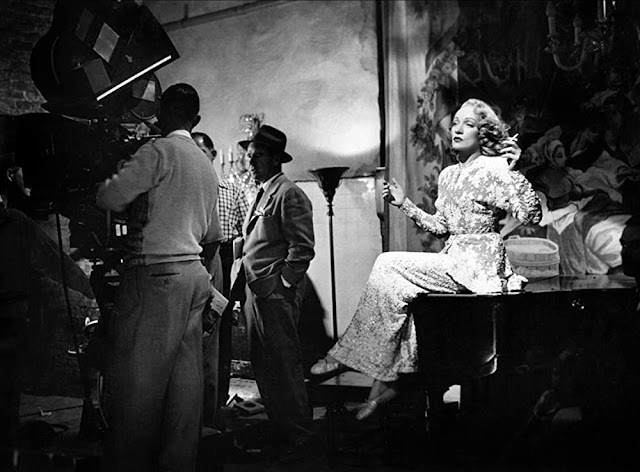
Marlene Dietrich's, on the set of Billy Wilder's "A Foreign Affair."

It’s commendable that Billy Wilder cast two actresses he admired, despite even by the late 1940s, with divas in their late ‘40s, was more than a bit unusual. Leading man John Lund was a decade younger than both—usually such casting was the other way around!

Marlene Dietrich gets to use her seldom utilized flair for sardonic comedy as the cynical chanteuse Erika, whose side she is on is whoever’s in power. She is warm, sexy, complicated, pragmatic, and worldly. Marlene gets to warble three numbers by Friedrich Hollaender, which underline the action. “Black Market,” in particular, gives movie audiences a chance to observe Dietrich’s interpretation of a song that would make her a concert legend.

Billy Wilder watches as Marlene Dietrich's about to sing a number in "A Foreign Affair."


Jean Arthur makes her comedic last hurrah as the mid-west politician there to inspect morale. However, she gets caught up in some questionable morals herself! As Iowa-proud Phoebe Frost, Jean Arthur goes from comic perfectionist to a romantic whose steel trap mind slowly opens up for love. I’m not a die-hard fan of Jean Arthur’s eccentric persona by any means, but she was aces as a comedic actress who could segue into drama with ease.

Nothing escapes Jean Arthur's congresswoman, except that she's about to fall in love,
in 1948's "A Foreign Affair."

John Lund, as Captain John Pringle, was considered the weak link of A Foreign Affair’s romantic triangle. Paramount was then trying to give Lund the buildup, but it’s too bad Wilder hadn’t discovered William Holden yet, also a Paramount star. Also, Tyrone Power could have been quite good, as Ty and Marlene proved a decade later in Witness for the Prosecution. Wilder liked John Lund a great deal, thought while he was a solid actor, but correctly felt that Lund didn't have the star quality to hold up his end with these two dynamic divas. Especially since post-war, films were back to the male star dominating the show.

Marlene Dietrich & John Lund pose for publicity photos, in 1948's "A Foreign Affair."

Wilder was disappointed by the reception that A Foreign Affair received, but it got mostly good reviews, and it was a moderate box office hit, making around $150 million in today’s dollars. There are some biting lines by screenwriters Wilder and Charles Brackett about the spoils of war that still sting today. A Foreign Affair is intelligent, adult, with some memorable set pieces. 

Billy Wilder found Marlene Dietrich easy to get along with...
Jean Arthur, not so much! On the set of "A Foreign Affair."

Though two actresses couldn’t be more opposite, Jean Arthur and Marlene Dietrich shared some interesting similarities in their later careers, despite their essential differences.

Jean was a year older than Marlene. Arthur was born in October, 1900 and Dietrich was born in late December, 1901. While Marlene Dietrich moved heaven and earth to look eternally young her entire career, Arthur actually looked youthful her entire public life. Now, while Jean fretted about how she was photographed (Wilder was one of several who cited this) and she probably used wigs, tapes, and makeup tricks as well, Arthur always looked like “herself.” Whereas as time went by, Marlene's face looked like a glamorous mask of her former self, much like the latter day Cher. Off-camera photos of older Arthur shows some lines, but essentially looking like herself, much like Doris Day when she retired. Coincidentally, they both retired to Carmel—a showbiz Shangri-la? 

Jean Arthur looked amazing at 66 in her short-lived 1966 sitcom.

Arthur's insecurities resulted in her only acting intermittently from the mid-1940s on. Sadly, Jean dropped out of two stage classics, Born Yesterday and Peter Pan (though she did perform the latter briefly.) Typically, most film stars’ final movies or roles are reduced, yet Arthur had the biggest hit in her film finale, 1953’s Shane. Thereafter, she only acted before the camera on two TV shows, Gunsmoke, and The Jean Arthur Show, cancelled after 12 episodes. And Jean looked amazing at 66!

Marlene Dietrich segued from movie star to sequined concert star. Here she is,
at nearly 75, before a fall ended her performing career.

Marlene Dietrich's films became more infrequent after the war years, as well. However, there were some diamonds amongst the dross: Hitchcock’s Stage Fright, Wilder’s Witness for the Prosecution, and Stanley Kramer’s Judgment at Nuremberg. Along the way, Dietrich became a concert performer, giving her a whole new career. Marlene performed until 1975, when a final fall caused her to break a hip. 

Jean Arthur at 75, with Melvyn Douglas, on stage in "First Monday in October."

Both Jean and Marlene essentially retired after 1975. Arthur performed a handful of stage performances with Melvyn Douglas in First Monday in October. Marlene only made two more films after the '75 fall: a cameo in 1979's Just a Gigolo and then audio recordings by director Maximilian Schell for the 1984 documentary, Marlene. 

Marlene Dietrich, giving pesky paparazzi hell, in the early '70. Go, Marlene!

Though Marlene Dietrich enjoyed public life, Jean Arthur didn't. Yet both became reclusive the last years of their lives. When Marlene died, there was a huge funeral, attended by thousands of people in Germany. With Jean, at her request, there was no funeral. Jean Arthur died in 1991 at age 90. A year later, Marlene Dietrich died at the same age.

A Foreign Affair is an adult take on a movie love story, mixing clever comedy with heartfelt romance, with a smart view on life after war.

Here’s my take on Jean Arthur’s last film, the western classic Shane:

https://ricksrealreel.blogspot.com/2018/04/shane-1953.html

Here’s my look at one of Marlene Dietrich’s final films, Billy Wilder’s all-star courtroom mystery, Witness for the Prosecution:

https://ricksrealreel.blogspot.com/2020/11/witness-for-prosecution-1957.html


The cinematic triangle of Billy Wilder's "A Foreign Affair": Marlene Dietrich,
John Lund, & Jean Arthur.


Sunday, November 15, 2020

‘Witness for the Prosecution’ 1957


Marlene Dietrich & Charles Laughton, fascinating adversaries in "Witness for the Prosecution."

Witness for the Prosecution is the combined talents of two razor sharp artistic minds, Agatha Christie and Billy Wilder. Based on the play from mystery queen Christie’s short story, director/screenwriter Wilder expands on the premise in this terrifically told adaptation. Agatha is aces with her ingenious premise and Billy brings his smart dialogue and telling character detail here. Both are great storytellers and this ’57 version of Witness is still the best of the bunch.

Love how the ads hyped up thrills for what was a smart courtroom drama.

This Witness is an addictively watchable courtroom drama about a shady charmer on trial for murder, with an older wife who may or may not be on his side. More important than the mystery itself—who is most wily, the legendary lawyer with a bad heart, or the suspect’s wife, who seems to have no heart?

Elsa Lanchester & Charles Laughton make a great team as the bickering nurse and barrister. Elsa's character was a Wilder addition to "Witness."

Charles Laughton is great fun to watch as Sir Wilfred, Witness’ irascible lawyer. Wilfred, recovering from a heart attack, is saddled with an officious nurse, Miss Plimsoll, cheerfully played by Elsa Lanchester. Mr. and Mrs. Laughton’s bickering banter offers great comic relief in this courtroom drama. Wilder cited Laughton as his favorite actor to work with, marveling at his inventiveness for characterization. I’d say they were perfect for each other, as Wilder was great at bringing out the best in actors, and Laughton benefitted from directorial restraint. Laughton is most believable as a lawyer possibly facing his last hurrah. Only 58 at the time, he looks very frail and older, much like Spencer Tracy did in his last decade or two. In fact, Charles died five years after this film was released. Laughton gives it his all here and is funny and ferocious.

Marlene Dietrich as the mystery woman, in an Edith Head suit reminiscent
of the designs she created for Alfred Hitchcock's blondes.

The other outstanding performance, surprisingly, is from Marlene Dietrich. Considered a great persona rather than a great actress, Marlene’s cool demeanor is perfect as the seemingly cold-hearted wife. Dietrich and Laughton make a great pair, polar opposites in acting styles, and at odds as characters. As Christine Vole, the wife of the accused, Marlene is the master of restraint. In her “big” moments, Dietrich rises to the occasion. Marlene’s Christine is a character whose motivations are peeled back throughout the film and give Dietrich great opportunities as an actress. Dietrich is deliberately deadpan and snarky in her first scenes, then has some bittersweet moments in a flashback, as Christine’s frosty demeanor begins to thaw for future husband, Leonard. As the story unfolds, Christine is anything but the aloof wife. The plot twists in the last act were urged to be kept secret by the filmmakers, and some felt this cost Dietrich an Oscar nomination. Realistically, I question that, as Marlene was no longer a full-time Hollywood actress, but her performance definitely rated one.

Dietrich recalls her WWII era & gender-bending fashion in a "Witness" flashback.

 My only caveat with Dietrich in Witness is her appearance. Marlene was the forerunner to today’s actresses, whose faces are pulled tighter than a drum. During filming Marlene was 56. With her wigs and skin pulls, she looked neither old nor young, but “somewhere between 40 and death,” as Mame opines of bosom buddy Vera Charles. Still, Dietrich’s far too old in the flashback scene, with her as the sex bomb performer, and Power as the “young” soldier. Watching a second time, I got past her drag queen looks in the flashback, with her measured responses to Power's character, who’s trying to win her over. Dietrich projects a quiet strength beneath the cool veneer. Edith Head, an Alfred Hitchcock favorite, designs tailored costumes for Marlene Dietrich that cause the film seem even more Hitch-like!

Marlene has some sweet moments in her flashback scene, despite wearing the most obvious wig since Barbara Stanwyck in Billy Wilder's "Double Indemnity!"

Hollywood’s fun house mirror regarding age is one of my movie pet peeves. Dietrich refers to the victim as that “old woman” even though they were nearly the same age. At 22, Ruta Lee was the other woman, paired with Power at age 43, and up against Dietrich at 56! Laughton refers to Power as “young man,” which only calls attention to Ty’s age.

Dietrich w/Tyrone Power, from a "Witness" promo shoot that looks like they're for a pulp novel cover. Marlene's "ageless"appearance seems to have inspired today's divas!

Tyrone Power, as murder suspect Leonard Vole, is supposed to be boyishly charming and handsome—also, a ne’er-do-well, which he freely admits. This is a tricky type of role to pull off and still retain audience sympathy. Power had that quality as an actor. However, Leonard, as a recent vet, should be 30-ish. Ty was 43 and frankly looked at least a decade older. This makes his character seem like a case of arrested development. Still, Power was still box office and was cast after William Holden turned the role down. Richard Burton, who was not box office at the time, but a decade younger and far more talented, would have been brilliant as the charismatic cad.

Tyrone Power's first close-up as charming young cad Leonard Vole. Ty was just 43.

Witness for the Prosecution would be Power's last completed role and he died of a massive heart attack on the set of Solomon and Sheba. It's a shock to see Power in close up the first time in Witness. Here, his once lean figure and good looks now look bloated and slightly jowly. With dark bags under his eyes and black hair slicked back, Ty looks like he's about to turn into Mr. Hyde in his more dramatic moments. Power acts the charming boy well enough, but his dissipation undercuts him. In the subtle moments, Power’s performing is quite good, such as his smarmy expression at the finale, when Leonard’s wife pleads with him not to leave her. For his big dramatic moments, Power falls short, he's just not enough of a grand performer to pull them off, and it’s just bad acting. 

Tyrone Power's attempts at bravura acting make him look like Mr. Hyde! 

Power had been a top star right out of the box for over 20 years. Ty was rather like Rock Hudson in that he was well-liked, unpretentious, and very professional. Like Hudson, Ty's great looks were off-set by a genuine warmth and low-key charm, and un-self conscious about his physical appeal. Ty and Rock yearned to stretch artistically and be more than the handsome hero. Both did stage work and also performed in passion projects that went against their image: Power in '47's Nightmare Alley and Hudson in '66's Seconds. Both were bleak films that were dumped into theaters and bombed. They are now cult classics. 

What a shame Witness for the Prosecution wasn’t filmed a decade earlier, Marlene and Power would have been perfectly cast. This would have been the era that Wilder and Dietrich teamed for A Foreign Affair and Tyrone Power was trying to broaden his range as a villain Nightmare Alley. But alas, the play version of Witness hadn’t been written yet!

What do they see that's so frightening?!

The characters, from the aging barrister and all his ailments, right down to the housekeeper and murder victim, are funny, quirky, and human. This is what makes this straight forward courtroom drama interesting. Billy Wilder marveled at Christie's model of construction, but astutely noted her writing was flat when it came to characterization. And this was one of Wilder's gifts as a screenwriter. Much of the memorable detail in Witness originated with this film adaptation.

Ruta Lee is light years away from her brassy blonde persona as the other woman.
 Love the blase look on Power's face as Leonard's wife begs him not to leave her.

A superb cast of British character actors are scene stealers here: Henry Daniell, John Williams, Ian Wolfe, Torin Thatcher, Francis Compton, Phillip Tonge, and especially cranky Una O’ Connor and droll Norma Varden as the victim, Mrs. French. The lone young star is Ruta Lee in her brunette starlet phase and she’s pretty innocuous, but figures in the finale. Witness got six Oscar nominations, four in major categories: Best Picture, Best Director, Best Actor, and Best Supporting Actress.

Another Best Director Oscar nomination for Billy Wilder.

Interesting that two years later, similarly Oscar-nominated Anatomy of a Murder was also based on a real life crime that centered on a duplicitous married couple with an army background. Like Anatomy, there’s not much mystery as to WHO dunnit, but there’s more here than meets the eye of barrister’s blinding monocle. Wilder’s take on Witness of the Prosecution is still the winning version.

FYI: I put my movie overflow on my public FB movie page. 

Check it out & join!  https://www.facebook.com/groups/178488909366865/


The makeup man got a bit carried away. Her hand looks like it belongs to the bride of Mr. Hyde!