Showing posts with label Audrey Hepburn. Show all posts

Sunday, January 12, 2025

Cary & Audrey Bring Charisma to “Charade” 1963


Cary Grant & Audrey Hepburn charm in 1963's suspense-comedy "Charade."


 The Stanley Donen comedy-suspense film Charade was filmed late ‘62/ early ‘63, and released for 1963's Christmas holidays. At age 65, my first time watching Charade was during 2024’s Christmas holidays, and I’ve been watching classic movies since I was in my early teens!

My impression had always been that Charade was a bland version of Alfred Hitchcock, so I'd just watch North by Northwest for the millionth time. This is especially inexplicable even to me, because I enjoy Cary Grant and Audrey Hepburn a great deal. I’m so glad I corrected my Charade situation.

Once again, Cary Grant is the charming stranger, in 1963's "Charade."
Should Audrey Hepburn's heroine trust him?

Charade really is like Hitchcock’s more mainstream works because there are none of the emotional undercurrents that often suffuse Hitch's more serious work. I’d compare the mix of suspense, romance, and comedy along the lines of Hitchcock’s To Catch a Thief and North by Northwest. Likewise, Charade is smart entertainment. Much of this is due to director Stanley Donen, one of the best for grown-up entertainment. Donen’s humor and intelligence made him versatile in musicals, comedy, and drama. In Charade, Donen brings all the ingredients of this cinematic confection together beautifully. Peter Stone got his first screenwriter credit at 33 from his own story, and it’s quite smart, leading to an association with director Donen. Also, Stone had a solid career in film, on television and stage, winning an Oscar, Emmy, and two Tony awards.

Here's a Hitchcock-esque shot from Stanley Donen's 1963's "Charade." Definitely in
 the Hitch style, Donen does a fine job mixing suspense, comedy, and romance.

I knew right from the start I should have watched Charade eons ago. The opening titles are by Maurice Binder, famed for his 16 opening titles for the James Bond film series, starting with the first, Doctor No. The colorful graphics would make Hitch fave Saul Bass green with envy. The insinuating score is by Henry Mancini, a subtle contrast to Bernard Herrmann’s booming scores for Hitch. 18-time Oscar nominee Charles Lang supplies the glamorous cinematography of the stars and locales.

I love this romantic shot of Cary Grant & Audrey Hepburn in 1963's "Charade."

Charade’s opening scene shows a dead body dispatched from a moving train. That would be Charles Lampert, estranged husband of Audrey Hepburn’s “Reggie.” When we first meet her at a ski resort, she doesn't know yet. What Reggie does know is that her marriage is over. She meets cute with mystery man Cary Grant, who introduces himself as Peter Joshua. Not so cute is when Reggie returns home and finds it emptied of all belongings. Then Cary shows up again, very much the Hitchcock mystery man, who finds her a modest hotel. And there are three men also in residence, who feel she has money from her hubby that is due to them. And they aren't nice about it: Ned Glass is Gideon; James Coburn is Tex; and George Kennedy plays Scobie. They are former WWII soldiers, who want their share of money from absconded war time gold that Charles cheated from them. A fourth man, Carson Dyle, was wounded and left for dead at the time. Soon after, Walter Matthau is introduced as a CIA administrator, who also wants the money, as it belonged to the US OSS.

James Coburn, as bad guy Tex, who just has a revelation, in 1963's "Charade."
Walter Matthau with the CIA? In "Charade," most of the characters don't even know
 what the agency stands for. Such innocent times!

Reggie doesn't have the money, but the thugs don't believe her. Cary's character’s identity changes practically scene by scene, and Audrey’s widow doesn't know whether to believe him or not. There are a number of alternately thrilling scenes and amusing moments, which leads to a genuinely suspenseful climax. The real villain is no surprise, but that's not Charade is really about—it’s the ride, not the destination.

Audrey Hepburn's widow gets an eyeful about her husband's past,
in 1963's "Charade."

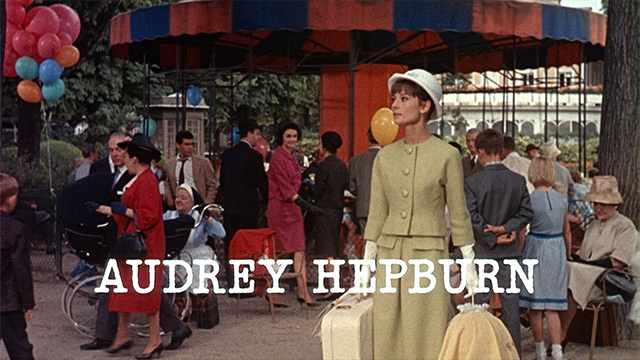
Audrey Hepburn is most endearing as the beleaguered heroine. Audrey is amusing in her exaggerated reactions to the extreme situations, warm in her attraction to Grant’s mysterious stranger, and natural in her dramatic moments. It takes subtle skills to go from the various moods this type of movie offers. Hepburn also embodies flawless early ‘60s style here: stylized hair and makeup, plus simply chic clothes by Hubert de Givenchy. The look is ultimately timeless and Audrey puts the glamour girls of today in the shade. A running gag in Charade is when famously thin Audrey’s heroine is anxious, she starts eating! Hepburn would reunite with director Donen in one of their best films, 1967’s Two for the Road.

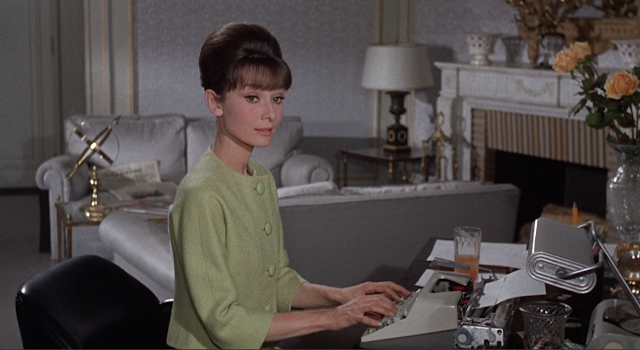
Audrey Hepburn's look is timeless in 1963's "Charade."

There are moments that foreshadow Hepburn’s 1967’s Wait Until Dark. Like when the thugs torment her, especially James Coburn’s Tex, as he accosts her with lit matches in a phone booth. Or characters who misrepresent themselves to Audrey’s trusting character. Reggie drolly wonders if her husband’s tooth powder is actually heroin, a substance that was a strong plot point in Dark.

Audrey Hepburn gets a rehearsal for the torment to come, in 1967's "Wait Until Dark."
Here, James Coburn is the villain terrorizing Hepburn, in 1963's "Charade."

There’s been criticism of Cary Grant as too old for the role opposite Audrey. Well, 60 at Charade's release, he was. But he was also perhaps the best preserved male star of his era. Grant's tan, lean, and stylish. Look at the three big male stars that have just passed 60 in recent years: Depp, Cruise, and Pitt. Cary Grant is in better form than any of them, in my opinion. I think that Cary Grant has great chemistry with Audrey Hepburn in Charade. Cary had more in common with Audrey than he did with Doris Day in the previous year’s That Touch of Mink. Grant’s role in Charade is as perfectly tailored to his persona as his suits. Grant is most cool and charming. But the role also gives him some humorous moments to off-set Cary’s aloofness.

To me, Cary Grant looks like a million at 60, when 1963's "Charade" was released.

It's interesting that James Coburn, Arthur Kennedy, and Walter Matthau play supporting roles here. They are all quite good, no doubt. And soon movie stars like Grant and Hepburn would be obsolete; Cary and Audrey would soon retire. And realistic actors like the first three would become big stars—for a while. Of the trio, Walter would retain his star status. Coburn would later play villains, and Kennedy character roles, after the “realistic” trend of late ‘60s and early ‘70s played out.

George Kennedy & Cary Grant: '60s realism meets 60-year-old classic leading man.
1963's "Charade."

Charade is like a snapshot of an era, when “Camelot” at its peak, with some shots of stars Grant and Hepburn giving off a Jack and Jackie Kennedy vibe. Actually, the film icons made their style imprint first. Anyway, after 1963, life and movies became increasingly realistic and less romantic than the charming Charade.

Cary Grant & Audrey Hepburn give off a JFK & Jackie vibe here, stylish & classy,
in 1963's romantic suspense comedy, "Charade."

Here’s Cary Grant, in one of his and Hitchcock’s best, my take on 1959’s North by Northwest: https://ricksrealreel.blogspot.com/2020/08/north-by-northwest-1959.html

And here’s one of Audrey Hepburn’s latter day best, my look at 1967’s Wait Until Dark: https://ricksrealreel.blogspot.com/2022/10/wait-until-dark-slick-thrills-stellar.html


Wednesday, October 26, 2022

‘Wait Until Dark’ Slick Thrills, Stellar Cast 1967

"Wait Until Dark" a 1967 suspense film written by Frederick Knott, also had a
stage and film hit with "Dial M For Murder." With Alan Arkin & Audrey Hepburn.


If Wait Until Dark was ever remade, it’d have to be done as a period piece.

***Spoiler alerts are discussed throughout this review***

Though there are clever reasons for the villains' actions and plot twists (to show how resourceful the blind heroine is, while tormenting her needlessly), those plot points don't always add up. Alfred Hitchcock never got hung up on plots making perfect sense, as he relied on suspension of disbelief in service of thrills. This is all well and good, though some of Hitch’s lesser sleights of hand were audience head-scratchers. 

The film version of "Wait Until Dark" was a big hit in '67.

Adapted from the 1966 Broadway hit, Frederick Knott’s Wait Until Dark up close and personal film version shows the plot strings being pulled too obviously. Unlike Gaslight, another woman in distress stage play turned movie, there's no character depth beneath the chills. Watching the heroine's character trajectory in Gaslight works on several levels; in Wait Until Dark, the blind heroine proves resourceful in the face of danger, and presented heavy-handedly. The movie is well-acted enough so that you become invested in the characters. 

The plot of Wait Until Dark is a bit convoluted, but in a nutshell: A young woman, Lisa, runs drugs via a heroin-filled doll. Startled by the villain she sees at the airport, she gives the doll to stranger Sam Hendrix, to be collected later. She's intercepted by the movie's psycho, Harry Roat. And that's all she wrote! Roat lures two small time criminals to the Hendrix apartment and coerces them into shaking down the Hendrix couple to retrieve the doll. Sam thinks it's just a doll and he's away; wife Susy is totally in the dark—figuratively and literally—she’s blind. Roat engineers an elaborate gaslight on Susy to get the valuable doll. Game on!

Richard Crenna as Mike discovers Lisa, who discovered stealing drugs doesn't pay,
in 1967's "Wait Until Dark."

On the plus side, the set-up is clever and cast is first-class. On the minus side, there are a number of plot holes. If this movie had more depth of character and plot development, I would not have focused on the deficiencies. But when the characters and logic are as slim as Audrey's figure, the mind wanders.

The big one: Roat's psychopathic villain visits Susy in several elaborate character disguises to find the doll. Why? Susy's BLIND! 

"Nice disguise there, evil genius. Spoiler alert, I'm blind!" 1967's "Wait Until Dark."

The second big one: When Susy catches on to the thug trio's ruse, she enlists neighbor girl Gloria to go to the bus station to get husband Sam home to the rescue. There's a very patronizing undertone to Sam wanting Susy to be more independent after her recent accident-caused blindness. Susy’s rationale that "Sam will know what to do" rings very false. You send three killers looking for drugs on a fool’s errand, they are coming back to kill you, and you send a kid on a mission to the bus station, when she could just go upstairs and call the police?

Audrey Hepburn & Julie Herrod have a nice camaraderie as blind Susie Hendrix
and neglected upstairs girl, Gloria, in "Wait Until Dark."

And the third big one: Once Susy has the doll, why doesn’t she just give it to them? She was scared when she heard about the woman (Lisa) found murdered a block away. Now she knows they killed “Mrs. Roat,” does she want to be next?

Once Susy has the drug doll in her possession, why won't she turn it over?

Also, during the final black-out confrontation with killer Roat, he tells her game over as she tries to escape from her chained front door and he's found a light. Why? She still has a knife and matches, and he's still soaked in gasoline. 

Of course, it would be hard to film this movie in present day without major changes: the drug runner getting the doll through security no problem; the two ex-cons making themselves at home in the Hendrix apartment, leaving their DNA everywhere; and today, the three criminals would just get down to business and torture and kill the heroine until they got the doll. This is just for starters.

Audrey Hepburn is ideally cast as a sympathetic blind woman tormented in
"Wait Until Dark." Also in '67, Audrey made one of her best, "Two For the Road."

As a popcorn suspense film there are certainly some very clever twists and characterizations. Audrey Hepburn is a natural as Susy Hendrix, the self-described world champion blind lady. Empathy and warmth was the essence of Hepburn's persona. Hepburn plays the character strongly without overplaying and it is a stellar movie star performance. It's noteworthy that Audrey got the film's lone Oscar nomination. She makes you root for and believe in her, though the movie still has a foot in the studio era style: Audrey's Susy just may be the most stylish blind woman in the world. The thought of a blind woman with big false eyelashes made me smile. She even changes clothes in the middle of the movie, for no apparent reason. Also, Audrey gets lovely soft focus close-ups. Wait Until Dark makes this movie more of a throwback to classic ‘50s Hitchcock than a gritty late '60s thriller. Speaking of Hitch, I'm surprised nobody tapped him to do this film. He nearly worked with Audrey before, and also filmed the playwright's Dial M For Murder to great effect. But Terence Young does a solid job here and does the best he can with what was basically a one-set stage piece. 

Audrey Hepburn as Susy Hendrix, a woman recently blinded, in "Wait Until Dark."

Lee Remick played Susy on Broadway to Robert Duvall's Harry Roat. I bet that was something to see. And though I'm sure Lee was just as good as Audrey, Remick was a leading lady who never carried a movie, where Hepburn was one of the few female stars of the ‘60s who could.

Lee Remick won a Tony nomination as Susy Hendrix in the Broadway version of
 "Wait Until Dark." Robert Duvall was Harry Roat. And Arthur Penn directed,
for whom "Bonnie and Clyde" was just around the corner!

Not having seen this in a number of years, I had forgotten how good Richard Crenna was as "Mike," the criminal pretending to be Sam's old war buddy. He offers what may be the most complex character. A con and crook, yes, but he's also taken by Susy's tenacity. He's the bad guy, but you want to like him! Jack Weston is good as the lowest functioning bad guy, Carlino, a bit of comic relief.

Jack Weston and Richard Crenna as two ex-cons coerced into retrieving a drug doll,
in 1967's "Wait Until Dark."

Alan Arkin has the showiest role as Harry Roat. I found him more interesting as the creepy criminal himself than in his various disguises. Humorous, creepy, sly and when he goes one on one with Susy, it's the hair-raising highlight of the film. The last set piece is very well done and I've heard many stories about how audiences in the dark involuntarily gasped and shrieked as Arkin's Roat goes after Hepburn's Susy.

Alan Arkin as the twisted, darkly humorous villain Harry Roat, in "Wait Until Dark."

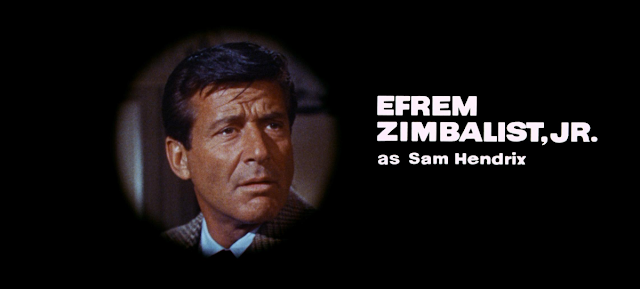
One plot element and acting I found a bit smarmy: Sam Hendrix, the character and Efrem Zimbalist, Jr., the actor. Given the fact his wife has been blind just a year, his tough love bit feels a bit like a husbandly bully, insisting that she "do" for herself. When Sam and the cops finally rescue her, they step over dead bodies, a trashed, gasoline-soaked apartment, and find a hiding Hepburn as Susy behind the fridge door. And Zimbalist's smiling Sam urges her to come to him! I wonder if a blind wife could kick her husband in the balls? And Zimbalist's acting is old-school Ronald Reagan variety, like a charming TV host, complete with a Hollywood tan—while playing a New Yorker.

Efrem Zimbalist, Jr. is Sam Hendrix, the photographer husband of blind Susy.

Julie Herrod as Gloria, the young girl upstairs, is natural, quirky, and appealing. She also played the character onstage with Lee Remick. Lisa, the doomed drug runner looks like a refugee from Valley of the Dolls, with the most obvious fall, and a more deadly doll than pills! Her stage name is Samantha Jones, which was later used as Kim Cattrall’s character in Sex in the City!

Samantha Jones is Lisa, a drug runner who looks like a runner-up for "Valley of the Dolls," complete with a fall and false eyelashes. Instead of "dolls," this doll has heroin!

The score by Henry Mancini is expertly eerie and the natural NYC location shooting gives this glossy thriller some needed grit.

Don't get me wrong, Wait Until Dark is still a fun thrill ride. Just don't look too closely at the story behind a blind woman's long night from hell.

Despite some serious gaps in logic, you'll be gasping in shock in the last act of
"Wait Until Dark."


Wednesday, May 18, 2022

Holden & Hepburn: ‘Paris When It Sizzles” 1964


Audrey Hepburn & William Holden teamed a second time for "Paris When it Sizzles."


Here's the link! http://clamba.blogspot.com/2022/05/its-time-for-cmba-spring-blogathon-fun.html


I’ve avoided the ‘60s rom-com Paris When It Sizzles because of its rotten reputation. Until recently, I wrote it off as just another lame sex comedy, a campy spoof from the ‘60s. Bedroom farces are one of my least favorite film genres. In this era, it was mostly talk about sex, with much winking and nudging. These movies are usually loud and frantic, with lavish visuals and slim plots—not to mention a dated mentality. Think That Touch of Mink, A New Kind of Love, What a Way to Go!, and What’s New, Pussycat? These films are just a few of many titles.

Audrey Hepburn brings her usual class and comedic style to "Paris When it Sizzles."

What sets Paris When it Sizzles apart is that it spoofs sex farces and the film industry. Richard Quine deftly directed this comedy and screenwriter/playwright George Axelrod supplied the zingers. The shaggy dog style of storytelling perplexed critics and audiences alike when Paris was released. More than a few critics pointed out that William Holden wasn’t Cary Grant. Hey, Cary Grant himself once said, “Even I want to be Cary Grant!”

William Holden as a hard-drinking screenwriter wasn't exactly a stretch, but Bill
gives a solid comedy performance in "Paris When it Sizzles."

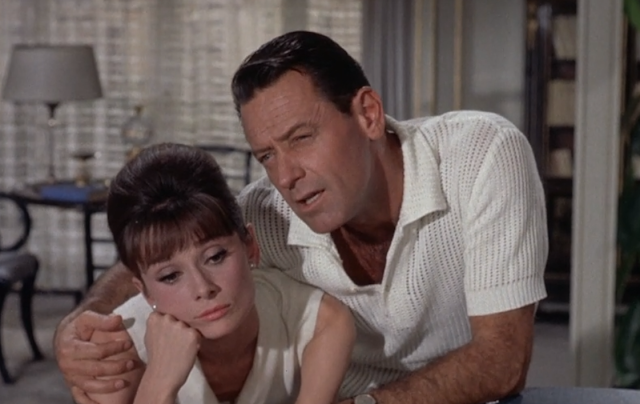
Holden’s subtle comedic skills are one of the saving graces of Paris When It Sizzles. William Holden seemed to be playing Norman Maine of A Star is Born off-camera; Audrey Hepburn, his once co-star in Sabrina, was now a superstar. And Audrey chose not to be his Vicki Lester. The stars apparently had an affair during Sabrina. But his bad marriage, drinking, and vasectomy put an end to any thoughts of Audrey marrying Bill. While she remained most fond of Holden, Hepburn was now married to Mel Ferrer and starting a family. This disappointed Holden and furthered his drinking despair. Still, the two got on well during the shoot, despite Bill’s angst and antics. Holden and Hepburn displayed a warm chemistry on film, if not sizzling.

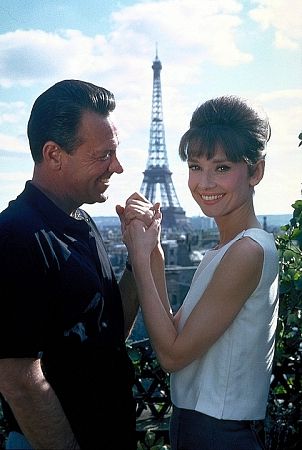
I love this shot of Bill & Audrey, on location for "Paris When it Sizzles."

As Richard, the screenwriter who drinks more than he writes, Holden has most of the dialogue, with the showbiz veteran sharing his font of knowledge to Hepburn’s newbie secretary. The writer with the gift of gab also narrates the film. This seemed to be a Holden hat trick, especially with his Hollywood-set films: Sunset Blvd., Paris When It Sizzles, and Fedora. That’s just fine, because Bill had a warm, distinctive speaking voice.

Audrey Hepburn is a secretary sent to Bill Holden's screenwriter to get the script done!

Yes, William Holden looks prematurely aged in Paris When It Sizzles. But his weathered looks had been noticed for a decade, as when Bill’s hair was dyed blonde in Sabrina as the carefree playboy. It was again noted a year later, when Holden played 20-something Hal in Picnic, at age 37. Even on Sunset Blvd., when clean-living Gloria Swanson refused to wear old-age make up at 50, they gave Bill a college boy haircut and plenty of pancake makeup.

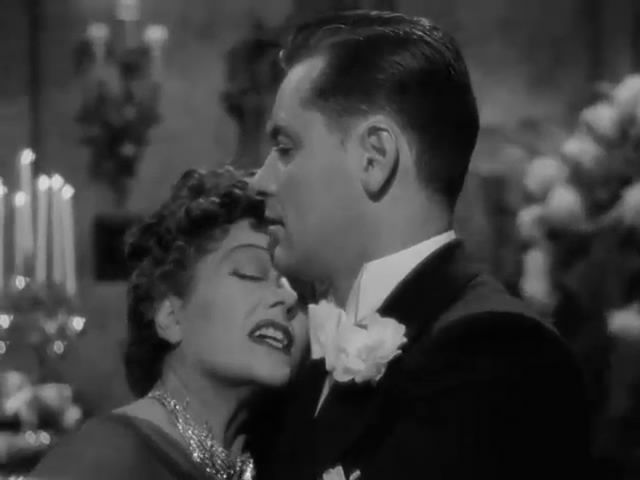
Bill Holden in "Sunset Blvd.," a dozen years before filming "Paris When it Sizzles."

Now William Holden was 44, and people were really startled by his fading good looks. This was a bit of karmic irony, since back on Sabrina, the main criticism was that Humphrey Bogart was too old to play Bill’s brother and Audrey’s suitor—and rightfully so. Perhaps Holden should have played the older brother and a younger star should have played the young playboy, like Tab Hunter or Robert Wagner. Or John Kerr, who looked like Holden.

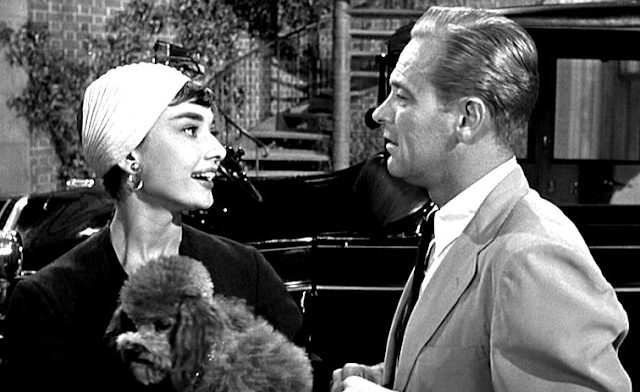
Just four years after "Sunset Blvd.," Bill at 36, with Audrey Hepburn in "Sabrina."


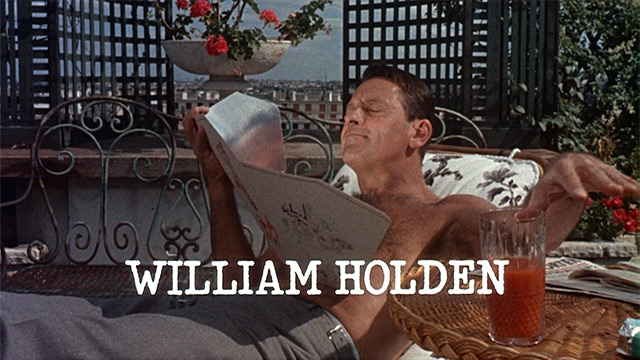
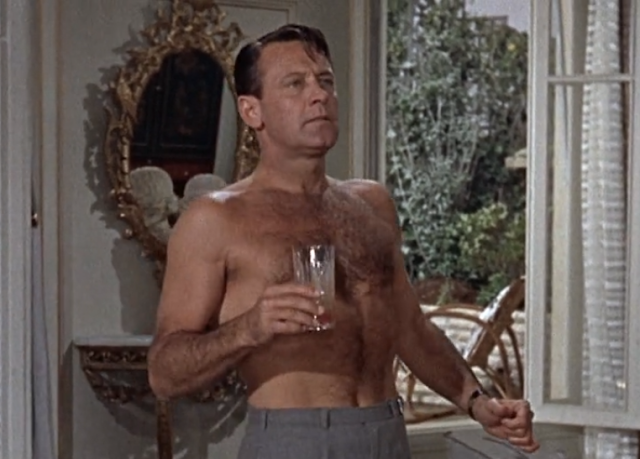
Despite Bill’s face, he’s in fine form. Holden is semi-shirtless for the first segment of the film and he doesn’t have an ounce of fat on him. At one point, Audrey’s character even finds him doing a headstand! Bill’s quite graceful in his extended comic moments, literally laying out the empty script pages as he moves about the apartment, spouting non-stop dialogue all the while. And he’s relaxed and loose in the dance scene that spoofs Funny Face.

William Holden's drinking was taking it's toll on his face, but his body was still fit.


While the movie genres spoofed are more silly than smart, Holden and Hepburn are most game. What really provides most of the genuine laughs are the asides that the duo delivers on the sex comedy genre and movie industry. The plot revolves around a weekend where the screenwriter must finish a long delayed project, “The Girl Who Stole the Eiffel Tower.” The producer has sent a charming typist with a background in film to help him finish. Holden and Hepburn’s characters strike me as equals: Holden isn’t a wolf looking to seduce a helpless woman; Hepburn isn’t a desperate female looking for a hapless male.

A nifty scene when Bill Holden's erratic screenwriter decides not to quit writing.


None of the nonstop banter and flirting is the heavy-handed double entendres that were typical of the era. It’s true that Paris When It Sizzles doesn’t have the snap of Billy Wilder’s best films. Yet, the type of ironic banter reminds me of later TV shows like Friends or Seinfeld. Apparently ‘60s audiences or critics didn’t appreciate subtlety in their sex comedies.

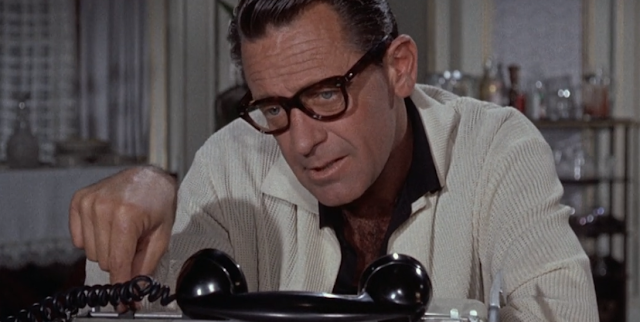
The scenes where Bill and Audrey’s characters are holed up in his lavish apartment, feverishly working on his script, are the most charming. I especially love where the script’s sophisticated lead characters order a sumptuous lunch which dissolves to the scriptwriter and secretary ravenously ordering lavish room service. And when Bill puts on those glasses like he did in Born Yesterday, they are framed by his warm blue eyes and wry smile.

Occasional scenes like this show Holden's premature aging in "Paris When it Sizzles."

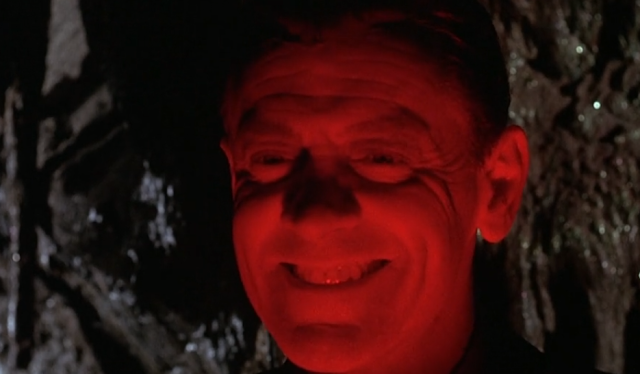
The only cringe-worthy moments are during a horror movie spoof , where Holden is supposed to be Dracula and the Wolf Man, with colored lights shining up his face to make him look scary—but just makes 40-something Bill look 60!

Audrey has some good lines, too. Unlike most of the ‘60s sex comedies, Hepburn is no unwilling participant, defending her honor. At one point, Gabrielle says, “I’m not that kind of girl.” Then she looks toward the camera and says, “I hate girls that say things like that!”

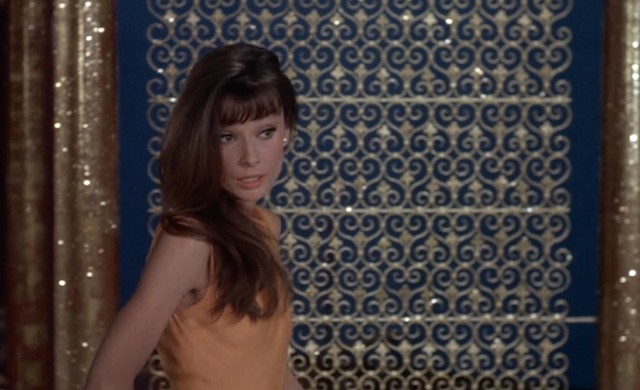
Audrey Hepburn lets her hair down as a "seductive spy" in "Paris When it Sizzles." 

Hepburn uses her lanky physicality well, when getting chased by Bill in his various movie spoof guises. Audrey’s charmingly flirtatious in her understated way and of course looks like a million in her Givenchy wardrobe. In several scenes, Hepburn’s lovely frocks and Holden’s classy casual wear would make Mad Men’s Don and Betty Draper green with envy.

Holden & Hepburn make a stylish couple as they work on his film script!

George Axelrod’s script doesn’t feel dated like some of his previous work, since the leading lady’s not the butt of his jokes, as in The Seven Year Itch. He also wrote the script for Breakfast at Tiffany’s and must have had a crush on Audrey. Because while Holden gets much of the dialogue, Hepburn gets so much homage from her previous films it’s like Audrey’s greatest hits. Roman Holiday, Sabrina, Funny Face, Breakfast at Tiffany’s, and My Fair Lady all get a nod here.

Tony Curtis is a riot as a vain, clueless actor in "Paris When it Sizzles." 


There are a few star cameos: Noel Coward is his usual latter day precious self as the crass producer; Marlene Dietrich looks divine for the hot minute she’s on screen; Tony Curtis, not a favorite, is hysterical as the ham actor. Curtis is at the absolute peak of his great looks here—and knows it! First, he’s the actor pretending to be a method actor, through Holden’s eyes. Tony is utterly daft in his delivery, but also quite funny in his mannerisms and catchphrases of the hip serious actor. Later, Curtis shows up again, this time as a different version of the character, playing a preening movie star who was impersonating a method actor. Curtis’ clueless actor is just as funny and Tony steals the show. Lucky, Bill was delivering his performance or Curtis might have replaced Holden!

When I was a wee child of the '60s, I used to get
Audrey Hepburn and Jackie Kennedy mixed up!

Two great stars in lovely Paris, lovely clothes and sets, tossing some clever lines—a classic it ain’t—but Paris When It Sizzles is pretty breezy fun.

William Holden & Audrey Hepburn in a close-up clinch for "Paris When it Sizzles."


Bonus!Here's my look at Bill Holden's breakout year! 
https://ricksrealreel.blogspot.com/2022/04/william-holdens-golden-year-1950.html

Director Richard Quine, Bill Holden, & Audrey Hepburn in "Paris When it Sizzles."