Showing posts with label George Cukor. Show all posts

Friday, June 27, 2025

Kate Hepburn’s Signature Role: Tracy Lord in ‘The Philadelphia Story’


Katharine Hepburn as Tracy Samantha Lord in her 1940 comeback,
MGM's "The Philadelphia Story."


I am not a great Katharine Hepburn fan, though I have admired aspects of her life and career. Aside from being slightly allergic to The Great Kate, I am also not a fan of drawing room comedies. I just watched 1940’s The Philadelphia Story for the first time. As I approach 66 years, I’m trying to make up for missing many classic movies, despite considering myself a life-long film fan.

So I watched The Philadelphia Story mainly out of curiosity, since this was hailed as Kate's great comeback. I can now see why. Katharine Hepburn arguably played her greatest role as Tracy Lord. It is the perfect distillation of the Katharine Hepburn persona, sparkling as the champagne Tracy imbibes too much of the night before her wedding.

Katharine Hepburn with frequent collaborator, director George Cukor, on the set
of MGM's "The Philadelphia Story."

Like a lot of classic stars, I first saw Katharine Hepburn in latter day movies in my younger years of the '70s and '80s. Hepburn did some fine work later in Suddenly, Last Summer, Long Day's Journey into Night, and The Lion in Winter; with her other films, I was averse to the sentimental Kate of Guess Who's Coming to Dinner?, On Golden Pond, and those last TV movies where she played her persona self to the point of self-parody. Most of her '30s work I find unwatchable, though she was great in Alice Adams, Stage Door, and a few others. Katharine Hepburn was often badly cast or chose badly. No surprise that she was among the film stars labeled box office poison in 1938.

On Broadway, Katharine Hepburn got BIG top billing
in "The Philadelphia Story."

For Katharine Hepburn's film comeback, she got second billing
in 1940's "The Philadelphia Story."

The oft-told backstory in a nutshell: after a string of bombs and even a couple of last films that got good reviews, the public and critics finally had their fill of a flighty/eccentric/haughty Hepburn. Kate was in dire need a comeback. So, Hepburn hired Philip Barry to write a play for her. Based on an incident involving a socialite friend of Barry’s, with Hepburn’s prodding, the character became more like Kate! She found the backing to get Barry’s The Philadelphia Story on Broadway and it was a hit, with future film stars Joseph Cotten and Van Heflin. Kate got Howard Hughes to buy the film rights for her so she could take it to MGM, with herself as part of the package. The result was a smash for film version of The Philadelphia Story, followed up by a studio contract for Hepburn.

After a string of film flops, Kate Hepburn was among the stars labelled "box office poison." Kate was down but not out, when she came back in "The Philadelphia Story."

The big question was why didn't this commercial and critical hit get Kate a second Oscar? Well, the competition was tough that year, with Bette Davis in The Letter and Joan Fontaine’s breakthrough in Rebecca. Yet, it was Ginger Rogers who won for Kitty Foyle. At the time, Rogers was very popular with fans and the industry, making a smooth transition from musical to comedy/dramatic star. Kate was making a comeback from Siberia. However, I think Katharine Hepburn's vehicle holds up much better and is better-remembered today. 

The MGM production is top-drawer: George Cukor directing, Joseph L. Mankiewicz producing, script by Donald Ogden Stewart, a snazzy score by Franz Waxman, with Kate radiantly photographed by Joseph Ruttenberg, in gowns by Adrian, and hair styled by Sydney Guilaroff. Oh—and Cary Grant and James Stewart as Hepburn’s leading men. Plus, a great supporting cast, including Ruth Hussey. The resulting film of The Philadelphia Story is studio era style at its finest.

It didn't hurt that Katharine Hepburn had two popular new stars in Cary Grant
& James Stewart as her leading men, in her comeback, "The Philadelphia Story."

Katharine Hepburn’s comeback was the greatest of those stars fighting the “box office poison” label. Joan Crawford countered hers by taking on the smaller, but juicy villain role in The Women. Marlene Dietrich took a break from moody fashion plate posturing to perform in the raucous western Destry Rides Again. With Katharine Hepburn, she stepped down her pedestal to become the more accessible Kate. But really, the change was not all that drastic from her previous ‘30s persona, just recalibrated to be more generally appealing. It reminds me of how Doris Day’s image makeover in Pillow Talk was considered such a departure for her. Except for the emphasis on glamour and sexuality, Pillow Talk wasn’t that much different than the previous year’s Teacher’s Pet.

With Katharine Hepburn’s Tracy, she is essentially a heroine, but a judgmental one. And on the eve of her wedding to a respectable dullard, some champagne and flirtatious frivolity makes her realize that she’s only human, too.

Cary Grant and James Stewart do fine work, despite Kate's first preferences for Metro’s kings, Clark Gable and Spencer Tracy. Grant had polished his persona as “Cary Grant” perfectly by this time and it plays wonderfully in this romantic comedy, as C.K. Dexter Haven. Though Dexter has a drinking problem, he scolds Tracy for not being more understanding. That attitude obviously doesn’t play well today. Ironically, Hepburn would soon be an understanding companion to alcoholic Spencer Tracy! Aside from needling Kate’s Tracy to come off her pedestal, Cary’s Dexter obviously still adores her. Their banter is razor sharp and witty.

Cary Grant as C.K. Dexter Haven in 1940's "The Philadelphia Story."

Stewart, after his breakout year in 1939, entered the ‘40s as a boyish leading man with great appeal. As down to earth reporter Mike Connor, who becomes enchanted by Tracy, James Stewart is just fine. He’s charmingly skeptical and goofily besotted by champagne and this society girl. I do think his Oscar win for The Philadelphia Story is a makeup award for missing out for ‘39s Mr. Smith Goes to Washington, as did Jimmy himself. But hey, Clark lost that year for his signature role, Rhett Butler in Gone with the Wind!

Is James Stewart wishing for his Oscar in "The Philadelphia Story?"

Ruth Hussey is a sardonic delight as photographer Liz Imbrie, who accompanies Stewart’s reporter to cover the society wedding of the year. Hussey is expert with the comic lines, but also imbues certain lines about Stewart’s Mike that are touchingly wistful.  She won a Best Supporting Actress Oscar nomination for her intelligent, modern style and holding her own with star Hepburn.

Ruth Hussey was Oscar-nominated & James Stewart won the Oscar, as visiting magazine media, to cover the society wedding of the year,
in 1940's "The Philadelphia Story."

There are a number of clever, fun touches in The Philadelphia Story, thanks to screenwriter Stewart’s script and George Cukor’s smart, stylish directing. An example is that brilliant and brief setup, where Tracy and Dexter split up in the film’s opening scene on their front steps.

Love the opening scene of 1940's "The Philadelphia Story!"

Tracy Lord became a basic boilerplate of the type of women Hepburn would play in her best mid-career vehicles. Kate would play strong-minded women who by the finale, were softened by love. This was much like the character arc Rosalind Russell would play in her career woman roles. This would satisfy most mainstream audiences and the audiences who loved such spirited female stars could believe that transformation was just to appease her leading man’s character. Such was life on film in Hollywood’s golden age!

There’s a lot to like about the film adaptation of The Philadelphia Story, but you will love Katharine Hepburn at her leading lady best, adored by three co-stars!

I love this romantic shot of Grant's Dexter finding Hepburn's Tracy asleep in the car, after imbibing too much champagne, in 1940's "The Philadelphia Story."

Here’s Kate in her second outing with Spencer Tracy in a suspense drama, 1942’s Keeper of the Flame:

https://ricksrealreel.blogspot.com/2025/05/tracy-hepburn-team-in-rare-drama-keeper.html

And here is my look at Katharine Hepburn in her only villainous role, as Aunt Violet in Tennessee Williams’1959 Suddenly, Last Summer, with Elizabeth Taylor and Montgomery Clift:

https://ricksrealreel.blogspot.com/2018/03/suddenly-last-summer-1959.html


Friday, May 30, 2025

Tracy & Hepburn Team in Rare Drama ‘Keeper of the Flame’ 1942


Spencer Tracy is a reporter & Katharine Hepburn is the widow of a wartime hero,
in MGM's 1942 suspense drama, "Keeper of the Flame."


MGM’s suspense story Keeper of the Flame is one of two straight-up dramas that Spencer Tracy and Katharine Hepburn made, from their nine films together. (The other was The Sea of Grass.) This film premiered at the end of 1942, with its political overtones, a year after the Pearl Harbor attack. FDR's administration strongly encouraged Hollywood to make movies that inspired patriotism.

MGM’s Big Daddy, L.B. Mayer, was also a big American flag waver, who had just made Mrs. Miniver, and who reportedly didn't like Keeper of the Flame. The story of a revered American hero who turns out to be a cultish fascist wasn’t exactly what FDR and Papa Mayer had in mind! I can see this dark political thriller given the green light at WB or RKO, where grittier movies were made.

Despite the MGM gloss and some diva posturing, the message of 1942's
"Keeper of the Flame" is as timely as ever. 

So, Metro’s resulting Keeper of the Flame seems a rather odd entry. The film was based on controversial I.A.R. Wylie’s novel, with a screenplay by Donald Ogden Stewart, who was unapologetically political, and later blacklisted. Stewart seems inspired by the then-recent Citizen Kane in the telling of the investigation behind the death of a larger than life public figure. Cinematographer William H. Daniels noir-like photography, the extensive use of sets instead of location or exterior shooting, lots of matte work to suggest opulent mansions and scenic properties, makes this all feel like a dark fairytale. 

Some say that Keeper of the Flame was also inspired by the life of William Randolph Hearst. Others have said Charles Lindbergh, which feels closer to the mark, IMO. There were certainly enough world figures with secret fascist leanings at the time. Lindbergh, who came from modest means, became a world-wide hero, then a political figure, preaching isolationist and anti-Semitic and racist theories. By the late 1930s his reputation was tarnished; by the early '40s, FDR had isolated Lindbergh! The timing makes him the likely inspiration for Keeper of the Flame.

Director George Cukor on the set of 1942;s "Keeper of the Flame," with stars
Spencer Tracy & Katharine Hepburn.

Despite the sometimes prosaic plotting, the story’s premise, strong cast, and intelligent direction by George Cukor, all make the film worth watching. Spencer Tracy is at his best, with his solid and restrained performance as reporter Stephen O’Malley, who is an admirer of the revered public figure Richard Bennett, who has died in a mysterious car accident. Tracy is objective as the man who is intent on getting at the truth, despite surrounding suspicion that he is just a muckraker looking for scandal. Spence's interacting with Hepburn, child actor Darryl Hickman, and the array of distinctive character actors, is fascinating. Spence was truly one of the first of the naturalistic film actors.

Spencer Tracy is a rock as the principled reporter determined to get at the truth,
 regarding a dead hero and his wife, in 1942's "The Keeper of the Flame."

Katharine Hepburn, in one of her last glam leading lady roles, has the showier role as the haunted widow of the hero. Under favorite director George Cukor, Hepburn is mostly restrained, though some of that Metro diva posturing seeps through. As her character is conflicted and motivations misunderstood, Kate's Christine Bennett allows for some dramatic moments. Hepburn is undercut a bit by the over-lavish MGM production values, with her widow wafting through the mammoth mansion in Adrian gowns.  Especially in the first scene, where Kate looks like a ghost in a white gown, carrying an arm full of lilies to place before the portrait of her dead husband. At least, Kate didn't reprise her calla lily speech from Stage Door!

Spencer Tracy's reporter first encounters Katharine Hepburn's widow as she wafts
 into the library in white, placing flowers at her late husband's portrait,
in 1942's "Keeper of the Flame."

I was struck that Kate's grieving character was a foreshadowing of Hepburn in one of her latter day triumphs, 1959's Suddenly, Last Summer. In both movies, Kate's characters are distracted over larger than life dead people and determined to protect their reputations, though for different reasons. In both Keeper and Suddenly, the loved one was in reality a sordid character. Both of Kate's characters are faced with a hero who is seeking to find out the truth. And some of Kate's speeches in Keeper are in keeping with Suddenly's Violet Venable.

Katharine Hepburn as another haunted mourner in white,
in 1959's "Suddenly, Last Summer."
,

The male secretary character, Richard Whorf’s Clive, slavishly offers reporters speeches and information over the late hero's works. Protective to the point of obsessive, Clive comes across like a male version of Rebecca's Mrs. Danvers, even to the point of starting a fire in the finale!

Spencer Tracy, as the straightforward reporter determined to write the truth of a
late hero, with the revered man's assistant looking on with distrust, played by
Richard Whorf. From 1942's wartime suspense drama, "Keeper of the Flame." 

Darryl Hickman as the child of the groundskeeper, who idolized Bennett, is a bit overwrought. This is mostly from the way his character is written, rather than performed. A young Howard da Silva is instantly recognizable by his voice as the boy’s protective father. 

Darryl Hickman plays one of the children who are devastated by their hero's death,
in 1942's political drama, "Keeper of the Flame."

Percy Kilbride is a hoot as the close-mouthed cabbie who doesn’t like snoops. Audrey Christie as the brash reporter with a crush on Tracy is such a stereotype that she comes off like a Glenda Ferrell clone. I found her performance immediately irritating. Stephen McNally has an early role as a competing reporter—he kept reminding me of Zachary Scott!

Margaret Wycherly has a field day as the hero's elderly, demented mother. Old Mrs. Bennett’s scenes give you an idea where her son got his ideas on class superiority. The mother goes off on how once she was a maid to the wealthy, and because of her son's success, SHE now lives in a big house, declaring, “Big people live in big houses!” Ironically, I had just viewed a clip of Mary Trump talking about her namesake grandmother, and how she had come from Scotland and was a maid to the Carnegie family. Later, Mrs. Trump lived in a huge home with husband Fred after he climbed up the ladder as a realtor/landlord.

Margaret Wycherly is riveting as the demented mother of the deceased "hero,"
in 1942's wartime suspense drama, "Keeper of the Flame."

On a lighter note, newcomer Forrest Tucker was borrowed by MGM to play Hepburn’s handsome cousin. Six foot, four inch Tucker was a big boy, and director Cukor was not above hiring young beefcake for more than their on-screen talent!

Forrest Tucker plays Katharine Hepburn's brooding young cousin in "Keeper of the Flame." That's Audrey Christie, annoying as the brash gal reporter!

The baroque music score is by Bronislaw Kaper—was he MGM’s answer to Bernard Herrmann? Kaper’s score is both bombastic and creepy. I always hated his intrusive score for the later BUtterfield 8, a cross between a Tom and Jerry cartoon and a horror movie!

The climactic scene, when Richard Bennett's real leanings are revealed by Hepburn’s Christine, is chilling. The speech on fascism is fascinating and how insidiously it occurs may seem familiar to some modern audiences. The widow of the “hero” speaks of people's group gullibility in worshipping false idols, for a movement that pits different groups of people against each one another, all the while seizing power. Christine tells the reporter, “Of course they didn’t call it fascism. They painted it red, white, and blue. They called it Americanism.” Today, it might be called Nationalism? Or perhaps Bennett’s plan would be Project 2025?  

Katharine Hepburn plays the keeper of the secret files,
as well as "The Keeper of the Flame!"

Cukor later said he found Keeper of the Flame artificial and he was right. Yet, there is a message that is still true, and fascinating that it was told at the height of the United States patriotic movement in finally supporting WWII.

Here’s my look at Katharine Hepburn in a similar later role where she’s grieving and glossing over the reputation of her late poet son, with Montgomery Clift as the doctor determined to get at the truth, in 1959’s Suddenly, Last Summer. My review:

 https://ricksrealreel.blogspot.com/2018/03/suddenly-last-summer-1959.html

"Keeper of the Flame" was Tracy & Hepburn's 2nd film pairing, after their classic
 debut in "Woman of the Year." Parker Posey at times reminds me of Kate Hepburn!


Sunday, October 16, 2022

Stars & Story Light up MGM's ‘Gaslight’ 1944

The hot house atmosphere of 1944's "Gaslight" gets much of its heat from these
great stars: Ingrid Bergman, Angela Lansbury, and Charles Boyer.


As a suspense film fan, it’s amazing to me that I've only seen clips of 1944's Gaslight in my 50 years of watching movies. With the recent death of Angela Lansbury, plus the 40th anniversary of Ingrid Bergman’s passing on Aug. 29, I thought it was high time to remedy this.

Ingrid Bergman is the lady of the house who's so fragile that even the malicious maid
 (Angela Lansbury) gets under her skin, in MGM's "Gaslight."

Based on the Broadway hit 1938 Angel Street, MGM then bought U.S. film rights and tried to bury the British version that was made in 1940. They didn't succeed, but more about that later.

MGM glamorized Gaslight like they did to many period stories—Pride and Prejudice, Madame Bovary, and Little Women—all made to look super wealthy, though they weren't. Metro does so here, too, though it's not quite as intrusive. 

Ingrid Bergman in one of many striking shots from 1944's "Gaslight."

What MGM does well in this version, which makes me prefer their Gaslight as a suspense film, is a certain amount of ambiguity (partly due to censorship) and by not overtly giving away the husband's villainy from the get-go. 

A huge plus is the cast, particularly the stars whose characters inhabit this hot house household: Ingrid Bergman, Charles Boyer, and Angela Lansbury—in her first film. Their personas say much that dialogue can't. Bergman and Boyer have so much natural sensuality, much can be implied regarding what flamed their relationship. And Lansbury had that saucy and impudent look that could turn sour and bitchy in a blink of her huge eyes as the maid on the make.

Charles Boyer surround by his tall co-stars, Angela Lansbury & Ingrid Bergman,
on the set of MGM's "Gaslight."

The changes made in the MGM version work well, overall. Though it's an excuse to slather on some more Metro gloss, the prologue where young Paula meets and is swept off her feet by Gregory in Italy shows that this is her first love, with Boyer in full romantic mode. They also flipped certain plot points from the leading man to the leading lady, which works, too. The biggest change is the murdered relative and empty house now comes from her side of the family, not his.

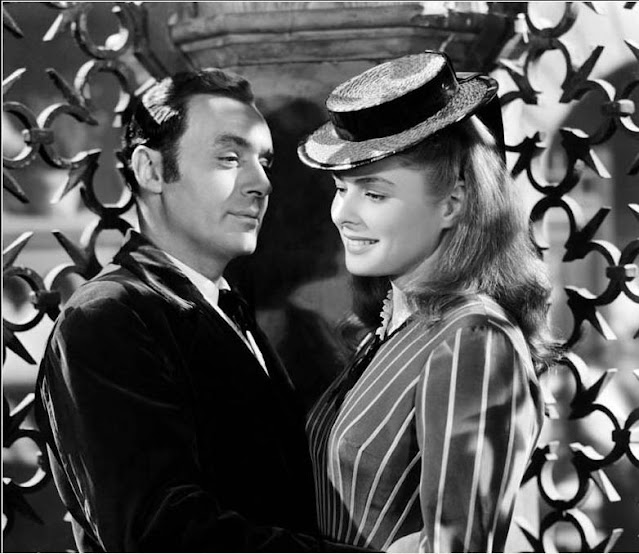
The prologue to MGM's "Gaslight" shows Boyer & Bergman in love, on their honeymoon.

Though you know Boyer is the bad guy, the fact that he's played both heroes and villains has you hoping against hope he's not a total rat. That we don't see him actually setting up his tricks on Bergman, or that he's not blatantly abusive or adulterous, as in the British version.

MGM's version of "Gaslight" cleverly plays on Charles Boyer's romantic image
to create suspense as to his character's later villainy.

The great trio of performances gives the edge to this Gaslight. Ingrid Bergman's naturalness and emotionalism was her calling card as an actress, which is perfect for the role of Paula. That she has suffered trauma finding her murdered aunt makes great plot sense, and gives further authenticity to her fragility. When Boyer's Gregory subtly toys with her to the point where she begs not to be shamed in front of the servants, her humiliation is palpable. As the heroine questions her own sanity as the movie goes on, Bergman is utterly believable. Hedy Lamarr was the studio’s choice as Paula, but director George Cukor rightly rejected the idea. Most of MGM’s great dramatic divas had already left, leaving mature newcomer Greer Garson. British Deborah Kerr, who could have been great, didn’t arrive to Metro until ’47.

One of cinematographer Joseph Ruttenberg's amazing closeups of Ingrid Bergman
as Paula, who begins to question her own sanity, in MGM's "Gaslight."

Charles Boyer had already scored as charming cads in Algiers and Hold Back the Dawn. But he also played warm, romantic roles like All This, and Heaven Too. That duality adds to his fine performance. Those great dark eyes and deep romantic voice transfix you as much as Paula. The moments where Boyer’s charm turns cold are utterly chilling. As Gregory, Charles Boyer runs nearly the same range of emotions as Bergman’s, except his are those of a sociopath, and he’s a memorable villain.

Charles Boyer used his aristocratic looks, soulful eyes, and beautiful speaking voice
to help create the most manipulative villain in 1944's "Gaslight."

It's hard to believe that Angela Lansbury turned just 18 during the making of Gaslight. Her saucy, sharp-tongued maid reminded me a bit of Bette Davis as Mildred Rogers in Of Human Bondage. Which always made me think that Angela should been cast as a Bette Davis-style leading lady at MGM, which had more glamour girls than great actresses, frankly. But what a great start this was for Angela, and she's most subtle here. Nancy is tart with the missus and slightly tarty with the master. She’s very street smart and self-possessed. When Boyer’s master comments that she’s much too charming for the mistress of the house, Lansbury’s Nancy slyly replies, “She’s not the only one in the house, is she?”

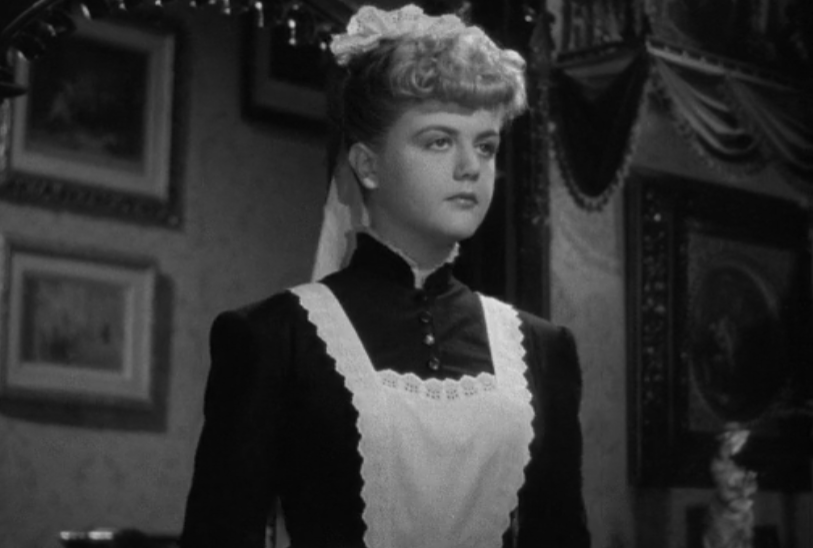
Angela Lansbury as Nancy, the domestic who seems to be untamed! Angela was not yet
 18 when she worked on 1944's "Gaslight," but holds her own with Bergman & Boyer.

All three of these actors got Oscar nominations and Bergman deservedly won, I thought. Even Barbara Stanwyck, nominated for her classic performance in Double Indemnity, publicly lauded Ingrid’s victory. Watching the arc of Bergman’s character start off as bright and girlish to tormented and finally, nearly emotionally beaten, is fascinating to watch.

A fresh-faced Ingrid Bergman as young Paula at the beginning of MGM's "Gaslight."

This is one of those movies that more than a few have mistakenly attributed to Alfred Hitchcock. Indeed, since two of the stars—Bergman and Cotten—were under contract to David Selznick, it's a wonder that his director didn't come along to Metro for the ride. That said, MGM director George Cukor was in his prime here, his strengths were getting the best from his actors and in sophisticated storytelling.

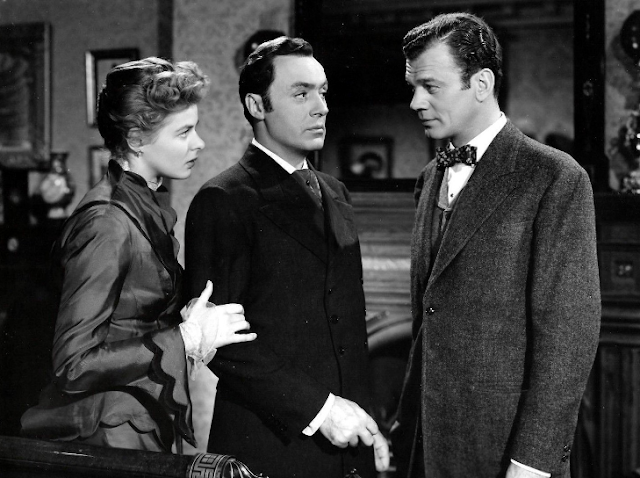
Two of producer David Selznick's stars--Ingrid Bergman & Joseph Cotten--were loaned to MGM for "Gaslight." With Charles Boyer here.

I've watched the British version, which has been saved and restored. I notice that the 1940 and ‘44 versions have been pitted in the typical movie critics/movie lovers’ game of which is better. The '40 version gets a lot of sympathy because Hollywood's biggest studio tried to destroy the smaller British version. I believe MGM also tried to do the same with the Italian version of The Postman Always Rings Twice. Well, the 1940 version is more faithful to the Patrick Hamilton play and it is much more straightforward—in fact it barely runs 90 minutes. Does that necessarily make it better? The Mildred Pierce remake was more faithful, but I really prefer the 1945 film version.

Ingrid Bergman is radiant as a woman in love in 1944's "Gaslight."

What the British version offers are British leads whose characters live a more upper middle class British life. Also, playwright Patrick Hamilton offers side commentary on the British social hierarchy, especially when it comes to marriage and money. The two leads are Diana Wynyard and Anton Walbrook. Their performances are fine by their film era's standards. While her character stands up to her husband on occasion, Diana Wynyard’s performance feels very leading lady-ish, with much wide-eyed displays of  fear and disbelief. There’s very little of the raw emotion that Ingrid Bergman evinces as the beleaguered wife here. And while I enjoyed the expert mustache twirling of Anton Walbrook as the heartless husband, he feels a bit campy, and I wondered if Kevin Branagh’s mad “Maestro” was inspired by him later in Dead Again. Laurence Olivier and Vivien Leigh would have been wonderful—and British, but they didn’t get cast in either version. Cathleen Cordell as the maid was strictly one-note, with none of the magnetism or malice that Lansbury possessed. Joseph Cotten made a younger, attractive detective who is on the husband’s case in the ’44 Gaslight, and I found his warm charm preferable to his British counterpart’s aging ham. Yes, MGM does play the hint of romance card at the literal last minute, between Cotten and Bergman, with Dame May Whitty clucking cutely.

Angela Lansbury's maid on the make Nancy is performed with much more depth
in the MGM version of "Gaslight."

The 1940 version seems rather barebones and can’t imagine that the stage play was only 90 minutes. The MGM is 30 minutes longer, and feels more fully fleshed, not merely padded. Joseph Ruttenberg's photography is masterful, particularly depicting Bergman’s gradually growing unbalanced. BTW, though Bergman’s makeup-free, soft close-ups as the young Paula leaving the crime scene are convincing, did it look like they used an actual teenager in long-shot over the 5’9” Bergman? The score by Bronislau Kaper is superbly eerie.

Ingrid Bergman as the beaten-down wife in 1944's "Gaslight."

Gaslight is one of the first movies to depict spousal emotional abuse in a marriage, under the guise of a suspense film. The husband woos the wife, only to isolate and gradually wear down her self-esteem with abuse, is still relevant today. The final monologue, where Paula confronts her tormentor husband, is strongly written and performed by Bergman. Gaslight is a superior thriller with intriguing underlying themes.

Ingrid Bergman's big scene where her abused wife Paula tells off her
tormentor husband, now captured and helpless, in 1944's "Gaslight."